

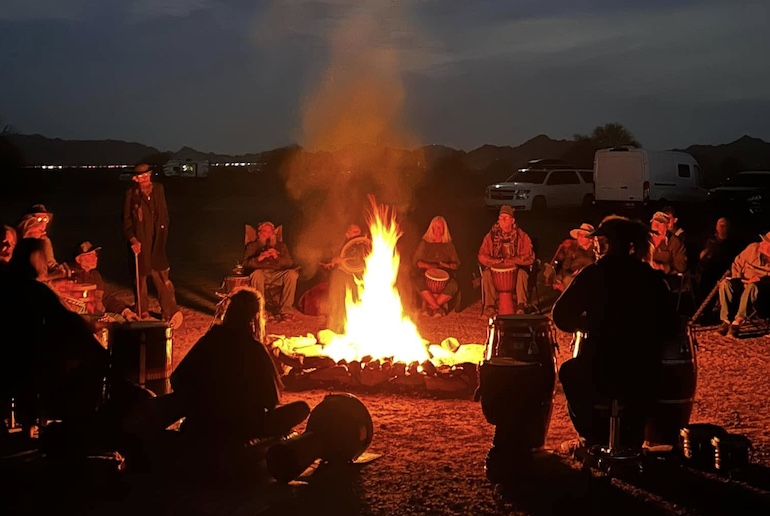
Drums Manifest Truth hosts weekly winter drum circles in the desert surrounding Quartzsite. Photo courtesy of Cynde Watson/Drums Manifest Truth.
By Teresa Bitler
Just outside Quartzite, Arizona, not far from the California border, a massive bonfire crackles and occasionally pops, sending sparks into the dimming sky. Basketball-sized boulders circle the flames, and about three feet wider, smaller rocks ring the boulders to keep anyone from getting too close to the fire. Double that distance again and a mix of retirees and free spirits congregate. Most sit in camp chairs, but some are standing as the drum circle begins with a slow, steady beat.
One by one, they join in. Quite a few beat bongo or handheld drums, while others shake rattles or rain sticks made from hollowed cactus and filled with small pebbles. Still others strike tambourines, clap their hands or slap their thigh. As the sky darkens and the flames rise higher, some move outside the circle to swing colorful poi balls, but a number of brave souls trickle into the space between the chairs and fire, where they dance and twirl to the beat.
Rachel Fort, who hosts the weekly Drums Manifest Truth events with James Davies, describes drum circles as a conversation that uses rhythm rather than words to connect with others. The rules are simple, she says: no alcohol or drugs, ask for permission to use someone else’s instrument and don’t criticize how others participate. Depending on the week, 25 to 30 regulars and up to 125 additional people attend.
“Drumming in a group is something humans have done for thousands of years across cultures and traditions,” Fort says. “People are often naturally drawn to it because it feels grounding, expressive and deeply good to participate in.”
She and Davies began hosting these weekly drum circles 11 years ago when they first wintered in Quartzsite. At the time, they lived in a 1987 Chevy van and were drawn to the area’s dispersed camping—free camping without amenities on public land. They’ve since upgraded to a converted school bus and alternate between dispersed camping and inexpensive camping at the Bureau of Land Management’s (BLM) more structured La Posa Long Term Visitor Area (LTVA) campground.
It’s a world few drivers on I-10 realize exists as they cross the Arizona desert between Phoenix and Los Angeles, and drum circles are just a part of the story. Every year, from October through March, Quartzsite swells from a town of about 2,400 residents to a peak of nearly one million, according to the Chamber of Commerce’s best estimates. Depending on who you ask, the visitors come for mild winter days averaging highs in the mid-60s or to shop at the gem vendor and Recreational Vehicle (RV) industry shows that attract enthusiasts from around the country. Others, like Fort, are drawn to the sense of community they find there and the low-cost and free camping.
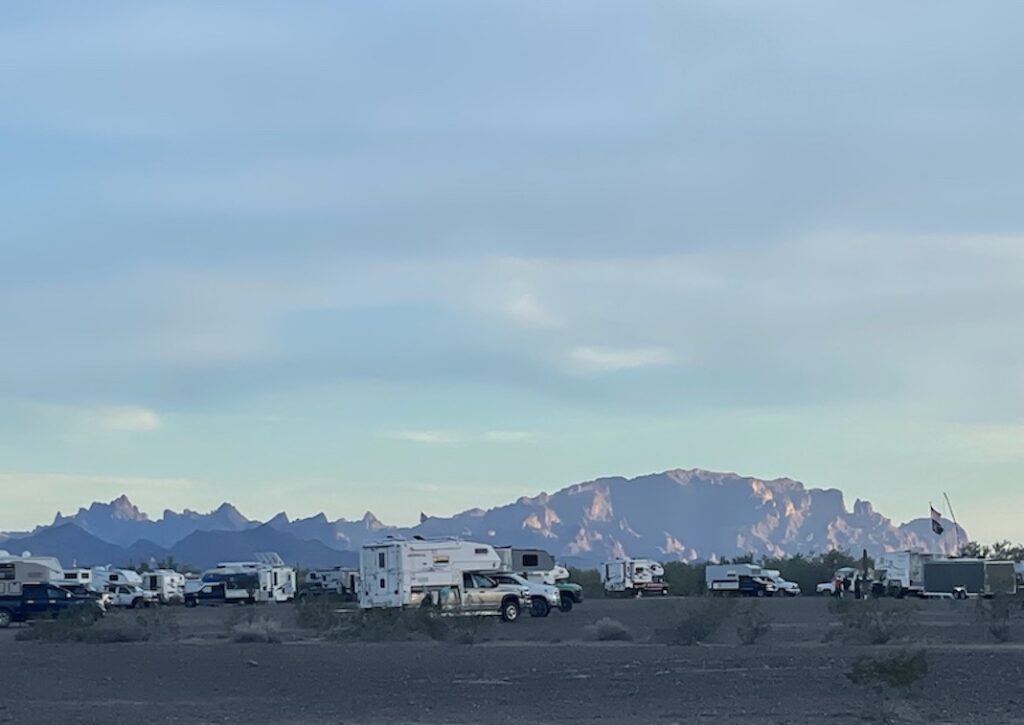
More than 700 attendees are expected at the Truck Camper Adventure rally next February 10 through 14, 2027, in Quartzsite. Photo courtesy of Gaylon Morris.
The people who spend winter—or at least part of it—in Quartzsite vary dramatically, too. Looking across the flat desert basin lands surrounding the town, you’ll see multi-million-dollar RVs separated from decades-old vans by only a spattering of creosote bushes and scrubby trees. Retirees camp next to influencers who are next to nomads living under the radar there full-time. It’s an eclectic mix, but it’s also home for the winter.
Earlier this year, RV Trader named Quartzsite “America’s Top Winter Migration Spot,” noting that its weather and cheap camping earned it high marks. But Quartzsite has a unique culture that keeps people returning year after year.
Gold, Camping and A Gem Show
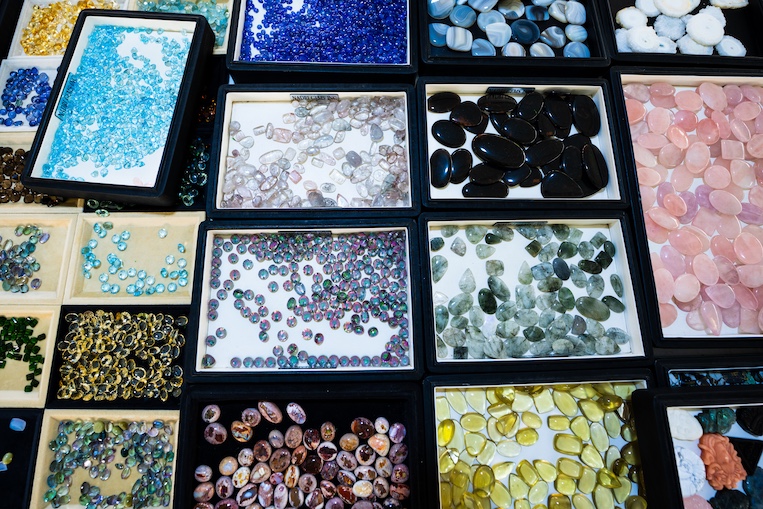
Vendors at the Quartzsite Powwow sell almost any stone imaginable, including finished ones ready to use in jewelry like these. Photo courtesy of Visit Arizona.
Originally named Tyson Wells by Charles Tyson, who dug a well there in 1864, Quartzsite served as a stagecoach stop between the Colorado River community of Ehrenberg, Arizona, and the territorial capital, Prescott. When the railroad bypassed it, the town died.
In 1897, prospectors discovered placer gold in the area’s mountains, and the town reformed, this time under the name Quartzite, an abundant local stone. However, while processing the request for a new post office, the U.S. Postal Service mistakenly added an “s” to the proposed name, and Quartzsite became the official spelling.
From the beginning, people have camped on the land surrounding Quartzsite. Miners used it as a base while searching for gold, and during the Depression, homeless families set up tents and called it home. By the late 1950s, people began wintering in the area—some purchasing land and eventually building homes, while others stayed seasonally in travel trailers. However, Quartzsite may not have become the winter destination it is today without the Quality Improvement Association (QIA).
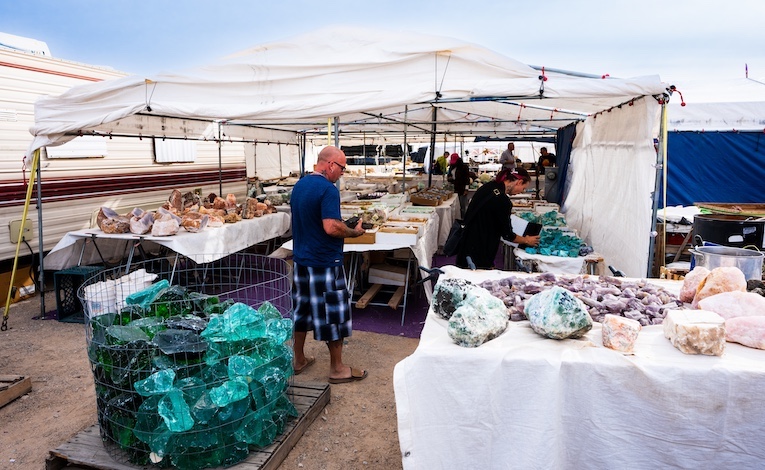
Hundreds of thousands attend Quartzsite’s free gem shows every winter. Photo courtesy of Russell Varisco.
Formed in 1965, the QIA began when three couples decided they needed an event where they could buy and sell rocks and rock-related merchandise, according to Louise Rhinevault, the organization’s office manager and wife of its current president, Gary Rhinevault. Over the next two years, the group hosted social events like potlucks and fundraisers for their own building.
Then, on February 9, 1967, the QIA held its first Powwow, a five-day gem show named for the Native American word for “gathering.” Twenty-two exhibitors displayed everything from fire agates and Native American jewelry to a rare bottle collection, and members sold homemade chili, coleslaw, and cookies, as Mary Allen details in A History of the Quartzsite Improvement Association.
Today, nearly 5,000 people attend each of the show’s five days, and vendors travel from around the world to sell their rocks, gems, and minerals, ranging from hand-cut quartz crystals and burnt-orange wulfenite fragments found locally to milky-green jade from Siberia and grape-jelly-colored sugilite pieces from South Africa. You can also purchase hand-crafted jewelry or purses, key chains and belts bedazzled with gems, not to mention Powwow-branded t-shirts, rock hound-themed koozies, and even Girl Scout cookies.
Clubs, Shows and Weather
As the gem show grew so did the number of visitors, and an increasing number stayed for the winter. To give them something to do, the QIA began providing more activities and social events. The typical winter calendar features craft fairs, bingo nights, line dancing (a form of dancing where participants stand in rows and perform synchronized movements as a group) and pancake dinners. Visitors can also listen to tribute band concerts, attend movie nights and try to find a match at the weekly singles night.
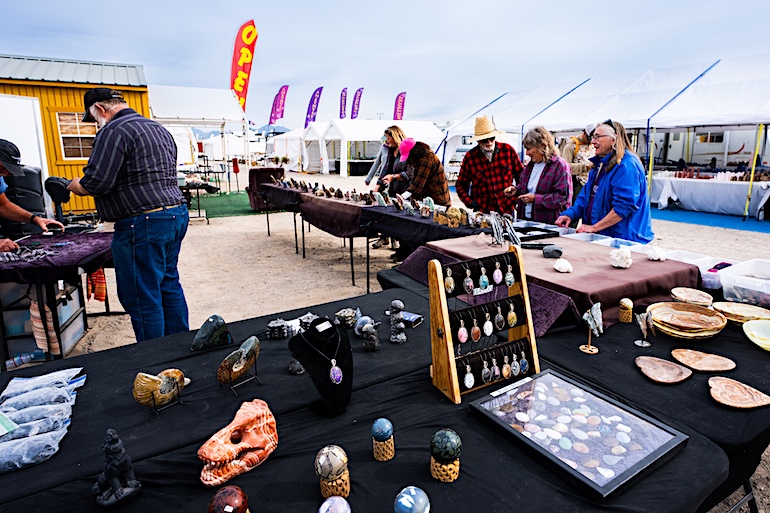
Visitors shop for gems from around the world at the Quartzsite Powwow and other local gem shows. Photo courtesy of Visit Arizona.
Over time, other groups formed to fill in the gaps, including the Quartzsite Metal Detecting Club and the Arizona SunRiders OHV Club, which accesses the 675-mile off-road Arizona Peace Trail north of the town for many of its rides.
Even among these, the Quartzsite Roadrunners Gem & Mineral Club stands out with roughly 800 members—mostly winter visitors—making it the largest gem and mineral club in the country. Members go on weekly rock hunts for agate, petrified wood and jasper; they enroll in lapidary, metal smithing, steel knife making and other classes; and they socialize.
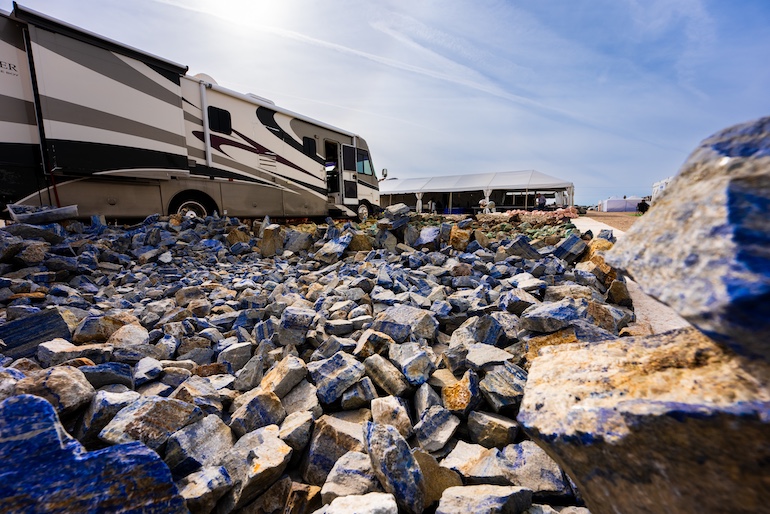
Gems like lapis lazuli are available for purchase at the Quartzsite gem shows. Photo courtesy of Visit Arizona.
“We’re a big family,” says club president and Quartzsite resident Rachel Clary, describing how members bond over events like overnight rock hunts where they share hobo stew made from whatever they have on hand for dinner. “I’ve never had so many close friends as when I came to Quartzsite.”
After the success of the QIA Powwow, new shows became annual events. In 1984, the Quartzsite Sports, Vacation & RV Show—commonly known as the Quartzsite RV Show—debuted. Billed as “The Largest Gathering of RVers in the World,” it attracts hundreds of thousands of people (the free event doesn’t record admissions) to its massive tent and outdoor marketplace, where over 300 vendors sell everything from gear like sanitizing systems for RV toilets to campsite décor like colorful spinners that blow in the wind and personalized welcome signs. There are plastic food containers, greeting cards, dog collars, massage guns, sandals, hot sauces and even massage guns for sale.
Dozens of other shows followed: Tyson Wells Rock & Gem Show, Prospectors’ Panorama, Desert Gardens International Rock, Gem & Mineral Show, Quartzsite Gold Show, the Sell-A-Rama flea market and the Tyson Wells Arts & Crafts Fair, to name a few. Quartzsite attracts events like the Homes on Wheels Alliance’s Rubber Tramp Rendezvous, an annual gathering for people who live on the road full-time, too.
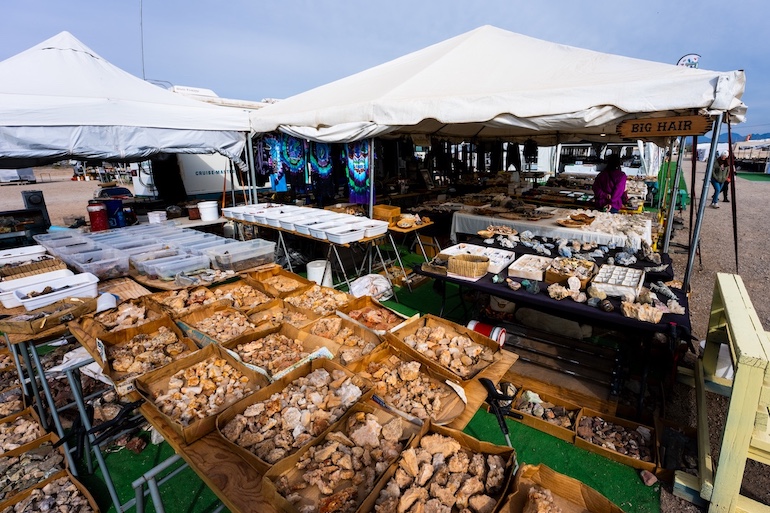
Hundreds of vendors display their rocks and rock-related items at Quartzsite’s gem shows. Photo courtesy of Visit Arizona.
It was the Rendezvous that introduced Wendy Householder and her husband, a retired pastor, to Quartzsite in 2025. As they traveled in their vintage Scotsman travel trailer, the two fell in love with the boondocking lifestyle of camping without hookups or amenities like campground bathrooms. The Rendezvous was an opportunity for them to learn how to live full-time on the road,
“They teach you things like how health insurance works when you’re on the road, how to get your mail and how to make money with seasonal work,” she explains.
While in Quartzsite, the Householders met up with friends and attended the Quartzsite RV Show, but otherwise they spent most of their time at their campsite, relaxing with a view of fuzzy teddy-bear cholla cacti and desert bushes instead of the canopy of trees they were used to. The weather made the experience even better.
“There’s sunshine, and it’s cool,” says Householder, who documents their travels on their Tin Can Twosome YouTube channel. “It’s the best of both worlds.”
Gaylon Morris, who travels with his wife and two dogs, drove their truck camper from Bean Station, Tennessee, to Quartzsite two years ago to attend a similar event organized by online magazine Truck Camper Adventure. For Morris, the magazine’s truck camper rally let him share his love of camping with hundreds of others—the 2026 rally welcomed 375 truck campers—and attend workshops on everything from boondocking basics to off-roading and traveling with pets. The five-day event also featured vendors such as Lance Campers and TemboTusk, a camping equipment manufacturer.
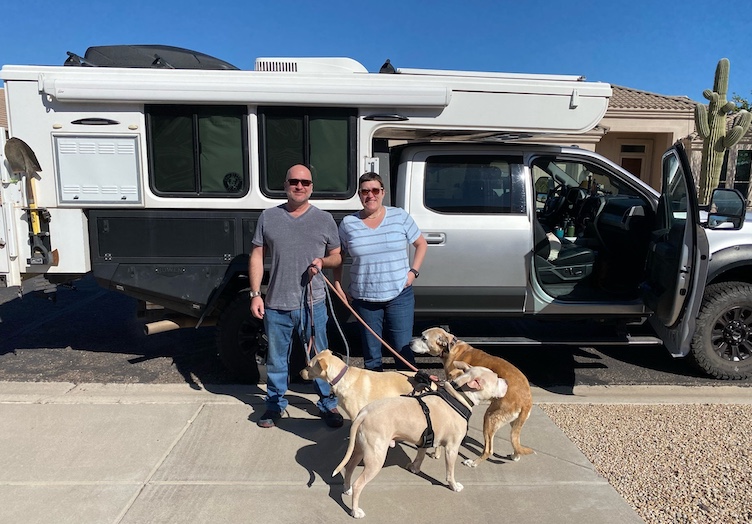
Gaylon Morris, his wife Chandra and their dogs pose in front of their truck camper, which makes a regular winter appearance in Quartzsite. Gaylon and Chandra look forward to seeing old friends at the week-long events sponsored by RV vendors and off-roading magazines. Photo courtesy of Gaylon Morris.
Between attending the workshops, Morris toured vendors’ campers that were on display and socialized with other rally-goers, even though he knew Quartzsite “always had something going on.” Instead, he preferred to grab a glass of wine, sit outside and do nothing.
“Camping consists of a whole lot of doing nothing,” he says. “That’s the allure of it.”
Inevitably, a neighboring camper would drop by as he sat outside his trailer, and they’d share the wine and talk. Morris appreciated the sense of community he felt in Quartzsite while attending the event, and he’s looking forward to coming back—whether to attend the rally or not. Either way, he’ll likely return in the winter.
“The real allure is that it’s warm and beautiful while the rest of the country is freezing,” he says.
Low-cost Winter Camping
Quartzsite’s appeal runs deeper than its activities and weather, though. Russell Varisco, who extensively covers Quartzsite on his YouTube channel, RVerTV, points out that many major Southwest cities, such as Phoenix, offer more activities and camping nearby. However, you can’t camp in other places for so little money.
In general, you can camp for free on public lands for up to 14 days within a 28-day period, although, around Quartzsite, the BLM limits where you can camp to 14 designated but undeveloped areas where you will be “roughing it.” There are no marked spaces, no hookups and no amenities; campers even have to drive into Quartzsite for fresh water.
For those who want more amenities, the BLM created the LTVA, an 11,4000-acre area with trash bins, vault toilets, and access to water and dump stations at designated locations. LTVA campers can stay for up to 14 days for only $40 or for the entire season, September 15 through April 15, for $180.
Varisco describes the people who camp on BLM land—whether to disperse camp or stay at LTVA—as a diverse lot. Lawyers camp next to homeless vets or musicians with tie-dye T-shirts and ponytails. Wander into the wrong area, and you may find yourself in an optional clothing encampment. More common, though, are people living a nomadic lifestyle, retirees relishing the sunshine and show attendees.
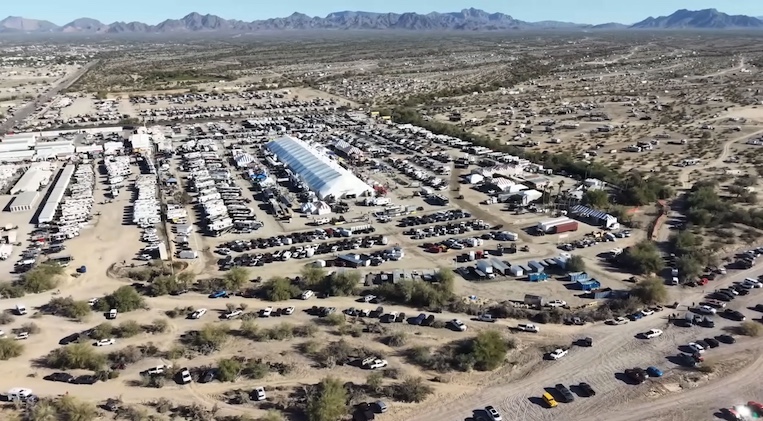
Hundreds of thousands attend Quartzsite’s free gem shows every winter. Photo courtesy of Russell Varisco.
BLM camping isn’t for everyone. Kym Scott, owner of Tyson Wells RV Park, says staying at an RV park offers many conveniences that even LTVA campers don’t have, such as easily accessible water, sewer and electricity. Staying at one of Quartzsite’s dozens of RV parks has the added advantage of being within walking distance of grocery stores and restaurants, and a manager makes sure no loud parties wake you after hours.
Those perks come at a price, though. Scott says you can expect to pay from $225 to $450 per month to stay at an RV park. However, for families, seniors, and some RVers, it may be worth it.
Maintaining Top Spot
The Quartzite Chamber of Commerce doesn’t keep track of the number of winter visitors every year, but for decades, more and more people have arrived over the course of a season. Lately, that number has tapered off. No one knows by how much, but RV Trader reports that this year the Quartzsite RV Show had less foot traffic due to a decrease in Canadian visitors.
Varisco says it’s something he’s noticed since the “crunch in ’08,” but he attributes the downturn primarily to the area’s Wi-Fi and cell services, which were meant for a population of under 2,500. An additional 997,500 people with laptops and cell phones strain its infrastructure, and the town can’t afford improvements to accommodate the needs of those who stay only a few months.
As a result, influencers who depend on social media and grandparents who want to wish a grandchild happy birthday may struggle to get reliable cell service for the foreseeable future. And, if they can’t connect, they may limit their time in Quartzsite.
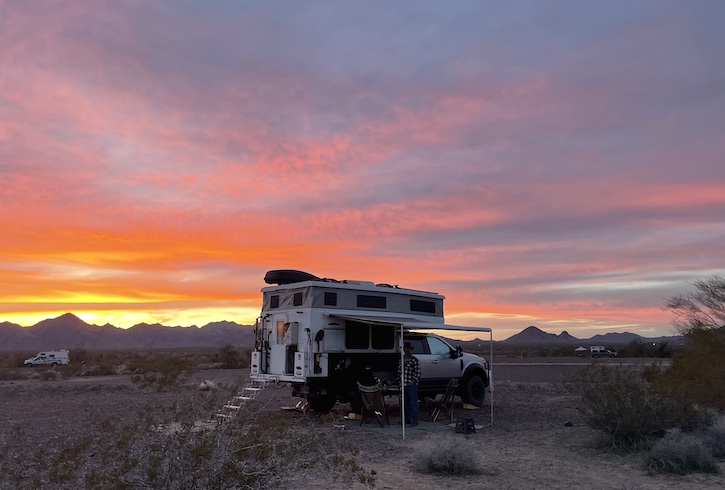
Another perk to camping in Quartzsite is the incredible sunsets, according to Gaylon Morris. Photo courtesy of Gaylon Morris.
Despite Spring and Summer temperatures that can soar above 100 degrees, Quartzsite’s seasonal RV population is expected to creep beyond winter. Over 170,000 Americans older than 55 already live as RV nomads, according to R.V.I.A, the Recreational Vehicle trade association. This number is expected to increase as more people born between 1965 and 1980 (Gen. X) decide to retire. Why are they more likely to hit the road? Because theirs is the first U.S. generation to be enrolled in 401(k) retirement plans instead of receiving employer-guaranteed contributions to more structured pension programs.
Whatever may happen, Varisco says Quartzsite has its own, unique vibe, one that you won’t find in places like Yuma, Arizona; Winter Haven, Florida; or the Rio Grande Valley, Texas, all runners-up to Quartzsite for RV Trader’s title of best winter camping destination. Quartzsite will always appeal to winter campers because of the weather, the free and low-cost camping, the trade shows and, of course, the sense of community.
“People either love it or hate it, but you’ve gotta try it,” Varisco says of camping in Quartzsite.
Arizona-based Teresa Bitler is a globe-trotting travel journalist whose recent East-West News Service articles examined the growing popularity of Dark Tourism and the global market for Spain’s Ibérico ham. Before leaving our website, please read her book review on “100 Years of Dude Ranching.”