

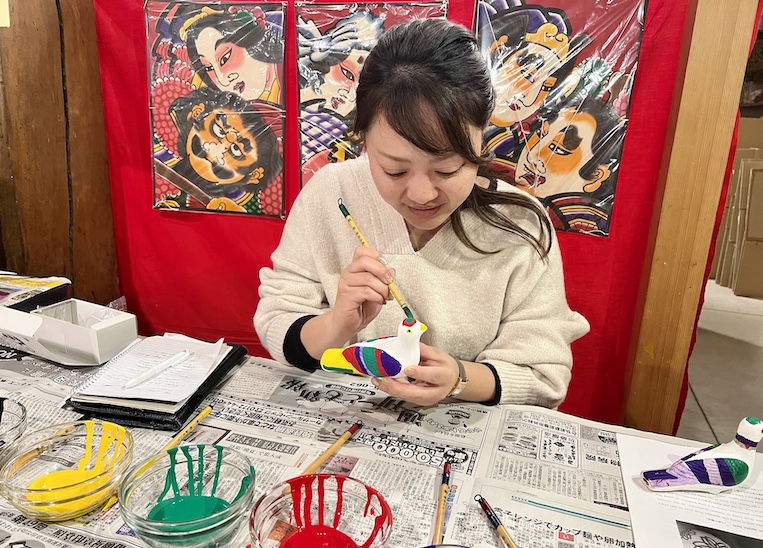
Neputa Village in Aomori offers visitors several craft experiences, including decorating clay pigeons with white, purple, red, green, and yellow paints, a color combination not seen anywhere else in feudal Japan. Photo by Beth Reiber
By Beth Reiber
You’ll probably eat miso on a trip to Japan, but what if you could also learn how to make the fermented soybean paste and bring it home? What insight might you gain into wabi-sabi, the Japanese appreciation for the imperfection and impermanence of life, if you learned how to restore broken ceramics using a centuries-old technique called kintsugi, which accents cracks with color instead of trying to conceal them?
I’ve participated in numerous workshops throughout the four decades I’ve been writing about Japan, from indigo-cloth dying in Iwate Prefecture to making lampshades fashioned from Japanese paper recycled from festival floats. Never have there been so many immersive English classes as now.
Not only do these experiences afford deep dives into Japanese culture, but they also provide personal connections to the history, techniques, and philosophy behind centuries of Japanese crafts and cuisine. They’re a great way to interact with locals, who may represent the third- or fourth-generation artisan in their families. Finally, you get to bring your handmade craft or new skill home, creating lasting memories.
Exalted Japanese Crafts and Cuisine
Because Japan’s traditional crafts and cuisine are so deeply intertwined in everyday life, foreign visitors may not recognize just how revered they are in the Japanese mind. In 1955, Japan became the first country in the world to designate its most skilled craftsmen and performing artists as “Living National Treasures,” a practice later adopted by Korea, China, the Philippines, Australia, and Ireland.
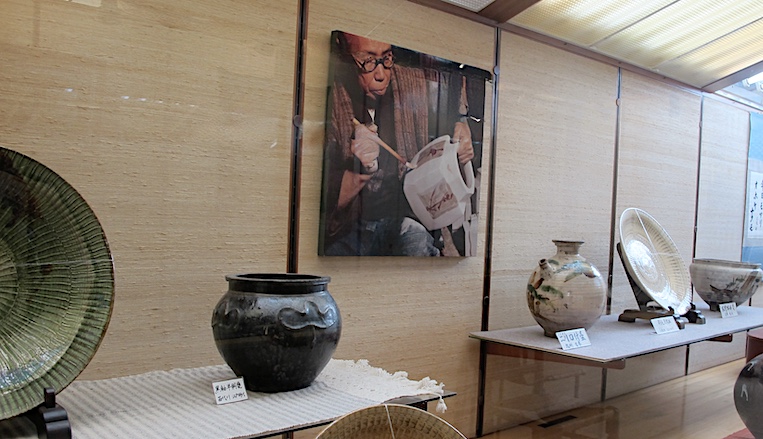
Shoji Hamada (1894-1978) was among Japan’s first to be designated a Living National Treasure. His home and studio in Mashiko are now a museum. Photo by Beth Reiber
Since 1974, the Japanese government has also designated more than 240 specific items manufactured throughout the country as Traditional Craft Products, the criteria being that they must be handmade, must be used mainly for everyday life, and must be produced using techniques that go back more than 100 years. These Traditional Craft Products include textiles, ceramics, lacquerware, bamboo ware, woodwork, tea pots, woodblock prints, Buddhist altars, washi (Japanese paper), cut glassware, dolls, braided cords, hair ornaments, and writing tools, as well as items we might not associate with crafts, such as bamboo fishing rods and even fishing lures.
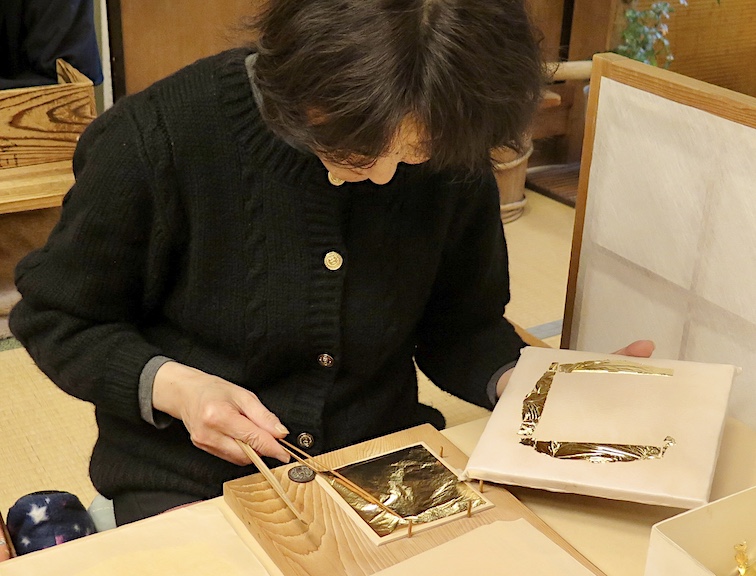
Kanazawa produces 90% of Japan’s gold leaf, a Traditional Craft Product used to decorate everything from lacquerware to household altars. Photo by Beth Reiber
As for food, traditional Japanese cuisine, or washoku, enjoys star status as a healthy and well-balanced diet. Since 2013, it has been on UNESCO’s Intangible Cultural Heritage list. More recently, a movement is currently underway to add a new category of Living National Treasures: chefs and sake brewers.
Examples of Japanese Craft Workshops
Many handmade crafts in Japan employ time-honored techniques passed down through generations. Not all of Japan’s ancient crafts are taught in workshops. Some require so much time-consuming dedication that they’re not practical for the short-term visitor. Working with lacquer, for example, involves multiple steps because each layer requires time to harden. Lacquer also requires precaution because the natural tree sap causes an allergic reaction on the skin, like poison ivy.
Fortunately, there are endless possibilities for workshops that last two hours or less, allowing participants plenty of time to explore other interests and attractions that same day. Prices range widely depending on the class. The Ochanomizu Origami Kaikan in Tokyo, for example, charges ¥1,100 (about $7) for its 30-minute origami lesson, while my 90-minute kintsugi workshop (described below) costs ¥6,600 ($42). Check individual websites for more information on workshop schedules, advance-booking requirements, and pricing.
Japan’s most famous activities and experiences, like the tea ceremony, origami, and making sushi or udon, are widely available, with companies like GetYourGuide and byFood.com offering classes in Tokyo, Osaka, Kyoto, and beyond.
Better yet, look locally for independently owned facilities. The suggestions below focus on experiences that are less common or are closely tied to their places of origin. The best advice is to search for classes aligned with your own personal interests. Maybe you’ll even plan your travel itinerary based on a workshop located in a town you otherwise might not have visited.
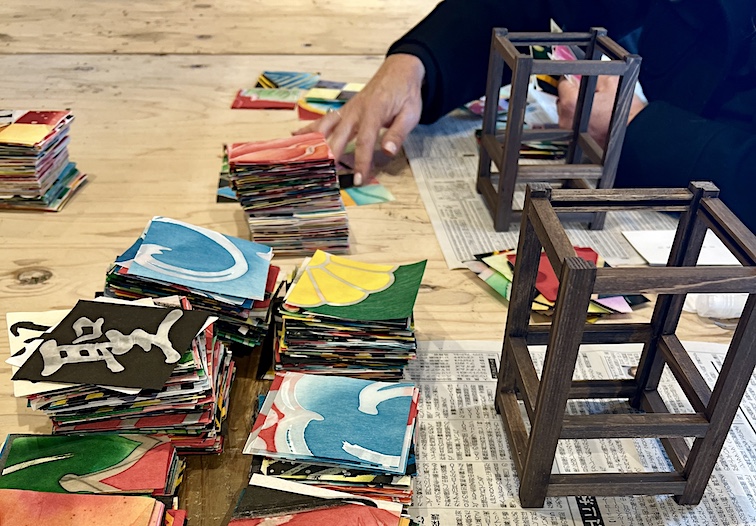
Japanese paper (washi) recycled from hand-painted floats in Aomori Prefecture’s Neputa Festival finds new purpose at Idodori, a shop in Kuroishi City where visitors can turn them into lampshades and fans. Photo by Beth Reiber
For example, Fukui Prefecture, on the main island of Honshu is famous for Echizen blades that have been produced for more than 700 years and now are listed as a Traditional Craft Product. Want to learn more? Takefu Knife Village shows visitors how to make their own kitchen or outdoor knives by heating and forging blades before attaching them to handles.
Likewise, sea anchors have long been a hot commodity near the port town of Tomonoura in Hiroshima Prefecture, where at the ironworks Sangyo Corporation, I experienced forging my own frying pan.

Some traditional crafts, due to their importance in Japanese history, are widespread. Yet it’s amazing how many regional variations exist for the same item, especially considering that Japan is about the same size as Italy. Some 30 distinct types of regional handmade ceramics, for example, are on Japan’s list of Traditional Craft Products. The unglazed Bizen-yaki pottery tea cups or chopstick rests you can make in Okayama differ from the glazed Mashiko-yaki pottery you’ll produce in Mashiko, a village outside Tokyo.
Some crafts might not even register as such to the casual observer. Samurai armor looks arrestingly fierce, so you might not give much thought to the lowly braided cords used to secure it. Yet kumihimo, the Japanese art of braiding thread into cords, has a history going back 1,400 years and was used for everything from tying sutra scrolls to adorning formal attire. Leave it to the Japanese to create kumihimo both practical and beautifully decorative.
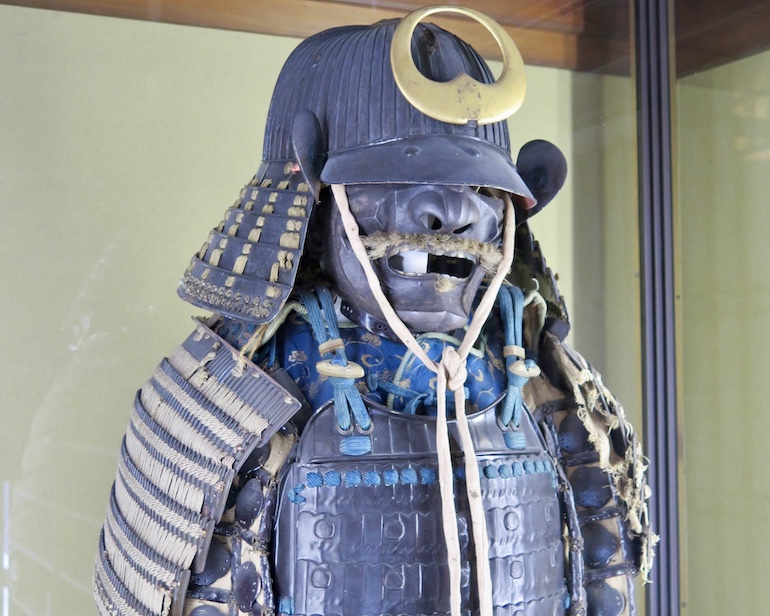
Braided cords had many uses, from joining plates on samurai armor to wrapping sword hilts for a better grip. Photo by Beth Reiber
The Iga Kumihimo Center in Mie Prefecture, the Adachi Kumihimo Gallery in Kyoto, and Domyo, established in 1652 in Tokyo, offer workshops where you can braid cords to make bracelets, keychains, bookmarks, and other items.
What Goes On At A Craft Workshop?
Edo Kiriko
One of my favorite workshops involved faceted glassware, a craft that’s a relative newcomer in Japanese history and isn’t even particular to Japan. But it’s been around long enough to qualify as a Traditional Craft Product from Tokyo.
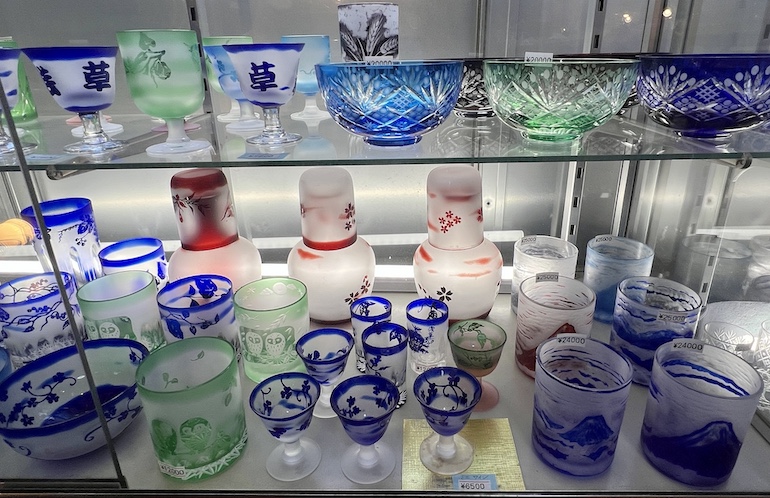
More than 50 Tokyo companies produce handmade cut glassware in addition to those shown here Asakusa Ojima. Photo by Beth Reiber
The art of cutting glass for decorative appeal goes back to antiquity in places like Persia and Egypt. After the arrival in Japan of European glass and cutting techniques during the Edo Period (early 17th century to 1868), the Japanese did something they excel at—taking a foreign product and making it their own (think Sony cameras and Honda automobiles in the 20th century).
In 1834, Kyube Kagaya devised his own method for making faceted glass, using emery powder at his glassware shop in Edo (present-day Tokyo). The current method for making Edo kiriko (Tokyo’s cut glass) was established in 1883. Edo kiriko drinking glasses, vases, plates, and other glassware come in colors ranging from red to cobalt blue to green. But only the glassware’s outer layer is colored. By cutting through this colored layer to the clear glass underneath, chrysanthemums, basket patterns, and other intricate designs come to life.
Although I had some trepidation about working with equipment strong enough to cut glass, my experience at Asakusa Ojima in Tokyo set me straight. Making Edo kiriko is so safe, elementary students and groups of women are frequent customers. You don’t even need safety glasses.
Asakusa Ojima has a history going back more than 100 years and offers workshops under the guidance of third-generation owner and artisan, Eiji Ojima. After watching a short video, I was given a small, clear drinking glass (more expensive colored glass isn’t wasted on amateurs), along with a pen to sketch my hoped-for design. Ojima-san demonstrated how to apply the glass evenly to a spinning wheel covered with industrial-grade diamond powder, each stroke creating one line of the pattern. Different wheels are used for different cuts.
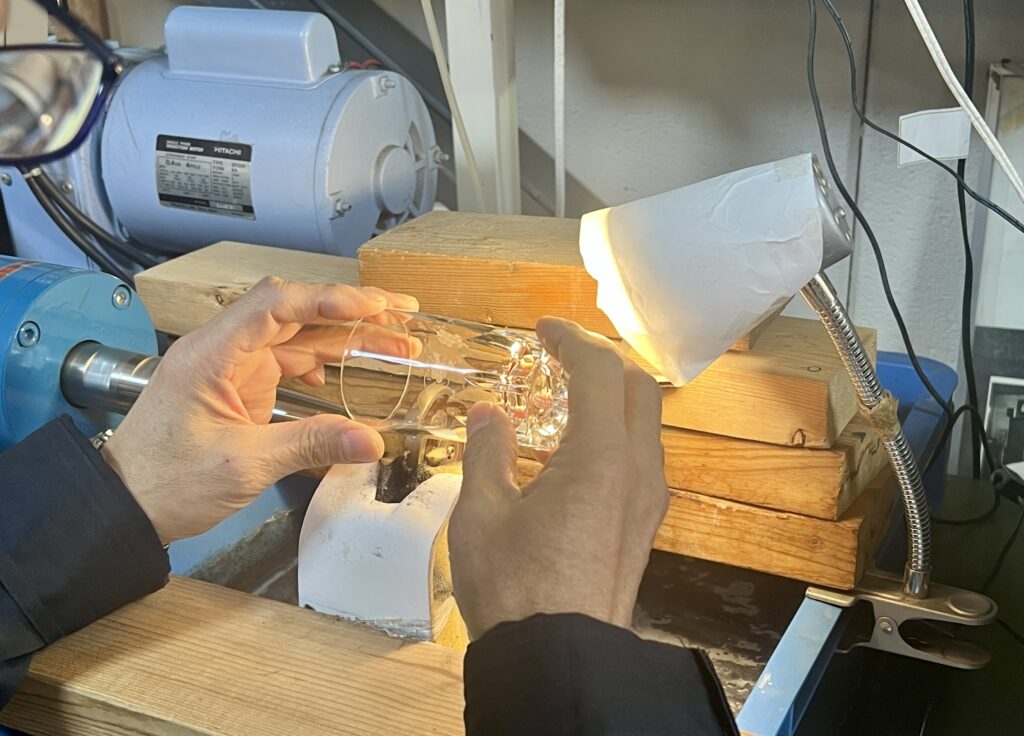
Ojima-san demonstrates glass cutting on clear glass, which he buys in bulk from a manufacturer for his workshops. He procures his colored glass from a company that handmakes them, which he uses for the Edo kiriko he sells in his shop. Photo by Beth Reiber
Easier said than done. My careful but wobbly sunburst design looked childish, nothing like the grapevine design Ojima-san whipped out in less than a minute.
After my workshop, I appreciated why Edo kiriko is so expensive. Each faceted glassware is handmade, a skill that takes an apprentice about 10 years to learn. These cups are not for drinking your daily oat milk. Rather, these prized possessions are favorite gifts for momentous occasions like weddings, with a single glass easily costing $200 or more.
Kintsugi
Another Tokyo workshop I thoroughly enjoyed did not involve making a craft but rather repairing one. To learn kintsugi, the art of repairing broken ceramics by accenting the cracks in gold or another color, I joined a class at Mutoh in Tokyo’s Nihombashi district.
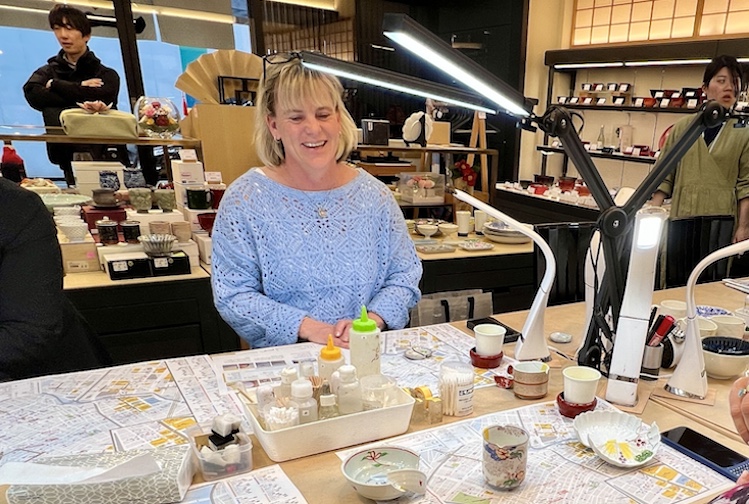
You can bring your own broken ceramic to repair at Mutoh or pay a small fee to repair a broken piece the shop acquires for its workshop. Photo by Beth Reiber
Although no one knows kintsugi’s origins, it seems to have gained popularity in the 15th century alongside the rise of the tea ceremony to repair expensive tea sets. Instead of hiding cracks, the faults are highlighted with lacquer and gold as a visual reminder of the object’s history. This fits the Japanese philosophy of wabi sabi, which finds beauty in the imperfection, aging, and impermanence of life.
Kintsugi is one of those endeavors that takes one to two months to do properly, because the traditional method uses a strong adhesive made from natural lacquer (urushi), flour, rice glue, and other ingredients that’s applied to cracks and requires time to harden. Other steps might include making a putty-like paste of urushi and clay powder to fill in gaps left by missing ceramic pieces, followed by sanding before applying lacquer mixed with gold powder to accent the repaired cracks.
Because lacquer takes so long to harden, the women running my workshop agreed that summer is best for the real kintsugi class.
“Kintsugi needs a hot and humid temperature,” one of them said, adding that in winter, they use a special humidity box to simulate summer. “Typhoon season is best.”
My short visit in winter did not allow time for the real kintsugi experience. Instead, my 90-minute workshop evaded the longer steps by using fast-drying epoxy instead of lacquer, which also meant that the Arita ceramic bowl I chose to repair can’t be used for food.
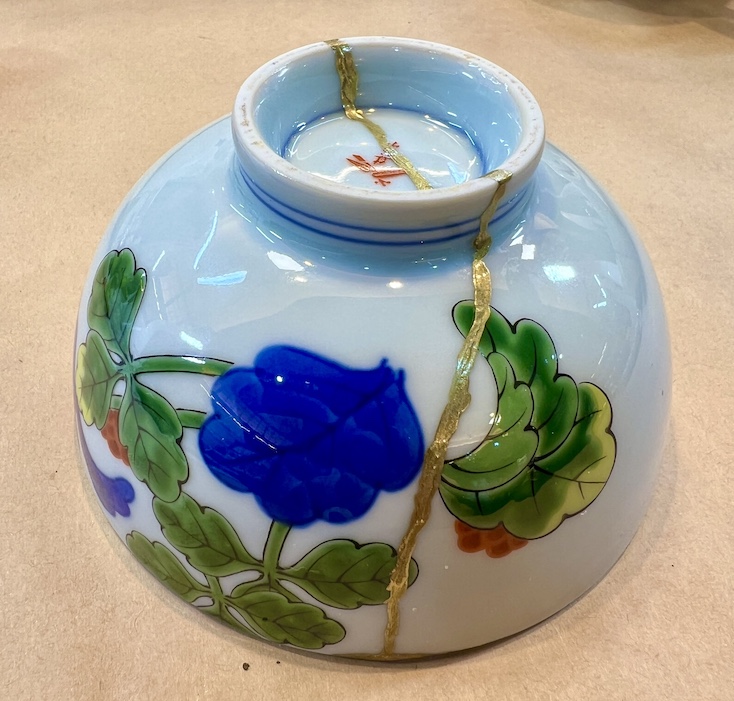
My repaired Arita bowl using the kintsugi method. Photo by Beth Reiber
Still, the basic steps were the same, including sandpapering the putty I’d applied to fill in a gap. I sanded and sanded, but the woman overseeing my progress said it was the most important step and kept me at it until my handiwork met her satisfaction.
“We accent the weak point and then think it’s beautiful,” she said.
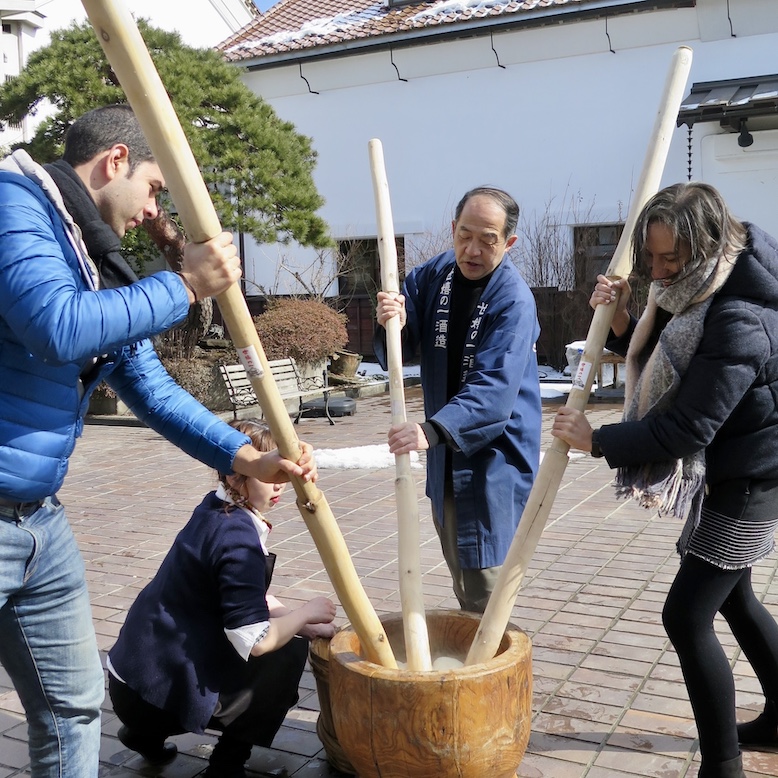
Learning how to pound mochi in Iwate Prefecture. Photo by Beth Reiber
Food Workshops Around Japan
Japanese cuisine is popular around the world, so it’s no surprise that classes for making ramen, udon, mochi (rice cakes), sushi, and other fare are easy to find. But for one-of-a-kind experiences, again, look locally.
Chino Tabi, for example, connects travelers to locals through a variety of activities in rural mountain villages in Nagano Prefecture, including making tofu, miso, and traditional dishes, all under the tutelage of “Village Grannies.”
Searching locally is also what led me to a taiyaki cooking class in Tokyo, located, appropriately enough, near the Kappabashi district famous for its cooking-supply stores. Taiyaki is a fish-shaped snack thought to have originated in Tokyo around 1906. The fast food caught on not only because it’s cheap (made from dough and a filling), but also because taiyaki is shaped like a red snapper, a symbol for good luck.
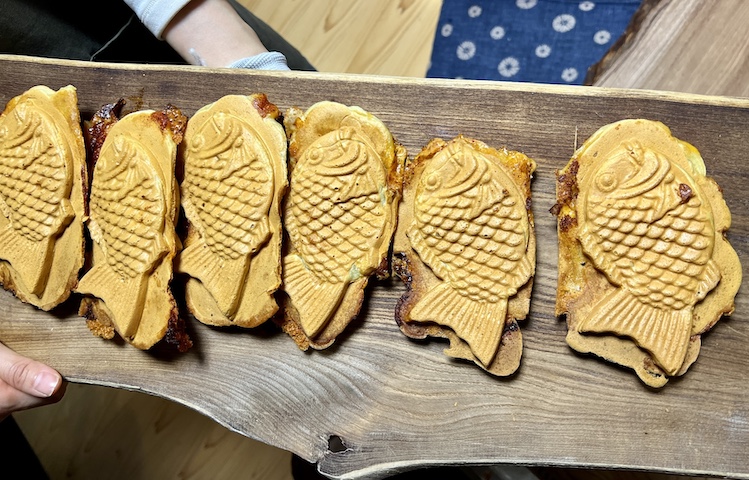
Taiyaki Photo by Beth Reiber
Asakusa Taiyaki Guraku, run by a Japanese couple, is both a modest restaurant and the only place in the world where you can learn how to make taiyaki. Seated on tatami in front of a low table, you’ll learn how to make the dough from scratch, pour it into fish-shaped molds, and add the filling of your choice. Anko, a red bean paste, is the traditional filling, but the restaurant also offers matcha paste and sweet potato and modern ingredients like tuna and mayonnaise, kimchi and cheese, and even hot dogs.
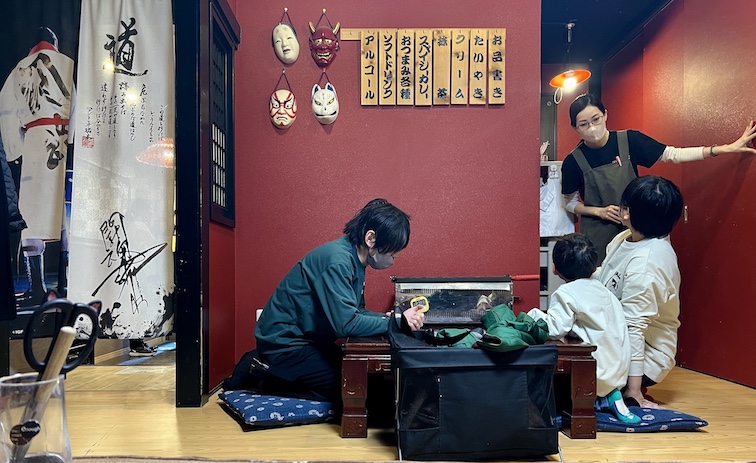
Many cultural experiences are geared toward families, including making taiyaki at Askusa Taiyaki Guraku. Photo by Beth Reiber
Another unique food experience is making your own miso. An online search of miso-making classes turns up opportunities in Tokyo, Kyoto, Osaka, Kagoshima, and a few other places, but none are as inexpensive as the one offered at Kanesa Co., founded in 1875 and located on the tip of the main island of Honshu in Aomori City.
A free tour of Kanesa’s Bonju facility, with plenty of information in English, explains each step in the process of turning soybeans, rice mold, and salt into regional Tsugaru Miso, considered especially tasty because of the region’s pure underground water and Aomori’s cold winter temperatures.
Kanesa’s miso-making class, which costs ¥2,000 ($13), includes a video explaining the different types of miso (such as sweet miso made with barley on the islands of Kyushu and Shikoku) and the steps to making your own miso. You’ll then mash steamed soybeans, placed into a plastic bag for easy manipulation, by hand until they become a paste. At the end you’ll add rice mold, salt, and yeast.
At home, your miso should be stored at room temperature for about one month in summer or up to four months in winter. It will then last in the refrigerator for about one year, ready for soups, marinades (great on fish), and many other uses.
Learn Multiple Crafts In One Location
Although many workshop experiences are tied to a studio or location where the craft is produced, some cities boast one-stop facilities with a variety of classes featuring local crafts.
As Japan’s Imperial capital for more than 1,000 years, Kyoto has more artisanal crafts than anywhere else. To appreciate this, visit to the Kyoto Museum of Crafts and Design, which showcases 74 of the ancient city’s traditional products and describes how they’re made, including woven textiles, folding fans, cloisonne, incense, arrows, bamboo ware, and ornamental hairpins.
I’ve long been a fan of WAK JAPAN, established in Kyoto in 1997 long before everyone else jumped on the cultural bandwagon. It offers a multitude of experiences and workshops, including the tea ceremony, origami, calligraphy, flower arranging, watoji (book binding), and Tsumami-zaiku, unique to Kyoto, which involves delicately folding and pinching colorful pieces of fabric to create three-dimensional floral motifs.
In Tokyo, the Yanesen Tourist Information & Culture Center offers workshops for making wagashi (Japanese sweets) and onigiri (rice balls), as well as instruction in flower arranging and calligraphy.
Farther afield, Neputa Village in Aomori Prefecture is a repurposed miso and soy sauce factory that’s now one of Hirosaki’s top destinations for its displays of local crafts and fan-shaped floats used in its Neputa Festival. In addition to a restaurant serving regional specialties, musical performances centered on the local Tsugaru shamisen, and a garden, it also features artisans at work and the opportunity to decorate traditional crafts, mostly by painting them with your own designs. These include apple-shaped ceramic bells, kites, paper goldfish, bells, whistles in the shapes of clay pigeons, kokeshi dolls, and more, all with ties to local history.
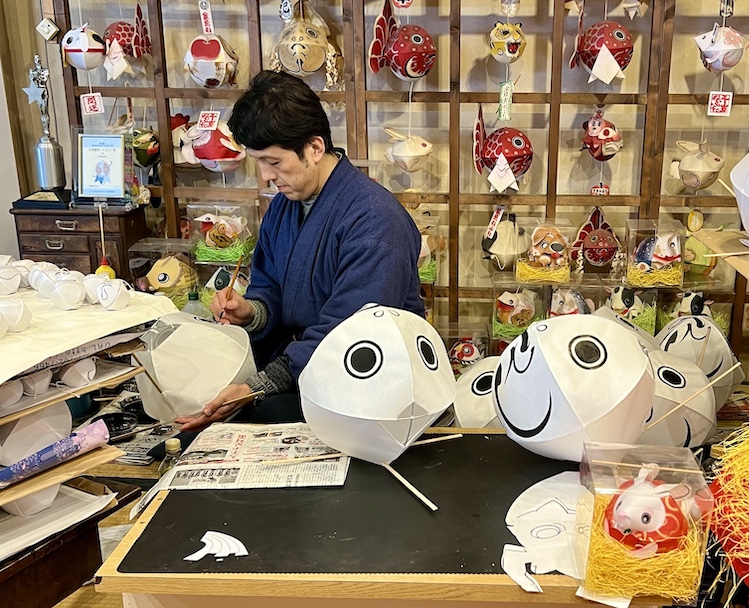
An artisan paints goldfish, revered as a symbol of good luck, at Neputa Village, which offers a variety of craft workshops for visitors. Photo by Beth Reiber
Yunokuni no Mori, a handicrafts village in Komatsu, Ishikawa Prefecture, showcases works by local artisans and offers hands-on experiences. These include designing an insect cage made from bamboo lattice, working with gold leaf, and painting Kutani ceramics.
At Takumishuku, located in Shizuoka City between Tokyo and Nagoya, you can create your own flower vase, insect cage, or coaster using Suruga bamboo, experience indigo dying, and, in a nod to modern times, craft a plastic Tyrannosaurus. And at the Hakata Machiya Folk Museum, in Fukuoka on the island of Kyushu, you can paint traditional crafts like spinning tops and the Hakata doll.
Even your hotel might have immersive activities. Shiba Park Hotel in Tokyo offers guests a kintsugi class. Kai Tsugaru, a Japanese inn with hot-spring baths in Aomori Prefecture, offers Tsugaru shamisen musical performances and the chance to try your hand at playing the instrument. It also has workshops for Tsugaru Kogin-zashi, a traditional stitching handicraft of symmetrical patterns.
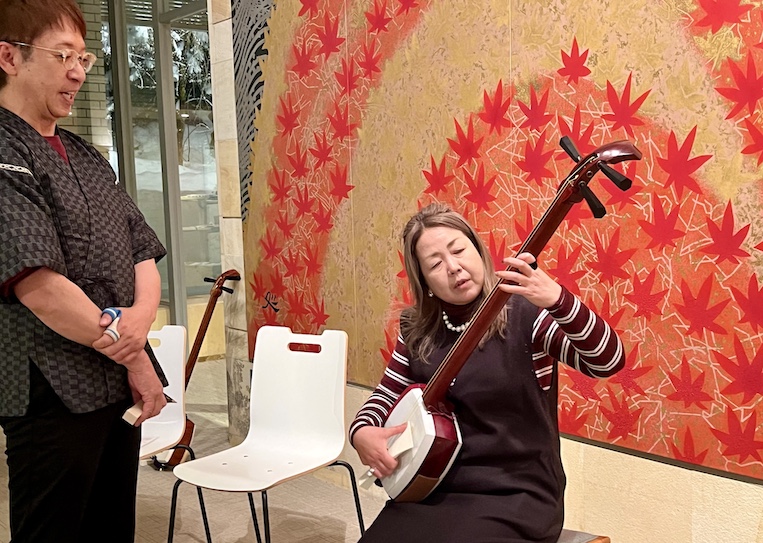
Hotel guests at Kai Tsugaru OR can sign up for short shamisen lessons. Photo by Beth Reiber
In short, it’s easy to add a cultural workshop or two on a trip to Japan. Although you won’t learn enough to become a master, you’ll learn enough to appreciate the dedication it takes to become one.
“In Japan, long-term dedication to intensive training and apprenticeships in an art or craft is highly respected,” noted Sherry Fowler, Professor of Japanese art history at the University of Kansas. “A hands-on workshop can provide a memorable experience. Most importantly, it gives visitors an inkling of what that training might involve.”
Participating in a Japanese workshop is also just plain fun.
Beth Reiber, the author of Frommer’s guides to Japan for more than 40 years, is an East-West News Service contributor who recently escorted readers through Germany’s Black Forest and introduced Hinohara, Japan to people who like venturing off the beaten path.