

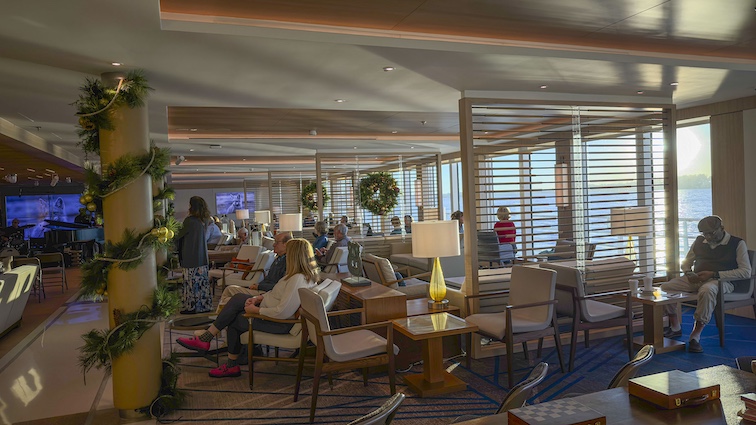
Guests enjoy live music in the Living Room on late afternoons on the Viking Mississippi.
All Aboard
America’s greatest writer, Samuel Clemens, who wrote under the pen name Mark Twain, grew up on the western shore of North America’s greatest river, the mighty Mississippi. Abraham Lincoln called it the Father of Waters. I prefer to think of this wide, muscular river as America’s Nile, since it drains 1,125 million square miles (2,914 sq. kilometers) across the broad heart of the nation. From the small river port town of Hannibal, Missouri, this ambitious and spirited young lad achieved at the tender age of 23 the most exalted job on the river, that of steamboat pilot. Though his reign lasted just two years, 1859-1861, it set him on a path to literary fame, fortune and worldwide acclaim as the first true international travel writer.
We must thank the Civil War, which constricted commerce up and down the Mississippi, for causing Sam Clemens to lose his dream job. Cast adrift, he tried his hand at soldiering, silver mining and ‘scribbling’, as he called it. War seldom has silver linings, but the legacy of the steamboat man turned scribbler continues to this very day. We still read his marvelous tales, The Innocents Abroad (1869), Roughing It (1872), Tom Sawyer (1876), the Adventures of Huckleberry Finn (1884), A Connecticut Yankee in King Arthur’s Court (1889), and a travel tale to savor, Life on the Mississippi (1883). Piloting reputedly gave him his literary name, Mark Twain, which to pilots meant two fathoms or 12-ft. of safe water that would prevent steamboats then plying the muddy Mississippi from running aground.
The Viking Vessel
I’ve cruised vastly different rivers in Asia, Europe and Egypt, but never sailed the Big Muddy. So, after years of longing, I finally took the plunge and boarded the Viking Mississippi, the biggest cruise ship on the 2,350-mile-long river. Launched in 2022, this USA-built vessel is 450-ft. in length, has a 75-ft. beam, and features 193 outside staterooms, plus ample public spaces for 386 passengers and 148 crew. Its state-of-the-art propulsion system is quiet and responsive. To satisfy my curiosity I took the bridge tour where I met chief pilot Kenny Williams. He’s been piloting on the Mississippi for 52 years and is an aficionado of Mark Twain, whose books he collects. “This river is an Artist, always carving its floor and course,” he muses from his lofty pilot’s chair, which seems designed more for James T. Kirk’s starship Enterprise than a terrestrial riverboat.
What would Mark Twain have written about the Viking Mississippi? Reflecting the origins of the company, the ship’s modern furnishings and design are Scandinavian, yet words from Huckleberry Finn adorn the stairwells. Twain’s last trip on the river was in 1882 yet today nearly 150 years later his thoughts live on with every trip up and down the river.
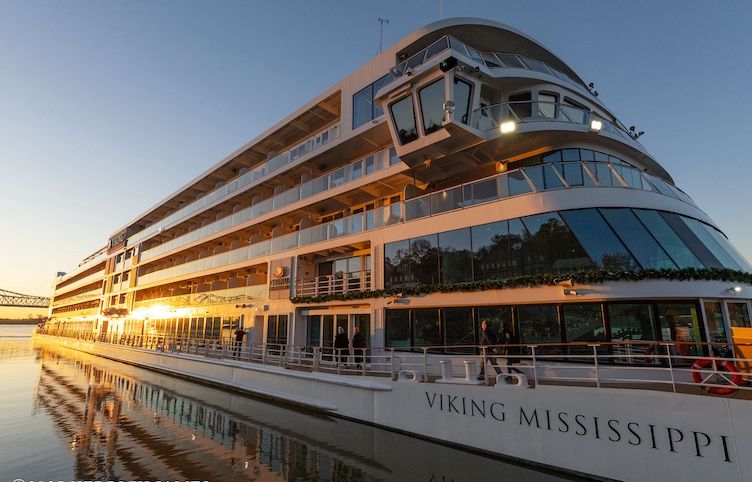
The setting sun lights up the Viking Mississippi, docked at Natchez, Mississippi. Photo by Kerrick James
Although purpose built for the Mississippi, Kenny Williams’ vessel shares many design elements with other Viking craft cruising Portugal’s Rio Douro and the lagoons of Venice in Italy. The vast majority of our passengers are repeat Viking cruisers who appreciate the company’s ‘no children” policy, the local musicians who perform during every meal and the complimentary beer and wine that flow at every lunch and dinner. We mostly cruise at night and tour by day, all the while dining like plantation patricians as we travel from New Orleans north to Memphis on this late autumn journey. The Viking Mississippi sails year-round, staying south in the cold season while going all the way to St. Paul, Minnesota in the summer when the Delta gets a bit steamy. You can do the whole river in 21 days, if you desire.
Reading the daily onboard bulletin, I learn that the Mississippi Delta extends from Memphis 650 river miles south to the Crescent City, (New Orleans), and the Gulf of Mexico, delivering its massive load of loess or fertile glacial silt. The Lower Mississippi especially bears heavy the hand of history, most prominently the Civil War and the legacy of 246 years of slavery, which legally ended in December 1865 with the 13th Amendment.
Old South Plantation House
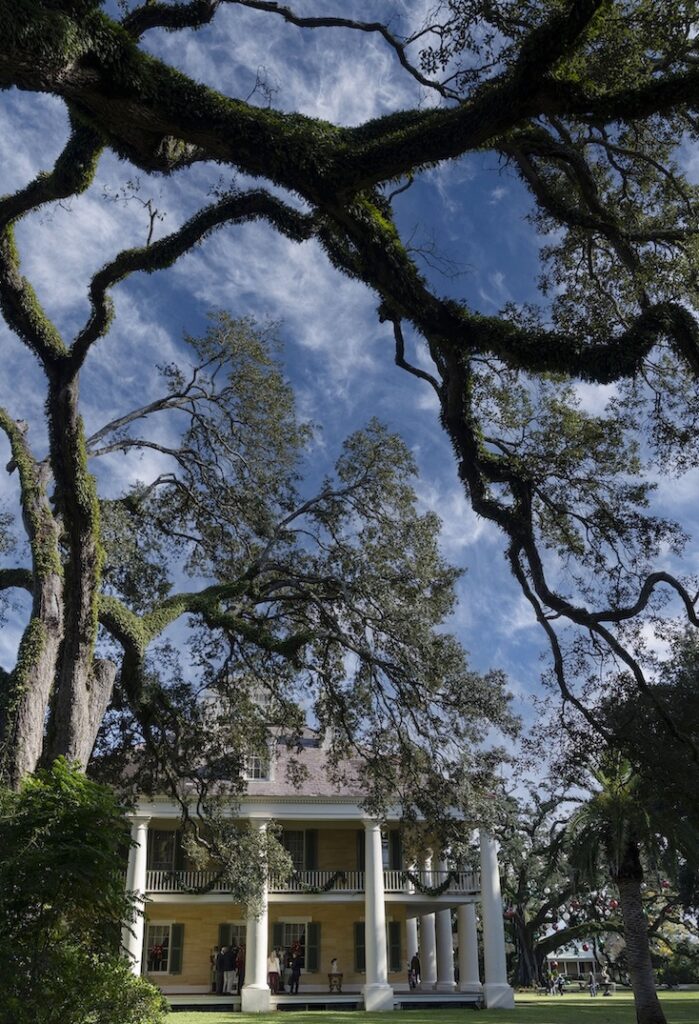
Southern live oaks frame the elegant 1840’s Houmas House in Darrow, Louisiana. Photo by Kerrick James
The first stop is Darrow, Louisiana, 75 miles upstream from the Big Easy, where after breakfast passengers stroll off the ship to the 38 acres of the Houmas House Estate. Immense southern live oaks many centuries old dominate the grounds. They are graceful sweeping trees with moss and ferns hanging from branches the length of fishing boats. This plantation home was finished in 1840, in the Greek Revival esthetic, when Doric columns were the absolute rage. At one time Houmas was the most profitable sugar plantation in the South, located on 12,000 prime acres acquired from the Houmas Indians for the then princely sum of $150. During our tour of the grounds and beautifully maintained home, our effusive guide Jennifer DeeWeese relates that Houmas House survived being torched by Union troops when Irish American owner John Burnside convinced General Benjamin Franklin Butler to spare the house by claiming international woe if it were ruined. Fortunately, his ploy worked, and today we all enjoy its beauty and atmosphere, within and without.
Atchafalaya Swamp
After cruising overnight for 196 miles the ship docks before dawn at St. Francisville, Louisiana. Several excursions depart for various plantations, but I opt for adventure, riding westward by motorcoach, to explore by airboat the famous Atchafalaya Swamp. The morning is chill and gusty so we drape ourselves in blankets, don earmuffs for warmth and to cut the din of the huge fan, and whoosh, off we glide…into the bayou. Our three boats effortlessly clear downed trees and water obstacles, as Captain Mitch points out herons and other waterfowl, perched atop old cypress stumps. I’d hoped to see alligators, feeling an affinity for craggy reptiles, but they were hidden in hibernation given the ambient temperature, so none eyed us hungrily this mid-December morning. Quite sensible, as they are cold-blooded.
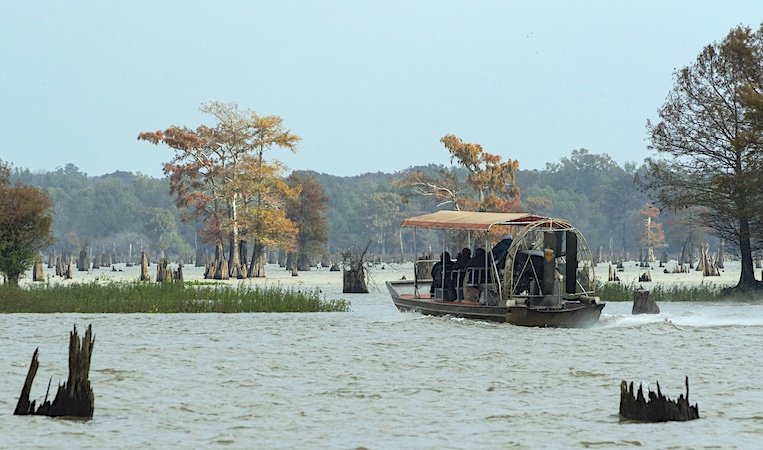
An airboat tour winds a watery path through Louisiana’s Atchafalaya Swamp. Photo by Kerrick James
Captain Mitch is a genuine Cajun, his distinctive accent voicing pride, humor and irony. His eloquent stories informed and tickled us, teaching about the Arcadians and how they morphed into Cajun culture. If Mark Twain had met Mitch, I bet he’d have woven him into a river tale. Before turning back from the picturesque swamp for our tasty hot lunch at the dockside bar, Mitch shares a good-news conservation story of how the endangered American alligator rebounded from the edge of extinction in the 1960’s, to perhaps 2 million today thriving in ten southern states. Louisiana boasts the most. Mitch smilingly relates that mother gators, though smaller than big males, fight like hell shielding their babies, leading him to remark, “So you see we have hot-headed males and cold-hearted females here in the swamp too…”, truly a man from the old school.
Natchez
The river glides on by us in the moonless night as passengers feast in their restaurants of choice. Ninety-seven calm miles and a deep sleep prep me for the Best of Natchez excursion on Day 4. Natchez originally was Fort Rosalie, established by the French in 1716, a real fort atop bluffs commanding the river. A checkered colonial history ensued, first mostly peaceful then just murderous, as 229 French colonists perished during the final Natchez Rebellion of November 28, 1729. Over the next two years the French defeated the Natchez people, a dominant local tribe, killing and enslaving them, though some fled and joined the Creek and Cherokee tribes. In 1763 the British kicked the French out of Natchez, but the Spanish intervened in 1779. Britain ceded the raucous territory to their erstwhile colonists in 1783 after losing the Revolutionary War, but Spain refused to accept fate until 1797, when a young Army Major named Ellicott planted the U.S. flag on the bluffs and claimed all Spanish possessions above the 31st parallel and east of the Mississippi for the young republic. That last gesture has held up for 229 years.
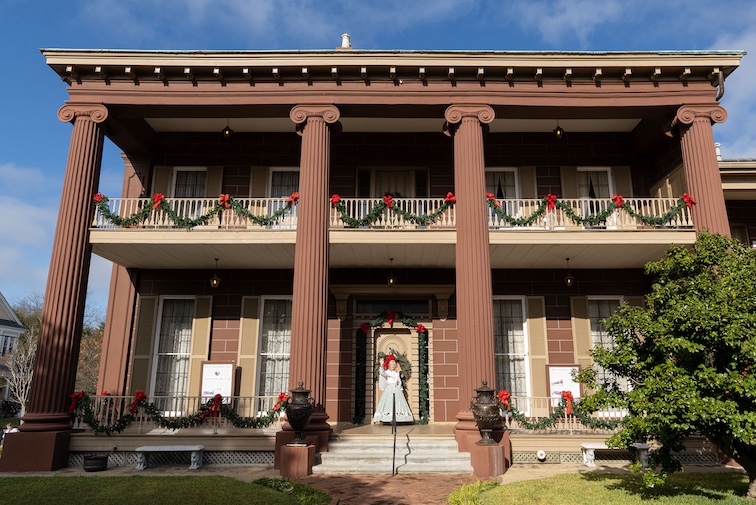
Guide Norma Bearden waves a greeting at the Magnolia House in Natchez, Mississippi. Confederate President Jefferson Davis stayed here briefly during the Civil War. His portrait hangs inside. Photo by Kerrick James
Being the richest town per capita in North America in the 1840’s and 50’s means Natchez is home to over 1,000 buildings on the National Register of Historic Places. If you love history and architecture, Natchez has it all starting with the landmark Magnolia Hall. Built in 1858 in the Greek Revival theme, it continued a legacy of ornate antebellum mansions, of which hundreds still exist in and around Natchez. We tour both floors slowly and discreetly, soaking up details of life in the pre-Civil War South, a time of astonishing prosperity for some, but not all.
Our tour guide is Rusty Jenkins, a smart, glib, self-described ‘recovering lawyer and judge,’ whose loquacious wit illustrates local color with good humor as he serves up 300 years of history. He rakishly regales us with a tale of doubling for Al Pacino in a recent movie filmed here. A born entertainer, he even answered “Why yes”, when I asked if he knew another recovering Southern lawyer who changed professions, author John Grisham.
Our next stop is a revelation, a gold mine of imagery for lovers of the riverboat milieu. Upstairs in the First Presbyterian Church on State Street is the Stratton Chapel Gallery, which displays more than 500 monochrome prints from original negatives, made by three Natchez photographers from the 1850’s to 1951. This free exhibition, which toured world-wide, is comprised of priceless documentary images of riverboats great and small, wrecks and tragedies, and the portraits of those who worked, lived and loved on the Mississippi. The faces of the river folk, both stern and playful, dressed up and down, will stay with you as fellow Americans. I studied the prints quite carefully, hoping to spy a young Mark Twain, but though he visited Natchez often, perhaps even crossing paths with the photographers, no dice for me here.
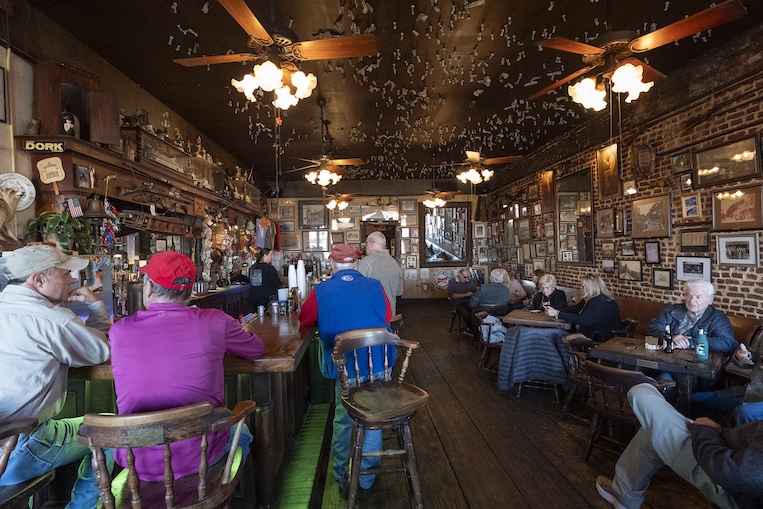
A laid-back group sips and chats in the infamous Under-The-Hill Saloon, located at the base of a Natchez bluff overlooking the Mississippi River. For 200 years this Under-The-Hill district was notorious for being lawless. For a brief period the waterfront hosted the second largest slave market in the South. Prior to the Union assault on Vicksburg Gen. U. S. Grant was a frequent imbiber. Photo by Kerrick James
Before he became Mark Twain, Sam Clemens slept in Natchez, possibly directly above the infamous Under-The-Hill Saloon, reputedly a hangout for renegades, thieves and cut-throats. His time here was productive though, as he coined the phrase “den of iniquity” for Natchez’ Under-The-Hill district. Numerous floods since Twain’s day have completely removed this once seamy and dangerous zone, but today you can rest where he did in the Mark Twain Guesthouse, though real sleep may be delayed as both rooms are above the bar. The view of the Mississippi from the balcony will compensate, and the cocktails still flow every day of the year, just as they have for 200 years. Inside the saloon we meet Parnell Burns, a local proudly spinning tales of Natchez’ long and colorful history, over a walkabout beer of course. “When Cotton was King and Sugar was sweet, Natchez had more millionaires per capita than NYC,” he boasts. While it’s just a five-minute stroll from here to board the Viking Mississippi, don’t miss the boat due to mingling with colorful characters. That’s been a Natchez tradition since the early 1800’s, just a whole lot safer now.
Vicksburg: Key to the South
As a teenager I went to Gettysburg and knew its significance in eventually ending the U.S. Civil War, known then up North as “The Great Rebellion” and down South as the “War for Southern Independence.” What I never knew, until this trip and on this included tour through the Vicksburg National Military Park, was that both epic battles climaxed over the same sweltering days in early July of 1863. They were likely the turning point of the Civil War. Vicksburg’s valiant defenders, the Confederate Army of Mississippi, surrendered to future president General Ulysses S. Grant on Independence Day, July 4, after a 46-day siege. Lincoln called Vicksburg “the key to the South”, it being the most strategic location on the entire river. Grant mourned a bitter toll of 10,200 men lost, though from a much larger army than the Confederates could muster. The South lost 8,600 they could ill afford. Many of the soldiers died from accidents or disease, or later in hellish prisons. Both sides in total employed about 400 cannons, with 127 of varying calibers still displayed on site today. Grant’s (US Army) and Porter’s (US Navy) gunners fired 143,000 cannon rounds during the Vicksburg campaign, a sign of the ferocity of the fight.
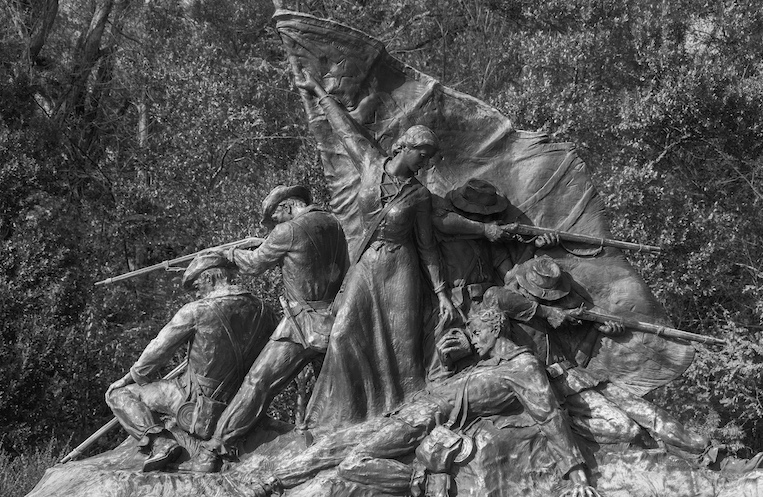
A multitude of Civil War memorial sculptures adorn sacred ground at the Vicksburg National Military Park in Vicksburg, Mississippi. This one depicts the struggle of outnumbered Confederate defenders fighting in the War of Northern Aggression. Photo by Kerrick James
Our extremely well-trained guide/historian painted a painful human panorama of Yankee soldiers facing horrific challenges; the exhausting marches, fording the flooding Mississippi, assaulting up the hilly terrain under fire from above, the siege itself and poignant personal stories. The Southern soldiers suffered equally, shelled day and night, running out of food and critical supplies, which meant their impregnable defenses were simply not enough. It cannot be overstated that both sides were Americans, fighting either for the dream of a country without slavery, or for their ideals of protecting their very homes and way of life from disruption. The antebellum South they fought and bled for was forever lost, as in the aftermath much of their infrastructure and economy was destroyed. From 50 months of conflict, Confederate dead and wounded are estimated at 864,000. The Union side sustained 828,000 casualties, with roughly a quarter to a third being foreign born.
The Civil War was the first conflict to utilize industrial technology at scale. One example at VNMP is a restored ironclad, the USS Cairo, victim of a torpedo (mine) in December 1862. All sailors survived the sinking, which seems miraculous in these turbid waters. The wreck was discovered in 1956, salvaged and restored in the 1960’s, and is a time capsule of early naval technology. The Cairo was built of 14 inch-thick white oak planks, armored with 2 ½-inch steel plates, and moved by coal-fired steam boilers. This is a tour you must not miss, and for me it was sobering, as I have a relative who fought for the Union during the Civil War, though not in Vicksburg.
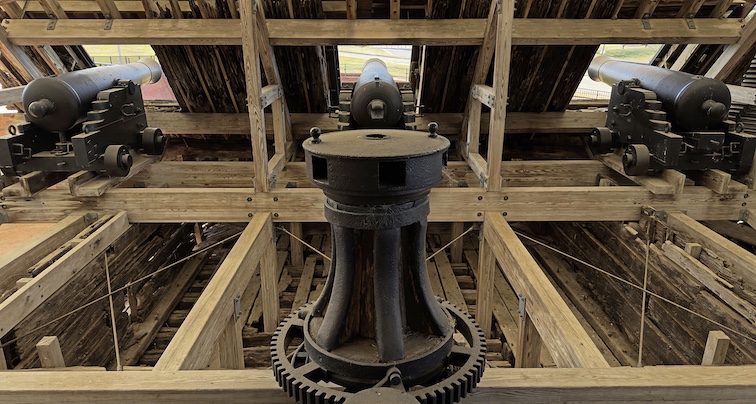
Cannons face forward on the semi-restored USS Cairo ironclad gunboat, Vicksburg Military National Park, Vicksburg, Mississippi. Photo by Kerrick James
Tidbit: Coca-Cola was invented by John C. Pemberton, the Confederate general in charge of the defense of Vicksburg. A serious saber wound suffered later in the war left him in chronic pain, but he survived to create a tonic named Coca-Cola which was first bottled in Vicksburg in 1894.
Greenville – Art, Literature and Music
A mere 100 miles passed by on our night voyage, with a much more light-hearted day awaiting us. We are awash in music on this cruise, with Memphis Jones from B. B. King’s playing music from “Walking in Memphis” and “Rollin’ on the River”, Benton Parker doing two shows on American Blues, and daily live jazz and classics every afternoon and after dinner with the Viking Trio in the Living Room, snacks and drinks provided of course. I bet no one will forget the ever-popular themed Cocktail Demos by Senior Bartender Richard in the Explorer’s Lounge, learning mixology while bending elbows with friends.
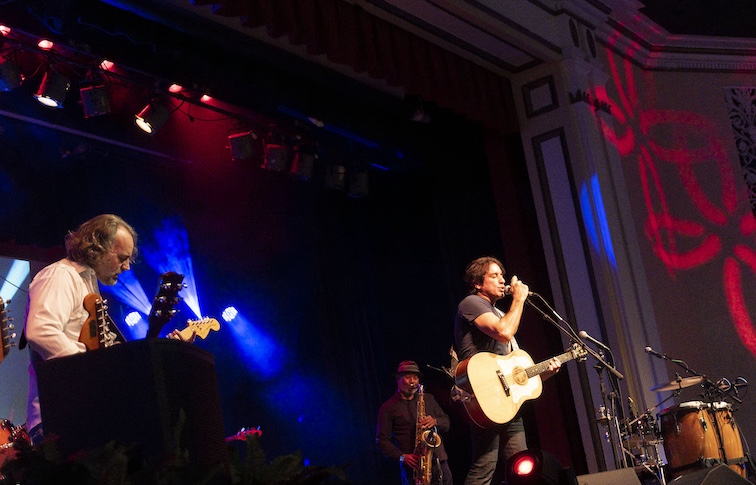
If you’re passing through Greenville, Mississippi make a determined effort to catch Steve Azar’s rollicking live show. Photo by Kerrick James
Fittingly, our last excursion is dedicated to live music. Greensville, Mississippi’s largest river port, is home for the day, so mid-morning we take a short ride to experience a Delta themed lunch in the Jake & Freda Stein Hall and, more importantly, experience the music of a Greenville native who made it in Nashville and came home. Steve Azar is the leader of the band, which showcases bluesy country fusion songs of love, loss and family, Southern-tinged and beautifully performed in this 350-seat theatre. By the time we reach the show’s climatic moments our somewhat elderly crowd is standing, clapping, hooting, and some are even hollering and dancing. It’s a rousing time and the infectious energy is my peak memory of all the shore excursions. It probably was helped a tad by the shot of moonshine served us after our repast of ‘hot’ tamales, fried catfish, hush puppies, pulled pork, mac and cheese, coleslaw, topped off with homemade banana cream pudding. Steve Azar is a charismatic performer focused on bringing better times back to his hometown of Greensville, which also was home to Muppet creator Jim Henson, historian Shelby Foote and more published writers per capita than any other town is the US.
Patrician Dining En Route to Memphis
After a quiet afternoon recovering from the final excursion in Greenville, our last dinner is a Surf & Turf extravaganza featuring all you can eat Maine Lobster, Filet mignon and an array of salads.
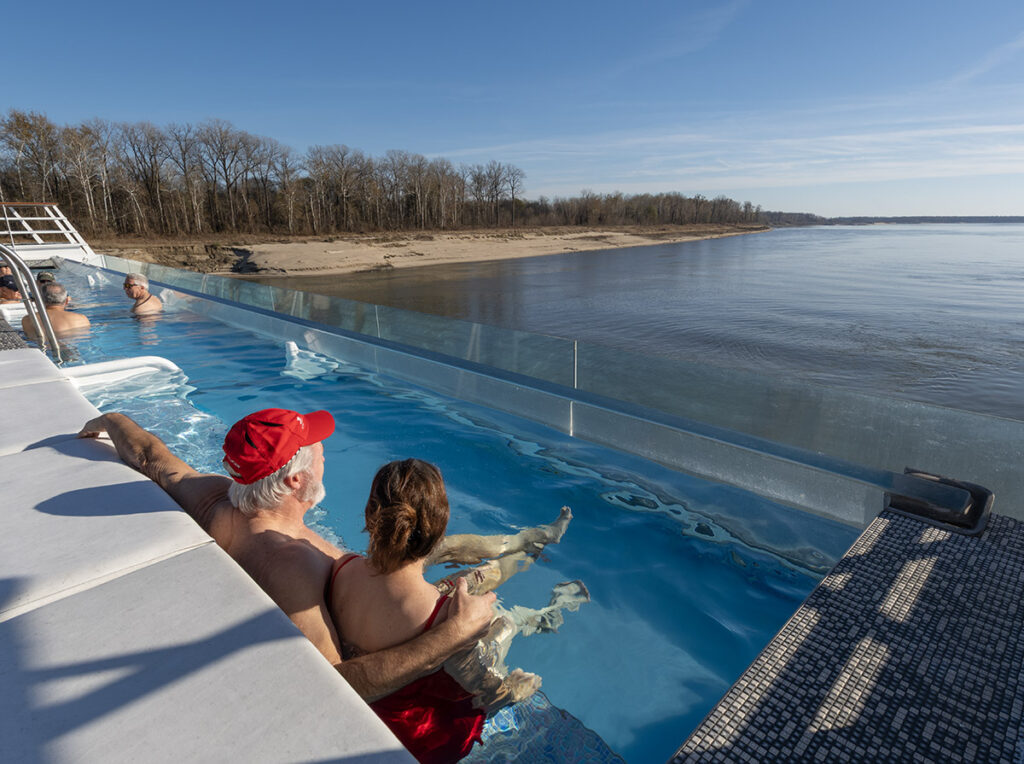
Watching the river run by from the ‘sliver’ infinity pool, on the stern of the opulent Viking Mississippi, here cruising the Muddy Mississippi north of Greenville. Photo by Kerrick James
Our last day is spent cruising the final 200 miles to Memphis, while reading books from the ship’s expansive library, soaking in the 94-degree sliver ‘infinity’ pool and trying to identify some of the more than 325 bird species migrating the Mississippi Flyway above the river. We’ve been served by an all-American crew and come to know many of them quite well. When time comes to disembark, we hug for real and they urge us to come back for another cruise on ‘Ol Man River. If we do, I bet some might still know our names, and I theirs. It’s been that kind of a cruise to remember, always Mark Twain, safe water.
Arizona journalist Kerrick James has photographed and written about the American West, Pacific Rim and Europe for over 30 years. He also teaches travel photography. His most recent articles for EWNS celebrated the centennial of America’s Route 66 and the undying attraction of western ghost towns.