

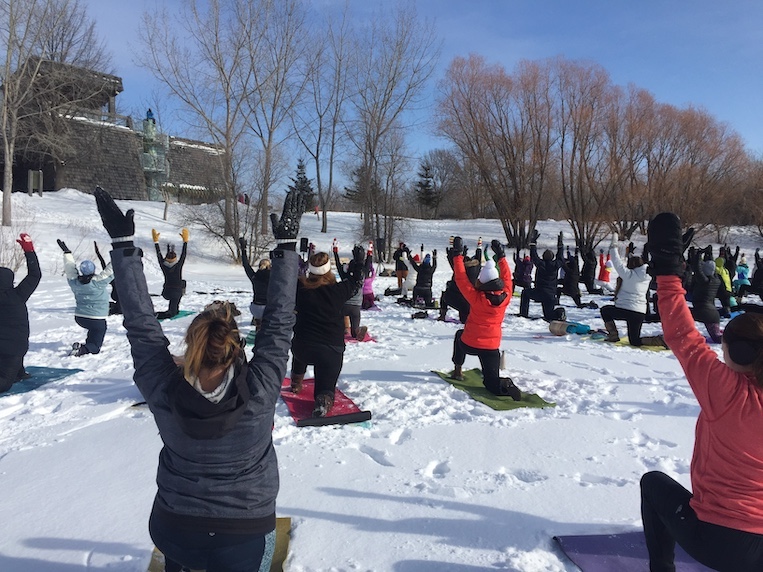
All geared up for a snowga, or snow yoga, in Winnipeg, Manitoba. Photo by Teresa Bergen
By Teresa Bergen
The crowd of over 500 wellness and medical professionals from around the world pack the opulent new Mandarin Oriental in Downtown Dubai as Katherine Johnston, senior research fellow at the nonprofit Global Wellness Institute, takes the stage. She is calm and self-assured, the sort of person who seems trustworthy with reams of data. She’s about to make the big reveal, the total worth of the global wellness economy in 2024. And it’s…6.8 trillion dollars! A healthy increase from 6.3 trillion in 2023.
Johnston oversees a small group of researchers who track numbers year-round. In Dubai, she announced the release of the seventh edition of the Global Wellness Economy Monitor. It covers the years 2019-2024 and examines 218 countries, territories and markets.
“At the Global Wellness Institute, we are very proud of all the rigor that goes into our work,” Johnston told us. “We aim to provide transparency on what we measure and what we don’t, how we measure things and where the information comes from. Our new report is 120 pages long, and about a quarter of them are dedicated to definitions and methodologies.”
The Global Wellness Summit is an invitation-only affair that costs more than $5,000 per delegate. Most of the action happens in the ballroom, where spa founders, western and Ayurvedic doctors and other luminaries gather in the ballroom to share their thoughts and research in individual 10 to 20-minute bursts of information. Early morning offerings included sound baths and exercise classes, while evenings featured glitzy receptions.
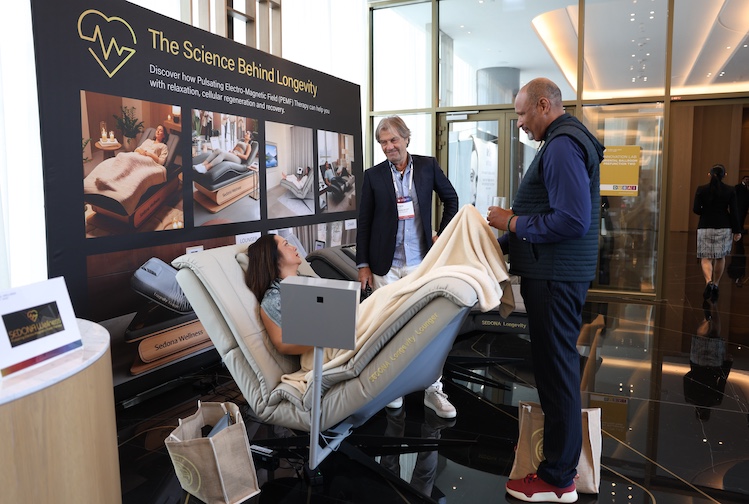
Pulsed Electromagnetic Field (PEMF) therapy allegedly stimulates the body’s healing process with low-frequency electromagnetic fields. Photo courtesy of Global Wellness Institute.
The summit’s 2025 theme was “longevity through a wellness lens.” But how do powerful executives define wellness? When it comes to tourism, who is the target audience? What does wellness, the product, resemble and how much should it cost?
What is wellness?
About half the summit delegates are new each year. Susie Ellis, CEO, chairman and co-founder of the Global Wellness Institute, gave a brief history of the organization. She traced the story back to 2007 when spa and wellness leaders gathered in New York City to emulate such events as the World Economic Forum. Initially the event was called the Global Spa Summit.
“Back then there was confusion in the spa industry,” Ellis said. “In fact, there was strong disagreement about how to define spa. Did spas need to have water? How to value spas? Were day spas part of the picture?”
Defining “wellness” is much harder than defining “spa.” The 2025 edition of the Global Wellness Economy Monitor explains, “The Global Wellness Institute defines wellness as: the active pursuit of activities, choices and lifestyles that lead to a state of holistic health.” By holistic, the GWI includes social, mental, spiritual, emotional, and environmental aspects. Unlike terms like happiness or well-being, GWI emphasizes that wellness is an active process of achieving optimal health outcomes.
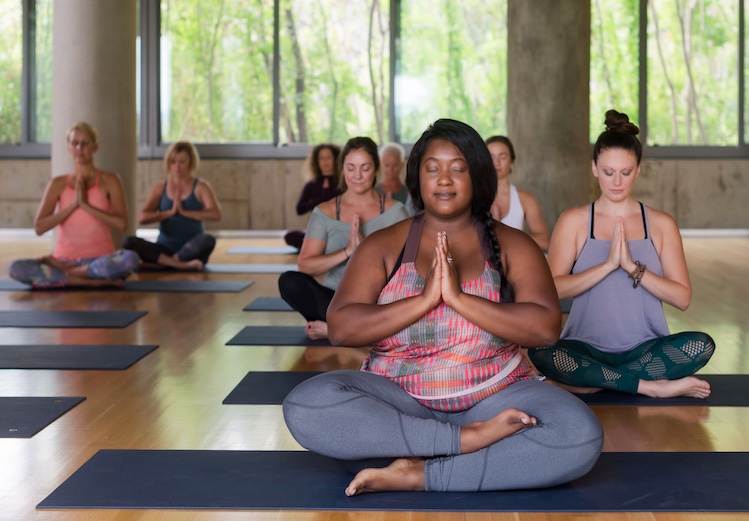
A yoga class at Kripalu Center for Yoga & Health in Stockbridge, MA. Kripalu opened in 1983 and is one of the US’ biggest wellness retreats. Photo courtesy of Kripalu.
GWI divides wellness into eleven sectors: spas; thermal/mineral springs; wellness tourism; workplace wellness; wellness real estate; physical activity; mental wellness; traditional and complementary medicine; public health, prevention and personalized medicine; personal care and beauty; and healthy eating, nutrition and weight loss.
The rise of wellness tourism
Wellness approaches come from all directions at the summit. I participate in a desert hike where everyone wears headphones to listen to Luuk Melisse of the Netherlands, the founder of Sanctum, tell his story. We then stop to do wild gyrations in the dark desert night. (I later learn that three types of viper and two cobra species weren’t far from our bare feet.) At a cocktail party, an Ayurvedic doctor from India lectures me on how to improve my immune system. In the exhibit area, delegates lounge on demo massage beds, eyes hidden under blackout masks. A European man expounds on the wonders of cryo chambers that you enter—nude—to spend several minutes at negative 200 degrees.
Katherine Johnston reported that wellness tourism accounted for $894 billion in global spending in 2024. The GWI predicts this figure will reach $1,383 billion by 2029.
“It’s valuable for each country to trumpet its indigenous wellness practices,” Ellis said during her introductory talk. The summit delegates could spotlight cultural products like Japanese natural hot spring onsen baths, Thai massage, Finnish sauna and Mexico’s dome-shaped temazcal sweat lodges to attract more wellness travelers all over the world, she said.
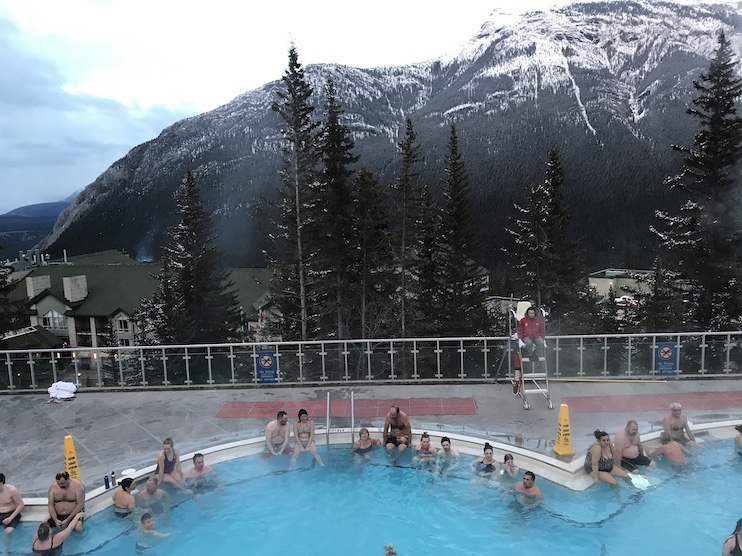
Thermal springs are one of the fastest-growing trends in wellness tourism. This one is the Banff Upper Hot Springs in Alberta, Canada. Photo by Teresa Bergen
Wellness tourism was well represented at the summit, especially in the Middle East. I became fascinated with AlUla, which is being developed as a major wellness destination in Saudi Arabia. “AlUla has been a stopping point for rest and rejuvenation for the last 7000 years,” said Phillip Jones, chief tourism officer for the Royal Commission for AlUla. “Multiple civilizations have all left their mark.” He touted the desert’s restful qualities and AlUla’s status as the Middle East’s first dark-sky-certified destination. “Wellness is the new luxury. We’re a luxury destination. I can’t tell you how many billionaires who’ve come to AlUla come back every year, because they said there’s nothing else like it in the world.”
Debbie Flynn, the managing partner and global travel practice leader at FINN Partners in the United Kingdom, discussed the importance of wellness in destinations’ promotional strategies. “Wellness is no longer a stand-alone product,” she said. “It shapes how destinations develop and connect with travelers. It’s not just a trend, it’s a seismic shift in how people travel and what they want from the experience, because in travel and tourism now it’s very much about the experience economy.”
The Middle East is leading this trend, Flynn believes, with governments weaving wellness into their national strategies for economic diversification. “Wellness is now tied directly to destinations’ competitiveness.”
Am I on vacation or at a hospital?
A lot comes through my inbox related to wellness tourism. I recently received a media invitation to experience a vitamin-filled intravenous treatment. The graphic showed two glamorous women socializing while hooked up to IV bags. Another promotion invited me to a women’s retreat that started with bloodwork and a mammogram on the first day, followed by a few days of sightseeing and shopping, and concluded with test results.
As the 2025 Global Wellness Economy Monitor pointed out, procedures that used to be performed in hospitals are now appearing in spas: blood/biomarker analysis, gut microbiome assessment, and lymphatic drainage. Since the Dubai summit’s theme was longevity, the medical side of wellness was especially prevalent.
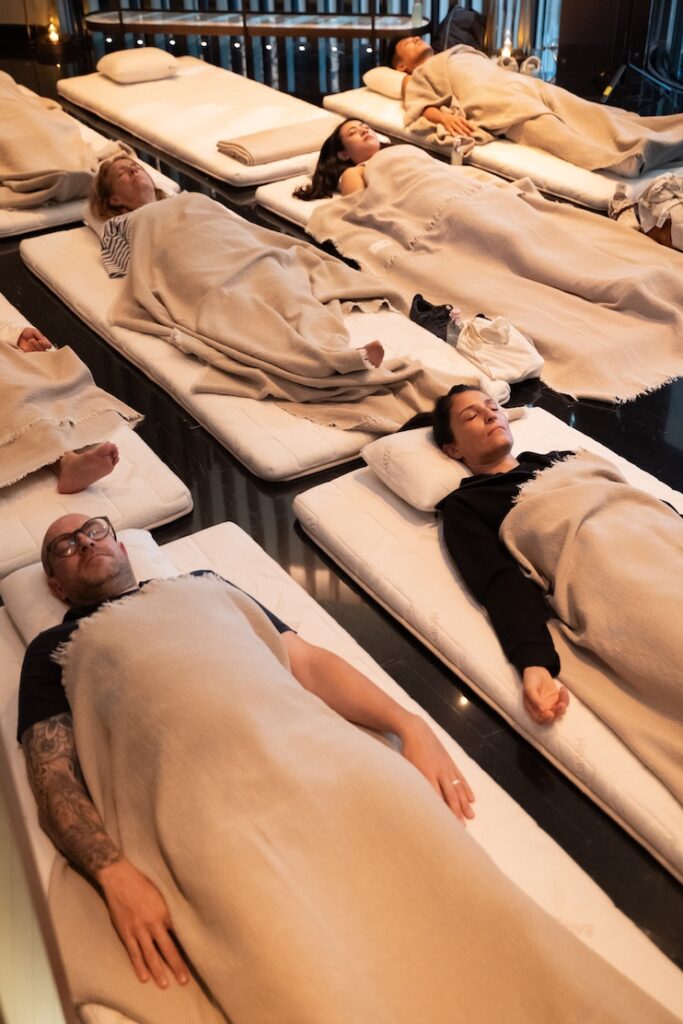
People experiencing a sound bath during the Global Wellness Summit in Dubai. Vibrations from music promote deep meditation and mental clarity. Photo courtesy of Global Wellness Institute.
Notably, entrepreneur, author and “father of biohacking” Dave Asprey prowled the stage in yellow-tinted glasses talking about brain upgrades. His 40 Years of Zen program promises the benefits of 40 years of meditation in just five days for $16,000 (extra for the optional upgrade to add psychedelic assistance to your experience). He tells his story about how he outsmarted his doctors, brought his biological age down by 20 years and got ripped abs. “What’s going on in that whole world of biohacking and longevity and consciousness is just that, if you want to have control, it’s a radical act,” he said. “Because that means your doctor’s not in control, your insurance company is not in control, that means the FDA is not in control. The government’s not in control. Your employer is not in control. In fact, who’s your health daddy? You’re your health daddy.”
Asprey wants to live to be at least 180. “And some people still say, ‘My goal is health span.’ And to those people, I say, ‘Cowards!’ Our goal is to extend human life far beyond its original design, and to feel really good the entire time, and to look better and feel better than we do right now.” He bases the 180 year figure on people who live to be 120 years old today. “So, if we can’t do 50% better than our current best with all of the benefits that we have today it’s because a comet hit the planet. Or maybe some government regulator told you weren’t allowed to.”
Who is longevity for?
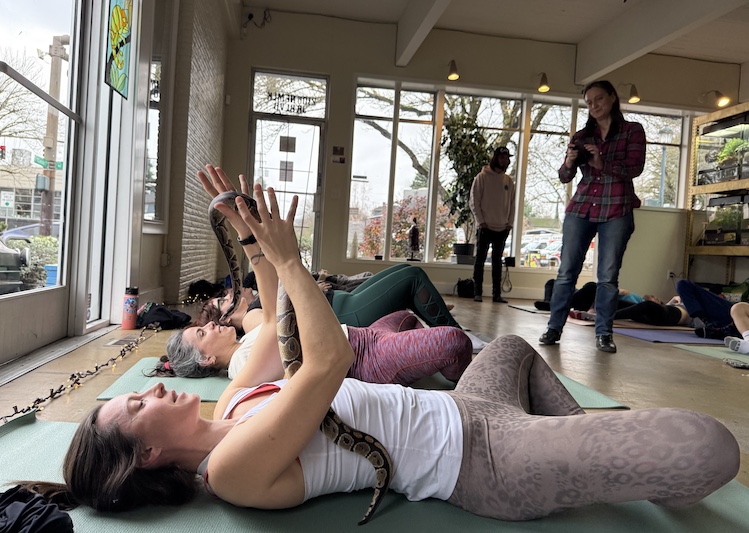
A snake yoga class at Hisss Reptile Store in Portland, Oregon. Photo by Teresa Bergen
Listening to Richard Carmona—physician, Vietnam veteran, former police officer, 17th US surgeon general and now chief of health innovations at Canyon Ranch—brought a dose of reality for us non-billionaires. He’d prepared a speech on the topic of what the world needs now. “We live in an era of breathtaking scientific acceleration,” he said. “You’ve heard it here. Every week brings new discoveries, mapping the human genome, reversing paralysis, enhancing brain function, extending lifespan and health span, and even exploring the molecular and genetic basis of wellness. Yet, while science races forward, humanity often is left behind. We’re growing older and smarter, but not always wiser or kinder. We can create artificial intelligence that mimics human reasoning, yet we struggle to show genuine human empathy.
“The paradox of our time is that we have never known more, yet we have never felt more divided. We can send rockets to Mars, but we cannot seem to send clean water to every village or prenatal care to every mother. We can prolong life in the lab, but millions still die for lack of basic necessities.”
Carmona went on to mention the 300,000 children who die globally each year from malnutrition, and that the leading cause of death for children in the US is gunshot wounds.
Longevity strategies are divided into two main areas. One is the lower-tech approaches which are practiced in famed blue zone areas where people often live to the age of 100 in good health. Researchers attribute blue zone longevity to things like social connection, mainly eating plant-based diets, exercise and low stress.
High tech categories include cell renewal, organ preservation and maintenance, and systemic aging reversal. During the summit, we even heard about scientists growing tiny backup organs stored on chips. These interventions are currently above the pay grade of a travel writer. I’d best keep exercising and seeing my friends.

Spa food at Sun Siyam in the Maldives. Photo by Teresa Bergen
Then there’s the planet. According to the Pew Research Center, Earth’s population is expected to peak at 10.3 billion in 2084 and then decline to 10.2 billion through the end of the century. If the average person lived to be 180, this figure would be in the tens of billions, or possibly hit a trillion, depending on birth rate. This would pose a few problems.
If the 180-year lifespan is only available to the world’s current crop of 3,028 billionaires, overcrowding is less of an issue. But God only knows what they’ll get up to in their 1.8 centuries.
The spiritual side
Anna Bjurstam, wellness pioneer and strategic advisor for Six Senses and Raison d’Etre, has been interested in spirituality for many years. She’s studied meditation, stayed in ashrams and is an initiated shaman. “It all started the day I died,” she told the summit. She was 14, dying in a hospital, feeling extreme bliss. She wasn’t done yet, so she came back—but, unlike most of us, free from the fear of dying.
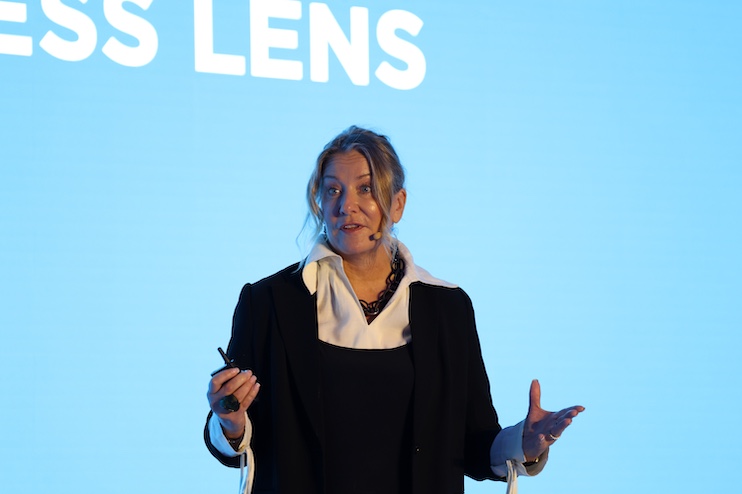
Anna Bjurstam talks about wellness and spirituality during the Global Wellness Summit. Photo courtesy of the Global Wellness Institute
She cited scientific studies showing that people with spiritual practices live longer and have drastically lower rates of suicide. Every ancient culture understood some energy medicine, she said, whether it was Hawaii’s mana or India’s prana. “We once dismissed this tradition as primitive. But now cutting-edge quantum physics and vital science are rigorously proving their profound validity.”
According to Bjurstam, we might not be facing a health crisis; it’s actually a meaning crisis. “If we truly aim to extend life, we must also expand what it means to live. As we design the next generation of longevity clinics, biohacking labs and medical retreats, let’s not forget, it’s not just mitochondria that keep us alive, it is meaning. Spirituality isn’t an add-on. It’s not optional. It is essential longevity infrastructure.”
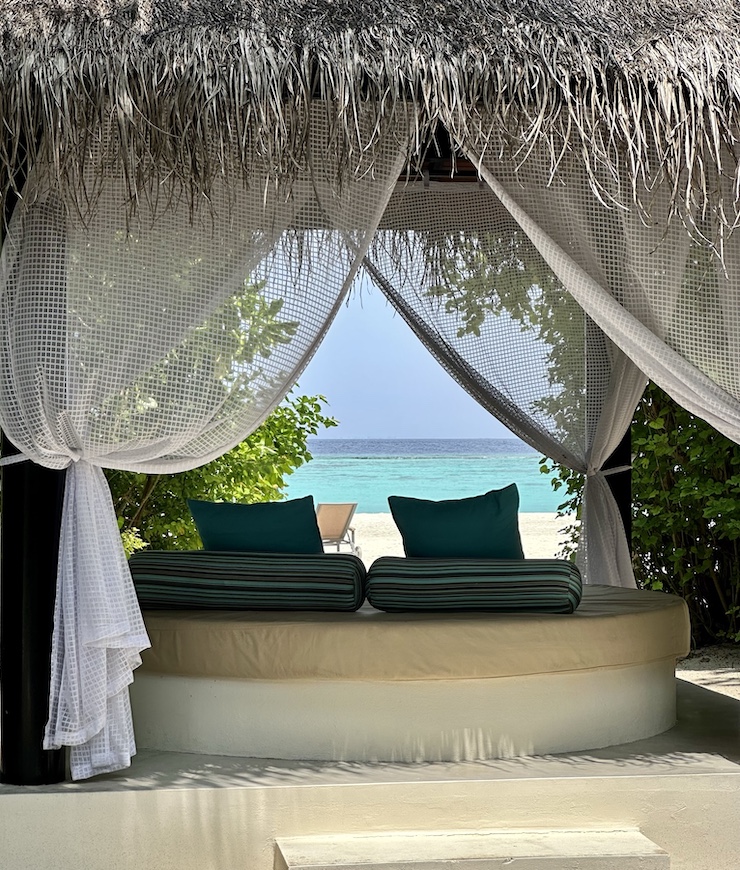
A serene seating area at Iru Fushi, Maldives. Photo by Teresa Bergen
The person who spoke most passionately about finding meaning was also the only one with a near-death experience, as far as I know. Coincidence? It made me wonder how much of the longevity movement is driven by fear of death rather than love of life.
“We’re not machines to be optimized,” Bjurstam said. “We are mysteries to be lived.”
That’s certainly how I feel about wellness travel. No vacationing in a medical clinic for me. I want to experience the Finnish sauna and be awed by AlUla’s dark skies. And I want to enjoy the years I have—preferably unencumbered by IV bags.