

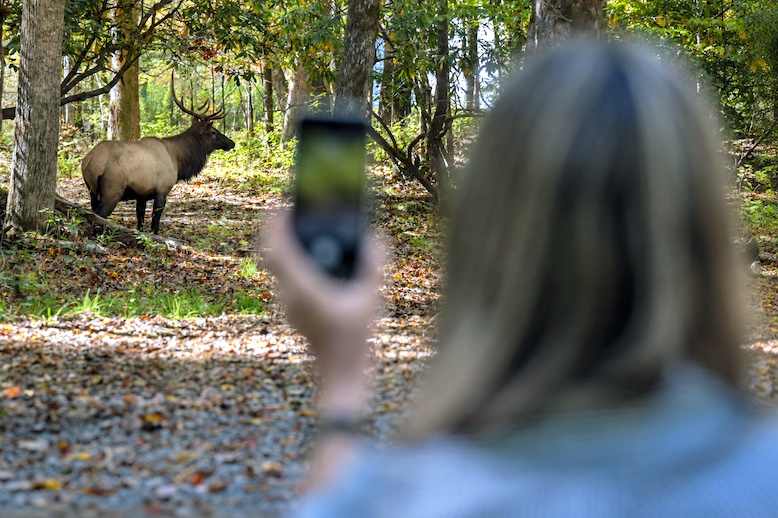
A bull elk stands among the trees in Cataloochee Valley during the fall rut, when males compete for females. Elk were reintroduced to Great Smoky Mountains National Park in 2001 after being absent from the region for more than a century. Elk were reintroduced to Great Smoky Mountains National Park in 2001 after being absent from the region for more than a century. Photo by Wendy Pramik
The bull elk has an unusual way of attracting females.
First, he scrapes the ground with his antlers. Then he urinates on the dirt and himself before settling into the mixture.
It’s rut season in the Smokies, and this is the elk version of cologne.
Naturalist Liz Domingue is delighted.
“And he did the whole thing right there!” she tells our group of onlookers in Cataloochee Valley, a remote corner of Great Smoky Mountains National Park in western North Carolina.
Domingue, a wildlife biologist and professional guide, has been explaining the rituals of elk courtship. Now, one of her subjects has offered a live demonstration.
“Did anybody see him before he lay down?” she asks.
Some females rest in the grass while others move through the trees. The bull makes his rounds, sniffing for signs that they’re ready to mate.
Every so often, he lets out a tremendous bugle. It’s a startling sound, somewhere between a lion’s roar at the zoo and the roar Hollywood has taught us to associate with dinosaurs.
I’d traveled from my home in Columbus, Ohio, where I work as a photographer, hoping to spend some time outdoors and try my hand at wildlife photography. The elk seemed a little less intimidating than, say, photographing bears. I was also curious about the mountain communities surrounding the park, their history and the people who call this place home.
What I found were two comeback stories. Elk, once eliminated from these mountains, have been reestablishing themselves since a reintroduction program began in 2001. Beyond the park, Haywood County is rebuilding after Hurricane Helene’s devastating floods in 2024. As wildlife populations grow and visitors return, the region faces a shared challenge: welcoming people while protecting the natural beauty and Appalachian heritage that bring them here.
A second chance for the elk
Getting to Cataloochee takes some determination. A winding gravel road leads into the valley, helping explain why this corner of the park sees fewer visitors than its more accessible destinations.
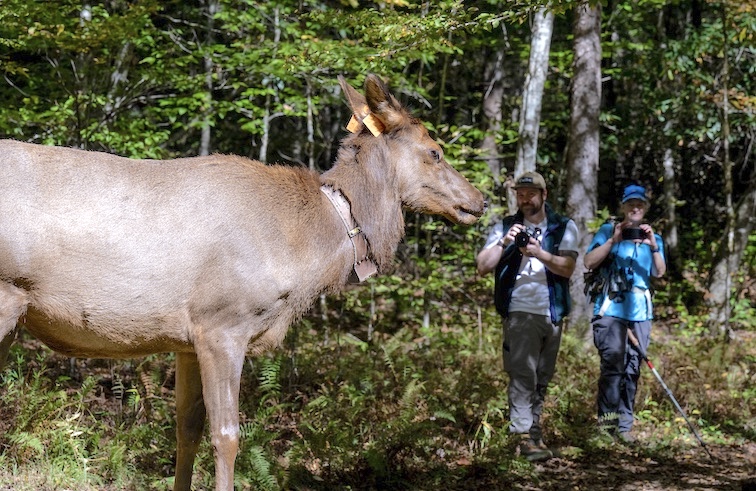
A cow elk wearing an ear tag and tracking collar stands near Smokies Life membership engagement project manager André Vest, center, and naturalist Liz Domingue, right, during a guided wildlife excursion in Cataloochee Valley. Wildlife managers use tracking equipment to monitor the reintroduced elk population. Photo by Wendy Pramik
In October, hardwood forests turn gold, orange and red. Mountains rise in overlapping ridges, their familiar blue-gray haze lending the Smokies their name.
Hunting and habitat loss eliminated elk from the region more than a century ago. In 2001, wildlife managers released 25 animals into Cataloochee, beginning an effort to restore the species to its former range. Another 27 arrived the following year.
The elk originated in Elk Island National Park in Alberta, Canada. Before arriving in Cataloochee, they stopped at Land Between the Lakes in Kentucky, where wildlife managers monitored them for disease.
In the Smokies, the animals lived in an enclosure for several months to acclimate to their surroundings. Even after the gate opened, some wandered back inside.
The herd has since grown to more than 250 elk, according to an elk-viewing brochure I picked up at the Lake Junaluska welcome center. They’ve spread beyond Cataloochee into other parts of the park and nearby communities. Some wear ear tags or tracking collars that allow wildlife managers to monitor them.
Katie Liming, chief of staff for Great Smoky Mountains National Park, says the reintroduction has succeeded.
“A lot of research went into determining whether the reintroduction could be successful, but you never really know until you try,” she tells me.
Back in Cataloochee, our group follows a path near the Pretty Hollow Gap Trailhead, not far from Palmer Creek. Thick stands of rosebay rhododendron and tree trunks often obscure our view of the animals.
For much of the afternoon, we catch only glimpses of the bull through the branches. Then he emerges, giving us a clear look at his broad shoulders and impressive antlers.
Families carry young children in backpack carriers, and photographers raise their cameras. Most visitors keep their distance, watching quietly.
During the rut, bulls can become aggressive. The National Park Service requires visitors to stay at least 25 yards from elk. The brochure recommends an even more cautious distance of 150 feet.
When some visitors approach the animals, Domingue calls out, “Back up, you’re too close.”
At one point, the bull rubs his antlers against a tree with enough force to shake it. Domingue notices people standing on the opposite side of the wooded area.
She cautions us not to move ahead and block the elk’s escape route. If too many people surround the bull, it could feel threatened and charge.
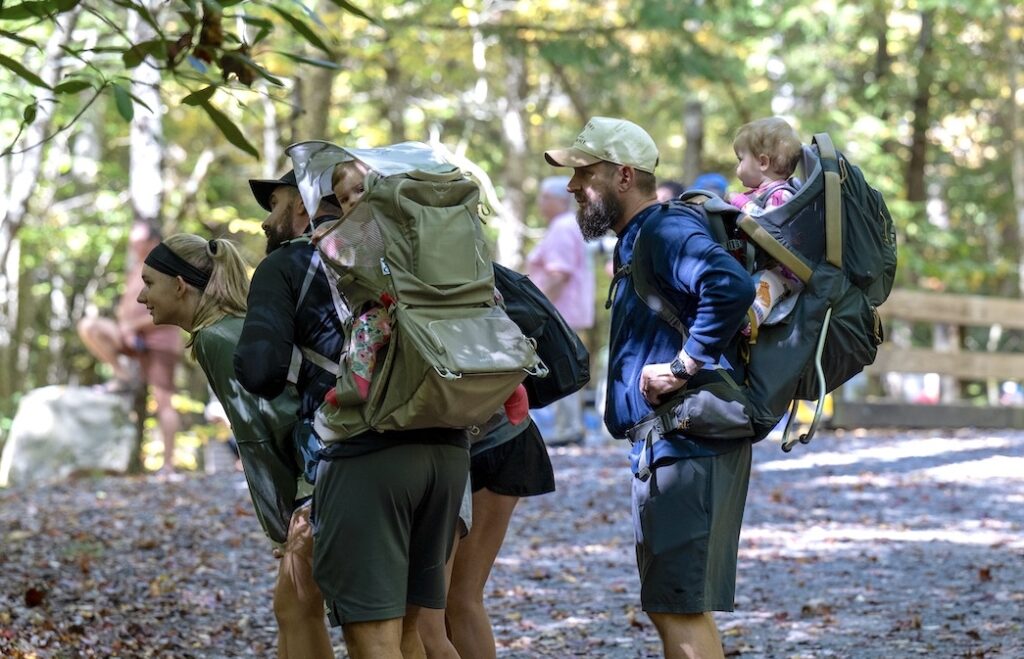
Families gather for an elk-viewing excursion in Cataloochee Valley, where the animals have become a popular attraction. The National Park Service requires visitors to remain at least 25 yards from elk. Photo by Wendy Pramik
Learning to watch wildlife
Domingue originally came to the Smokies to study amphibians. When her research project ended, she stayed and eventually founded Just Get Outdoors, a company offering guided nature experiences.
Our outing is organized through Smokies Life, a nonprofit educational partner of the park. Founded in 1953, the organization supports conservation, research and educational programs through donations, purchases and memberships. Its more than 29,000 members, known as Park Keepers, help support this work.
Smokies Life’s Branch Out program offers guided excursions and educational experiences throughout the park, from elk watching to monarch butterfly tagging and birding.
André Vest, the organization’s membership engagement project manager, says the outings help visitors gain a deeper appreciation of the park’s wildlife.
“A guide can interpret what visitors are seeing and turn it into understanding,” Vest says. “Guides lead by example and model appropriate visitor behavior and interaction with wildlife.”
The National Park Service also offers free ranger-led programs.
Domingue explains how elk chew their cud, why they retreat to shade during warm afternoons, and how bulls determine which females are receptive.
“You don’t need to be a naturalist or a wildlife biologist to understand animal behavior,” she tells us. “You don’t need a degree. Just watch the animals.”
Even when the elk disappear into the foliage, she keeps us watching and listening.
The people who came before
The Cataloochee Valley lies within the ancestral homeland of the Cherokee, whose people lived in these mountains long before European settlers arrived. Many Cherokee were forcibly removed from the region in the 1830s, although others remained. Their descendants include members of today’s Eastern Band of Cherokee Indians.
European American settlers later established farms and communities here. By the early 20th century, roughly 1,200 people lived in the valley.
When Great Smoky Mountains National Park was established in the 1930s, Cataloochee residents were required to give up their homes. Some received compensation for their property, while others were permitted to remain for the rest of their lives.
Historic houses, churches and a school still stand among the meadows and forests.
Smokies Life’s educational mission includes telling these difficult parts of the park’s history, along with the story of its natural environment.
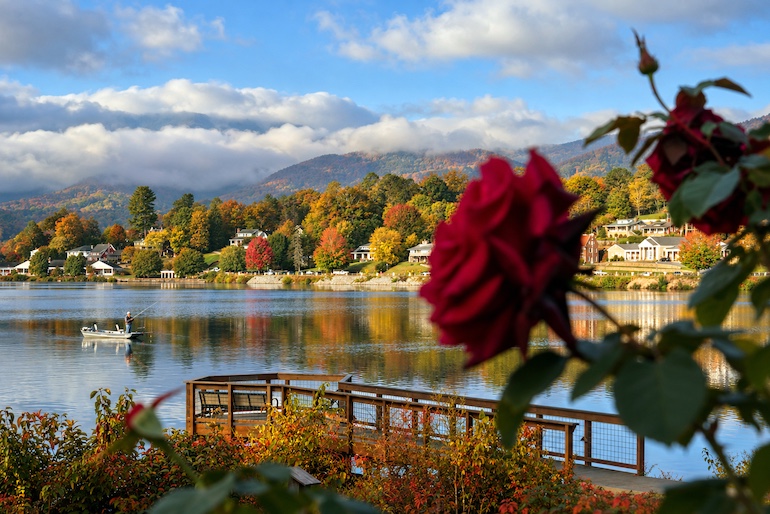
An angler fishes on Lake Junaluska as autumn colors spread across the surrounding mountains in Haywood County, North Carolina. The historic retreat community provides a base for exploring the North Carolina side of Great Smoky Mountains National Park. Photo by Wendy Pramik
Life after Hurricane Helene
My base for exploring Haywood County is Lake Junaluska, a historic retreat community where mountains rise beyond the water. One October morning, I watch an angler fishing from a small boat while clouds hang over the ridges.
“We’re right in the center of Haywood County, between the Blue Ridge Parkway and Great Smoky Mountains National Park,” says Pauline Pendarvis of Lake Junaluska.
Hurricane Helene’s torrential rains caused catastrophic flooding across western North Carolina in September 2024, damaging roads, trails, homes and businesses. Residents, volunteers and public agencies have worked to rebuild, while local businesses depend on visitors returning to the region.
Corrina Ruffieux, executive director of the Haywood County Tourism Development Authority, wants travelers to know there’s more to Haywood County than its recovery from the storm.
“Recovery is just one chapter of Haywood’s story,” she says.
She encourages visitors to meet the people who live here.
“They can tell you more about this place than we ever could.”
In downtown Waynesville, I take her advice.
Five months with a box of pencils
At Pennington Art Gallery, Teresa Pennington has spent more than four decades turning the surrounding mountains into detailed colored-pencil drawings.
Pennington remembers the excitement when the elk first arrived.
“I was in business when they brought the elk back, and it was a big deal,” she says. “We all went to Cataloochee to see them, and it was so exciting.”
Now they’re among the subjects she draws, along with bears, deer, historic buildings and recognizable mountain landscapes.
“I only sell my own work, and everything I depict is something you would find in Western North Carolina or eastern Tennessee,” she tells me.
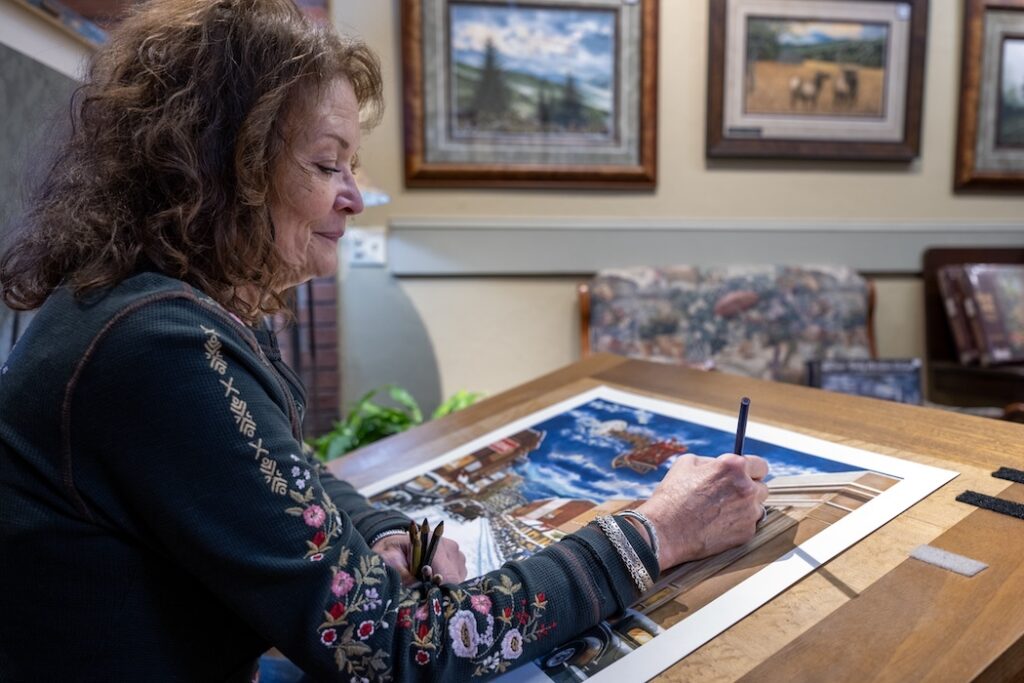
Artist Teresa Pennington works on a colored-pencil drawing at Pennington Art Gallery in downtown Waynesville. Her detailed artwork depicts the landscapes, wildlife and historic buildings of western North Carolina and eastern Tennessee. Some originals take five months to complete. Photo by Wendy Pramik
Her process begins with a camera. She photographs a landscape to establish its geography, then returns to her studio to recreate it with colored pencils. A single original can take five months.
“I can’t draw on location because, obviously, it takes five months to do a piece. I can’t sit there that long.”
Her Forever Places series supports preservation of historic structures in the Smokies, connecting her artwork to the region’s past.
As a photographer, I appreciate her patience. Waiting for the right light can test mine.
Wearing the mountains home
Just down the street, the elk have found their way onto a T-shirt.
At Old North Prints, Bailey McGinnis shows me a design featuring a bull elk against a red sun, framed by a map pin bearing the words “Waynesville NC.” A forest scene fills the bottom of the image.
McGinnis and his wife, Erin, began their business at home before moving into a downtown storefront, where they produce screen-printed and embroidered merchandise.
“There are so many small businesses instead of all the big corporate businesses,” Bailey says. “There’s a lot of good support from the community.”
The elk design came from a local artist’s suggestion.
“There are elk everywhere out here,” he recalls her saying. “You really need to put out some elk.”

A barista prepares a latte at Blue Ghost Outpost, a coffee bar near the route to Cataloochee Valley. The shop is one of the locally owned businesses welcoming visitors to North Carolina’s Smokies. Photo by Wendy Pramik
At Blue Ghost Outpost, a coffee bar along the road toward Cataloochee, a barista pours steamed milk into my latte, creating the shape of an elk in the foam.
At The Scotsman Public House in downtown Waynesville, fish and chips come with jalapeño tartar sauce, while Scotch eggs incorporate sausage from nearby Tennessee.
“We’re a little bit Irish, a little bit Appalachian,” explains Makyia Thayne-Hoyt Blair, who owns the pub with her husband, Scot Blair.
The pub draws on Scottish and Irish traditions that have influenced Appalachian culture. During my visit, Jenny & The Weazels play Celtic tunes on fiddle, guitar and bodhrán, an Irish hand drum.
Scot reminds us how much visitors mean to a community still recovering from Helene.
“Thank you for coming here to The Scotsman, but in particular, thank you for coming to Waynesville and Haywood County,” he tells our group.
“It means a lot, especially after what’s happened here.”

Jenny & The Weazels perform traditional Celtic music at The Scotsman Public House in downtown Waynesville, North Carolina. The pub celebrates the region’s Scottish and Irish influences through food and live music. Photo by Wendy Pramik
A place worth protecting
Great Smoky Mountains National Park receives roughly 12 million visitors annually. The surge in outdoor recreation during the COVID-19 pandemic added to the pressure on its roads, trails and wildlife.
During a discussion with public-land managers, I hear concerns about crowded trails, damaged resources and the challenge of protecting a place so many people want to experience.
In Haywood County, those concerns extend beyond the park. The historic buildings, local businesses and mountain communities that attract travelers are also part of what residents want to preserve as the region recovers and welcomes visitors.
Back near the Pretty Hollow Gap Trailhead, the bull emerges from the trees once more. His antlers rise above the brush, and he lets out another bugle.
Then he turns and disappears into the foliage.
We catch one last glimpse of him lying beside a female, his antlers still visible among the trees.
After all that bugling and posturing, perhaps simply being beside her and keeping quiet is his most promising move yet.
Wendy Pramik is a writer and photographer based in Columbus, Ohio. She’s an active member of the Society of American Travel Writers and the Midwest Travel Journalists Association, who recently visited North Carolina’s Great Smoky Mountains. This is her first story for the East-West News Service.