

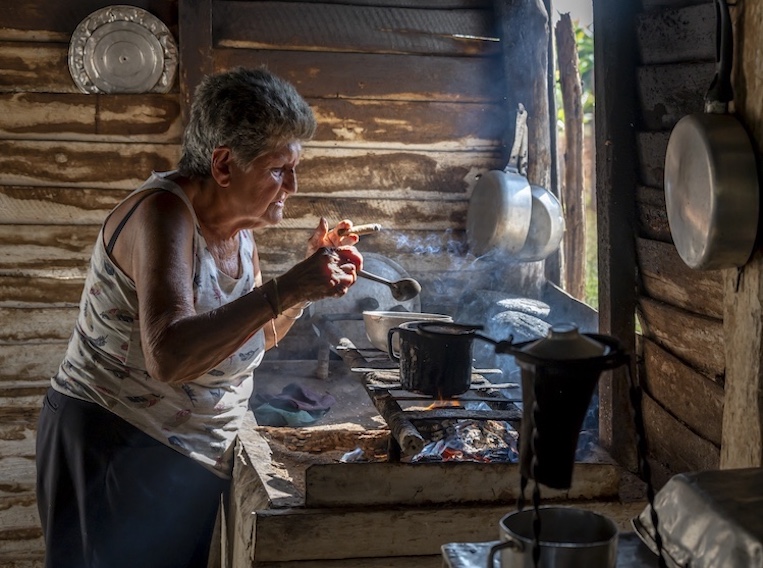
Cuban tobacco workers often smoke 10 or more cigars a day. So do their wives. This farmer’s wife continues to smoke while preparing coffee in her simple kitchen in the town of Vinales. Photo by Robert Holmes
Smoke filled the room like an autumn fog, adding to the already thick air of a warm Havana evening. It was being generated by a group of 20 or so men, most of them of substantial wealth and girth, in town from all over Europe and North America to indulge in the world’s finest cigars with Cuba’s finest rums flowing freely.
This annual Habanos Festival is the brainchild of Austrian entrepreneur Markus Fink. It was taking place in Capitolio Residences, a boutique hotel in Old Havana. The source of tobacco for these cigars is a poor agricultural area in Pinar del Río province, barely 110 miles west of Havana.
The road out west is long and straight and the closest thing to a freeway in Cuba, but don’t be deceived by a map. The condition of the Carretera Central (Central Highway) is unpredictable, with sections in serious need of repair. Despite the seemingly short distance, the journey can take up to three hours, even without traffic.
Every few miles, people dressed like extras for a Grapes of Wrath production stand waving their few meager crops to entice passing motorists. Bridges regularly cross over the road, and under each one, groups of people gather, avoiding the intense sun and hoping for a ride from one of the few vehicles passing by. Gas is often scarce in Cuba. Public transport is unreliable, and even the cheapest option is beyond the means of many people in these impoverished rural areas, so the kindness of strangers is the solution for a functioning transportation system.
Just before Pinar del Rio, the provincial capital, a side road snakes steeply north to Viñales. Many tourists venturing beyond Havana will visit Viñales, and with good reason. A single road winds through tobacco fields and mogotes – karst limestone towers that dominate the landscape, which is deservedly a UNESCO World Heritage Site. Single-story buildings line the main street. Over the last decade, many of these simple buildings have been converted into restaurants, bars, and an increasing number of Airbnb accommodations. The character of the town is changing with the growth of tourism, exploiting the Cuban tobacco industry.
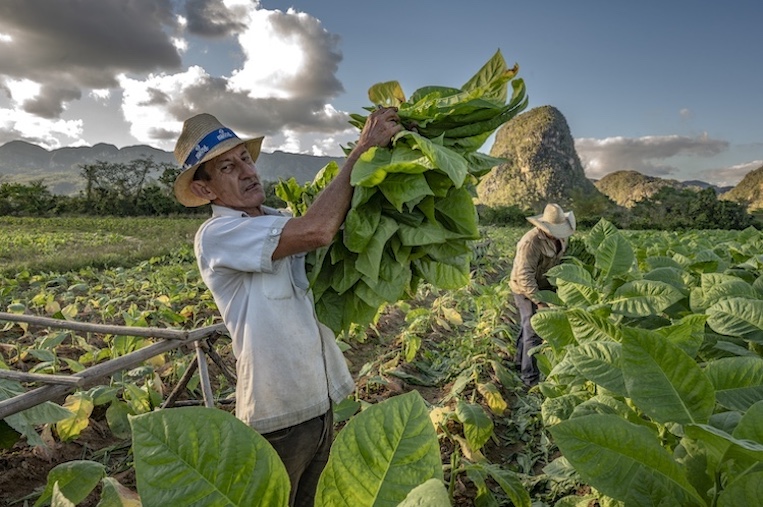
The harvest is in full swing for the Sarabia brothers, surrounded by the dramatic mogote scenery of the Vinales Valley. Photo by Robert Holmes
Tobacco is undeniably an essential crop in Viñales, evidenced by acres of tobacco fields surrounding huge, tent-shaped, wooden tobacco sheds, but the very finest tobacco grows twenty miles south in San Juan y Martinez, in a far less picturesque landscape.
The road from Viñales to San Juan y Martinez climbs back over the mountains to the provincial capital, Pinar del Rio, and soon turns into dirt on the far side of town. Cell phone reception here is spotty at best. “Can you hear me now?” is redundant. GPS is useless, and there are no detailed maps. Few people speak English, so a knowledge of Spanish is essential to ask for directions.
Everyone knows Iván Máximo Pérez Maseda, although on his business card, he simply goes by Máximo Pérez so getting directions to his farm should be easy, but the route, on a maze of dirt tracks, is so convoluted that directions have to be requested every few hundred yards.
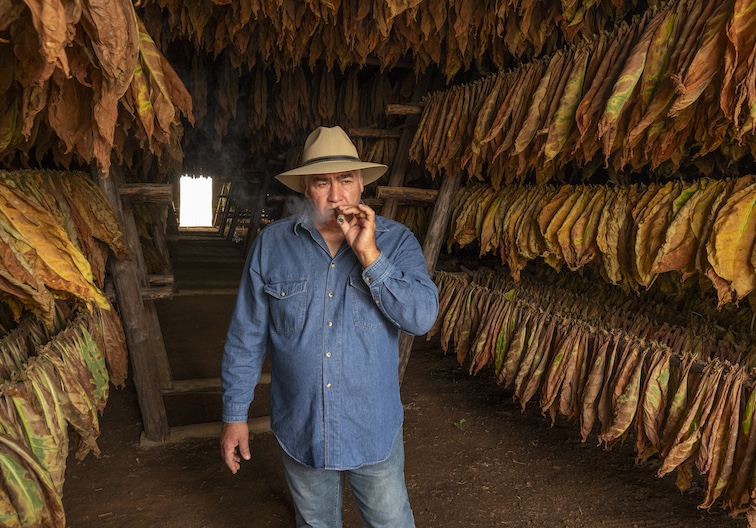
Maximo Perez in the curing shed he rebuilt after the hurricane. Photo by Robert Holmes
Máximo, as everyone calls him, has been a tobacco farmer all his life, or at least from the age of 14, when his father died in a car crash in 1984. His tobacco is considered to be some of the finest in the world.
Cigars are in many ways similar to wine. Terroir is all-important, and Máximo not only farms some of the very best 11 acres of farming land in Cuba, but he is also one of the great agricultural innovators. Some of this has been forced upon him by climate change. Higher ozone levels are detrimental to tobacco and varieties that once thrived now produce much smaller leaves. Maximo is developing clones that compensate for that. It is his passion. The State buys almost all premium tobacco grown in Cuba, and there is no black market for the unprocessed leaves grown by Maximo. However, he takes some of his crop to make cigars for his own use.
He cultivates the three different kinds of leaves required for every fine cigar. Filler, the inner tobacco leaves that make up the bulk of the cigar. The filler is critical for defining the cigar’s unique personality and overall smoking experience. The binder that holds the filler leaves together, and the wrapper provides not only an attractive appearance but also a uniform burn. Any holes in the wrapper, as often occurs with inexpensive cigars, will impact this. All three combine to determine the cigar’s flavor and smoking experience – ease of draw and even burn.
Ultimately, the skill of a master blender determines a cigar’s quality, not unlike a winemaker with wine. Like the importance of high-quality grapes in making the finest wine, a great cigar must begin with the finest possible tobacco, and this is where Maximo excels.
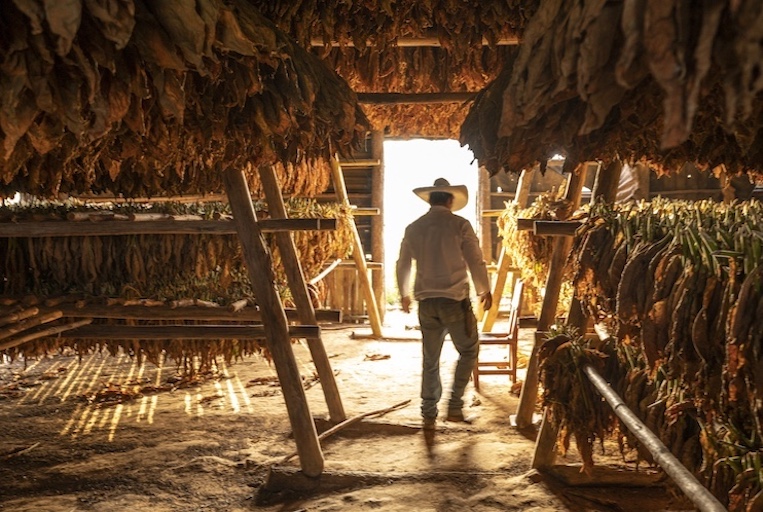
Benito Camejo who farms land on the outskirts of Vinales inspects his crop in his curing shed. The harvest is long over, and the tobacco has turned to its familiar dark brown color. Photo by Robert Holmes
Seeds are planted in greenhouses around October, and six weeks later, the seedlings are transplanted to the fields. After carefully tending to the plants, to which Maximo has devoted his life, harvesting begins in February and continues until the end of April. The leaves are transported to curing sheds, often dragged using huge wooden sleds pulled by oxen, where they will mature over several weeks, slowly turning from green to tobacco’s familiar brown color. The smell in the sheds also changes, from fresh, almost grassy aromas of recently harvested leaves to warm, earthy scents of leaves that have lost moisture and developed the characteristic flavors and aromas of cigar tobacco. Maximo grows his own farm-specific hybrids of traditional Cuban varieties.
The tobacco is transported to a fermentation facility where piles of leaves are stacked high to mature and fully develop flavor and aroma. This can take several months. Eventually, the cured, fermented leaves are sorted by size and quality.
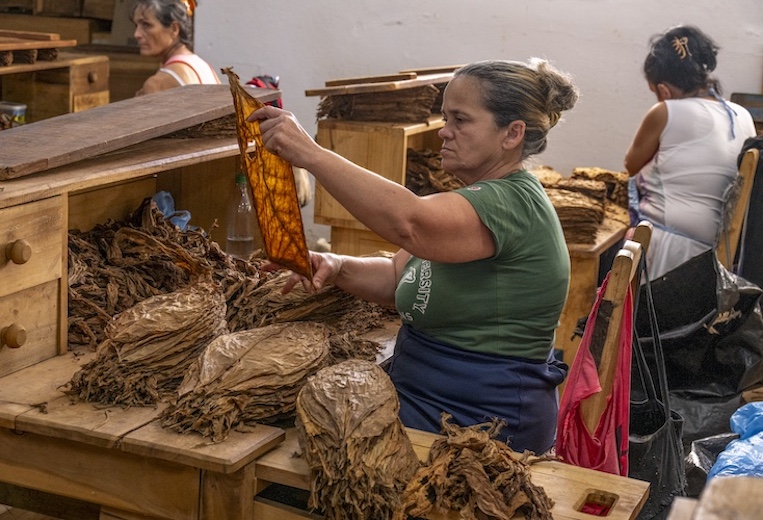
A woman in Vinales inspects and grades tobacco leaves, sorting them into piles according to their quality. Photo by Robert Holmes
“Lectores” or readers narrating books, newspapers, and other materials to tobacco workers dates back to the 19th century in Cuba. The reader sits on a raised platform in front of the workers, reading aloud the latest news or books with a strong political slant.
For several hours a day, the lectores will read the latest news from Granma, the official organ of the Communist Party of Cuba, plus anything that entertains, informs or educates the workers. Cuba has one of the highest literacy rates in the world and the most lowly of workers devour the information read to them.
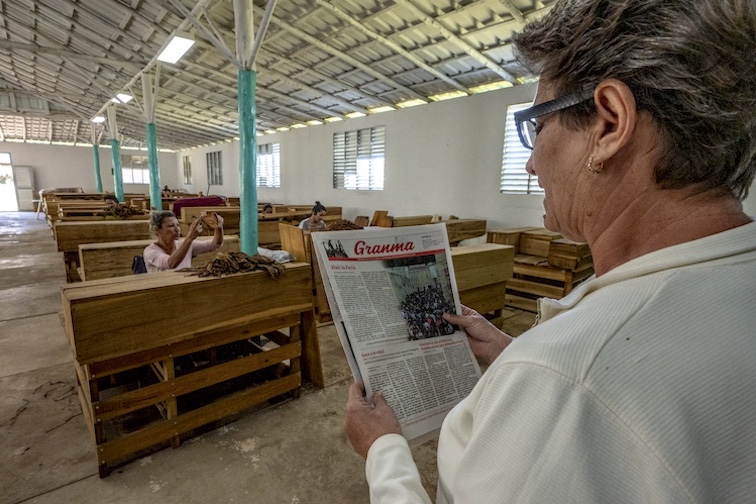
A lectore reads the day’s news in “Granma,” the official newspaper of the Central Committee of the Communist Party of Cuba,to workers grading tobacco leaves at a state facility in Vinales. Photo by Robert Holmes
Long hours of sorting and rolling tobacco are tedious. Sorters examine each leaf for imperfections and grade them according to quality. The myth of cigars being rolled on a young maiden’s thigh is the product of overimaginative marketing. Rolling cigars is a skilled craft usually performed on a flat, wooden table with barely a young maiden in sight!
Finally, the government steps in, grading the tobacco leaves and determining which cigar factory will get them. Almost all of Máximo’s leaves will go to premium brands such as Cohiba, Partagas and Montecristo.
The fields around San Juan y Martinez are ideal for growing what is widely regarded as the finest tobacco in the world. Unfortunately, it is also in the center of an area prone to some of the most powerful hurricanes in the world, and every few years, the landscape is devastated, as happened during Hurricane Ian in September 2022. The catastrophic event destroyed both crops and the tobacco sheds essential for curing the tobacco leaves. Altogether, over 10,000 sheds were destroyed, 90% of those in the entire country. Without curing sheds, harvested tobacco is useless.
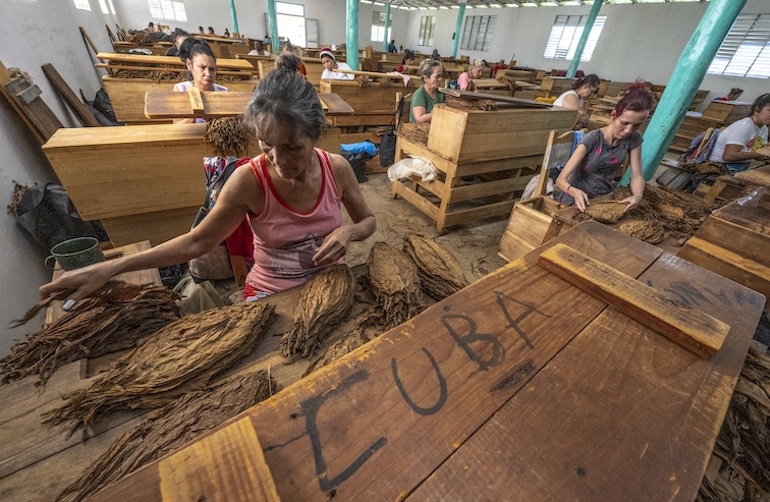
Tobacco graders at work in a state-owned facility in Vinales. The leaves are sorted according to quality before a state inspector determines the price and which cigar factory will get them. Photo by Robert Holmes
Unlike many countries, restoration in Cuba is a painfully slow process. Building materials are scarce, but now, three years later, many of the tobacco farms are up and running again, with the picturesque wooden sheds replaced with solid, reinforced concrete structures.
The best cigars, like the Cohiba Behike, the rarest and most sought-after, will sell for $200 each or more if you can find one, and that’s next to impossible. When the average monthly income in Cuba can be less than US$60 it’s no surprise that there is an active black market in fine cigars.
In every tourist area, cigar touts will approach offering cheap cigars with a variation of the “fell off the back of a truck” story. Back in Havana, put out the word that you are looking for a box of Cohiba Behike cigars, and after a theatrical performance of tracking down the world’s most elusive cigar and it being offered to you in an authentic-looking box with all the appropriate warranty seals, at a fraction of market price, it should raise alarm bells. How do you spot the fake? The box should be sealed with the Habanos seal and a warranty seal with a hologram. As a mark of authenticity, Habanos signifies a cigar’s Cuban origin and its adherence to quality standards.
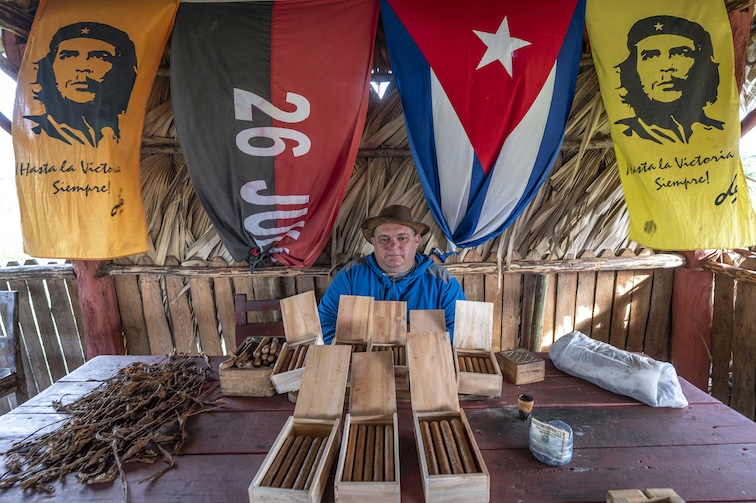
Many small farmers like these at Juan Luis y Luis on the Ruta del Tabaco, are allowed to make their own cigars for sale to tourists, but these are rarely of high quality. Photo by Robert Holmes
The cigars themselves should have a smooth, evenly colored wrapper with no soft spots. The cigar should have a rich, distinct aroma, and remember, as with most things, if the price seems too good to be true, then it probably is.
Still, every year, tourists are taken in by this elaborate ruse. The gullible may not appreciate the quality difference, but the aficionados back in the smoke-filled Old Havana hotel room would, but they can afford the real thing. Nevertheless, at the end of the day, it all goes up in smoke.
Robert Holmes is a British, multi-award-winning photographer and writer based in Northern California. His recent memoir, Passages, is a medalist in the Independent Publisher Book Awards.