

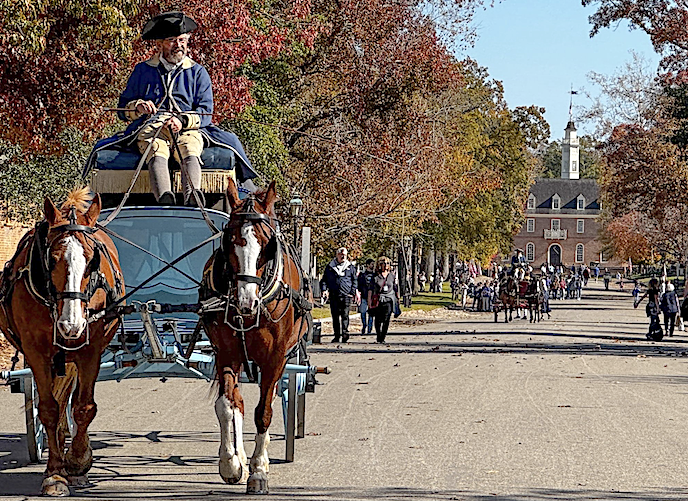
Visitors can ride horse-drawn carriages along Duke of Gloucester Street, the main thoroughfare of Colonial Williamsburg, where no modern vehicles are permitted. Photo by R.C. Staab
By RC Staab
On the eve of America’s 250th birthday, this country can sometimes feel like it is coming apart at the seams. Voices shout past each other to beg the question whether this grand experiment in democracy can hold. So, in the spirit of both escape and inquiry, I decided to step into a time machine and travel back to the year when the United States was still an untested idea, not yet a nation but no longer content to be a colony.
My destination was Colonial Williamsburg. It was never as “grand” as other colonial capitals such as Philadelphia, Boston, New York or Charleston, but this compact Virginia town helped seed the growth of American independence. Here, lawyers, farmers, merchants and craftsmen wrestled with the same questions that confront us today: Who gets to make the rules, and who just has to live with them? Who pays the taxes, and who seems to keep dodging the bill? What do you do when your leaders seem more interested in their image than in the people they govern? And why is there so little bread in bread pudding?
Today, Colonial Williamsburg is a 301-acre living‑history museum, less a static collection of buildings than a recreated village surrounded by the modern city of Williamsburg (population 15,400) Virginia. Each day, several dozen costumed interpreters move through its streets as if the 18th century never ended. They stay firmly rooted in their roles wearing, for example, 18th style waist coats, dresses and tri-cornered hats. In shops, craftsmen from the 21st century produce 18th century furniture, household goods, wigs and clothing using 18th century tools and techniques. For modern travelers – particularly inquisitive, highly opinionated adults — you’re no longer just reading about the Revolutionary era, you’re walking straight into its ongoing conversation.
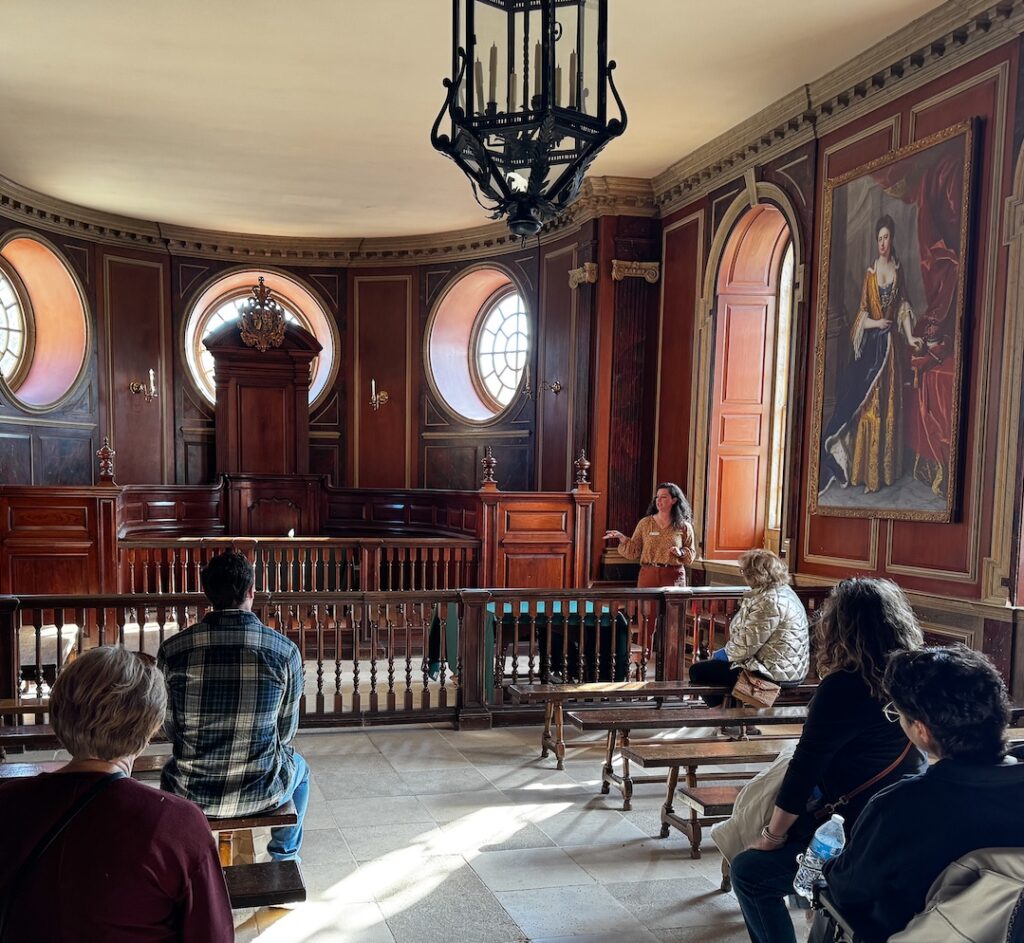
The Council and General Court of the State Capitol was the upper house of the Virginia legislature and also acted as colony’s highest civil and criminal court. Colonial Williamsburg reconstructed the Capitol of the Colony of Virginia on its old foundation in the 1930s. Photo by R.C. Staab
Stepping from the present into the past, I found myself on Duke of Gloucester Street, the main thoroughfare of Colonial Williamsburg, as it might have appeared in the spring of 1776 but lacking the dirt, dust and horse and carriage traffic you might expect from that period. Though it led directly from the modern city of Williamsburg, it was devoid of any parked cars or modern vehicles. Instead, the wide throughway was blissfully unhurried except for a few local Williamsburg citizens jogging along the paved street while early arriving tourists ambled on brick and cobblestone sidewalks past wooden shops, taverns and a few stately brick homes.
Liberty or Death
Up ahead, striding briskly across the Palace Green, came a familiar figure—Patrick Henry himself (played by Nathaniel Lasley) – far from his plantation just north of Richmond, where he practiced law between court sessions and tended modest tobacco fields with his growing family. This was no farmer or stable hand as evidenced by his handsome knee‑length brown wool frock coat over a buttoned waistcoat, tan knee breeches, white linen shirt with neckcloth and white stockings. His felt hat was cocked slightly on top of his brown wig as his buckle‑latched black leather shoes kept pace with his walking stick.
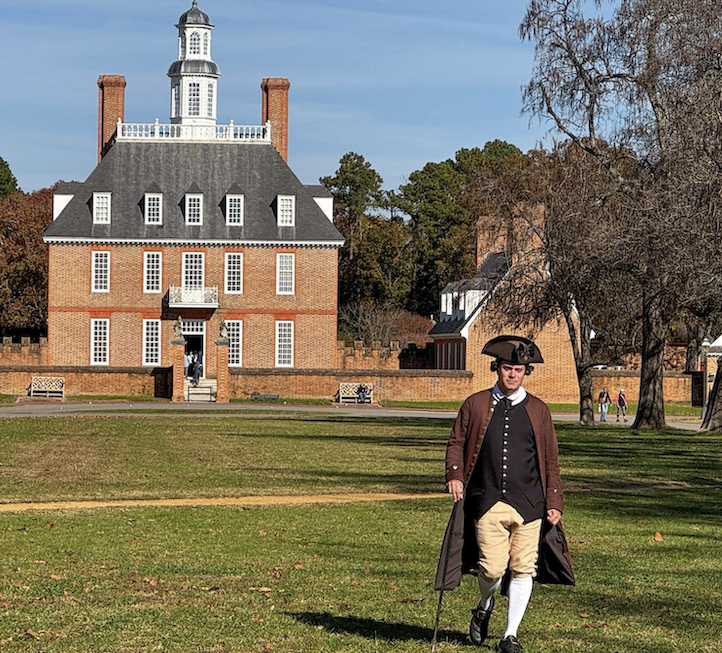
Young Man in a Hurry. Actor Nathaniel Lasley portraying a young Patrick Henry goes out for a morning walk along the Palace Green in front of the Governor’s Palace. The reconstruction of the Governor’s Palace restored a lavish 10-acre manicured ornamental garden where the Governor and his family would stroll and entertain guests. Photo by R.C. Staab
Here was the man whose thunderous words – “Give me liberty or give me death!”– had set all Virginia talking last year. Today, though, he seemed in a lighter mood. “We’ve been able to put down the Loyalist forces in Norfolk,” he beamed. “Norfolk is now free. She’s burned to the ground, but she’s free. And we have driven Lord Dunmore, his Negro army and his Tories into exile.” By early 1776, Henry had resigned as military commander of the 1st Virginia Regiment to focus on the Fifth Virginia Convention set for May where he led the call for independence from George III, King of Great Britian and Ireland.
Why was Henry not planning on attending the Second Continental Congress in Philadelphia? “There is no great need for me in Congress now,” he explained. “I was replaced by a far abler man, a man who is much finer in committee than I am, that being, of course, Mr. Thomas Jefferson.”
As a prosperous Virginia landowner, lawyer and appointed state leader, Henry stood to gain financially from working with the British crown. For a Williamsburg merchant concerned about business being interrupted by a war, it’s a much different issue. Henry said: “I spoke to merchants and farmers about this many times, and they often ask why we should risk tumult over such slight taxes—a mere three pence per pound on tea. But the issue isn’t the amount; it wouldn’t matter if it were half a penny. The true matter is the principle: who levies the tax upon us?
“Our ancestors crossed the ocean 150 years ago under a solemn compact with the Crown, promising we would remain fully British on these shores, with all the liberties of life, liberty and property that define a Briton. Property could only be taken by a jury of peers after a crime or by men we ourselves elected. Yet Parliament—never elected by a single Virginian, never even having seen America—claimed the right to tax us, reducing us from equal partners in the empire to mere subjects, like the Catholic Irish or the Indians of Bengal. That three-pence tea tax was the anchor of despotism, chaining us to tyranny forever, as Boston’s tea destruction proved when an entire city was enslaved in retaliation.”
Turning on to Duke of Gloucester Street, his rising voice caught the attention of one or two visitors. He nodded politely as we continued walking toward the State Capitol building. Apparently, most citizens of the era were used to hearing political arguments among gentlemen, and occasional journalists as they went about their business.
Henry admits that rebel forces will have a difficult time driving British soldiers from American soil. But he adds, “We can succeed through wise policy and fine diplomacy, through keeping the Indian tribes neutral, through negotiating treaties of alliance with France and Spain and, first and foremost, by taking the absolutely essential step of declaring ourselves independent. Through independence comes an alliance. Through foreign alliance comes arms, and through arms comes the reduction of the odds that Williamsburg or any other town will be burned.
“There is no possible means by which a people, three million strong, over such a vast expanse as North America, can be conquered by a distant island 3,000 miles across the ocean if we have the will to maintain the fight. The land is simply too great. There are simply too many of us. They cannot win if we maintain our will.”
Beyond the prospects of war, Henry had thoughts on almost any subject you can imagine from varied opinions on slavery to why Indians should be forced farther west so their lands could become European farms. Yet Henry’s persona was agile enough to turn from talks of liberty to helping a vacationing young family bearing a modern map find the nearby carpenter shop so the children could see furniture being made.
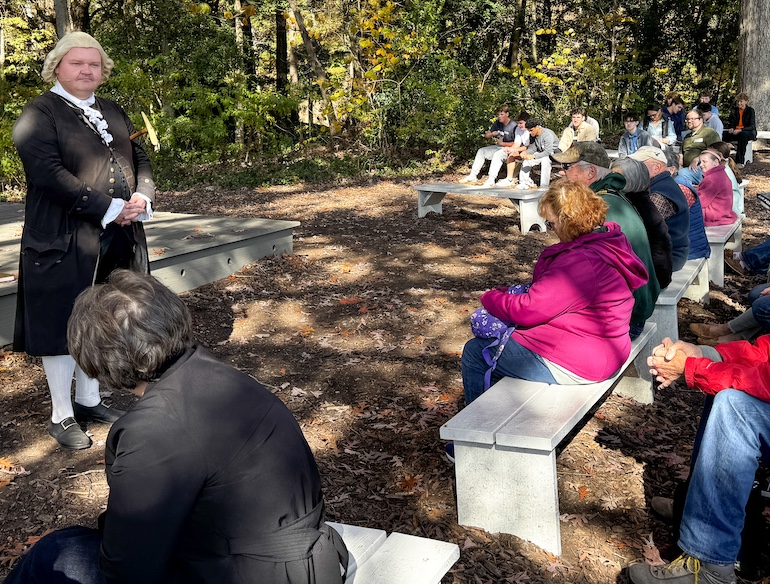
An actor portraying George Wythe, the first of seven Virginians to sign the Declaration of Independence, gives a speech to visitors about his thoughts on the American rebellion against King George III. Talks with noted Nation Builders such as Wythe, Patrick Henry, George Washington and the Marquis De Lafayette are regularly scheduled inside auditoriums and in outdoor theatrical settings each day. Admission is generally required. Photo by R.C. Staab
Along with George Washington and Martha Washington, Thomas Jefferson and other famous Virginians of the 18th century, visitors to Colonial Williamsburg can regularly greet Henry on the street or perhaps hear him speechify during one of the Nation Builders presentations offered daily throughout the town.
Interacting With Regular 18th Century Folk
Frankly, I was more interested to meet local Williamsburg people of the 18th century than I was patrician politicians. As I walked down the main throughfare past the blacksmith, silversmith and the shoemaker shops, I could see and hear a group of townspeople talking to visitors on the porch of the Raleigh Tavern.
As I learned later, the costumes for people of the past, trades people, guides and restaurant servers are made in-house by museum staff who rely on a century of study to ensure that clothing is cut and constructed as it would have been in the Colonial era.
Across the street, I saw three women with caps and a broad straw hat gossiping in front of a row of shops at the King’s Arms Tavern. Unlike Patrick Henry, their appearance suggested working class with printed aprons and pinned kerchiefs. Beside them was a fluttering Continental Union flag representing 13 American colonies with a nod to the British Union Jack flag.
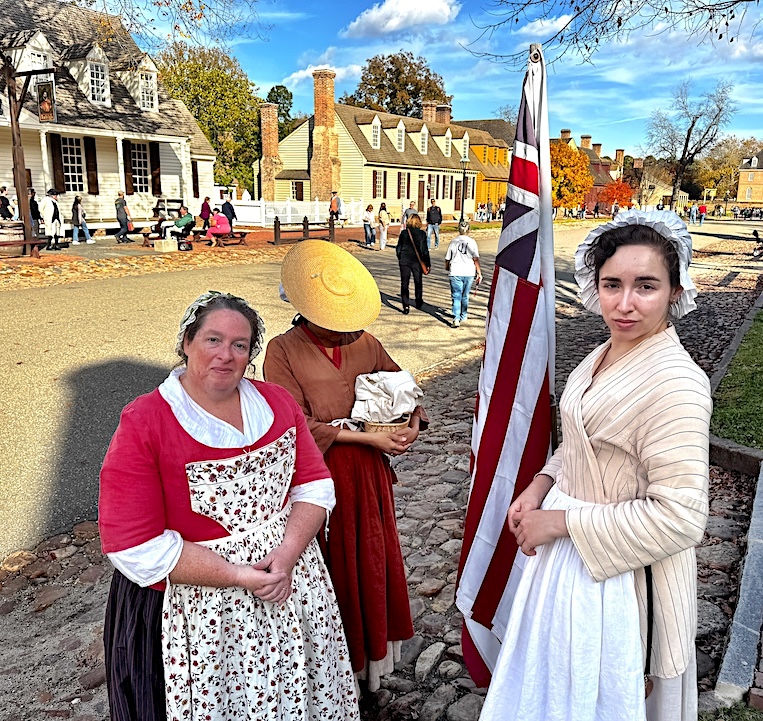
Actors portray three working-class women of the 1770s gossiping in front of shops on Duke of Gloucester Street. The actor with her head bowed was a “convict servant”, meaning she was convicted of a crime and sent to American to become a servant. The Continental Union Flag representing England’s original 13 colonies is at right. Photo by R.C. Staab
With a gentle nudge from their parents, children would hesitantly approach the woman, who, with their layered, billowing gowns, stood in stark contrast to the shorts, jeans and tennis shoes worn by their parents. With a bit of encouragement from the women with pleasant 18th century greetings, the children would step cautiously toward the inevitable photo ops.
Devoid of any traffic, save for a distant horse and carriage transporting tourists, there was plenty of opportunity to wonder from shop to shop, stop at the bakery for a pastry or occasionally encounter a costumed character of the past. Among the women was Mary Boston (played by Ardiana Mucia), a “convict servant” who was transported to Virginia as punishment for being found guilty of theft in England. Of her owner, Richard Henry Lee she disclosed, “He’s in Philadelphia as you are probably aware. I don’t travel by boat very well. He loaned me out to his brother, William Lee, who is still here, so as not have to endure my upchuck (sea sickness).”
Beside her was Mrs. Hall (played by Rachel Eiland-Hall), who like every mother since time began, was fretting about the changing world. She opined that Williamsburg had been growing rapidly and was hardly recognizable from five years ago. “It’s difficult to feel safe with all the change,” she sighed. “I know that it is inevitable, that sooner or later, the colonies of America and England will separate.” Then she said wistfully, “If you had told me a few years ago that I would have given up the stage and would be working in a tavern, I would have been flabbergasted.”
Meanwhile across the street, Mrs. Hall’s employer, James Southall (played by David Catanese), the owner of the Raleigh Tavern, roamed the brick sidewalk greeting potential customers. Dressed more plainly than Patrick Henry, he wore a knee‑length coat with a high stand collar open at the chest to show the matching waistcoat beneath. Like any good tavern keeper, he had opinions about almost everything from his love for wife and eight children to the tithes (aka taxes) he pays to the one church in town to Patrick Henry and his “bunch of peacocks,” meaning his regimental soldiers.
After slightly adjusting his black tricorne hat, he admitted sharing Mrs. Hall’s main concern. “I was hoping peace would reign but now I don’t think that’s possible in the least,” he scowled. “What I’m worried about is the man that makes the beer doing something. What I’m worried about is the people that serve the drinking not being there. What I’m worried about is when my guests go to sleep what might happen if someone decides to open the door because they know where they keys are.”
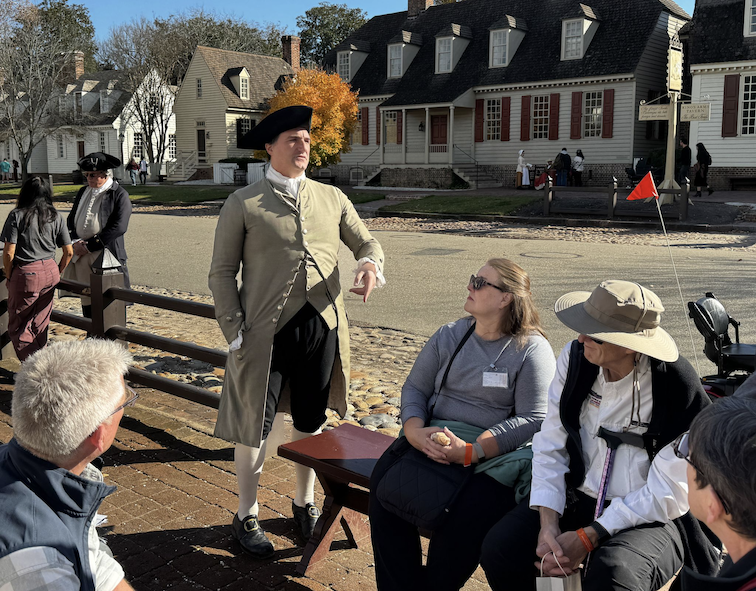
An actor portraying the owner of the Raleigh Tavern answers questions from 21st Century visitors about his life in 18th century Colonial Williamsburg. He’s one of the many actors who portray People of the Past. They take part in regularly scheduled interactions on Duke of Gloucester Street, plus scheduled theatrical performances, family sing-alongs, staged trials and soldier reenactments. Photo by R.C. Staab
History delivered with an authentic touch
If this exchange feels as fraught as any 21st-century exchange, that’s because you’re not at Disneyland listening to scripted animatronics. Colonial Williamsburg sets itself apart from sanitized attractions by delivering history that feels raw, honest and alive by trained actors.
Was this the kind of immersive, unfiltered confrontation with the past that John D. Rockefeller Jr. and Rev. Dr. W.A.R. Goodwin envisioned a century ago, when they began the restoration of Williamsburg in the late 1920s? Initially, they seemed more concerned with bricks and mortar, demolishing post-1790 buildings and restoring key structures such as the Capitol building. Even as early as 1932, though, they chose the motto “That the future may learn from the past.” This foresight made the debates I witnessed—echoing 1776 tensions—precisely the unvarnished historical engagement they sought. Says Robert Currie, Associate Vice President of Performing Arts and Signature Events, of Rockefeller and his staff, “I think they realized early on within the restoration period that having people interpret 18th century history was going be even more impactful” than static buildings with placards describing what happened there.
The path for actors into Performing Arts Department starts with a rigorous audition process. Prospective actors go through traditional open calls and callbacks, then sit in a room with the team to talk history, craft and stamina for this unusual kind of repertory work.
Once hired, training is both theatrical and scholarly. New interpreters dive into research with historians, curators and archivists, learning the details of their characters’ world. The actors rotate through different interpretive settings, from formal scripted programs to unscripted conversations in taverns, streets and homes, so they can shift seamlessly between monologue, dialogue and improvisation in front of guests.
“Some people approach our nation builders and our actors with respect,” adds Currie. “Other guests can kind of treat this like “Westworld” (Author Michael Crichton’s futuristic Wild West theme park staffed by lifelike androids.) The result is a company of actors who are as comfortable fielding tough questions as they are delivering set speeches or knowing how to respond to questions about cell phones and computers.
“It can be more complex for our African American actor interpreters who portray free and enslaved people of the past in 18th-century costumes every day,” says Currie. “Interpreting enslaved people can be extremely difficult, even traumatic We work to ensure that our team can perform at the highest level and be resilient in dealing with the emotional strain and challenging emotions that often come with this specialized work.”
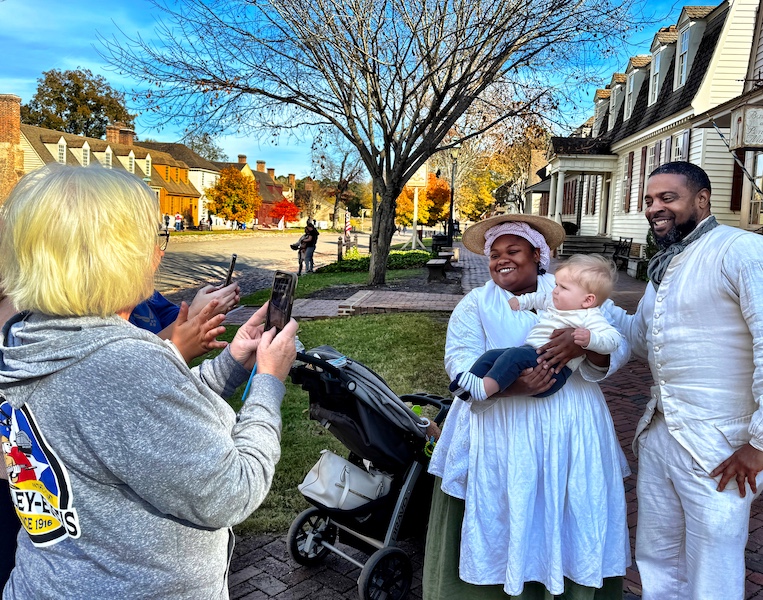
Visitors in front of shops on Duke of Gloucester Street pause to have a photo taken with their son and African America actors – one portraying an enslaved cook and the other an enslaved carpenter, who are taking a day off from their work. Photo by R.C. Staab
As the 250th anniversary of the nation approaches, most of the actors are imagining life exactly, to the day, as it was 250 years ago. Every day is different. In addition to the 4th of July, the focal point of this year’s celebration is May 15 and 16th when the Fifth Virginia Convention met in Williamsburg. “That is the moment Virginia declared independence,” Currie notes. “Arguably for Virginia, it’s more important than the Declaration of Independence.”
While visiting Colonial Williamsburg, I noticed a certain reluctance on the part of young adults and children to interact with costumed actors they encountered along the sidewalks. However, children were eager to watch and ask questions of craftspeople in the 18 trade shops on Duke of Gloucester Street and throughout the town. As one father said of his young boys, “This is so great. Our kids are going to be wiped out.”
A look at 18th century tradesmen
After a quick inspection of the joinery shop, I realized not everyone could assume these complicated jobs in the shops.
Assuming wig making was a quaint, archaic craft, I sought out Debbie Turpin, the master wigmaker. She gently reminded me that 18th century men and women were every bit as preoccupied with hair and appearance as we are today, and the parallels with our own modern hair obsessions were impossible to miss. George Washington never wore a wig – only pulled his hair back – while Thomas Jefferson had four brown wigs in three styles.
Turpin’s been with Colonial Williamsburg for just over 25 years, beginning not in a workshop, but as a group leader shepherding schoolkids on three‑hour and multi‑day tours. Turpin joined the wig shop as an apprentice in the fall of 2007 and became master wigmaker in January 2023. The timeline reads like a modern version of an 18th century career ladder, with each promotion marking deeper mastery of the craft and more responsibility for training the next generation.
“We’re the only shop like this in the country,” says Turpin. She talks about wigs not as dusty relics, but worn by men of all classes, even farmers donning a wig when coming into the city to transact business. Fortunately for contemporary American males, the generation following the Revolutionary War decided that powdered wigs were no longer their thing and by 1800 few men were wearing them.
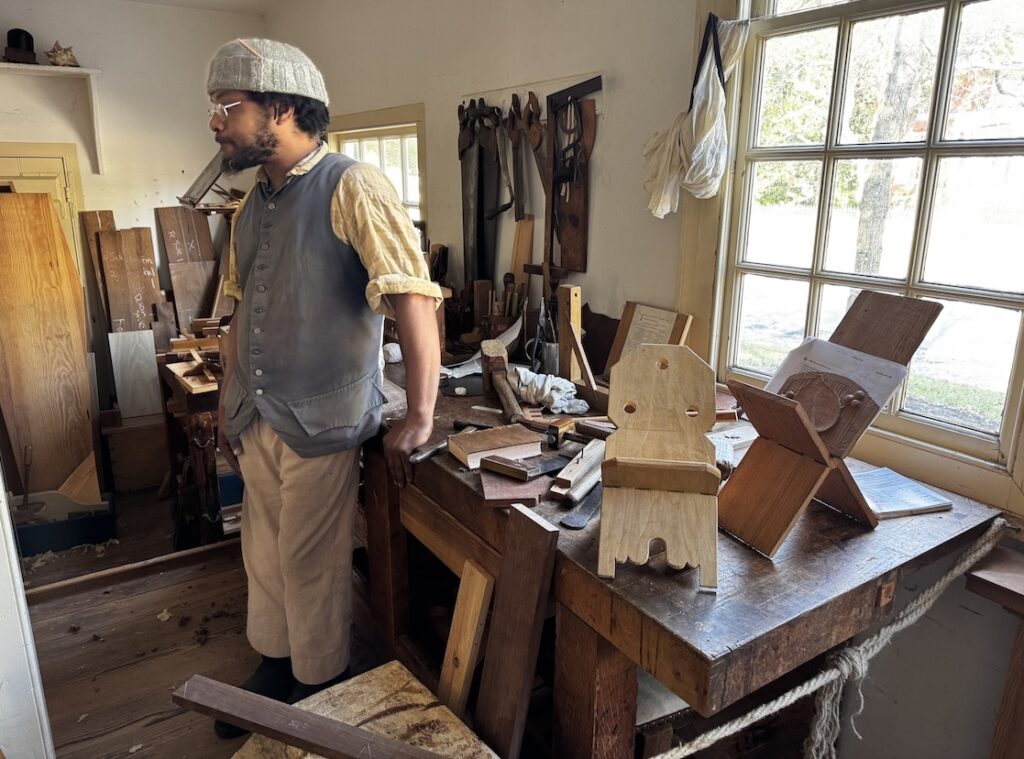
The the Joinery Shop employs craftsmen who use 18th century techniques to create detailed woodwork by joining pieces of wood. Their products such as window doors, stairs, furniture and mantels are used to maintain period shops and homes throughout Colonial Williamsburg. Photo by R.C. Staab
Turpin’s boss, Ted Boscana, Director of Historic Trades and Skills, oversees a program with 100 skilled artisans that spans everything from heavy carpentry and fine joinery to blacksmithing, weaving and other pre-industrial crafts. The trades program, which has been around in some form since 1936, preserves these skills through long-term apprenticeships in working shops, where artisans still build and repair productions with 18th century Williamsburg tools and techniques when possible.
Initially, some products were focused on the tourist trades, horseshoes stamped with people’s name for example. But today craftsmen working for the “largest outdoor living history museum,” produce everything from building materials such as window sashes, doors, hinges, latches and gates to furniture, wigs, clothing worn by characters and fabric used as sheets, towels, blankets, bed rugs and bed curtains.
Should they have extra products, Boscana has contacts at historic places throughout the country. Don’t be surprised to find a product crafted in Colonial Williamsburg on display in Mount Vernon or Monticello. Along with gifts made for dignitaries, they made a silver bell with an ebony handle that was given to Winston Churchill, the first receipt of the Williamsburg Award, who “embodied the spirit of the great patriots” of the 18th century.
Boscana is an offspring of the very system he now leads. After doing some carpentry with his father, “I started working for Colonial Williamsburg when I was 15, and I just never left.” That longevity is part of what allows tradespeople to move from apprentice to master within the foundation. “We have two silversmiths right now that celebrated 50 years working at Colonial Williamsburg,” Boscana admits.
In terms of what’s most interests visitors, Boscana says, “The armory is definitely one of the most heavily visited sites because we have the blacksmiths tinsmiths, gunsmiths there — a lot of different trades in that one small space. As for other shops, the fashion trades always do really well — milliners, the tailors, wig makers.”
Like most of the Colonial Williamsburg staff, the tradespeople are all in costume. However, they live in the 21st century and respond to people not as 18th century characters but as modern craftspeople trained in 18th century techniques. “When people ask modern questions, we want to make sure that we have the ability to answer those questions and make connections,” he says.
A layered historical experience
Ron Hurst, Colonial Williamsburg’s Chief Mission Officer, has watched the place transform over four decades from a largely third‑person history museum into a layered experience that puts visitors face to face with the 18th century. “A cadre of people portraying men and women of the past, both free and enslaved and at different levels of society,” he said.
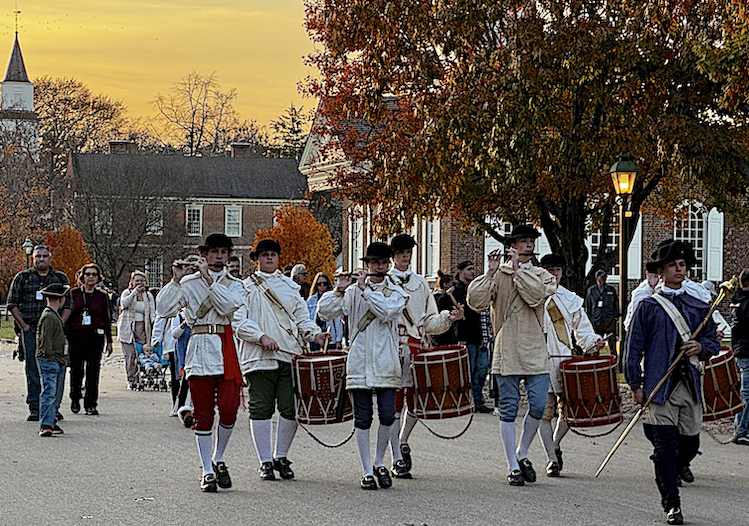
The Colonial Williamsburg Fifes & Drums corps marches down Duke of Gloucester Street, the main thoroughfare of Colonial Williamsburg. Photo by R.C. Staab
Over the past decades, the physical footprint of Colonial Williamsburg has expanded to meet that mission. Hurst points to a dramatically enlarged art museum with free admission, a new 40,000 square foot public archaeology center opening this year and projects such as reconstructing the African Baptist Meeting House and restoring the Bray School which educated Black children in the 1760s. Says Hurst: “The restoration of the town will never be completed because science and technology are allowing us to ask much deeper, much more penetrating questions than were thought of even 30 years ago.”
Hurst also sees a changing, more diverse audience arriving with “thinner school‑based history backgrounds and shorter attention spans,” which forces the institution to adjust without dumbing things down. The museum’s mission, he says, is twofold, preservation and education. “We’re going to tell you everything that happened, the positive things and the negative things. We’re not going to tell you what to think.”
For a first‑time visitor with just two days, his advice is old school and practical:
- Start with the flagship sites—the Governor’s Palace, the Capitol and the courthouse.
- Make time for two or three historic trades, where you see things actually being fashioned before your eyes.
- Meet at least one or two Nation Builders
- Add the art museums and the new archaeology center
To his list, let me add that the nightly fife and drum march on Duke of Gloucester Street is not to be missed.
For visitors to Colonial Williamsburg, there is no admission to walk through the town, interact with costumed characters, follow the Colonial Williamsburg Fifes and Drums corps marching on Duke of Gloucester Street, visit the art museums and dine at the restaurants. But for the true Colonial Williamsburg experience, to see craftsmen working their trades, tour historic buildings and hear Nation Builders in theatrical settings, one-price admission is $37.50 for adults and $10 for children 6-12.
On top of all that Colonial Williamsburg offers a year‑long slate of special programs, July 4th fireworks for the nation’s 250th birthday and in November, Colonial Williamsburg’s own 100th‑anniversary celebration. For more information, visit www.ColonialWilliamsburg.org.
New York City based R.C. Staab is a book author, award-winning photographer, playwright and wildlife enthusiast. He was immersed in Colonial history for many years while working for the Philadelphia Convention and Visitors Bureau and living in a very narrow, red brick rowhome built in 1790. After reading about Colonial Williamsburg, please see Staab’s previous article on Wild Bears.