

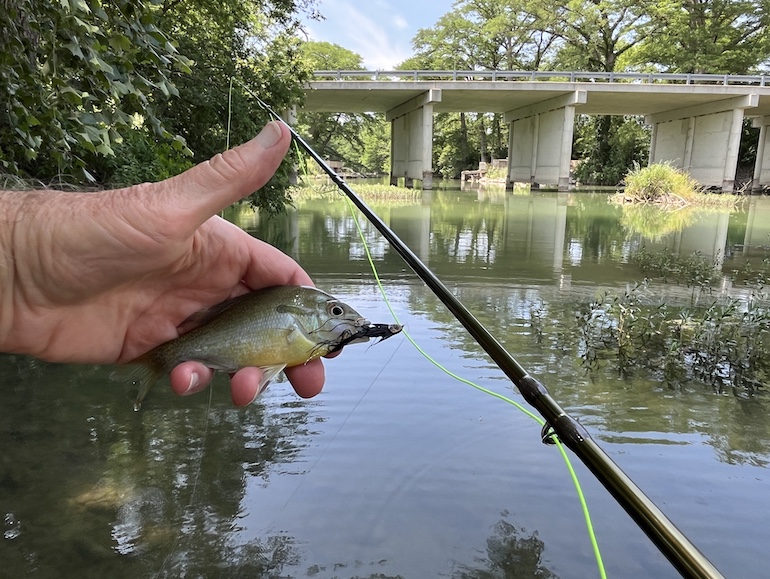
The languid Guadalupe River before July 4, 2025, offered no hints on what would soon come. But within a matter of minutes on July 4 flood waters almost covered this bridge spanning the river near Comfort. Photo by Tom Adkinson
The Guadalupe River appeared benign – quiet, slow-moving, fishy-looking. It was just what a visitor from a thousand miles away expected in the Central Texas Hill Country, a region of big skies, gentle hills and open land that native son President Lyndon Johnson loved. The Hill Country is north of San Antiono and south of Austin, and it is a retreat for urbanites escaping cacophony and concrete.
I had come to see the Hill Country’s famous displays of spring wildflowers and to fish some of the rivers that carved valleys through the countryside. Lack of rain had abbreviated the wildflower spectacle, so fishing rose to the top of the list of vacation pursuits – that and sampling wines from the scores of wineries that have proliferated here is recent decades.
The Guadalupe River was my primary target. With the guidance of Kendall County constable Bryan Vaughan, himself a fisherman, I parked near an elevated concrete bridge supporting a two-lane blacktop road outside the town of Comfort. I climbed down a steep embankment and surveyed the scene.
A Picture Of Serenity
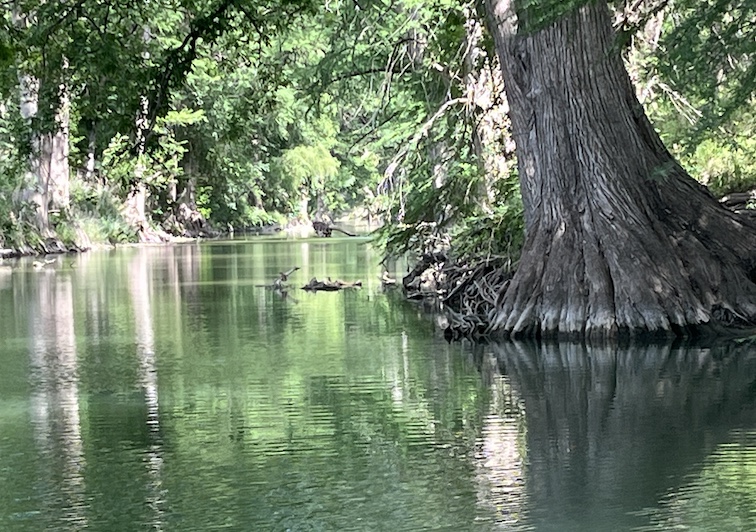
Massive cypress trees along the Guadalupe River exuded a feeling of permanent peacefulness that would disappear days later, along with many of the trees. Photo by Tom Adkindon
Massive cypress trees lined both banks. The base of each stately tree was as wide as an SUV is long. I was only about 20 river miles downstream from the headwaters at the town of Hunt, so the Guadalupe was still narrow here. The trees’ leafy canopies stretched across the river, creating a shady tunnel on a hot, dry day. Where I live, streams this size are called creeks, but I’m not one to quibble with Texans.
No other anglers were in the water to interrupt my quest for Guadelupe bass, a subspecies found only in Central Texas. Fly fishermen pursue Guadalupe bass because of their limited range and their reputation as strong fighters. They are the official state fish and sometimes are called the “Texas brook trout.”
I cast my line, and the thought that this quiet place could ever be dangerous never entered my mind. The serenity was intoxicating. Framed by the bridge 30 feet overhead, I caught a few sunfish, but not an elusive Guadalupe bass. I left to explore other streams, but I called a friend a few days later to ask about another location near Comfort. He said not to bother because a brief and isolated two-inch rain had muddied the water and made wading and fishing impossible. A multi-year drought had baked the soil, making it practically impermeable to the rain, which quickly flowed into the river.
My vacation lodging was upstream a few miles, and there had been no rain where I was.
The little storm my friend described was only a small inconvenience for me, but it was a blessing for the locals who so desperately needed rain. However, it actually was an omen had I known to pay attention in a region where flash floods have been a matter of life and death on numerous occasions.
Floods Through History
Memories and nightmares of flash floods lurk in the minds of long-time Hill Country residents. Major floods hit them in 1987, 1991, 1998 and 2002. None measured up to what struck in the early hours of July 4, 2025, when remnants of a tropical storm pounded the Hill Country unceasingly and turned the Guadalupe and other streams into raging, deadly torrents as flash floods barreled down riverbeds.
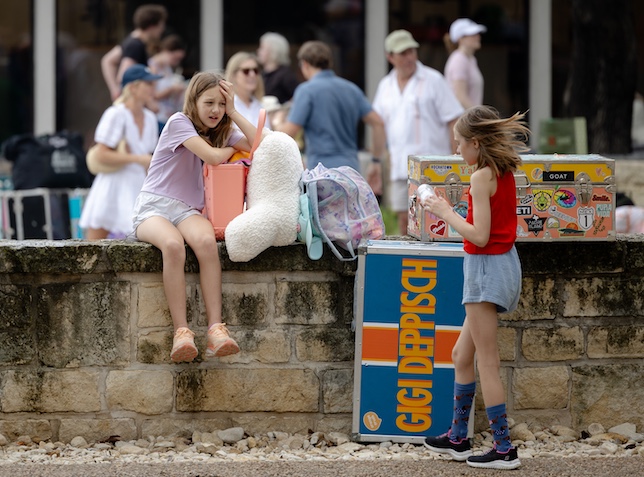
Surviving campers from Camp Waldemar in Hunt are reunited with their families at a reunification center at the Arcadia Live Theatre in Kerrville. Photo by Brenda Bazán for The Texas Tribune
“I was there when the wall of water hit. I watched cars float down the river. We’d never seen anything like this,” Constable Vaughn told me afterward. “It became a war zone – helicopters, rescue teams, search dogs.”
Even sterile scientific measurements of the flood sound frightening. The U.S. Geological Survey has a water measuring station at Hunt. Normal river flow there is between 10 to 20 cubic feet per second (cfs). When the July 4 flood hit, the flow measured 120,000 cfs.
More relatable numbers are even scarier. At Hunt, near a century-old summer retreat for girls called Camp Mystic, the Guadalupe rose two feet in five minutes. In just 45 minutes, it rose more than 26 feet, according to Talia Cogdill, a science writer for the Association of Certified Meteorologists. Twenty-seven staffers and young campers died there.
Only minutes later, the torrent that swallowed Camp Mystic, riverbank vacation homes and entire RV campgrounds reached Comfort and the place I had waded in water seldom more than waist deep.
Had I been in the river when a flood such as this occurred, I likely could not have gotten out. Even the initial wave would have pushed me off my feet. The bank, perhaps 50 feet away, would have been unreachable. I read later of a woman – a miraculous survivor – who was swept into the current near Hunt. She became just another piece of floating debris along with uprooted trees, refrigerators, propane tanks, RVs and pickup trucks. Twenty miles and several low-water dams later, she pulled herself into a tree. Battered and bruised, she waited until rescuers found her.
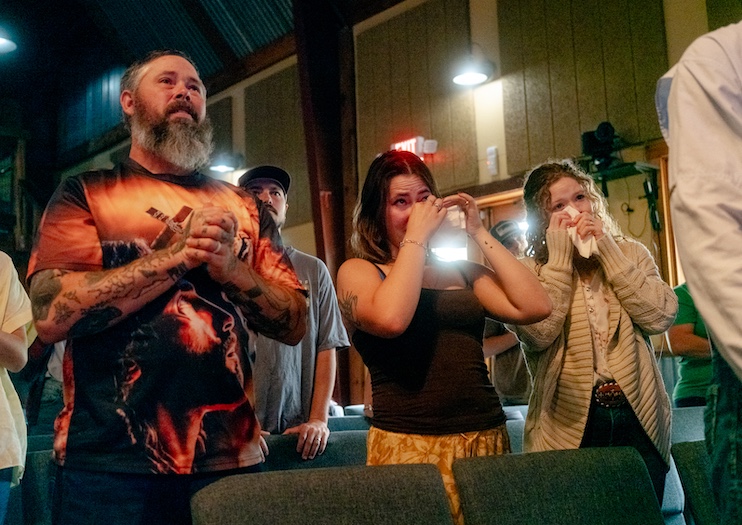
Community members grieve at the Cross Kingdom Church in Kerrville during the first Sunday service after the floods on July 6, 2025. Photo by Brenda Bazán for The Texas Tribune
Video shot from a bridge like the one under which I had fished documented the river’s rapid rise. The water’s speed and volume were astounding. Cresting waves, bobbing logs, automobiles – all raced by as the water rose higher and higher on the bridge abutments. Then, an intact house appeared, intact that is, until it struck the top of the bridge and splintered. Water normally a couple of feet deep was the height of a three-story building.
A Young Journalist’s Perspective
Haeley Carpenter earned her journalism degree at Tarleton State University and landed her first job as a reporter at The Kerrville Daily Times just days before the July 4 flood roared through her town.
“As awful as everything was, it was a time for me to step up for my new community. Who could have imagined that I’d walked across the stage (for commencement) and two weeks later would be in a press conference with the president of the United States. I grew up around nature hunting and fishing. I know how quickly nature can turn,” she said, reflecting on her experience with a disaster that had killed 117 people and left two others missing months after the Guadalupe looked like a normal stream again.
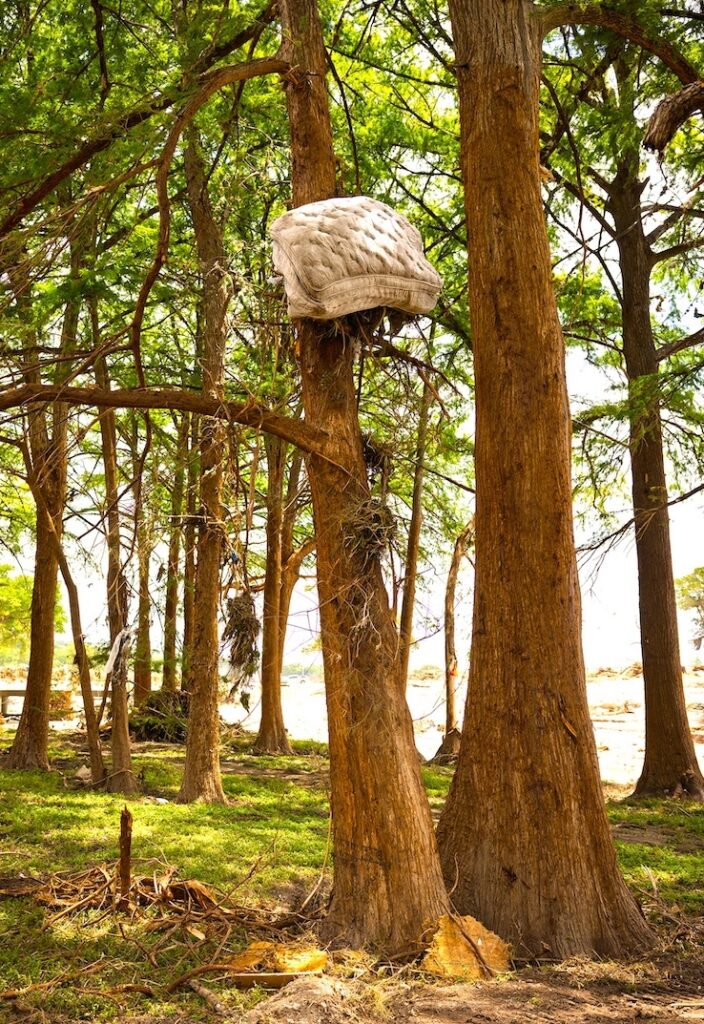
A mattress caught in a tree shows the height of the Guadalupe flood waters near the town of Hunt. Photo courtesy of the Kerrville Daily Times
Like me, she’s pensive about what happened along the Guadalupe. I think about times I’ve put myself in harm’s way and not even realized it. I wonder about precautions I should take before wading a stream by myself just to pursue a sub-species of bass or hiking to a backcountry mountain creek to catch a native brook trout. I wonder, and then I lace up my wading boots for another opportunity to experience the natural world – the sublime and the scary.
Tom Adkinson has fished for trout in 20 states plus Alberta, New Zealand and Australia. He intends to fish in Slovenia and Argentina next. His previous reports for the East-West News Service have described hot-air ballooning in Turkey, the man who taught Jack Daniel how to distill whiskey and autumn harvest festivals in the Mid-South.