

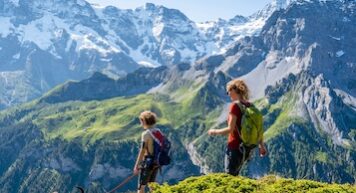
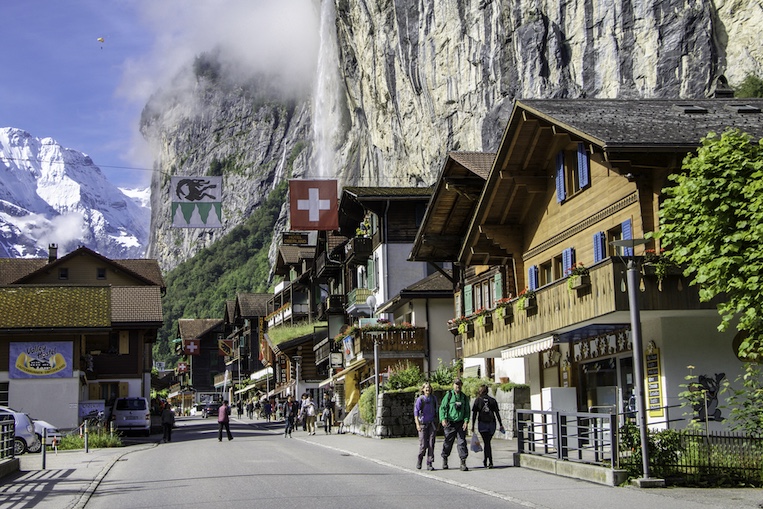
Lauterbrunnen Village, which has several hotels, shops and restaurants, is the gateway to surrounding alpine villages and Jungfraujoch-Top of Europe. Photo courtesy of the Jungfrau Region Tourism
In the Swiss alpine village of Lauterbrunnen, the snow-capped peaks of Eiger, Mönch and Jungfrau rise dramatically above the Lauterbrunnen Valley. And depending on the lunar cycle, the towering, jagged peaks can cradle a bright full moon, as they did during my summer visit.
Mountains in Switzerland’s Jungfrau Region are reachable via hiking trails and trains. My plan was to visit Jungfraujoch, the highest railway station in Europe. Also known as “Top of Europe,” Jungfraujoch sits at 11,332 feet elevation and is covered in snow and ice 365 days of the year. August temperatures typically hover around 35 degrees. Often, clouds obscure views, but my daughter and I got lucky with clear skies.
While our trip focused on exploring Jungfraujoch, the entire Jungfrau Region proved to be memorable, filled with delightful discoveries from an ice palace in the summit railway station to waterfalls in the valley below.
Getting to Lauterbrunnen
From Basel, Switzerland, it’s about a two-hour train ride, including a connection in Interlaken, to Lauterbrunnen. The small Lauterbrunnen railway station is just steps from village hotels and restaurants.
Lauterbrunnen Village
Situated south of Interlaken, Lauterbrunnen is a small village (population about 2,300) in the Lauterbrunnen Valley, known as the Valley of 72 Waterfalls. The name Lauterbrunnen translates to “loud springs” in German.
Framed by dramatic cliffs and cascading waterfalls, Lauterbrunnen is the gateway to Jungfraujoch, hiking trails and the surrounding villages of car-free Gimmelwald, Mürren and Wengen as well as Isenfluh and Stechelberg. The car-free villages are accessible via cable cars, trams and trains. (If you’re planning to stay for a few days, consider purchasing the Swiss Travel Pass for unlimited travel by bus, train and boats, in addition to free admission to more than 500 museums.)
In August, the compact village was bustling with international visitors from India, Asia, and America in addition to Europe. Tour buses rumbled up and down Auf der Fuhren, Lauterbrunnen’s narrow main street, that’s lined with Swiss chalet-style hotels. We stayed at the family-owned Hotel Oberland, a congenial hotel with a restaurant, beer garden, and spacious rooms, many of which have balconies.
The centrally located hotel is near numerous restaurants, souvenir and bike rental shops and a Tourist Office plus a Bank EKI and a popular Coop market.
The cuisine reflects the influence of Switzerland’s German and Italian neighbors. Traditional dishes are filling and include Rösti (pan-fried potatoes, cheese, eggs and various toppings), cheese fondue, raclette (melted cheese served over potatoes, meat and pickles) and goulash soup. Pasta and pizza are available on most menus. At the far end of main street, Hotel Horner Pub serves burgers and beer.
Need more visual stimulation? Sportanlage Eyelti, across the glacial Weisse Lutschine River, is a quiet spot to enjoy a glass of Valdobbiadene Prosecco Superiore and views of Staubbach Falls.
Walking in the Steps of Goethe and “Heidi”
Of the 72 waterfalls, the key landmark is Staubbach Falls, which cascades about 974 feet to the valley floor. It’s one of the highest waterfalls in Europe. The falls are named for its spray that looks like falling dust or staub. After one glass of wine, you’ll understand why this location inspired Johann Wolfgang von Goethe to write his poem Gesang der Geister uber den Wassern (“Song of the Spirits over the Waters”) in 1779. The poem compares the mystical journey of the soul to the cycle of water.
Staubbach Falls is easily seen from the main street. But for closer views and to feel the mist, there’s a short but steep hike that begins with a flight of stairs that lead to a tunnel, and more steps before arriving to a viewpoint behind the falls. On a busy summer day, get an early start to beat the heat and crowds.
One of our favorite hikes was the Lauterbrunnen Valley Walk, which follows a portion of the crystal clear Weisse Lutschine River that flows through Lauterbrunnen. The mostly flat scenic path meanders past traditional Swiss chalets adorned with window boxes filled with red geraniums, pastures with grazing goats and cows, and cheese vending machines. It’s easy to picture the storybook character Heidi skipping through the pastures.
Riding Europe’s Highest Railway
Even with the Swiss Travel Pass you’ll need to reserve your train tickets and purchase Jungfraujoch passes before your visit. Prices vary depending on the season but average about $290 per person. It’s a steep price (slightly more than a Disneyland ticket), but it was worth the unique experience. Swiss Travel Pass holders get 25 percent off the full fare.
Due to Jungfraujoch’s popularity, it’s best to get an early start, about 8 or 9 a.m., for the scenic, approximately 30-minute train ride from Lauterbrunnen to the Kleine Scheidegg railway station. As we waited a few minutes for the next train to Jungfraujoch, we heard what sounded like windchimes tinkling in the breeze. Instead, we saw dozens of black and brown cows grazing and mooing in the picturesque hilly pastures.
Once seated in the brightly painted red and yellow (or green and yellow) cogwheel train, the journey continues to Jungfraujoch. It doesn’t matter where you sit because the approximately 30-minute train ride mostly travels through dark tunnels to Jungfraujoch. Along the way there’s a five-minute stop at the Eismeer (Sea of Ice) station where you can hop off the train for a quick look out panorama windows carved into the mountain for glacier views.
About 10 minutes later, the train stops at the underground Jungfraujoch “Top of Europe” station equipped with the highest permanently manned research and weather station in Europe, interactive exhibits, and outdoor observation decks with panoramic views of the Swiss plateau and the Aletsch Glacier. Stretching about 14 miles in length, it’s the longest glacier in the Alps and is part of a UNESCO World Heritage Site. Sledding, tubing and ziplining are available at the Snow Park, usually open from May to October. The summit station also has four restaurants, a cafeteria, and the world’s highest Lindt chocolate shop).
There’s a lot to explore but take a moment to acclimate and hydrate. My 36-year-old daughter (an ICU nurse), who never had an issue with altitude before, felt lightheaded.
The first attraction is the self-guided Discovery Tour that leads to indoor and outdoor areas. The air is brisk on the outdoor Sphinx Observatory terrace that overlooks the snowy landscape. On a lower deck, we stepped outside to walk on the snow where kids were making snowballs while their parents took photos. The sun was shining but the chunky snow was slippery, and I was glad I wore my sturdy hiking shoes.
Inside the summit station is the Ice Palace, composed of winding tunnels carved within the glacier along with sculptures, such as penguins, bears, and characters from Ice Age. It’s like being inside a large igloo.
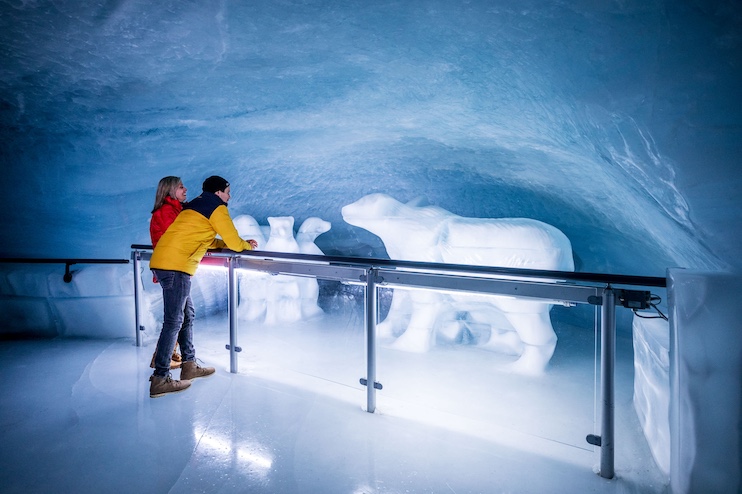
The Ice Palace, carved into the Aletsch Glacier, contains a series of tunnels and ice sculptures. Photo courtesy of Jungfrau Railways
Another part of the tour, the Alpine Sensation multimedia experience, depicts the railway’s fascinating history through photos, audio, music and memorial plaques.
Swiss entrepreneur and visionary Adolf Guyer-Zeller is credited with designing the ambitious plans for the mountain railway from Kleine Scheidegg to the summit of Jungfrau via a long tunnel through the Eiger and Mönch mountains. It was no small feat. Much of the construction work was done by hand using pickaxes, hammers, chisels and explosives. Due to the difficult geological conditions, labor strikes, and inclement weather, construction lasted from 1896 to 1912.
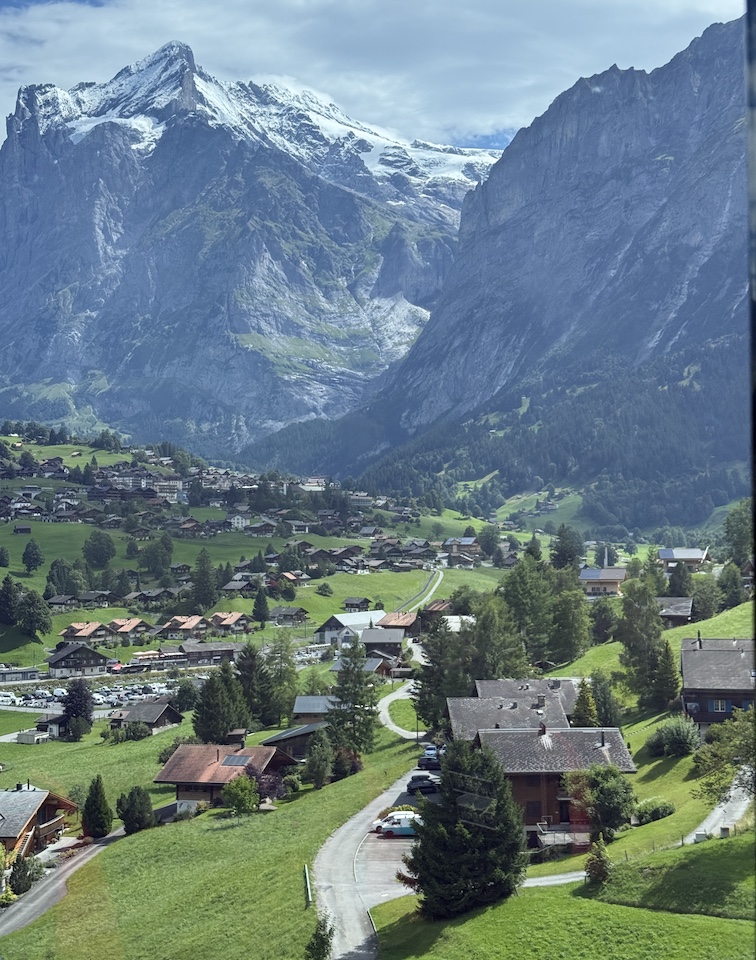
View of Grindelwald from the Eiger Express, a tri-cable gondola that travels between the Eiger Glacier Station and the alpine the village. Photo by Mimi Slawoff
To return to Lauterbrunnen, there are two options: Head directly to Lauterbrunnen or take a detour to visit Grindelwald. For the latter, we rode the cogwheel train to the Eigergltscher station to transfer to the Eiger Express, a tri-cable aerial cableway that travels to noticeably warmer Grindelwald in just 15 minutes. The key is to dress in layers. But there are plenty of shops selling clothing and other items you may need for a day trip. Grindelwald, population nearly 4,000, is among the most touristy Swiss alpine villages, so there’s no shortage of restaurants for a nice meal. From Grindelwald, it’s about a 40-minute train ride to Lauterbrunnen. For an additional cost, cable cars are another option.
Car-Free Murren and Gimmelwald
In contrast to bustling Grindelwald, car-free Mürren and Gimmelwald were delightfully serene. Getting there is fun and easy. From Lauterbrunnen, we rode the Grutschalp cable car for a short ride (about five minutes) to a railway (about a 10-minute ride) that travels to Mürren, high above the Lauterbrunnen Valley. The picturesque village has hotels, restaurants, shops, and a visitors center. It’s a popular alpine village for hiking, skiing, and hang gliding.
The streets are quiet until shops and restaurants open about 10 a.m. Hotel Edelweiss Restaurant is a good option for an outdoor patio lunch with views of Eiger, Mönch, and Jungfrau, as well as hang gliders soaring over the valley.
From Mürren to rustic Gimmelwald, you can walk down a 1.9-mile trail or take a cable car. Either way, Gimmelwald is worth a stop. Gimmelwald is an especially tranquil village that’s ideal for those who truly want to get off the grid.
Home to about 100 residents, the tiny farming village has just one main road, one small hotel (Pension Gimmelwald) and Mountain Hostel with a pizza restaurant. Residents sell produce from their farms, setting out eggs for sale on benches. Along the little road there’s a water pump for drinking water. A small Honesty Shop contains locally made products and a payment reader for credit cards and envelopes for cash. On a free-standing bulletin board were posts for smoke dried sausages, fresh milk, cheese, and fresh eggs.
From Icy Jungfraujoch to Thunderous Trümmelbach Falls
From Gimmelwald, a cable car travels down to Stechelberg and a bus stop with a route to Trümmelbach Falls. There was a long line to get in but it was worth it to see the 10 waterfalls that thunder through a labyrinth of rocks inside the mountain. It’s astonishing to see and hear the sheer force of water crashing through mountain crevices at nearly 5,300 gallons per second.
The Trümmelbach drains the huge glacier walls of the Eiger, Mönch and Jungfrau, and are Europe’s largest subterranean waterfalls. They’re accessible by an elevator, stairs, tunnels, walkways, and platforms.
Joining others, we rode an elevator to the sixth waterfall, the starting point. Next, we carefully navigated several flights of wet stairs through tunnels to see waterfalls seven to ten. There are platforms along the way for different views and to feel the mist. Walking back down are opportunities to see the remaining waterfalls, which eventually tumble into the Trümmelbach stream before joining the Weisse Lütschine River in Lauterbrunnen.
Native Angeleno Mimi Slawoff is an award-winning freelance travel journalist and author of three books about Los Angeles and Ventura Counties. Mimi’s previous story for EWNS featured Affordable Cruise Ship Condos for Digital Nomads Seeking Endless Vacations.