

In the past, travel and interest in culture directed me to deserts and crowded cities. But I did not have a lot of expectations of Antarctica. Icebergs were not essential to the enjoyment of travel and cultural analysis. It started with two days of open sea sailing across the Drake Passage from Ushuaia, Argentina to Antarctica’s South Shetland Islands. I observed giant waves and an unlimited sky from the ship’s deck on which I stood. I knew from its inception that this trip would not be just another ocean ride. It was the start of a very special journey.
It seemed like clear and smooth air when the first iceberg appeared in the distance. Antarctica does not come out of thin air. It gradually unfolds itself in mist, cold air, and varying light. I was standing on the deck when I had my first sight of a piece of blue-white ice. This is when I realised why it is referred to as the seventh continent.
The Drake and Entry to Another World
On the ship, we were led by a French research scientist heading to the South Shetland Islands. He informed us of where we were, the speed of the wind, and our next stop. Bird experts and marine biologists were also able to contribute to their knowledge. The vessel began to resemble a schoolroom. They described the circulation of ocean currents around Antarctica.
Entrance into Guaranteed Ground
Tourism in Antarctica started towards the close of the 1950s, and now over 100,000 tourists come to this region annually. Western governments limit intrusions of the environment in this sensitive field. These guidelines are provided in the Antarctica Treaty.
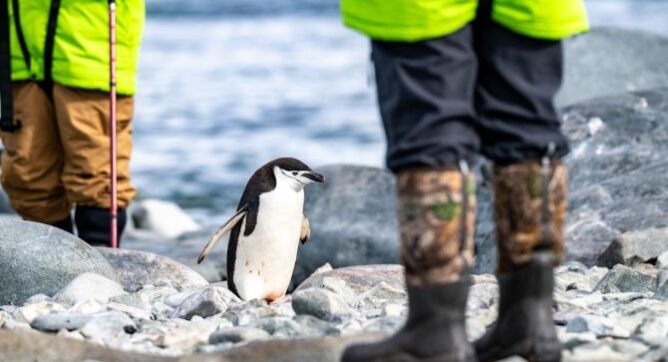
We disembarked the boat and first cleaned off our boots. The restrictions were tougher due to some cases of the bird flu last week. We could not sit on rocks or lay our bags on the snow. We had to clean our equipment in the mudroom of the ship before and after each of our trips. This is what made us remember that we were mere guests in a highly sensitive setting.
Whales at Eye Level
At Fournier Bay, humpback whales approached our boat. We were told to stay quiet. The whales came slowly in our direction. In which they came up out of the water and down again with their huge tails.
Later on the Antarctic Peninsula, at the Bancroft Bay, we were walking on the snow and crunching it under our feet. I was next to my dad, who had already become 75. I saw him silently feeling the moment. It was an experience I would not have shared with him without taking a photo.
Cold Water, Cloudless View
I participated in the Polar Plunge with most of our group in the volcano caldera of Deception Island. The water was extremely cold. It could not be very easily entered. It was not about being brave. It was all about the experiences of the moment and enjoying them.
There were penguin colonies in every direction. Gentoo and Chinstrap penguins strolled on the rocky beaches. Their little chicks were teddy-looking. The sight of them swimming in water was beautiful. But at a distance, there arrived a leopard seal, and it was all silent and dangerous.
I later went kayaking in Yankee Harbor. A thin pink sky illuminated the glaciers. Fur seals were floating around and were peering at my paddle. Antarctica was large, silent, and almost meditative without the noise of engines.
Bottom Line
During our journey back across the Drake Passage, we viewed a documentary film concerning ice-core studies. It described the use of old ice by scientists to learn about climate change. Everything we had seen on the trip was made deeper in the film.
When I reflect on my experience using East-West Travel, now I understand that Antarctica is not just a place to see beautiful things. The continent makes a strong impression on your mind very silently. The memory of ice and the silence remains in your mind even several years later. It will make you remember that the trips will make you look at our planet differently.
For deeper exploration, please refer to the complete article.