

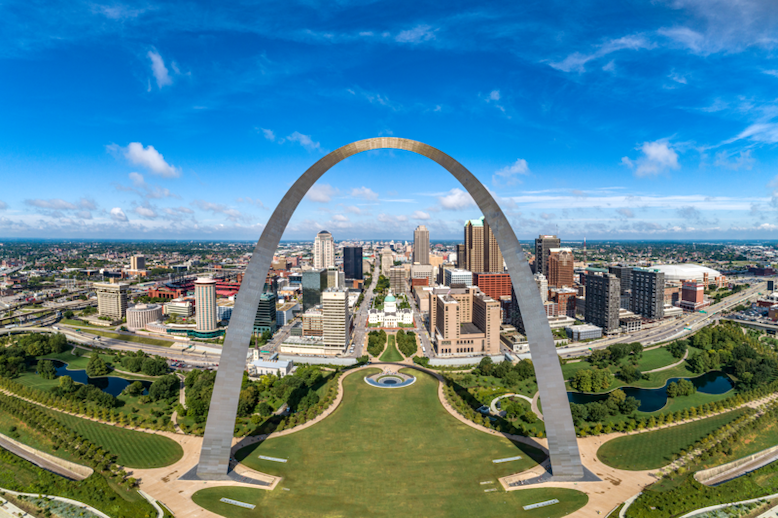
Gateway Arch and downtown St. Louis. Photo courtesy of Gateway Arch National Park.
By Beth Reiber
The silver Arch soars gracefully above the expansive grounds of Gateway Arch National Park on the banks of the Mississippi River. Visible from up to 30 miles away, the St. Louis icon was erected 60 years ago to commemorate the Missouri town’s role in westward expansion during the 1800s. It’s also an engineering miracle, a reflection of 1960s optimism for the future that also sent man to the moon.
Occupying just 91 acres, Gateway Arch National Park might be the smallest in the U.S. national park system, but its Arch is the tallest human-built monument in the United States and the tallest arch in the world, with a tram to the top to boot. Buried beneath Gateway Arch is a Visitor Center and state-of-the-art museum covering 200 years of city history, from its beginnings as a French fur trading settlement to building the Arch. Ever since America declared independence 250 years ago, St. Louis has played a major role in shaping what our country has become.
In fact, you could say that St. Louis’ history is really the story of America. The westernmost battle of the American Revolution took place here. Meriwether Lewis and William Clark embarked from here on their historic journey to explore the riches of President Thomas Jefferson’s Louisiana Purchase. It’s the story of immigration, the riverboat era, of slavery versus freedom, of countless treaties made and broken with America’s Indians, and of the Industrial Revolution.
The Gateway Arch is St. Louis’ most famous attraction, but there’s much more that makes St. Louis the gateway to fun. Forest Park, site of the 1904 World’s Fair, offers museums and a zoo–all free. You can cheer on the St. Louis Cardinals at downtown Busch Stadium, tour the historic Anheuser-Busch brewery, behold architectural marvels like Union Station, and even drive St. Louis’ stretch of Route 66, America’s most famous cross-country road now celebrating its 100th anniversary.
Birth of Gateway Arch National Park
The demise of the riverboat era brought neglect and decay to the St. Louis waterfront. Convinced that an open-air park with a memorial to westward expansion could beautify the city and attract visitors from around the world, lawyer Luther Ely Smith worked tirelessly to make that happen. On December 21, 1935, President Franklin D. Roosevelt proclaimed the development of the Jefferson National Expansion Memorial, to be located on the banks of the Mississippi River where French fur traders had settled in 1764.
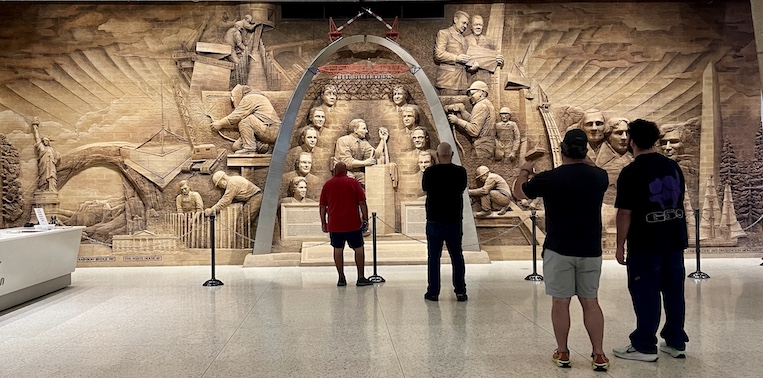
A brick mural in the Visitor Center commemorates those who made the Arch a reality and compares the Arch’s size to other buildings and monuments. Photo by Beth Reiber
The Arch was finally constructed in the 1960s, designed to withstand lightning strikes and sway up to 18 inches in high winds or an earthquake.
In 2018, the historic site was renamed the Gateway Arch National Park, and the new underground Visitor Center and Museum at the Gateway Arch opened their doors.
Building the Gateway Arch
Although little-known architect Eero Saarinen’s design may have looked deceptively simple, creating the 630-foot arch required revolutionary engineering. How could you build something that was too high for scaffolding? How could you prevent it from tipping over? How could both legs, spaced 630 feet apart, meet perfectly at the top so that the very last step, inserting the wedge-shaped keystone into the apex of the arch, didn’t end in failure?
The solution was an arch without an internal skeleton. It would be hollow inside, composed of 132 triangular sections clad with a sandwich of stainless steel on the outside, carbon steel on the inside, and concrete in the middle to stabilize the legs and to serve as a bond between the inner and outer steel skins. The foundations of the Arch, aligned on a north-south axis parallel to the Mississippi River, would be reinforced concrete embedded 60 feet deep, 30 of it in bedrock. But erecting something never before attempted called for mind-boggling innovation.
Construction of the Arch began February 12, 1963. Working on both legs simultaneously, on-the-ground cranes lifted one boxcar-size triangular steel piece after another so that workers could fit it onto the one below and weld them together. When the legs of the arch got too high for cranes, tracks were laid on the curved outer side of each leg to transport platform derricks, creeper cranes, and workmen elevator cars. As the legs grew, more track was laid, and the whole operation moved ever skyward.
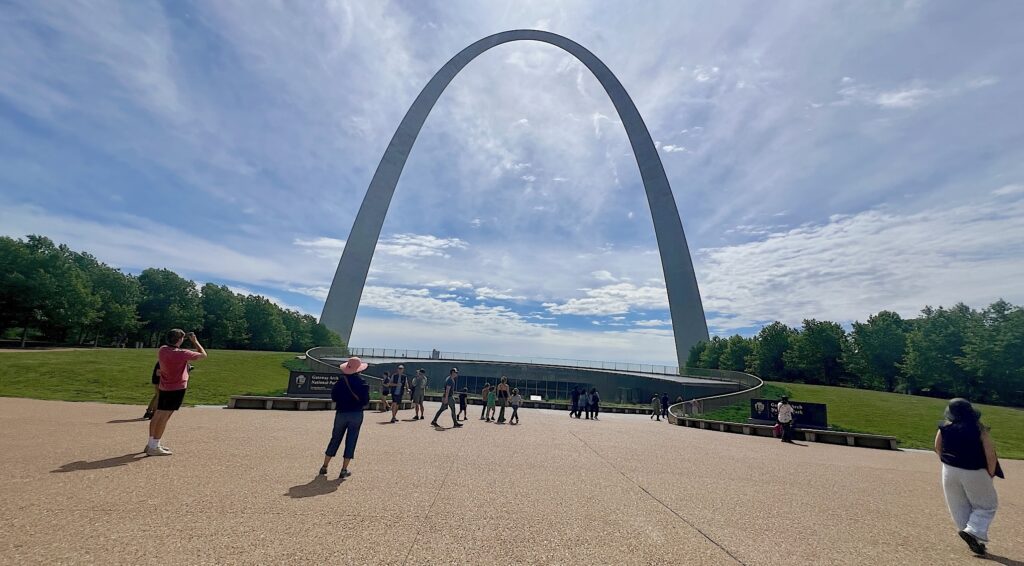
The entrance to Gateway Arch National Park’s underground Visitor Center and Museum. Photo by Beth Reiber
Monument to a Dream
To experience the drama of the Arch’s construction 60 years ago, pay admission to see the 35-minute documentary, Monument to the Dream, shown at the Visitor Center. Using original footage and suspenseful music, the film progresses like a thriller. Cranes, cables, machinery, and stainless-steel sections play their roles as the Arch grows ever higher. Cellphones still in the future, supervisors communicate with crackling walkie-talkies. Workers battle the elements, including high winds, biting cold, and searing heat. Lacking today’s safety standards, people move about without harnesses, despite dizzying heights. Yet not a single person dies.
Even though the audience knows the outcome, the documentary’s climax–seeing whether years of work and calculations would end in success–is still dramatic. The final day, October 28, 1965, brings such heat that water is sprayed on the stainless steel to cool it. The two legs are jacked four feet apart, and the keystone lifted by cable and crane moves ever closer to its goal. If the legs had been off by just 1/64th of an inch, the Arch would have been a failure.
Sadly, Saarinen never saw the Arch. He died at the age of 51 in 1961, before construction of the country’s most famous arch even began.
Tram Ride to the Top
If building the Gateway Arch seems like a miracle, the fact that you can take a tram to the top is over the moon. Because the Arch curves and the hollow space in the middle decreases from 40 feet at the bottom to only 15.5 feet at the top, conventional elevators were out. Yet elevator designer Dick Bowser created the one-of-a-kind tram system in just two weeks.
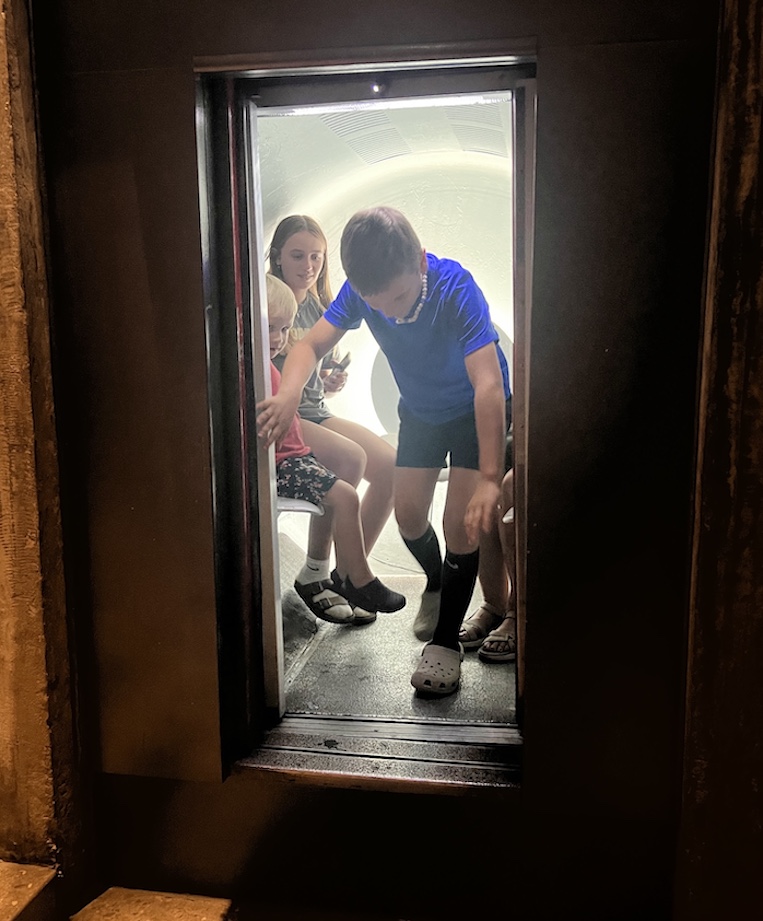
Each Tram to the Top seats five people on chairs designed by architect Eero Saarinen. Photo by Beth Reiber
When the tram became operational in 1967, it must have seemed like taking a ride into the future. Each compartment has just five seats–designed by Saarinen and resembling his famous tulip chair. The ride is four minutes up to the observation deck and three minutes back down, with trams running on both sides of the arch legs. Visitors have seven to nine minutes at the top, which turns out to be plenty for views up to 30 miles in clear weather. To the east is the Mississippi River and Illinois, while west views are of downtown, Busch Stadium, and the city skyline.
Tram rides require timed tickets. There’s plenty to do while you wait, but purchase tickets in advance during busy summer months. Because the Tram Ride to the Top involves stairs and is not handicap accessible, the Visitor Center has a keystone replica with real-time webcams showing views from the top.
The Gateway Arch Museum
The free Museum at the Gateway Arch is the second-most important thing to see, a kaleidoscope of colorful exhibits, interactive displays, and historic relics covering 200 years of St. Louis history.
You’ll learn about Colonial St. Louis, established in 1764 by French fur traders for its advantageous location near the confluence of the Mississippi and Missouri rivers. Thomas Jefferson’s 1803 Louisiana Purchase vastly multiplied American territory west of the Mississippi, with St. Louis profiting handsomely from westward expansion. The museum’s Lewis and Clark exhibit shows tools they brought with them, the indigenous people who helped them, and plants they discovered along the way.
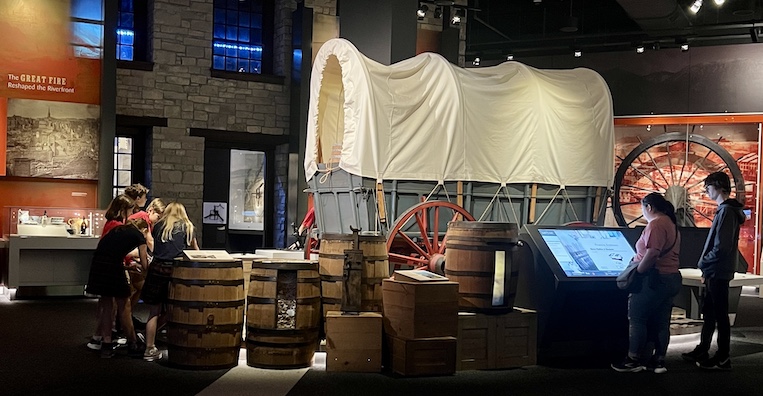
A covered wagon (nicknamed a “prairie schooner”) and other items that accompanied people traveling westward are on display at the Museum at the Gateway Arch. Photo by Beth Reiber
It wasn’t long before travelers seeking land, riches, or religious freedom headed westward. Between 1840 and 1860, an estimated 300,000 people migrated over the Oregon, Mormon, and California trails. Many bought their provisions on the St. Louis riverfront, making it the third-busiest port on the continent. Some immigrants stayed, especially the Germans and Irish, so that by 1850, as many as 43 percent of the city’s population was foreign-born.
To experience the bustling St. Louis riverfront of the 1850s, don 3-D headsets at the Virtual Reality Theater, where you’ll be surrounded by 360-degree scenes of steamboats, dock workers, slaves, German immigrants, and townspeople. Ponder the question asked by one of the actors at the end of the 12-minute experience: “I wonder what lessons people will take from us 150 years from now?”
The museum goes on to show how the West was memorialized and fictionalized in art, literature, and film, including clips of Hollywood Westerns. Meanwhile, St. Louis became an economic and manufacturing powerhouse with the advent of the Industrial Revolution.
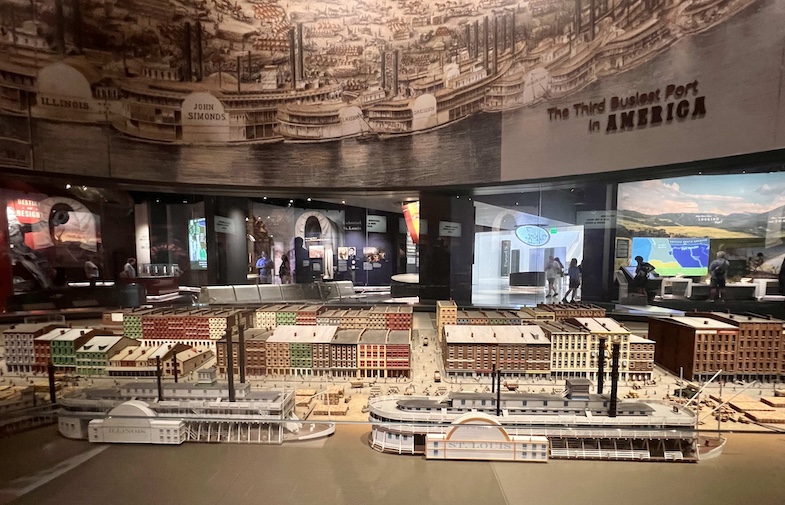
A model of the 1850s St. Louis riverfront at Museum at the Gateway Arch. Photo by Beth Reiber
The last exhibit is devoted to the Arch, including design and construction, oral commentaries from workers, and models of other ideas submitted for the architectural competition. It’s hard to imagine any of those other designs as dramatic as the Gateway Arch.
Beyond the Arch
Above ground are 11 acres of parkland and five miles of paved path. Take the Grand Staircase down to the Mississippi River, where you can board a replica 19th-century paddle-wheeler for different views of the riverfront skyline.
East of the Arch stands a plaque commemorating the Battle of Fort San Carlos, the westernmost reach of the American Revolutionary War. It was here, along what is now Fourth Street, that French settlers, enslaved and free African Americans, and Spanish soldiers (St. Louis was under Spain at the time) dug a mile-long trench circling the colonial town. On May 26, 1780, allied British and American Indian forces attacked, but the outnumbered 300 townspeople succeeded in defending their position, preventing the British from taking control of the upper Mississippi River.
Across Fourth Street is the imposing Old Courthouse, built in Greek Revival style from 1839 to 1862. Reopened in 2025 after a five-year renovation, the Old Courthouse is most famous for the suit Dred and Harriet Scott filed for their freedom in 1848. Although the Scotts won their case, both the Missouri and U.S. Supreme Courts overturned the decision, upholding slavery and inching the nation closer to civil war. Rooms throughout the courthouse serve as museums, where you can learn about the building’s history, the U.S. court system, the lives of Dred and Harriet Scott, and slavery in St. Louis.
More St. Louis Architectural Gems
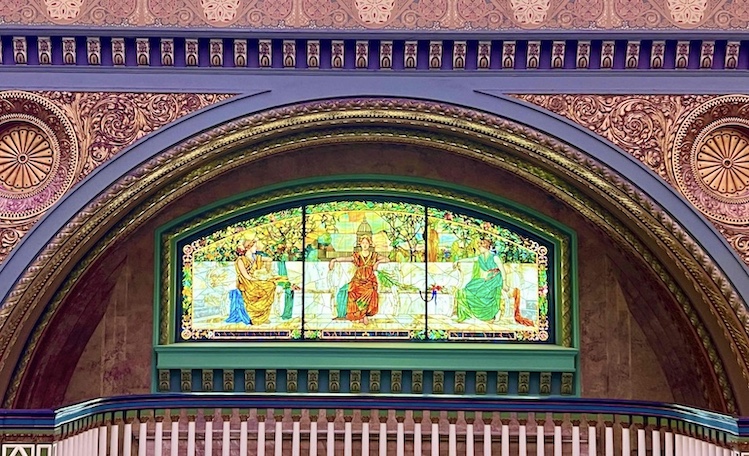
The famous stained-glass window at Union Station depicts the Gods of New York (right) and San Francisco (left) staring reverentially at the Goddess of St. Louis. Photo by Beth Reiber
It’s no contest: Gateway Arch is one of the most recognized structures on the continent. More than 2 million people visit Gateway Arch National Park every year.
“As many as 300 businesses use the Arch in their logo or the name of their company,” says Pam Sanfilippo, Acting Deputy Superintendent at Gateway Arch National Park.
But there are other architectural gems in St. Louis. St. Louis Union Station opened in 1894, soon becoming the largest and busiest rail terminal in the country. Today, it hosts family activities, including an aquarium and a multi-level obstacle course. But the show-stealer is the historic Grand Hall, now the lobby of the Union Station Hotel. Snap a photo of the stained-glass window depicting the span of train travel in the 1890s, represented by three goddesses (San Francisco on the left, New York City on the right, and St. Louis squarely in the middle). Then grab a drink from the bar and settle in to watch the nightly 3D light shows that dance across the 65-foot vaulted ceiling.
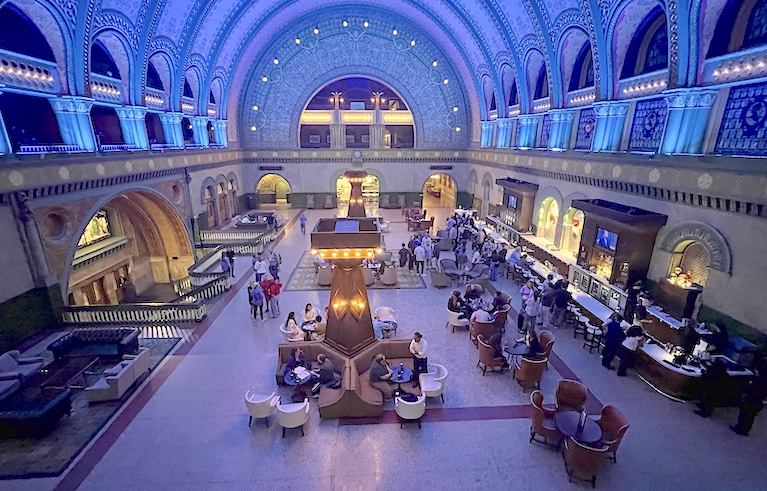
Union Station’s Grand Hall is now the lobby of Union Station Hotel. Beth Reiber photo
Not to be outdone is the Cathedral Basilica of St. Louis. Begun in 1907 and a magnificent tribute to the artisans, stonecutters, and masons who worked on it for more than 80 years, it houses the world’s largest collection of mosaics. Some 145 million pieces of stone and glass cover 83,000 square feet of ceilings, domes, arches, and walls. Not to be missed.
St. Louis Family Fun
Nothing evokes summer like the crack of the bat at downtown’s Busch Stadium. The St. Louis Cardinals baseball team has been swinging bats since 1882, but you don’t have to be a baseball fan to get into the spirit. This being St. Louis, the Arch shines beyond centerfield, where there’s plenty of cold Budweiser beer.
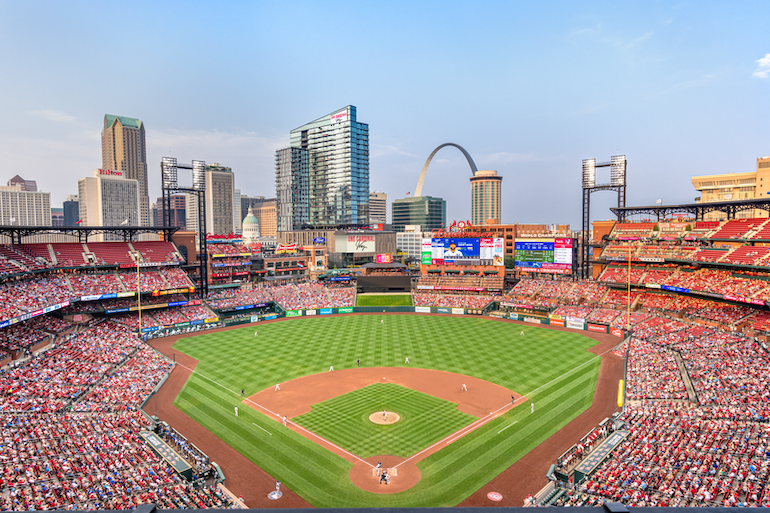
St. Louis Cardinals play home games at Busch Stadium. There is a variety of bars and resdtaurants, but most visitors enjoy strolling about photographing the baseball fans. Photo courtesy of Explore St. Louis.
Anyone can be a kid again at the whimsical City Museum, which isn’t a museum but rather an adventure-filled, artist-designed, ever-evolving playground that defies definition. Housed on four floors of an old shoe factory, it uses repurposed architectural elements from around the city to create indoor and outdoor playgrounds, imaginative caves, more than 30 slides, and tunnels. More mundane things include vintage pinball machines, a 1920 carousel, and performances like dog shows. And where else would you find a collection of 1,000 things found in outhouses? Or a rooftop complete with a Ferris Wheel, a school bus hanging over the edge, and a giant praying mantis?
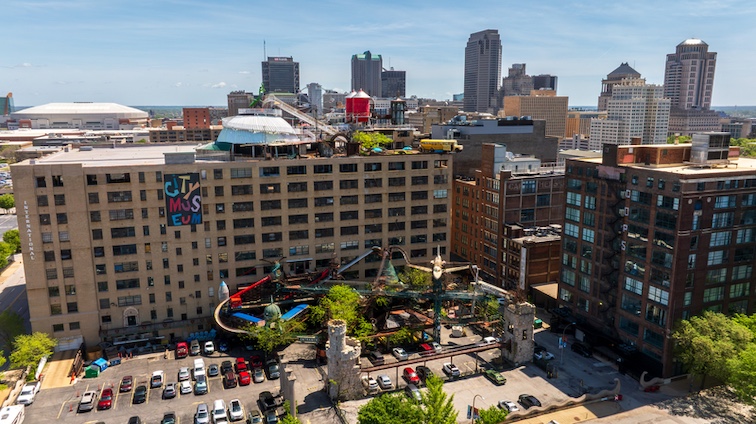
City Museum. Photo courtesy of Explore St. Louis
You could spend a day or more at Forest Park, and not only because it’s 500 acres larger than New York City’s Central Park. The 1904 World’s Fair, held here to commemorate the centennial of Thomas Jefferson’s Louisiana Purchase, introduced 19 million visitors to the first Olympics hosted in the United States and popularized iced tea.
In addition to nature preserves and 30 miles of trails and nature reserves, Forest Park offers a wealth of free attractions, including a world-class zoo, the Saint Louis Science Center with everything from a life-size moving dinosaur to a simulated earthquake, the Missouri History Museum (with a gallery devoted to the World’s Fair), and the Saint Louis Art Museum. The art museum, housed in an American Renaissance building constructed for the World’s Fair, boasts collections from every significant period of art history, from ancient Egypt to modern art. Its pre-Columbian and German Expressionist collections are among the top in the world. Tickets to The Muny, the country’s oldest, largest outdoor musical theater, start at $20.
St. Louis Iconic Eats and Drinks
Route 66 entered St. Louis from Illinois via the Chain of Rocks, a bridge built in 1929 and now pedestrian-only. Unfortunately, few major landmarks remain, but luckily some that do involve food.
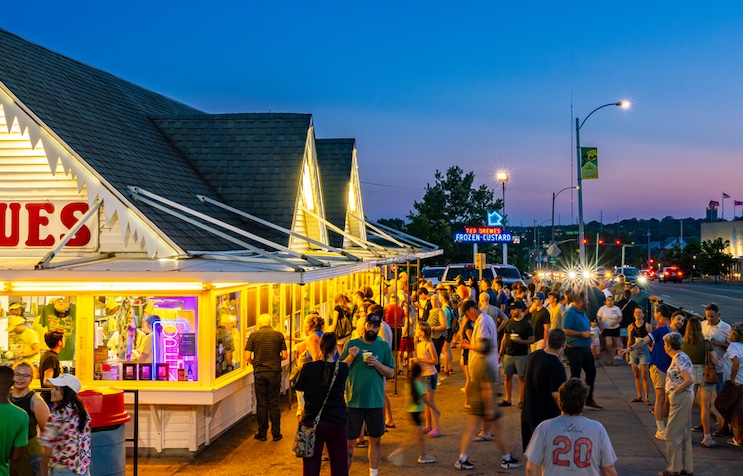
Ted Drewes Frozen Custard. Photo courtesy of Explore St. Louis
Carl’s Drive-In was once a gas station but, since 1959, has been serving burgers, hot dogs, and its own homemade root beer. One of St. Louis’ most beloved institutions is Ted Drewes Frozen Custard, famous for custards so thick you can hold them upside down. For a double sugar rush, down the road is Donut Drive-In, so tiny you’ll queue up outside.
Iconic dishes in St. Louis include toasted ravioli (fried, with marinara sauce inside), St. Louis’ own style of pizza (super-thin with a blend of cheddar, provolone, and Swiss cheeses), and gooey butter cake (essentially butter and sugar).
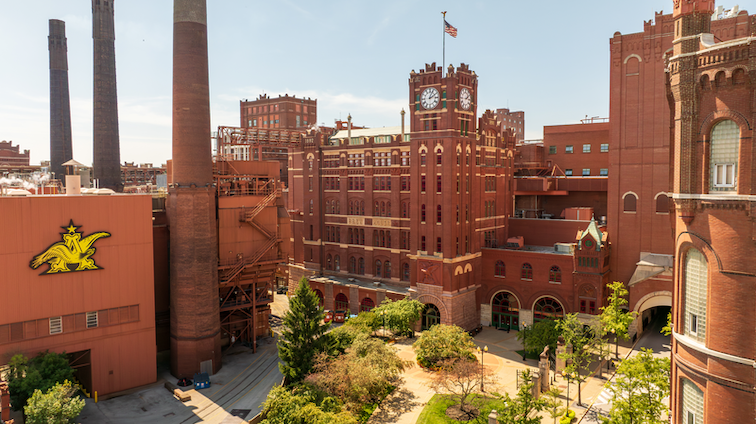
Anheuser-Busch Brewery. Photo courtesy of Explore St. Louis
But could the drink of choice be anything but beer? St. Louis is home to about 70 breweries, including craft breweries like 4 Hands Brewery near downtown and Schlafly, which pioneered craft brewing about 35 years ago. But the big name in town is Anheuser-Busch, which began in the 1850s as a small neighborhood brewery and now has 100 facilities across the country. Its St. Louis flagship offers a variety of tours, including those that take in its historic campus and those famous Clydesdale horses.
Beth Reiber lives in Kansas, west of St. Louis, but also feels at home in Japan, where she reported on Forest Bathing and Japan’s Cultural Handicrafts.