

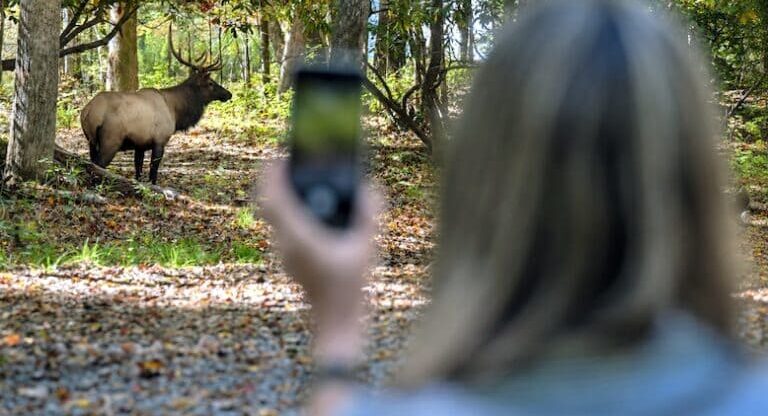
The bull elk has an unusual way of attracting females. First, he scrapes the ground with his antlers, then urinates on the dirt and himself before settling into the mixture. It is rut season in the Smokies, and this is the elk version of cologne.
Naturalist Liz Domingue is delighted by the display. “And he did the whole thing right there!” she tells our group in Cataloochee Valley, a remote corner of Great Smoky Mountains National Park. She is a wildlife biologist and professional guide.
Then the bull lifts his head and bugles. The sound starts as a low groan before rising into a high, whistling scream that echoes through the valley and fades into the cold morning air. I feel it in my chest. I traveled here from my home in Columbus, Ohio, where I work as a photographer. I wanted to try wildlife photography. Elk seemed less intimidating than bears. I was also curious about the mountain communities around the park and the people who call this place home.
What I found were two comeback stories. Elk, once gone from these mountains, have been returning since 2001. Beyond the park, Haywood County is rebuilding after Hurricane Helene’s floods in 2024. Both stories depend on protecting the beauty and Appalachian heritage that bring visitors here. This North America travel article explores the region’s remarkable wildlife recovery, local culture, and the communities working to preserve the Smokies for future generations.
How Did Elk Return After More Than a Century?
Cataloochee Valley is reached by a winding gravel road. Hardwood forests glow red and gold. When we step out, the air smells of damp leaves and wet earth. Hunting and habitat loss eliminated elk from the region more than a century ago. In 2001, wildlife managers released 25 elk into Cataloochee, and then 27 more the next year.
The herd has since grown to more than 250 elk, according to a brochure I picked up at the Lake Junaluska welcome center.
Katie Liming, chief of staff for the national park, calls the reintroduction a success. She says it followed extensive research and careful wildlife management.
How Can You Watch Wildlife the Right Way?
The fall rut makes male elk more active and sometimes aggressive. The National Park Service requires visitors to stay at least 25 yards away. A safe distance also lets wildlife move freely.
Who Lived in the Valley Before the Park?
Cataloochee Valley lies within the ancestral homeland of the Cherokee people. Many Cherokee were forcibly removed in the 1830s, although others remained. Their descendants include members of today’s Eastern Band of Cherokee Indians.
European American settlers later built farms here. By the early 20th century, about 1,200 people lived here. When the national park was established in the 1930s, residents had to leave. Historic houses, churches, and a school still stand.
Life After Hurricane Helene
My base for exploring Haywood County is Lake Junaluska, a historic retreat community where mountains rise beyond the water. One October morning, I watch an angler fish from a small boat while clouds hang over the ridges. “We’re right in the center of Haywood County, between the Blue Ridge Parkway and Great Smoky Mountains National Park,” says Pauline Pendarvis of Lake Junaluska.
Hurricane Helene’s torrential rains caused catastrophic flooding across western North Carolina in September 2024. Roads, trails, homes, and businesses were damaged. Residents and volunteers have worked to rebuild. Corrina Ruffieux, executive director of the Haywood County Tourism Development Authority, wants travelers to know there is more to the county than its recovery from the storm.
Recovery is just one chapter of Haywood’s story,” she says.
She encourages visitors to meet the people who live here.
“They can tell you more about this place than we ever could.”
In downtown Waynesville, I take her advice.
Five Months with a Box of Pencils
At Pennington Art Gallery, Teresa Pennington has spent more than four decades turning the mountains into colored-pencil drawings. She remembers when the elk first arrived.
“I was in business when they brought the elk back, and it was a big deal,” she says. “We all went to Cataloochee to see them, and it was so exciting.”
Her process begins with a camera. She photographs a landscape, then recreates it in her studio with colored pencils. A single original can take five months.
As a photographer, I appreciate her patience. Waiting for the right light can test mine.
Local Flavor
Near the road to Cataloochee, I stop at Blue Ghost Outpost, a locally owned coffee bar. I wrap my cold hands around a cup of hot, dark coffee. It tastes rich and slightly smoky. In Waynesville, The Scotsman Public House fills the room with Celtic and Appalachian music.
A place worth protecting
Great Smoky Mountains National Park receives roughly 12 million visitors each year. The pandemic-era surge in outdoor recreation added pressure on its roads, trails, and wildlife. I hear concerns from public land managers about crowded trails and damaged resources.
The return of elk is a conservation success story. The recovery of Haywood County shows the resilience of its people. Together, they give a once-vanished animal and the people around it a second chance.
Discover more about the elk’s incredible comeback and the people keeping the Smokies alive through this fascinating travel article: