

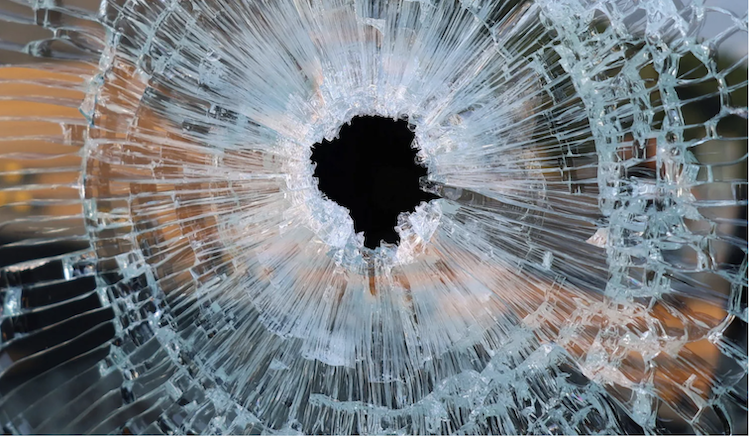
Guadalajara supermarket window shattered by a bullet in last week’s fighting between Mexican drug cartels and the Mexican Army. Photo courtesy of the National Review.
February 22 was a beautiful Sunday morning for our drive around Lake Patzcuaro in the Mexican state of Michoacán. But just as my three friends and I exited our rental car in Erongaricuaro, one of many artisan towns ringing the lake, we heard a loud boom just on the other side of a stone wall. It was followed by a minute-long burst of rat-tat-tats that sounded like a fusillade of firecrackers.
I wasn’t concerned initially, until I saw men scurrying down the street and a mother fearfully running in the opposite direction, pulling her young daughter behind her. By the time we walked the short distance to the intersection shopkeepers had closed their doors, and the main street was eerily void of cars and pedestrians.
On the corner, a driver cowered beside his empty bus, his customers, I assumed, already in a shop.
“Peligroso!” he said, his hand making a fist, his thumb pointed upward, his index finger stretched straight out. It was clearly the sign of a gun.
Were we really in danger? I’d never heard the sound of automatic gunfire before. But we quickly agreed to get out of there as quickly as possible. The main plaza, usually the center of Mexican life everywhere, was deserted.
We were shaken but had no reason to believe it was anything more than an isolated incident. That is, until the owner of our rental car called about an hour later and urged us to return to Patzcuaro. Immediately! At that point we searched our phones and learned that the country’s most wanted cartel boss, Nemesio Oseguera “El Mencho” Cervantes, had been killed by the Mexican government. Still, we didn’t notice anything out of the ordinary on our drive back to Patzcuaro, a historic town popular with vacationing Mexicans, except that it seemed subdued for a Sunday, with fewer people out and about.
It was only when we turned on Mexican TV and saw the burning trucks, gas stations, banks and businesses, that we realized the extent of violence across the country. The state of Jalisco seemed hardest hit, especially its capital, Guadalajara, and the tourist beachside town of Puerto Vallarta. But there were also videos of burning cars on the freeway between Patzcuaro and Morelia, Michoacán’s capital and our closest airport. I was relieved there were no reports of people being dragged out and shot before their cars and businesses were set on fire.
Five states were told to “shelter in place,” including Jalisco and Michoacán. Flights were cancelled, and school was called off for Monday.
But we found it difficult to get immediate information. Local reports on Facebook, according to a hotelier, were riddled with fake videos. Friends and family, alarmed by what they were seeing on U.S. television and social media texted and called us.
One husband urged his wife to stay in our hotel and not venture out. The daughter of another friend insisted her mother put an alert on her phone so that her movement could be tracked. My mother called twice, deeply afraid of what she was seeing on CNN. But I assured her that I was fine, that the news we see almost always represents the worst and most sensational, because that’s what sells. All of Mexico was not going up in flames.
But here’s the thing. Even before our arrival, the U.S. State Department had warned about gang activity in Michoacán. But none of the locals or foreigners I interviewed considers Patzcuaro a danger zone. This was confirmed a day later, when the Canadian government put out a warning to avoid non-essential travel in Michoacán, with the exceptions of Morelia and Patzcuaro.
Rather, it seemed cartels were mostly targeting tourist places with high visibility, like Guadalajara, a host city for the World Cup, and Cancun. Janice, one of the women in my group, heard from friends who had arrived in Puerto Vallarta on Saturday, who said they didn’t venture out for food until Monday, but then they were robbed on the way back to their condo. On Tuesday, from a taxi, they saw burned cars, buses and convenience stores, but people were out in the streets.
We hung low on Monday, and that night I couldn’t sleep, replaying the scene in Erongaricuaro in my mind and thinking of how things could have turned out differently. By Tuesday, people in Patzcuaro were on the streets, including in front of city hall for the annual National Flag Day celebration. It seemed like everyone was breathing a collective sigh of relief that the violence had not escalated.
I don’t want to downplay the brutal killings and disappearances that have wracked Mexico for decades. What everyone here is wondering is what happens next. Will violence increase if rival gangs jockey for position and power?
“There’s no greater freedom than the freedom from fear,” I once wrote about Japan, one of the world’s safest countries that I’ve been covering for decades.
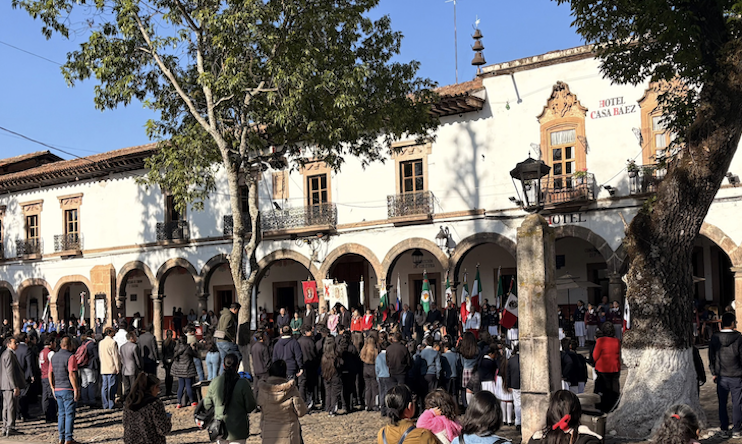
Mountain village of Patzcuaro celebrating Mexican Flag Day 48 hours after drug cartel violence roiled the State of Michoacán.
But I’ve never let fear determine my life. Otherwise, as a travel writer, I never would have ridden a camel into India’s Rajasthan desert bordering Pakistan and slept under the stars. Or left Chiang Mai with only a female friend and a guide to hike into the Golden Triangle where we stayed in a village that grew poppies for the opium trade. Or trekked to Machu Picchu on an Incan trail hugging cliffs with sheer drop-offs.
Maybe I’ve been lucky. Maybe I have a guardian angel. Maybe I’m foolhardy. But sometimes it’s simply a matter of being in the wrong place at the wrong time. Even my next plane or car ride could be my last.
Of course, I’m aware that things could have turned out differently in Erongaricuaro, especially if that stone wall hadn’t shielded us, and we still can’t get an answer to whether people were killed.
Wednesday, as I was sitting on our patio with views over rooftops toward mountains, I heard booms. Whereas I might not have thought much of them before, now my attention immediately went from my book to the peaceful-looking town in front of me.
“Fireworks,” said my friend, Sue, who comes here every winter. “They shoot them off all the time.”
Fireworks all the time, I thought to myself. Until suddenly they aren’t.
Beth Reiber is a contributor for the East-West News Service based in Lawrence, Kansas. Please see her recent story on Japanese handicrafts and the Roman city of Herculaneum.