

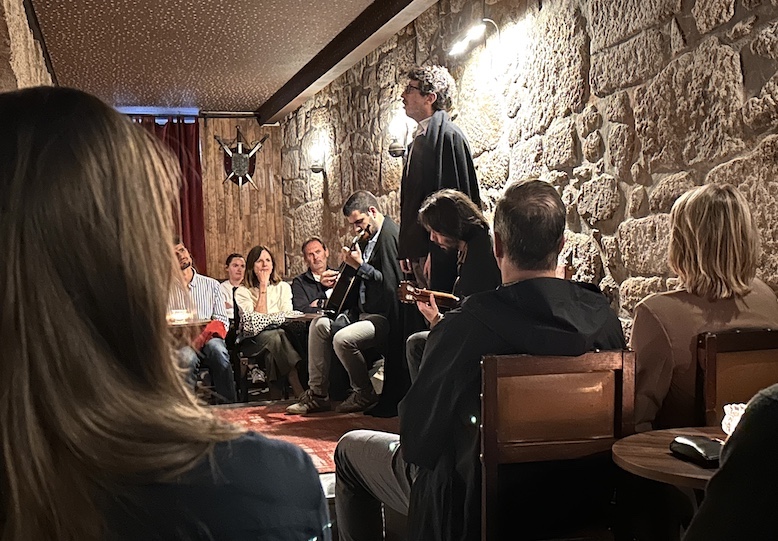
Performers at Porto’s Fado Maior demonstrate the Coimbra style of fado, in which the vocalist and musicians all wear black capes. Photo by Mary Bergin.
Our 10-minute taxi ride from central Porto is a muddled maze of twisty, narrow, and steep-hilled cobblestone streets that ends in the historic Miragaia neighborhood, a couple of blocks from the Douro River.
Families stroll with dogs and children scamper as sunset nears. A pickup game of basketball is about to end. Tourists board the occasional yellow streetcar that creaks along the waterfront.
We are seeking an introduction to Portugal’s fado, music so distinctive that in 2011 UNESCO (the United Nations Educational, Scientific and Cultural Organization) deemed it a treasure of cultural heritage.
We arrive too early to enter the centuries-old tavern that opens nightly for one-hour fado shows. Admission to the Fado Maior is a modest 15 Euros. Our tickets are for the second of the day’s three nearly back-to-back performances.
We take an outdoor seat at the only nearby café, the friendly family-run Casa Mirarcos. We order glasses of Super Bock, the area’s favored lager. Soon the door to Fado Maior opens, and we enter a candlelit, stone-walled, cave-like and intimate (40-seat) pub-theater whose seating arcs around a small, elevated stage with two chairs.
Most of us nurse 5 Euro glasses of Porto wine, the only beverage offered. Quiet murmurs of conversation turn to silence when the first of two fado trios appears. The young male vocalist stays standing, flanked by sitting guitarists.
Let the Music Begin
No microphones or fancy introduction. Just a slight nod to acknowledge the audience. Then the earnest music begins, with electrifying conviction. Although vocals dominate the show, the guitars add an important rhythmic pulse that deepens the dramatic tones that help define fado.
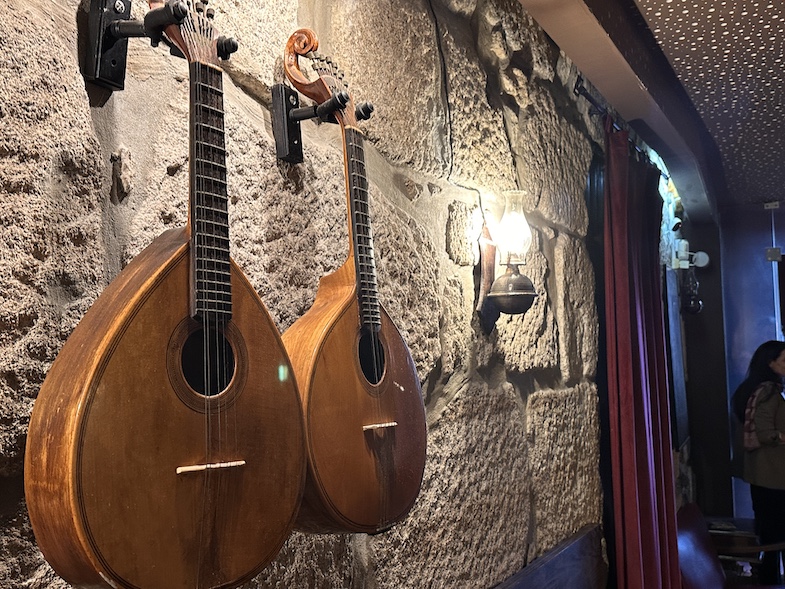
The pear-shaped Portuguese guitar, shown hanging on a Fado Maior wall in Porto, produces a lilting ring that contributes to the distinctiveness of fado music.
The songs mix sentiments ranging from heavy-hearted to triumphant life experiences. What the Portuguese refer to as saudade are cut-to-the-heart memories of deep loss, hope, longing, and survival.
This first trio of Fado Maior performers wears black academic capes, which are associated with fado’s Coimbra academic style, as are the emotion-filled lyrics that emphasize knowledge and the transitions of youth. Between each of the three selections is polite applause, and after a brief break, a second and older trio appears to perform the country’s more traditional fado.
Capes are gone, but black attire remains. So does the wistful and operatic music. But the push-pull of melancholy-joyful themes shifts to the laments, resilience and pride that somehow reflect Portuguese history. Standing tall is a female fadista in a glittery dress with a black-fringed shawl; on her feet are wickedly high, ultra-thin heels.
We notice more head-on-shoulder couples as the performance concludes – and we leave guessing about what we heard. That’s not unusual and no big deal, we are later told, because how the music makes you feel matters much more than the specific story conveyed.
Soulful Sounds
Fado’s hyper-emotional expressions of the heart are told through song. The often-mournful folk music – fado means “fate” – is a proud and enduring part of Portuguese identity. Dozens of evening fado houses operate daily in the country’s largest cities, Lisbon and Porto.
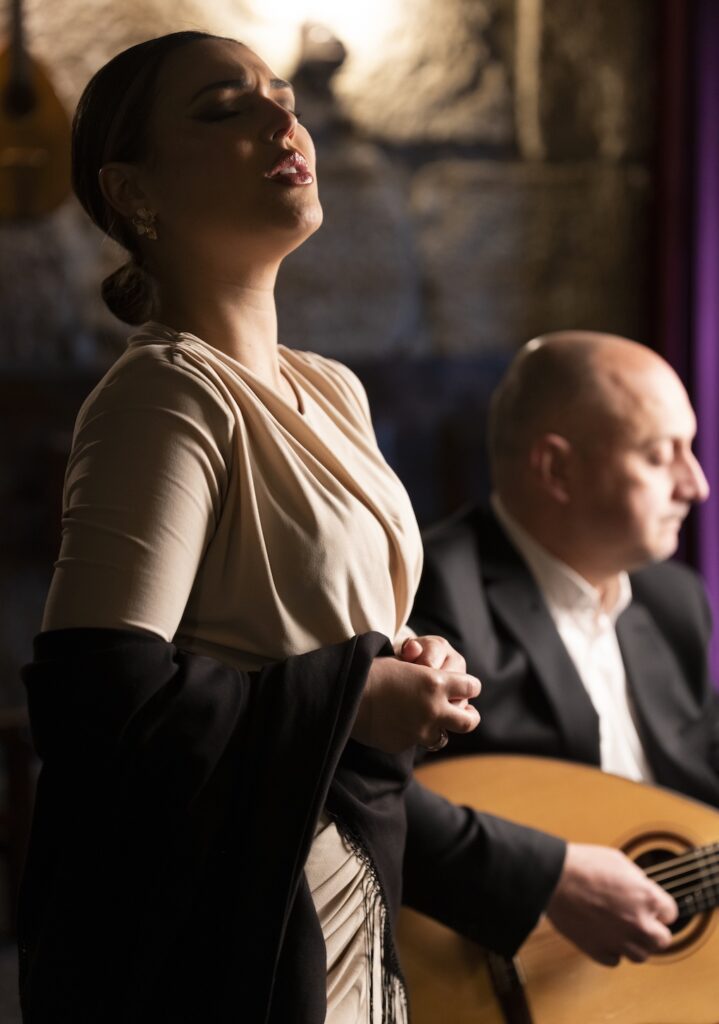
One-hour shows at Fado Maior, near waterfront in Porto, introduce traditional and Coimbra styles of the emotive and sometimes operatic music. Photo from Fado Maior
Don’t confuse fado with neighboring Spain’s flamenco: UNESCO recognizes both forms of emotive music as culturally unique, but a dancer is a key and lively part of a flamenco troupe. The audience at a flamenco performance leans toward jovial, not quiet.
Our Lisbon guides at Wild Walkers Tours say you don’t have to understand Portuguese during a fado concert. What’s most important is the cultural heritage conveyed through its raw emotions.
Between the historic São Jorge Castle and the Lisbon Cathedral in Old Town is the Alfama, Lisbon’s oldest neighborhood. It is ground zero for fado today, as well as fado’s birthplace. Here, laborers of land and sea in the early 1800s spontaneously sang to express and process their losses, longings, regrets, and hardships.
By mid-century, tavern singer Maria Severa turned soulful narratives into more of an artsy show, accompanied by musical instruments. Amália “Queen of Fado” Rodrigues would much later contribute contemporary spins and perform internationally to make the world aware of the art form.
Today, fado shows are a popular tourist draw in Portugal. Setting and price vary wildly. Example: Paying 100-plus Euro for a meal and music in a former Alfama palace is in stark contrast to our 15 Euro experience in Porto.
Fado and Food
We paid 40 Euros for a two-hour guided tour, set-menu dinner and fado show in Lisbon’s artsy and vibrant Bairro Alto nightlife district. Several businesses on Rua do Diario de Noticias advertise fado on a Monday night. Inside our tour’s casual restaurant, there were tables for six to 12 diners, and a traditional Portuguese meal that began with a glass of wine or beer, plus shared servings of marinated olives and slices of brioche.
Then came a starter of pastéis de bacalhau (cod cakes with salad) and entrée of carne de porco á alentejana (clams tossed with pork in a garlic-wine-paprika marinade). For dessert: a syrupy shot of ginja, the country’s beloved cherry-cinnamon liqueur.
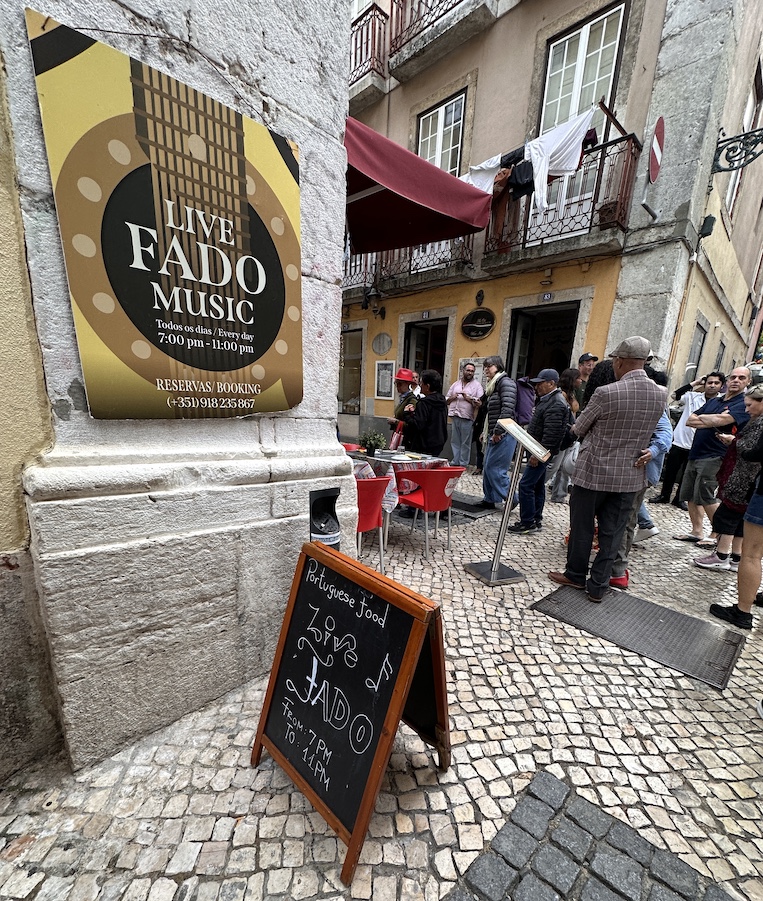
Dozens of fado houses operate daily in Portugal’s largest cities, Lisbon and Porto. A night of fado in the Bairro Alto nightlife district of Lisbon may well be accompanied by a three-course meal and communal dining. Photo by Mary Bergin.
“I had the keys to life, and I didn’t open anything,” our guide offered, as a lyrics translation, between meal courses and after the first of two fado sets. A more joyful song celebrated the mother of a neighborhood. The third was more of a march than fado, paying homage to Lisbon and its history.
UNESCO describes fado as a grassroots combination of music and poetry that has endured for generations. The audience is always expected to stay respectfully silent during a performance, and musicians typically improvise, toggling between historic and contemporary riffs on their dirges.
Regardless of setting, what most fado experiences have in common is the number of performers – one singer and two accompanists (one on an acoustic guitar, the other on a pear-shaped, 12-string Portuguese guitar). Portuguese guitar strings are set up as six pairs and produce a smooth, lilting, ringing sound when plucked with thumb and index finger.
A fado museum in Lisbon addresses additional history and nuances.
What else qualifies globally as artful heritage worth preserving? Kabuki theater in Japan and reggae music in Jamaica are other examples from UNESCO’s list.
Tangible Treasures
Many of UNESCO’s worldwide accolades are reserved for World Heritage sites, extraordinary places to visit in 170 countries. Think Taj Mahal in India, Machu Picchu in Peru, Holy See properties in Italy, Grand Canyon in the U.S.
A greatest hits tour of Portugal will embrace at least some of its remarkable natural and manmade destinations. The country’s 17 World Heritage sites are a sizable number for a small nation. The United States, which is 107 times larger than Portugal, has 26 World Heritage sites.
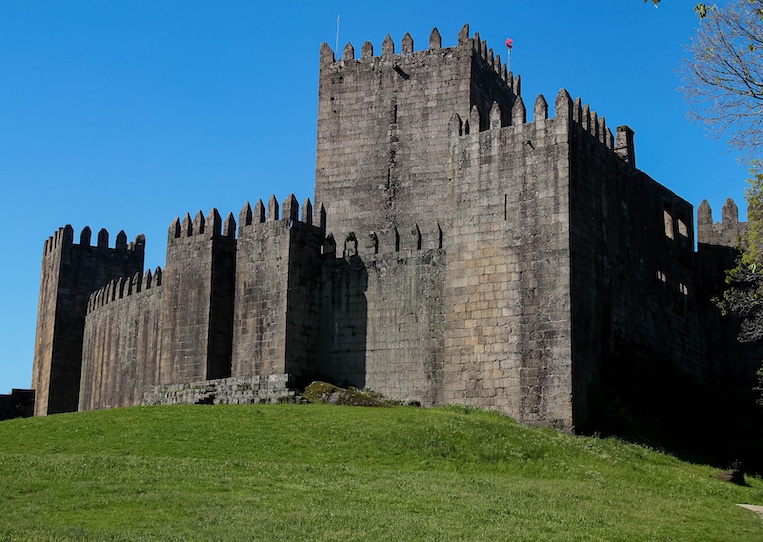
One of Portugal’s most significant examples of medieval architecture is Guimarães Castle. The city was the country’s first capital. Photo by Victor Suárez.
Fourteen UNESCO landmarks are on Portugal’s mainland; the other three are on islands – two on the Azores, one on Madeira.
“For many years, Portugal was a hidden jewel,” says Portugal native and certified tour guide Filipa Fernandes. Hot in beauty and temperature, but “not a destination for tourists.” Times are changing.
The borders of Europe’s oldest country have held steady since 1249. It was also not physically damaged by World War I or II. So many of Portugal’s historical remnants have aged gracefully with the passage of time.
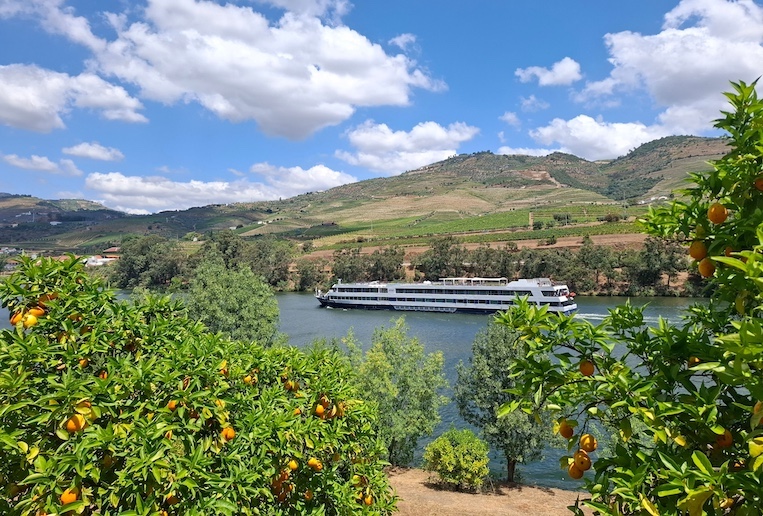
A river cruise ship on the Douro River is framed by orange trees. Travelers are introduced to the river via hourlong to multi-day cruises. The Alto Douro Wine Region in northern Portugal was the world’s first designated and protected viticulture. Photo by Filipa Moreira.
This certainly applies to the 15th-century palace and Romanesque castle of medieval Guimarães, which became Portugal’s first capital. Gothic arches, cobblestone streets and dozens of preserved buildings in the historic district show the evolution of architecture from one century to the next. As you photograph, try to visit the boutiques with embroidered linens and cafes with caldo verde (a cloudy chorizo-veggie greens soup) and rojões (stewed pork).
The Alto Douro Wine Region in northern Portugal is best known for port wine production. Since 1756, its viticulture has been protected by law. UNESCO recognized the area’s distinctive beauty in 2001. Today, dams built over the past century have turned the Douro River into an attractive waterway for hourlong to multi-day cruises.
Inland and roughly 300 miles south is Evora, a European Capital of Culture for 2027 (to showcase art, history, traditions). The home of 15th-century kings has 3,200 UNESCO-protected structures that include the creepy, mesmerizing Capela dos Ossos – a chapel of bones, adorned with the remains of 5,000 human skeletons and created by monks as lessons in morality and mortality.
At the chapel entrance is a bleak message that, when translated, reminds: “We bones that are here, we are waiting for yours.”
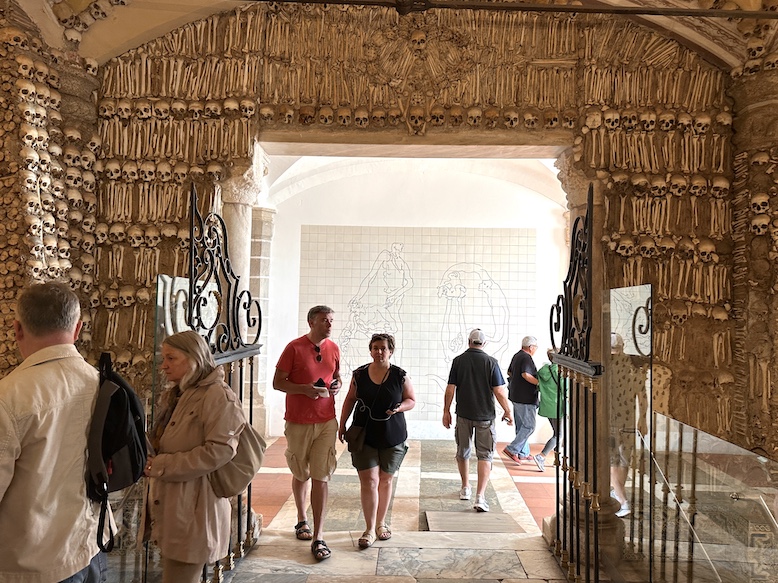
The interior of a most unusual chapel in Évora, Portugal, is adorned with the remains of 5,000 human skeletons. Photo by Mary Bergin.
Diverse Diversions
The campus of Coimbra University (Portugal’s version of Harvard or Oxford) makes the UNESCO cut too. Filling floor-to-ceiling shelves in the school’s opulent, 18th-century Joanine Library are tens of thousands of antique books.
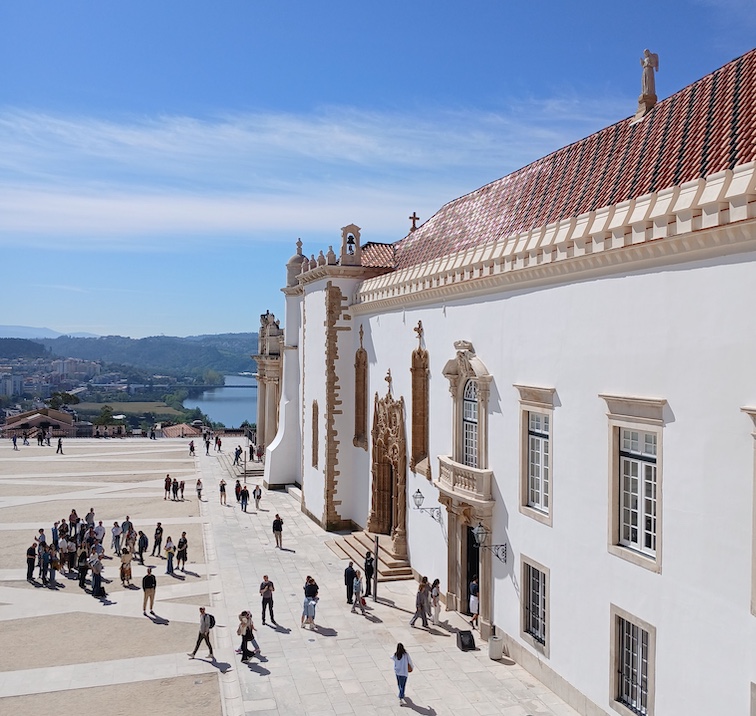
Visitors explore a courtyard at the University of Coimbra, one of the world’s oldest operating campuses for higher education and a UNESCO World Heritage Site. Photo by Botond Varga.
Less than 20 miles from Lisbon is the enchanting hilltop estate of Sintra. It includes castle-like Pena, the country’s oldest palace, which is surrounded by lush gardens and 500 species of trees.
UNESCO also recognizes various Portuguese monasteries and historic districts in communities as large as Porto, where the 12th-century Porto Cathedral features tile murals honoring the Virgin Mary, and as small as Tomar (population 20,000), which is home to the 12th-century Convent of Christ.
Three of Portugal’s World Heritage sites – in Tomar, Coimbra and Porto – are along a 149-mile Camino de Santiago trail that links Porto and Santiago de Compostela in Galicia, Spain. This Portuguese trail is the second most popular of the dozen recognized, marked pathways in the Camino’s network.
People of faith, especially Catholics, walk (or bike ride) when making these pilgrimages. Portugal’s other Camino trail is 383 miles and starts in Lisbon, but it is not marked as well.
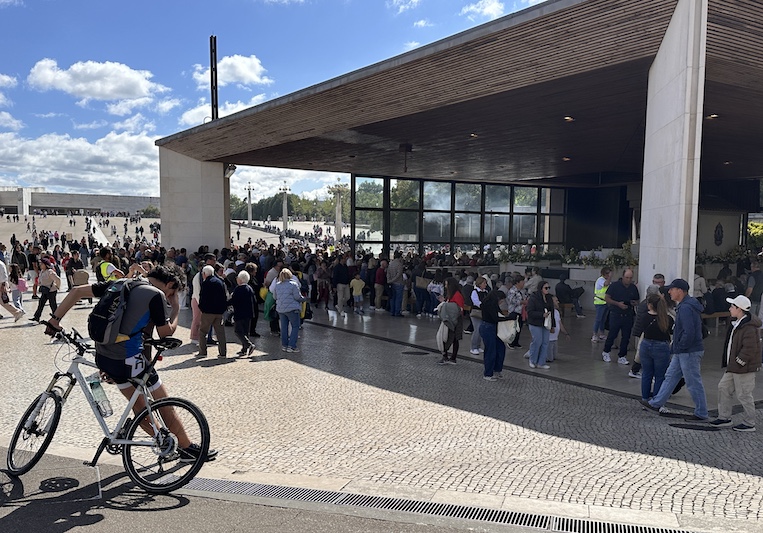
Spiritual pilgrims, especially Catholics, make their way to the massive Shrine at Fatima campus. Some come by bicycle, others by foot – and a few will approach this historic worship space on their knees. Photo by Mary Bergin
A popular detour during a Camino pilgrimage through Portugal starts 18 miles west of Tomar, and leads to the Shrine at Fatima, in a community of 13,000. The shrine attracts six million visitors annually but is not – yet – recognized by UNESCO. The massive religious campus is special because of the belief that this is where three children encountered the Virgin Mary in 1917, and a subsequent, related solar event with 70,000 witnesses was deemed a miracle.
Two basilicas (one seats 8,700 worshippers), prayer spaces sufficient for Mass in seven languages plus a mix of museums and modern art sit on 18.5 acres. Good luck getting it all into one picture frame. The biggest crowds – on an average day – gather at a modest indoor-outdoor chapel, built in 1920, where the apparitions reportedly occurred.
The entirety of Fatima represents a more recent, passionate example of the pride and care that Portugal takes to define and share its identity.
Mary Bergin of Madison, Wisconsin, is a five-time Lowell Thomas Award winner who seeks the exceptional in small-town tourism when writing for the East-West News Service. That includes articles about Türkiye’s Turquoise Coast and America’s Heartland.