

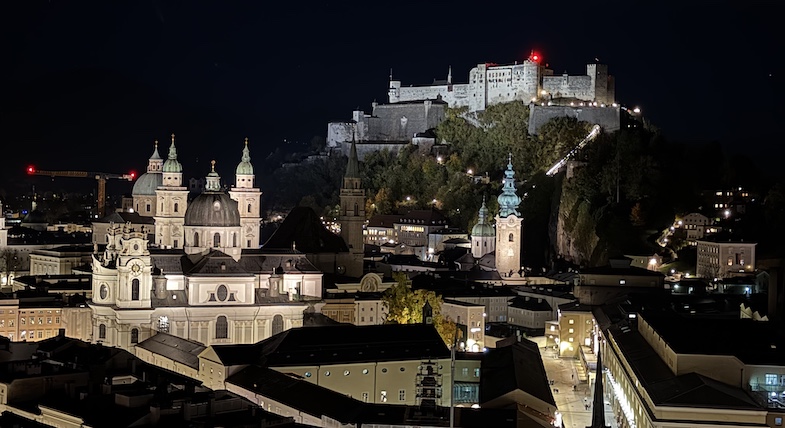
Salzburg’s fortress and the cathedral and palaces below were all built with the wealth derived from the salt trade. Photo by Barbara Noe Kennedy
By Barbara Noe Kennedy
High above Salzburg’s Alstadt (Old Town), the stark, impregnable, 11th-century stronghold of Fortress Hohensalzburg looms over a city long ruled by mighty prince-archbishops—Catholic prelates who wielded both spiritual authority and secular power within the Holy Roman Empire, which lasted from 800 to 1806. Below, amid glittering domes and ornate courtyards, visitors stream through the Salzburg Residenz, where gilded, frescoed galleries once served as the nerve center of ecclesiastical rule. Nearby, the twin spires of Salzburg Cathedral rise above crypts that hold generations of archbishops—stone, gold, and faith fused into a skyline built on power and wealth.
But Salzburg’s rise didn’t begin with fortresses or gilded palaces. It began with salt.
“The development into a prominent baroque residence city would have been unlikely without the sustained income from salt,” said Harald Pernkopf, a spokesperson for Salzwelten FmbH, which manages several of Austria’s premier salt-mine visitor attractions.
Long before prince-archbishops ruled from behind fortress walls and later from grand city palaces, salt—“white gold”—flowed from Alpine deposits at places like Hallstatt and, later, Hallein, fueling one of Central Europe’s oldest economies from prehistoric times through the Bronze and Iron Ages and beyond. That steady mineral wealth paid for Salzburg’s palaces, cathedrals, and cultural ambitions—and even gave the city its name (“Salt Fortress,” a nod to the salt trade along the Salzach River).
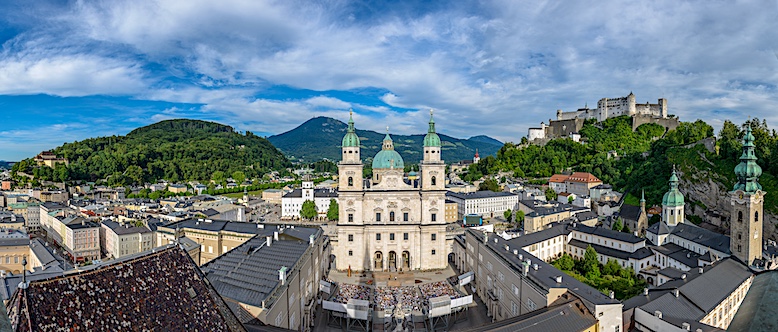
Salzburg’s Cathedral Square is also known as Festspielplatz Domplatz. Photo courtesy of Tourismus Salzburg GmbH
It’s a story more than 7,000 years in the making and one you can still follow today. There’s no official “salt road,” but a constellation of sites scattered across the region reveals the varied layers of Austria’s salt legacy.
Hallstatt
Drive about 40 miles southeast from Salzburg through the jagged peaks of the Dachstein Alps and you arrive in tiny Hallstatt, its 16th-century stone and wood houses perched delicately on the edge of a glassy, mountain-fringed Alpine lake.
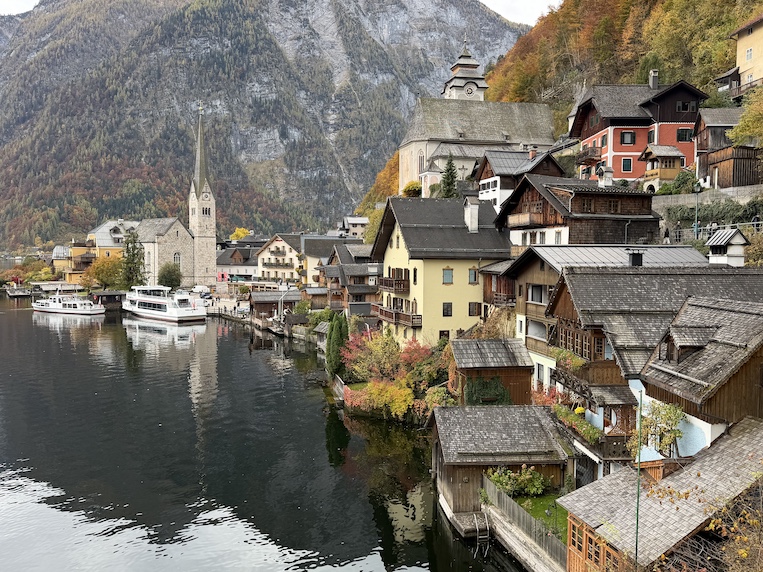
Downtown Hallstatt with salt mountain in the background. Photo by Barbara Noe Kennedy
Step inside, where flowery pedestrian lanes wander among Austrian gastlocals and shops brimming with locally carved wooden bowls, leather Lederhosen, and Christmas ornaments, with views over the mountain-edged lake at every turn. Hallstatt’s postcard charm ignited an onslaught of tourists since 2006, when a South Korean romantic drama catapulted it to viral fame, even inspiring a full-scale replica in China. Be forewarned: the tiny lanes can feel like swimming upstream as tour buses unload their charges along the swan-dotted lakeshore.
Among its most fascinating offerings, the Parish Church of the Assumption of the Virgin Mary is a mélange of Romanesque, late Gothic, and Baroque styles dating back nearly nine centuries. Salt miners donated its elaborate altar around 1500, while in the nearby ossuary, the skulls of former Hallstätters are hand-painted with flowers, animals, symbols, and their dates of death.
Archaeologists have another reason to spotlight this town. Yes—salt.
Recent discoveries show people were living in this Alpine landscape far earlier than once believed. Excavations in 2023–24 uncovered Neolithic flint blades, hammer stones, animal bones, and pottery fragments dating to around 5500 B.C., evidence that communities occupied the region some 7,500 years ago. Large-scale salt production had not yet begun, but these early settlers were already inhabiting the mountains that would later fuel one of Europe’s richest mineral economies.
By around 1500 B.C., during the Middle Bronze Age, Hallstatt had developed into a major salt-production center. At first, natural brine was collected in vessels and evaporated through systematic processing; later, underground mining replaced these early techniques.
Salt’s importance in ancient life was enormous. “In the Iron Age, salt was necessary for preserving food,” said Benjamin Mühlbachler, citing archaeological research by Keltenmuseum Hallein’s museum director, Florian Knopp, and archaeologist Anna Holzner.
That prosperity grew dramatically during the Early Iron Age (roughly 800–400 B.C.), when Hallstatt emerged as a major center of long-distance European trade. So influential was the settlement that archaeologists named the wider cultural sphere the Hallstatt culture. Rich burial grounds in the surrounding hills contain imported luxury goods—ornaments, weapons, and other prestige objects—revealing how widely salt from this Alpine valley circulated across the continent.
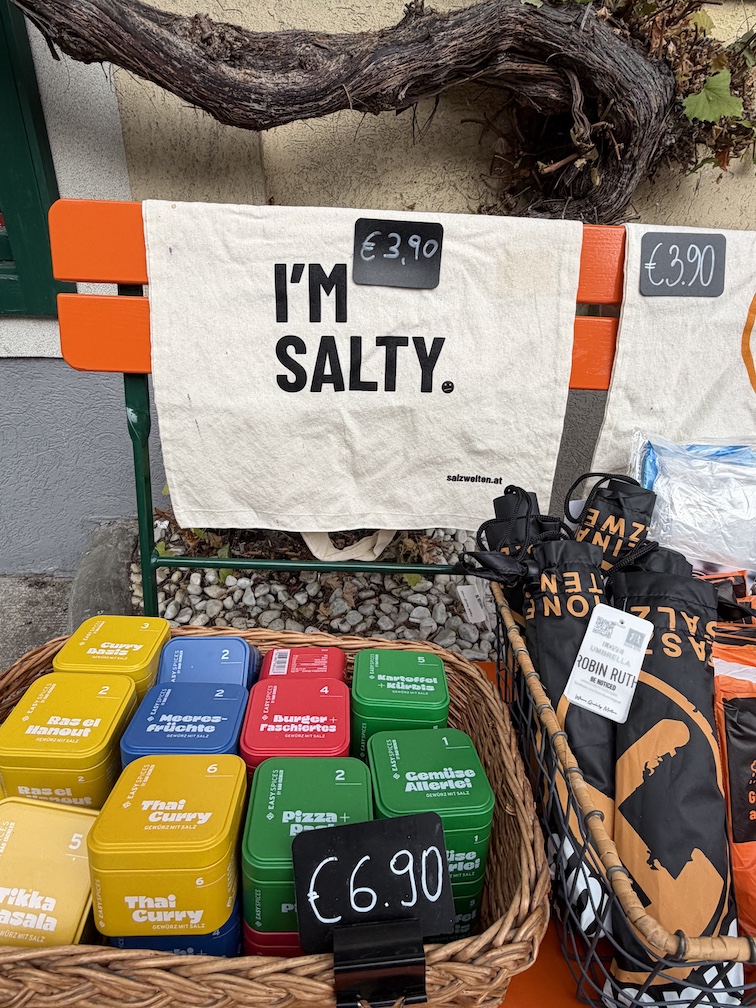
Street vendors sell salted foodstuffs in Hallstatt. Photo by Barbara Noe Kennedy
While Hallstatt’s visitor mine is currently undergoing major renovation (with reopening projected for mid-2026), visitors can explore the story at the compact but illuminating Hallstatt World Heritage Museum near the lakefront. The museum traces more than 7,000 years of human presence in the Salzkammergut, from Neolithic settlers to Iron Age miners to the medieval merchants who helped shape Central Europe’s trade networks.
Artifacts recovered from the surrounding mountains bring Hallstatt’s salt story into sharp focus: stone tools, ceramics, burial objects, and personal items preserved by the region’s uniquely salty conditions. Few places in Europe have safeguarded organic material so well—textiles, leather, even food remnants—offering rare glimpses into prehistoric daily life. The displays connect geology and civilization, revealing how this quiet Alpine village once sat at the center of a vast economic web.
Hallein
As demand for the mineral grew and trade networks expanded across Central Europe, mining spread westward through the Alps to new deposits—most notably to Dürrnberg mountain, near the town of Hallein. Today, the evolution of Austria’s salt story is best explored through Salzwelten Hallein, the world’s oldest visitor salt mine.
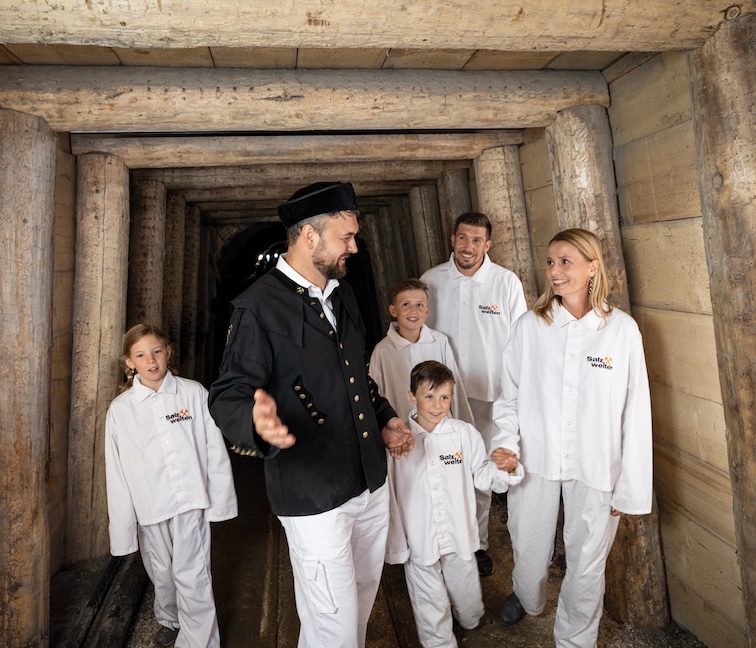
Tour guide shows visiting family around the Saltzwelten Hallein salt mine in Hallein. Photo by bergauer
At the entrance, visitors pull on white miner suits to protect their clothes, then hop aboard a small mine train that rattles into the mountain’s dark, time-worn tunnels. Along the way, they glide down polished wooden slides and cross a glassy underground salt lake by boat, pausing in damp chambers carved thousands of years ago as guides trace salt’s evolution from Iron Age ingenuity to medieval industry to modern tourism.
Celtic miners were already working these mountains around 600 B.C., using a technique known as dry mining. According to Mühlbachler, the salt-bearing rock was chipped out “using iron winged picks with wooden handles made of beech,” tools archaeologists have recovered from the mines, preserved for more than two millennia by the salt itself.
Mining technology evolved dramatically over time. When underground operations resumed in the Middle Ages, miners introduced wet mining, running water over rock salt and channeling the resulting brine out of the mountain.
“Once the water became saturated, the brine could be transported through wooden pipes and channels to Hallein,” Mühlbachler said, where it was boiled in evaporation pans to produce valuable salt crystals.
All tours end in the expansive, salt-themed gift shop, where you can browse every manner of Hallein salt, sold in bottles and gift packs and blended with flavors such as citrus, hot pepper, and lavender. Trace elements give Hallein salt its distinctive depth of flavor and is also believed to offer health benefits.
In town, the Celtic Museum, housed in the former Salt Offices, adds texture to the story. Among its treasures are lavish grave goods and imported luxuries discovered in nearby Iron Age tombs that testify to the fortunes made from salt and the surprisingly vast trade world it once powered.
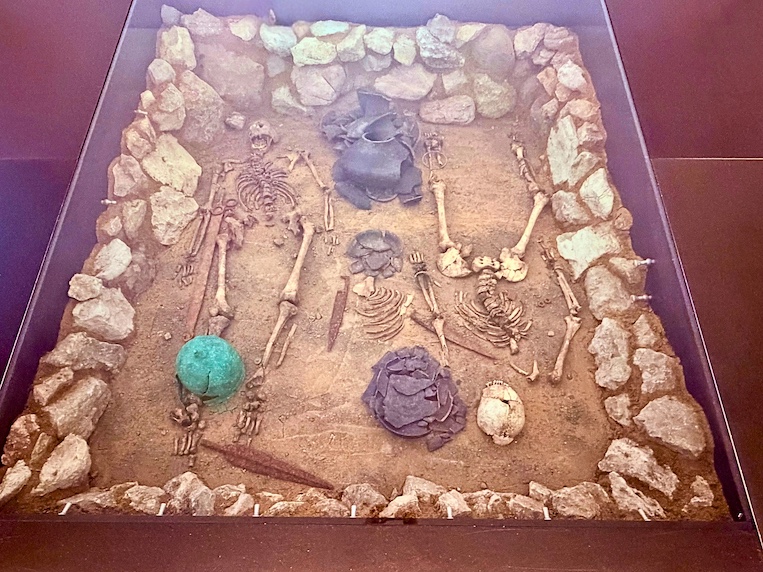
Reconstructed Iron-Age Celtic grave from the Dürrnberg near Hallein is now on display at the Celtic Museum. Photo by Barbara Noe Kennedy
“The Celts at Dürrnberg maintained far-reaching trade connections,” Mühlbachler explained. Imported goods found in the graves include amber from the Baltic, coral from the Mediterranean, and even Greek ceramics—luxury items that reveal how the salt trade linked this Alpine mining community to networks stretching across Europe.
In the twelfth century, the archbishops of Salzburg rediscovered Dürmber’s salt deposits, turning it into the cornerstone of their financial might. The town’s location on the Salzach River, a natural corridor through the Alps, made it a perfect hub for trade—Salzburg lies just 8 miles downstream.
“The salt could be transported along the Salzach River to Salzburg, with access to long-distance routes across the Tauern passes and toward Bavaria,” Mühlbachler said.
Not only was it the money earner for the imperial city of Salzburg, but it also contributed to Hallein’s elegance as well—its Alstadt remains one of Europe’s most unspoiled old towns. Take a stroll through its cobblestone lanes to admire the beautifully restored medieval architecture, mercifully having survived World War II.
Here, too, you’ll find stories that reach beyond salt at the Silent Night Museum Hallein. It’s dedicated to organist Frank Xaver Gruber, who co-composed the melody for the enduring Christmas carol “Stille Nacht, Heilige Nacht” (“Silent Night, Holy Night”); the lyrics were written earlier by priest Joseph Mohr, and the song was first performed on Christmas Eve 1818. He lived in this house for 25 years with his family—claiming he had three wives and twelve children born in wedlock—and the modern redesigned rooms are filled with original mementos, including his writing secretary, sheet music, and piano.
Many of the historic buildings now house cafes and restaurants, including Aarons Genusskrämerei, where chef-owner Aaron Prieasser transforms regional ingredients into inventive, beautifully plated dishes. A recent spring menu featured Arctic char salad with kohlrabi, snow pea raviolo, and salmon trout with wild garlic gnocchi.
Salzburg
And so, the story returns to Salzburg, literally a city built on salt.
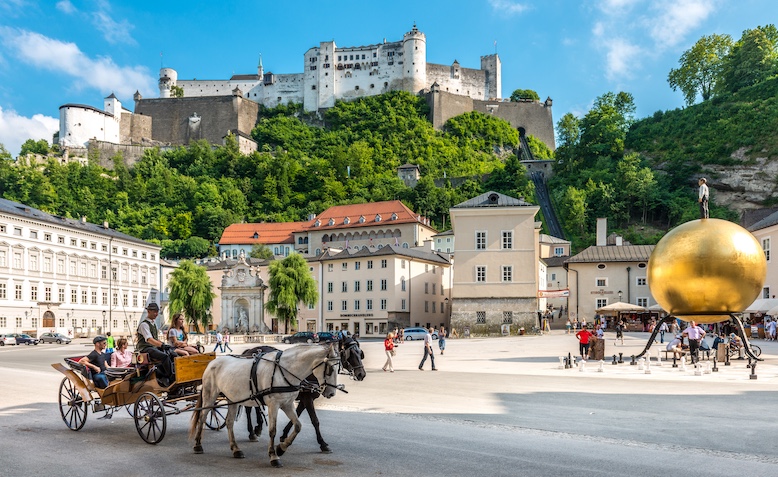
Kapitelplatz Festung in Salzburg’s Old Town center offers carriage rides and cafes serving delicious cakes. Photo courtesy of Tourismus Salzburg GmbH
After medieval prince-archbishops seized control of the Hallein mines and taxed trade, they ruled from here an ecclesiastical state within the Holy Roman Empire—a realm that would not join Austria until the 19th century.
By 1600, roughly three-quarters of Salzburg’s income came from the salt industry, according to research from the Keltenmuseum Hallein. With that steady revenue, the archbishops reshaped Salzburg into a baroque masterpiece, pouring mineral wealth into fortresses, palaces, and cathedrals.
That legacy comes alive at Fortress Hohensalzburg—the castle above the city—which served not only as an early prince-archbishop’s residence but also as a repository for the domain’s salt. Construction began in 1077 as a wall and residential tower and continued through the following six centuries. Inside, the late-medieval State Rooms reveal twisted marble columns, Gothic portals, ornate ceramic warming stoves—even an attached toilet—remarkable secular interiors preserved in stone.
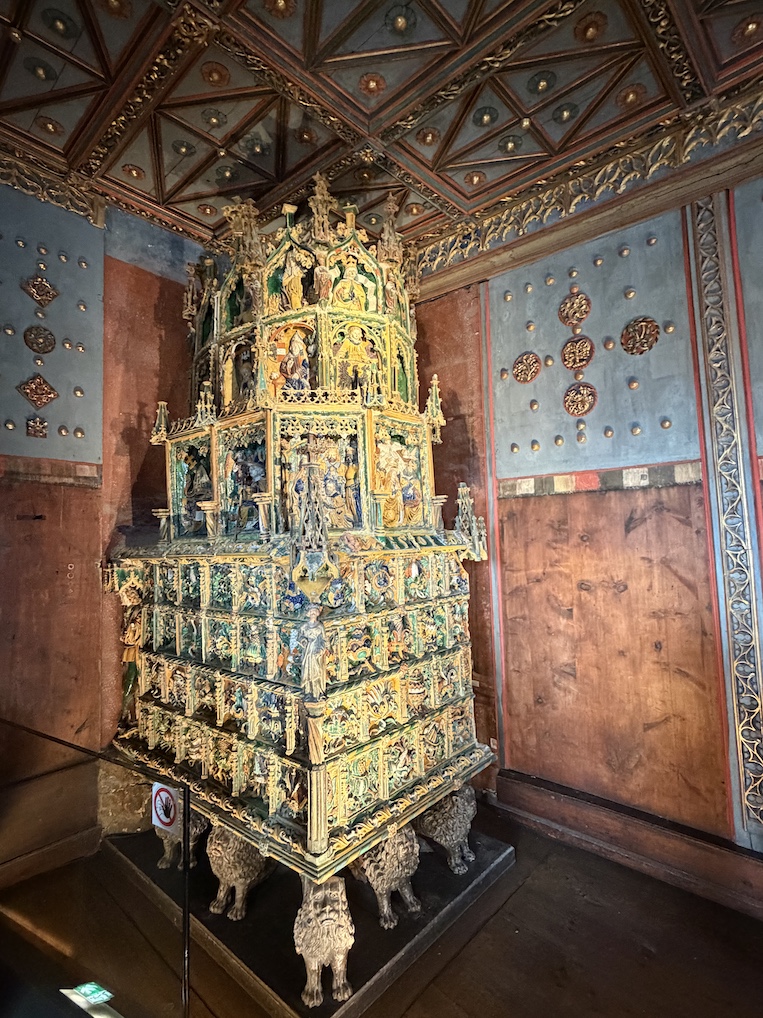
It’s not central heating, but elaborate Gothic tile stoves inside Salzburg’s Hohensalzburg Fortress kept Holy Roman Empire prelates comfortably warm. Photo by Barbara Noe Kennedy
But it’s the Salzburg Residenz down below, where the prince-archbishops gradually moved from their fortress home, that radiates the excess salt could buy. Visitors stroll from the Carabinieri Hall through ever more lavish apartments, decorated between the early 17th and 18th centuries, culminating in the sumptuous Audience Hall where princes and foreign dignitaries once sought favor with Salzburg’s rulers.
Nearby, generations of archbishops lie beneath Salzburg Cathedral, the city’s spiritual heart. First consecrated in 774 and reborn in baroque splendor in 1628, the cathedral transformed medieval Salzburg into an Italianate showpiece—a “Rome of the North.”
The prince-archbishops lost their rule in 1803 amid the political upheaval of the Napoleonic era, and Salzburg was ultimately incorporated into the Austrian Empire in 1816. But salt never abdicated.
“Salt is often perceived as an everyday commodity,” Pernkopf said. “A well-known saying captures its historical significance: ‘Human beings can live without gold, but not without salt.’”
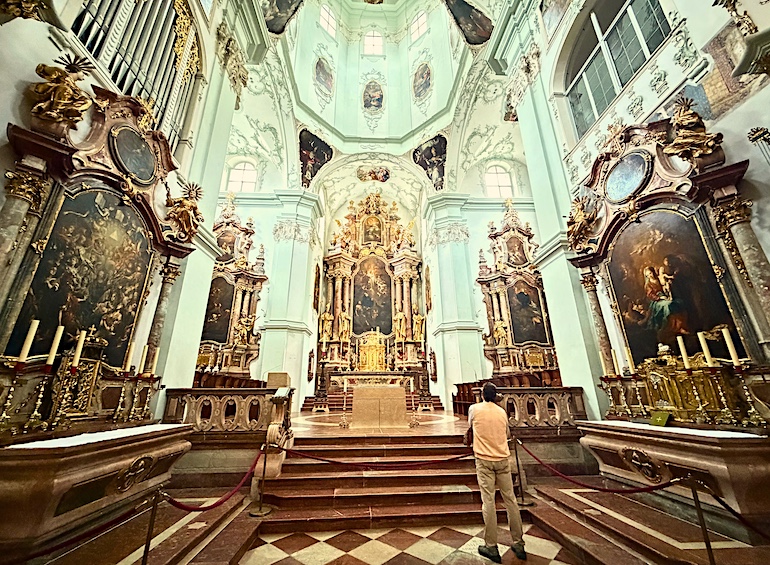
St. Peter’s Abbey Church was constructed in an ornate Rococo style with wealth resulting from the salt trade. Photo by Barbara Noe Kennedy
Today, Salzburg remains one of Austria’s most dynamic and prosperous cities, where baroque grandeur, Alpine scenery, and a rich musical legacy sustain a thriving visitor economy alongside universities, technology firms, culture industries, and regional trade.
And across Salzburg and the surrounding Salzkammergut, that legacy still echoes—hidden in mountain tunnels, reflected in Alpine lakes, and written across a skyline built, quite literally, grain by grain.
Barbara Noe Kennedy is a former senior editor at National Geographic Travel whose work now explores the hidden forces that shape iconic destinations. As you explore the EWNS website, please see Kennedy’s recent story that took her inside Turkey’s Olive Oil Revival.