

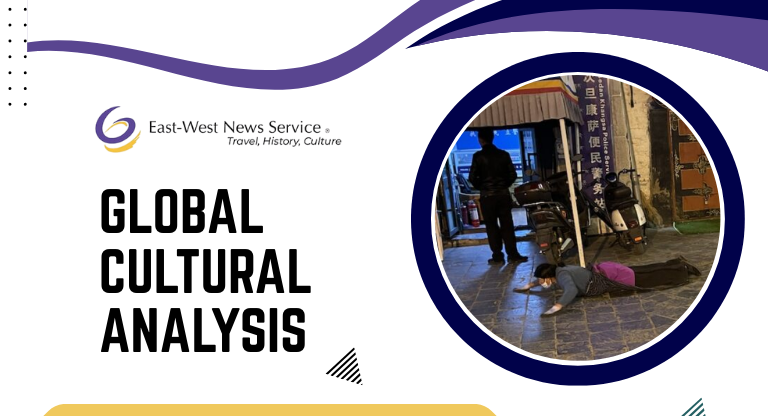
I came to believe that Lhasa only truly made sense in motion. In Barkhor Square, women dropped to the ground, arms stretched forward, rose, took a few steps, and repeated the ritual again and again. Around them, travelers moved steadily in wide circles, palms spinning prayer wheels worn smooth by decades of touch.
There was no pause, no performance. This was simply daily life. Pilgrims arrived from distant villages, some crawling on their knees across vast stretches of land. Trailing behind were relatives who carried money sent by family members who could not make the journey themselves. Witnessing these rituals up close felt less like tourism and more like an entry point into a broader global cultural analysis of how belief systems endure across generations.
Standing Beneath the Potala Palace
The Potala Palace announces itself long before one reaches Lhasa. When I finally stood at its entrance, the weight I felt came not only from the massive structure, but from the history embedded within. Inside, dark corridors twisted toward incense-filled chapels and sacred stupas where past Dalai Lamas lie entombed.
A guide spoke quietly of 1959, the year the Dalai Lama fled Tibet amid looming political takeover. By the next morning, centuries of religious leadership had effectively ended. Standing there, it became clear how power, faith, and politics can collide—an enduring theme in global cultural analysis, particularly in regions where spiritual authority once shaped daily governance.
A City Caught Between Eras
From the palace roof, modern Lhasa unfolded below. Han Chinese residents now make up nearly half the population. Mandarin dominates schools, government offices, and even monasteries. Political slogans hang beside prayer flags, an uneasy pairing that reflects the city’s internal tension.
Religious life continues, though often constrained. Temples remain active, but are shaped increasingly by tourism and regulation rather than pure devotion. Walking through the streets, I sensed a city still practicing its faith, yet constantly negotiating its survival under scrutiny and change.
Following the Tea Horse Road South
Leaving Lhasa, I followed sections of the ancient Tea Horse Road toward Lijiang, retracing routes once vital to regional trade. Lijiang, rebuilt after a devastating earthquake, exudes a careful sense of preservation. Tea shops still sell tightly packed cakes of Pu’er, echoing a commercial tradition that once sustained the region.
As the road wound south, towns thinned and monasteries appeared in increasingly remote landscapes. In one monastery, monks chanted for hours each day. When I asked a young monk what they prayed for, he replied simply that they hoped people would discover shared values. The sentiment stayed with me long after I left.
Reaching Shangri-La
Shangri-La—a Western myth made tangible—lies beneath the Songzanlin Monastery. Destroyed during the Cultural Revolution, the monastery has since been rebuilt, standing as a testament to resilience. Monks moved quietly through their rituals while visitors observed in respectful silence.
Here, Shangri-La revealed itself not as a mythical paradise, but as endurance—the capacity of faith to persist through disruption and loss.
Bottom Line
Tibet did not present an untouched world. Instead, it revealed how religion adapts under pressure, how history persists even as political systems change. Religious practice has not disappeared; it has transformed, continuing through small, repetitive acts of daily devotion.
By the end of my journey, Shangri-La was no longer a place. It had become a moment—a moment of quiet strength, reflection, and deliberate meaning in a rapidly changing world. Viewed through the lens of global cultural analysis, the journey was not defined by distance traveled, but by an understanding of how identity, belief, and history exist in a fragile yet enduring balance.
For a deeper exploration of this journey, read the full article: