

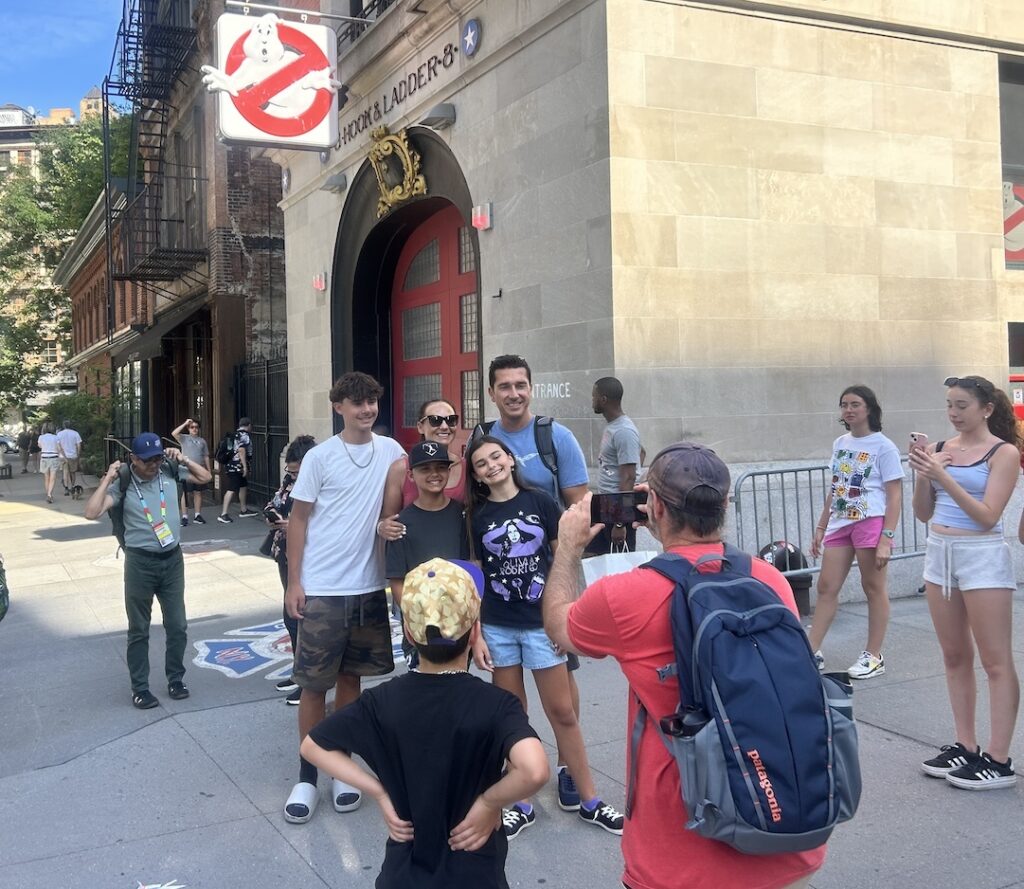
Some institutions have leaned into tourism, selling merchandise and allowing tourists to take photographs inside and outside. The Hook and Ladder Company 8 firehouse in Tribeca, which appeared in two Ghostbuster movies, remains an active FDNY station, but hosts hundreds of visitors every day. Photo by Caroline Erskine.
I hadn’t been in New York City more than a week before I got a text from a friend who’d also just moved here: “I just walked under Madonna.” She’d decided to give an impromptu concert in Times Square, which somewhere around 350,000 people walk through on an average day. Of course, being new to the city, my friend and I were star-struck. But for native New Yorkers? It was just another Thursday.
New York is a celebrity stomping ground — not only because it offers a kind of anonymity that Los Angeles never quite manages, but because so much of the industry’s work happens here. A folding chair labeled “TALENT,” a cluster of production trucks double-parked on a brownstone block, a boom mic swinging over a sidewalk — these are unremarkable sights to the people who live here. For everyone else, they’re a reason to visit.
The phenomenon has a name: set-jetting, a term coined by New York Post writer Gretchen Kelly nearly two decades ago to describe travelers who plan trips around the places they’ve seen on screen. What started as a niche instinct — visit Hobbiton in New Zealand or walk the Dubrovnik walls that stood in for King’s Landing — has become one of the defining forces in modern tourism. Industry surveys now put the number of travelers who choose a destination because of something they saw in a film or television show above 60 percent, and some projections value the American set-jetting market in the billions of dollars. New York City, which has been a film set since before film had sound, didn’t need to catch up to the trend. It invented it.
A City Built To Be Filmed
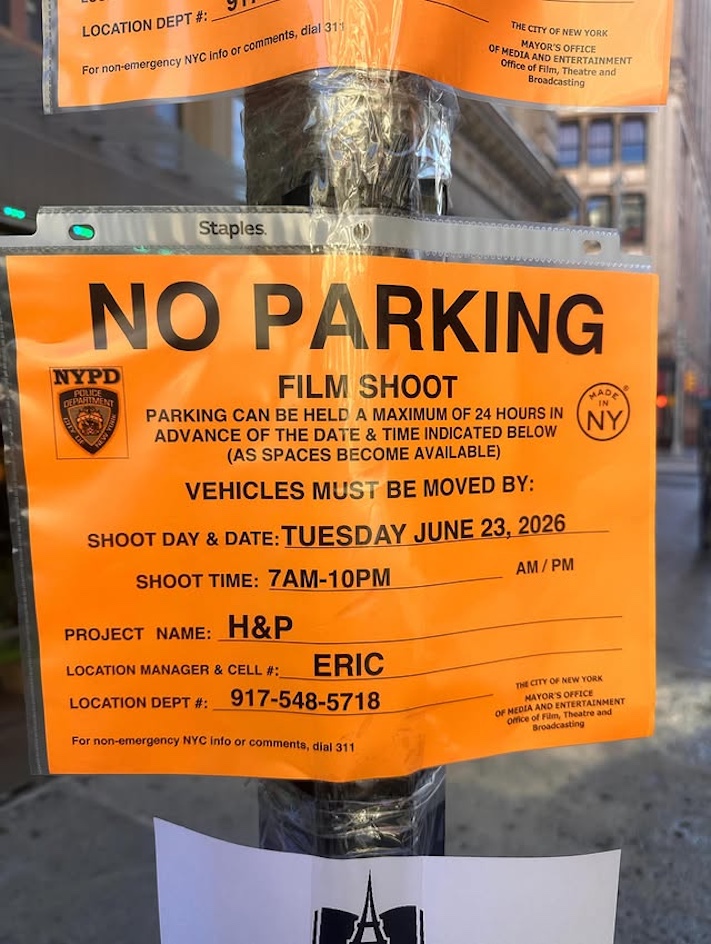
Production companies filming location shots depend on No Parking restrictions to prevent curious onlookers from disturbing exterior action and dialogue. They also feature a mysterious or vague project name to prevent fans from mobbing the site. Photo by Caroline Erskine
Few cities anywhere have as intimate a relationship with the camera as New York, and almost none of it is accidental. The Mayor’s Office of Media and Entertainment, the city agency that issues location permits, free police assistance and access to municipal property for productions, processes thousands of permits for well over a thousand projects a year — close to 5,500 permits for roughly 1,760 projects in 2025 alone. A 2021 economic impact study found that film and television production supports 185,000 jobs and generates more than $81 billion in economic output for the city. Whatever the exact figure in any given year, the practical upshot for visitors is simple math: with thousands of productions moving through the five boroughs annually, the odds of stumbling into an active shoot on any given walk are far better here than almost anywhere else in the world.
The sheer amount of film work shapes daily life in specific, mappable ways. Certain blocks have effectively become soundstages with sidewalks. Lower Manhattan’s Tribeca, known for its large, converted-warehouse luxury lofts, cobblestone streets, and Michelin-starred dining, is a magnet for period pieces and prestige dramas, largely for the same reasons it now houses a concentration of the city’s wealthiest residents. Greenwich Village and the West Village, with their tree-lined streets and pre-war brownstones, have supplied the exterior backdrop for so many sitcoms and rom-coms that certain corners exist now mostly as pilgrimage sites.
Midtown’s Rockefeller Center, near 5th and 50th, meanwhile, functions as something closer to a live broadcast factory than a filming location: “Saturday Night Live,” “The Tonight Show Starring Jimmy Fallon,” “Late Night with Seth Meyers,” “The Kelly Clarkson Show,” the “Today” show, MSNBC, NBC Nightly News and “Dateline” all originate from 30 Rockefeller Plaza, and “The Marvelous Mrs. Maisel” (an award-winning comedy-drama TV series based on the comedy career of a late 1950s divorcee) used its Art Deco lobbies and midcentury interiors as a recurring set piece. If you’re going to walk past a celebrity by accident, the block outside 30 Rock is a statistically excellent place to try.
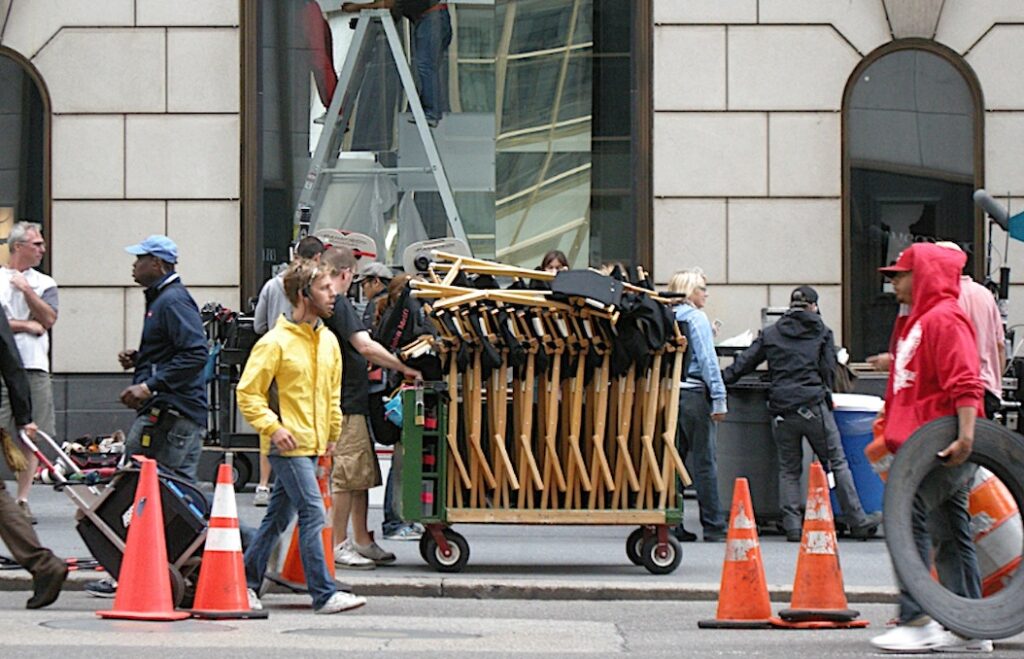
Film crews unload equipment in preparation for a day’s location shooting in Manhattan. Photo courtesy of the Mayor’s Office of Media and Entertainment
Many tourists don’t realize that the production they walk past may not be operating under its real name at all. High-profile shoots routinely file for permits under a deliberately fake working title specifically to keep vendors from price-gouging, deter theft of equipment or costumes, and thin out the crowd of onlookers before word gets around. “Spider-Man: Homecoming” was filmed as “Summer of George,” a “Seinfeld” reference; its sequel, “Far From Home,” followed up as “Fall of George.” “Die Hard with a Vengeance” was shot under the title “Die Hard: New York.” Marvel has sent crews out under names like “Group Hug” (for “The Avengers”), “Mary Lou” (for “Avengers: Infinity War”), and “Thursday Mourning” (for “Thor: The Dark World”). James Bond productions are routinely filed simply as “Bond 25” or whatever number comes next.
Crowdsourced tracking has become its own small industry: Instagram accounts like @now_filming_nyc post periodic updates on where crews are actually shooting, cross-referencing permit filings, fan tips and old-fashioned sidewalk sightings to help fans figure out what’s real behind the decoy title. The city’s own Mayor’s Office of Media and Entertainment also keeps a running, official list of what’s currently in production across the five boroughs, which tends to be the more reliable of the two if you want a straight answer over a treasure hunt.
Where Ghosts, Girlfriends and Gumshoes Live
Walk the West Village long enough and the itinerary writes itself. At the corner of Bedford and Grove streets stands the six-story, tan-brick building that served as the exterior of the gang’s apartments on “Friends” — an address so recognizable that groups of tourists photograph it at all hours, even though the building’s actual ground-floor tenant, the restaurant Little Owl, bears no resemblance to the green door of Central Perk that lived only on a Los Angeles soundstage. A short walk away, the stoop at 66 Perry Street has drawn “Sex and the City” fans since the show’s early seasons filmed there and, later, its 2021 sequel “And Just Like That…” returned to the same block, prompting the building’s owner to publicly request that fans please stop climbing the front steps.
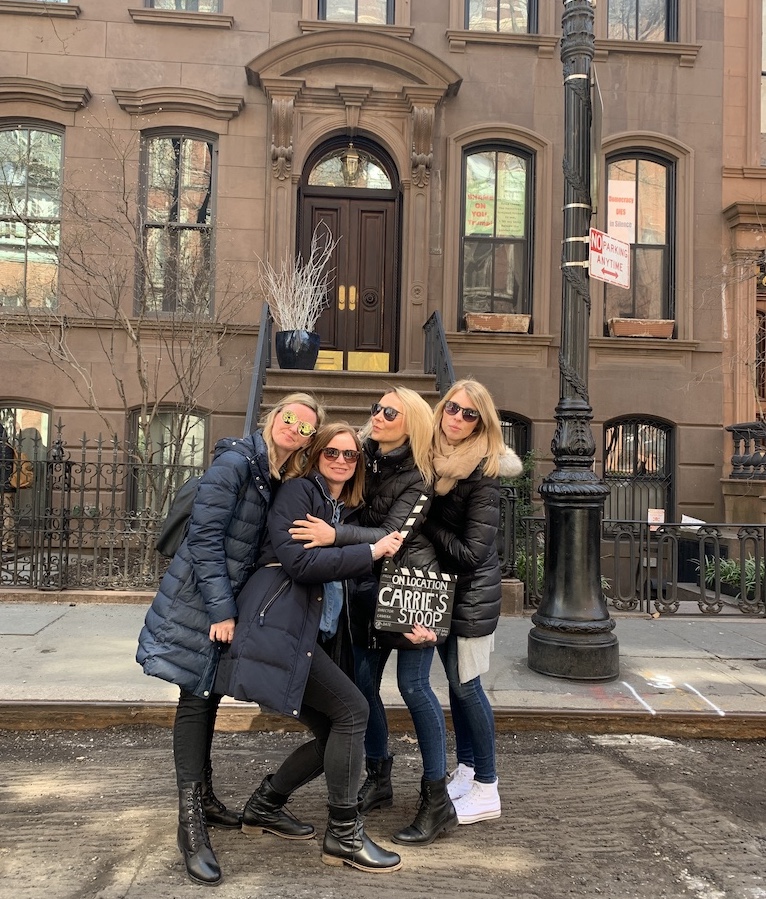
Manhattan brownstone at 66 Perry Street where Sex and the City’s Carrie Bradshaw lived. A constant flow of fans arrives at the address daily, individually or with tour groups, to take photographs. Visitors are welcome to reminisce about the characters they followed as teenagers, but they are asked to stay off the steps. Photo courtesy of On Location Tours.
Uptown, the exterior of Tom’s Restaurant at Broadway and 112th Street has been the site of Seinfeld- enthusiast trips since the early 1990s, even though the diner’s actual interior scenes were shot in Los Angeles — a pattern that repeats across almost every marquee New York filming site. In Tribeca, the 1903 Beaux-Arts firehouse at 14 North Moore Street, home to FDNY’s real, working Hook & Ladder Company 8, has spent four decades doubling as Ghostbusters headquarters; tour buses still stop on the corner, and the firehouse sells its own Ghostbusters-branded merchandise to help fund equipment the city budget doesn’t always cover. Further uptown, the Tiffany-blue door at 169 East 71st Street stood in for Holly Golightly’s brownstone stoop in “Breakfast at Tiffany’s,” while the actual Tiffany & Co. flagship on Fifth Avenue still draws visitors who want to stand where Audrey Hepburn once did, pastry in hand, window-shopping before dawn.
Out at Coney Island, Nathan’s Famous — the original hot dog stand, open since 1916 — hosted a scene in 2003’s “Uptown Girls,” and the Amazing Spider-Man films used the glass-and-steel lobby of the Hearst Tower near Columbus Circle as the entrance to the fictional Oscorp building, meaning tourists posing for photos under its escalators are, technically, standing in a supervillain’s headquarters.
Then there’s the harbor. The Staten Island Ferry — free, by the way — has quietly become one of the city’s most reliable movie sets, framing Melanie Griffith’s commute in “Working Girl” and Kate Hudson’s frantic dash in “How to Lose a Guy in 10 Days.”
Celebrity-Spotting as Sport
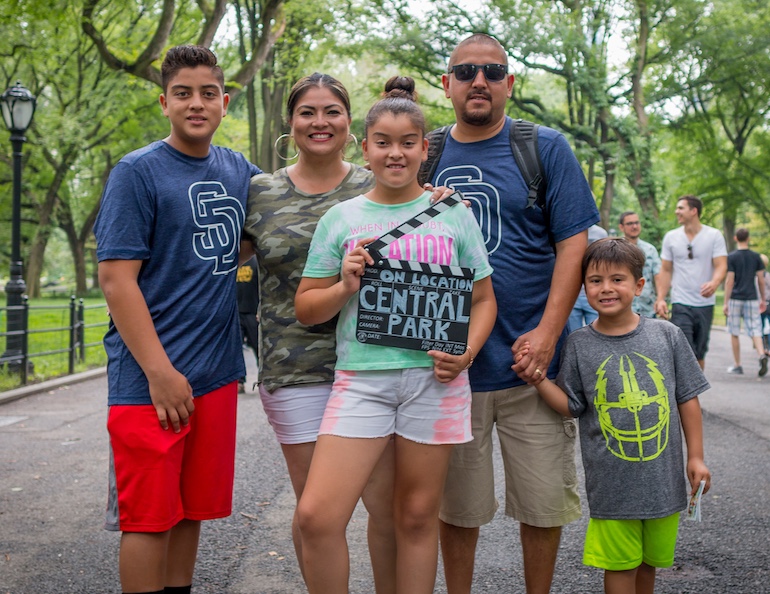
Manhattan’s Central Park is a favorite spot for families to visit since it has served as a location for dozens of popular films, like “When Harry Met Sally”, “Enchanted” and “Elf”. Photo courtesy of On Location Tours.
If filming locations are New York’s fixed stars, its celebrity residents are the moving targets — and locals have gotten remarkably good at tracking both. The neighborhoods where celebrities actually live have become their own kind of attraction, whether or not anyone official intended it that way. Tribeca, again, anchors much of it: Taylor Swift, Jay-Z and Beyoncé have all called the neighborhood home. The West Village and Greenwich Village have their own residents, from Sarah Jessica Parker to Timothée Chalamet, while Staten Island, of all places, being somewhat tucked away from the hustle-and-bustle of the other boroughs and known for a more suburban lifestyle, counts Hugh Jackman among its residents.
Los Angeles has turned this into a formal industry, with laminated maps and narrated bus routes past gated driveways. New York has a version of that too — companies like On Location Tours run guided routes past dozens of filming sites, from the “Friends” building to the “When Harry Met Sally” deli — but most opportunities stay informal. It offers the ordinary experience of sharing sidewalks, subway platforms and bodega lines with people whose faces are on billboards. I’ve heard from residents who see Zendaya at their local grocery store or walk past Taylor Swift on her way to go out. New York City is a global media capital that still requires its most famous residents to wait for the light to change — and that allows tourists a great opportunity to see what their idols actually live like.
Caroline Erskine is a Syracuse University student studying magazine journalism. She specializes in culture, music and travel writing, and is currently interning with Peter Greenberg Worldwide.