

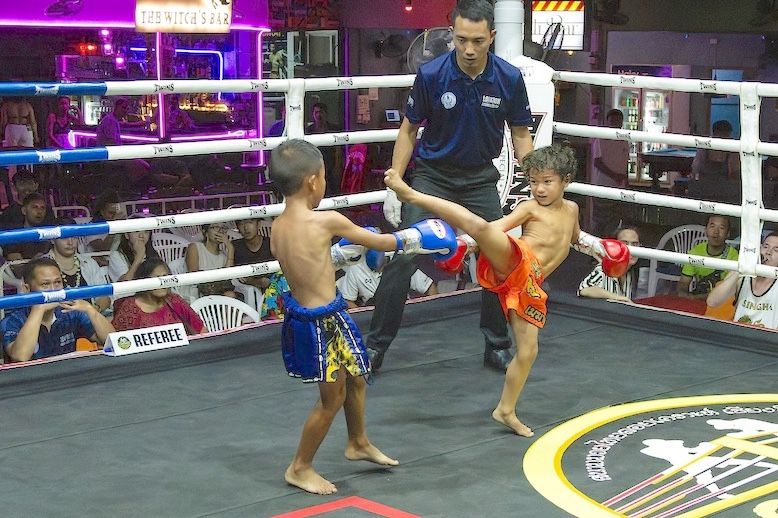
Seven-year-old Goku Alexander, right, unleashes a strong kick in a Muay Thai fight against rival Pod Pingkong. Children start at an early age to learn the traditional Thai martial art. Photo courtesy of The Fight Lens CM
Seven-year-old Goku Alexander stood on one leg, like a stork, raising his right knee to waist level. His gloved fists hovered just above his eyes as he peered intently at his taller opponent, a Thai boy named Pingkong.
Anticipating one another’s every move, the pair began cautiously, trading light jabs. Then Pingkong, in blue trunks, surged forward. As Goku slipped aside, the Thai boy’s attempted blow failed to connect. Goku, wearing red, responded with a sharp roundhouse kick that momentarily stunned his opponent. The fight was on.
Throughout the night, without attention to age or gender, an audience of several dozen fight fans raised their voices in support of their favorite pugilist. They were a mix of foreign visitors, many of them witnessing the sport for the first time, and locals who knew Thai boxing as well as Americans know baseball. They drank Chang beer and cheap Hong Thong whisky, smoked cigarettes, placed cash bets, and flirted heavily with the pretty bar girls who attended each section of stadium seating.
But young Goku paid no attention to the crowd. His attention was elsewhere. He struck hard and quickly, just as his father, American boxer “Uncle Sam” Alexander, had taught him. Three two-minute rounds later, Goku was a champion in the first Muay Thai boxing match of his blossoming career, in the 20-kilogram (44-pound) weight class. He delivered a classy embrace to Pingkong, then was lofted atop Uncle Sam’s shoulders and paraded around the ring.
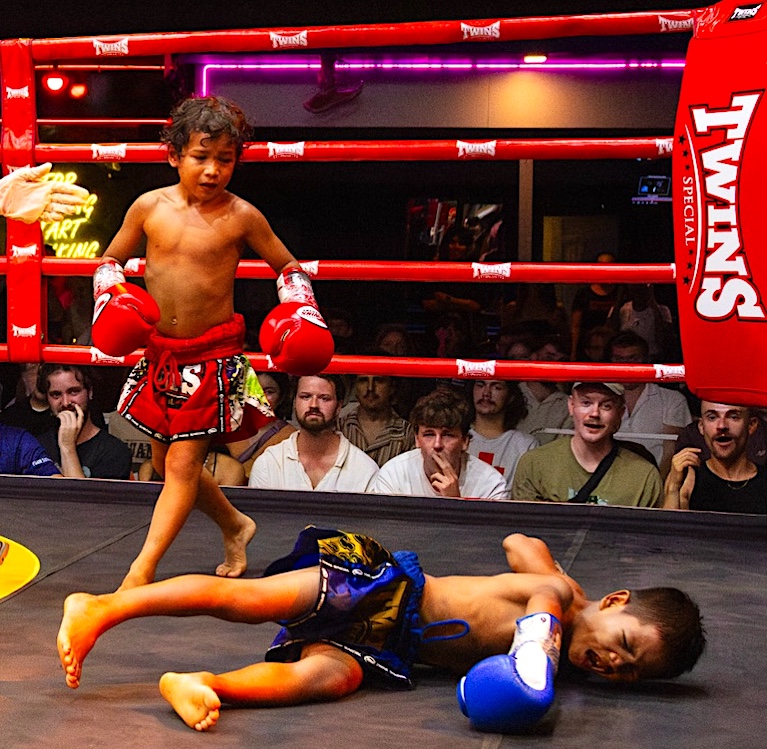
Goku paces around fallen foe Pingkong, who winces in pain as the Muay Thai crowd watches closely. Unlike Mixed Martial Arts, fighters are not permitted to attack opponents on the mat. Photo courtesy of The Fight Lens CM
An international appeal
Muay Thai (literally, Thai boxing) is the national sport of Thailand, a martial art often called “the art of eight limbs” because blows are delivered by two fists, elbows, knees and shins. Hundreds of years before gunpowder and modern weaponry transformed warfare, Muay Thai developed as a battlefield discipline in the 13th-century Kingdom of Sukhothai. It demanded strength, courage and discipline among soldiers as they readied for combat. Elements of traditional Thai dance later contributed agility and rhythm to fighters’ movements. The best warriors earned respect for their bravery and perseverance.
By the late 1700s, as cannons and guns eclipsed hand-to-hand confrontations, Muay Thai became a fixture in village festivals and public tournaments. At the start of the 20th century, the sport was formalized with timed rounds, weight classes and boxing gloves. Dedicated stadiums were built in the sprawling metropolis of Bangkok and the city of Chiang Mai.
By the 1960s, Muay Thai’s appeal was becoming international. It was introduced to the United States, Australia and Europe by the World Thai Boxing Association, which was founded in 1968. Although it is practiced in more than 150 countries today, “It’s still a niche sport,” said Per Albertsen of the Forever Muay Thai gym in Hang Dong, a Chiang Mai suburb. “Thailand is the only place in the world to learn it effectively.”
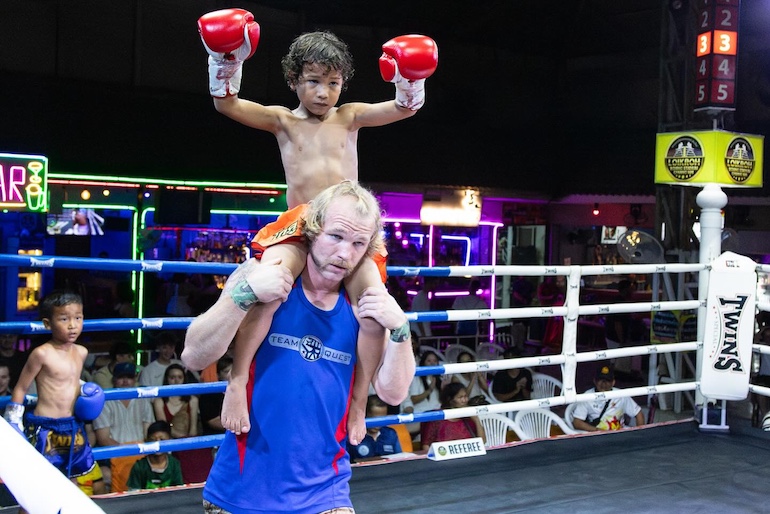
Sam Alexander carries his son, Goku, on his shoulders after the boy’s three-round Muay Thai victory at the Loi Kroh stadium. Photo courtesy of The Fight Lens CM
The thrill of the fight
Exposed to martial arts on television and video platforms, students come from all over the world. According to Globe News Bangkok, more than 60,000 foreigners engaged in Muay Thai training in 2025 alone. They came to more than 50 private training gyms in Chiang Mai, the largest city in northern Thailand, and hundreds of others across the country. The Thai government has fully bought into the phenomenon, encouraging Muay Thai schools to arrange 90-day study visas and regular matches, often between the newcomers and Thai citizens. They train in the gyms; they fight in the stadiums.
Why? Is it merely the thrill of the fight? Or is it, as Albertsen argues, the physical conditioning and exposure to Thai cultural heritage that go hand-in-hand with the ring experience? An outside observer can’t help but be impressed by the high degree of fitness and balance displayed by successful boxers. Direct strikes or punches are only a small part of what they learn. Through structured training, without sacrificing personal safety, boxers develop power, strength, quickness and endurance.
Muay Thai differs from American kick boxing in its eight points approach: The U.S. version doesn’t allow attacking with elbows or knees. Both emphasize body shots (above the waist only), and ankle-level sweeps with the feet to unbalance the opponent. Punches to the head are permitted, but no head butts or strikes to the eyes. Boxers learn a whole vocabulary of kicks: front, side, heel, roundhouse, crescent, axe, jump, spin.
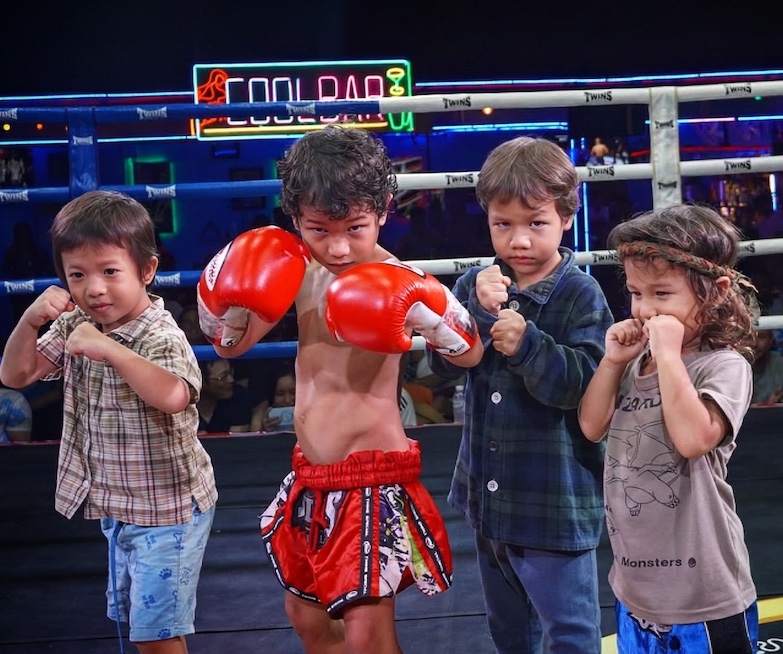
The Alexander boys, sons of Sam and Narisa, pose for a family portrait at the Loi Kroh stadium. From left, they are Anu, Goku, Apollo and Beowulf. Photo courtesy of Forever Muay Thai
Living a dream in Thailand
Goku is the oldest child of Samuel Alexander, an American who lives in Chiang Mai with his Thai partner, Narisa. At 33 years old, Sam may be the prototypical farang (white foreigner) boxer in northern Thailand. Growing up in Burlington, Vermont, he worked as a landscaper and laborer. He did not attempt a career as a fighter before coming to Southeast Asia in early 2017; after his arrival, he began to actively pursue Muay Thai and other “combat sports,” as he calls them. He met Narisa almost the moment he stepped off the overnight express train from Bangkok. Today they have four sons and an infant daughter.
“Now I live with my dream and they train with me,” Sam said. “All the children learn to defend themselves. My key advice to them is to do your best. Be respectful of yourself and the people around you, and you will have fun and learn.”
It’s important for children to study self-defense at a young age, Sam said: “They learn a lot about themselves in fighting. They learn how to win and lose, how to get comfortable surrounded by lights and intensity. The lifestyle is tough. Show me in the ring that you are strong and dedicated. Don’t over-celebrate.”
Sam is a man of average height and weight — about 5-foot-9, 170 pounds — but it’s all muscle. He studies multiple disciplines, from MMA to Japanese jujitsu, from traditional boxing to Greco-Roman wrestling. Muay Thai, he said, lays a sturdy foundation for stand-up striking and clinching.
Pageantry, prayer and performance
The Loi Kroh Boxing Stadium, one of six professional Muay Thai stadiums in Chiang Mai, occupies the rear section of a not-quite-red-light block of more than two dozen hostess bars. A boxing equipment, clothing and souvenir shop stands nearby. The fights are priced for the diverse expatriate and backpacker crowd that frequents Loi Kroh Road, just southeast of the ancient walls of this historic city.
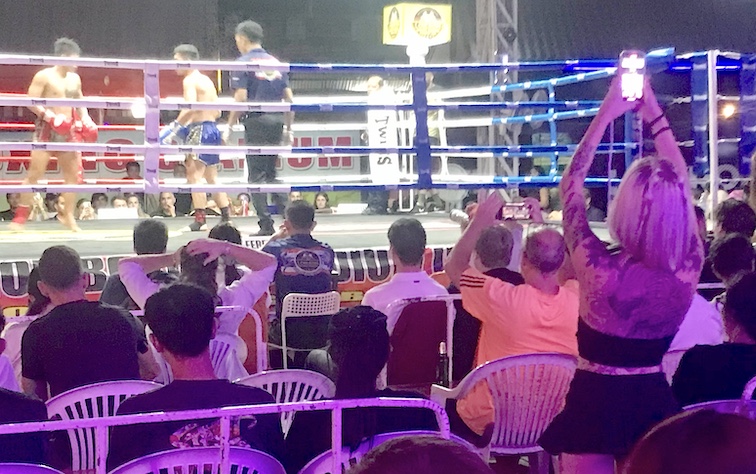
Bar girls join a mixed local and farang fan base in cheering a Muay Thai card at the Loi Kroh Boxing Stadium. Patrons pay $20 and up to watch eight to 10 fights over a period of a couple hours. Photo by John Gottberg Anderson
About 200 seats are arranged around all four sides of the elevated ring. Patrons pay 600 to 1,000 baht (US$20 to $33) for the privilege of watching eight to 10 fights — five rounds of three minutes each — over a period of a couple hours. The bouts can be fast-paced and intense; they are rarely boring. At entry-level events, prize money may range from 2,000 to 5,000 baht (US$60 to $150) per fight. Experienced fighters can earn higher purses, but even they don’t get a cut of the informal gambling that engages the audience.
The night’s pageantry begins with gentle drumming and pi chawa music that gradually builds to a crescendo, heightening anticipation before the opening bell. The audience rises for the Thai national anthem and remains standing as strains of “Eye of the Tiger,” made famous in the Rocky movies, filter loudly through a smoke screen. Then the first fighters make their way to their respective corners of the ring.
Each competitor has a ritual for preparing to fight, but it invariably begins with a wai kru, a ceremonial bow honoring teachers and tradition. For good luck and spiritual protection, many boxers also wear a mongkol (ornate headband) and pra jiad (armbands) into the ring. A symbol of courage, the mongkol is traditionally presented by a trainer to the fighter when he judges that the fighter is ready to represent the gym in the ring. The pra jiad are considered to have mystical power.
Execute and take charge
The first match of this particular night matched two teen-aged Thai boys, Songyang and Super Ball, in the 43-kilogram weight class. There were a lot of flailing fists, two big kicks, a couple of throwdowns. Songyang prevailed when the referee stopped the fight in the third round. Instead of trash-talking, the boys embraced.
The second match, between two women, Aklao and Namwhan, took a more measured pace, each fighter looking to score points with blows. The boxers’ warm-up dances were more entertaining than the denouement, and Namwhan was moved almost to tears when she lost by decision. Muay Thai, I learned, has a complicated system of scoring that considers effective striking, balance, dominance and ring control.
The third match was the first international match of the night, pitting tall, lanky Deniz, from Germany, against a Thai opponent. Deniz had arrived in Chiang Mai only three weeks earlier, he told me, but he had years of experience in fighting. I asked him: What’s the difference between Muay Thai and MMA, the mixed martial arts? He responded: “In Muay Thai, there’s no striking above the neck, no punching once they’re on the floor. Everything else goes.”
The Thai boxer, Sailab, was lean and compact: athletic, flexible and muscular. He scored some solid kicks against Deniz. But the barefoot German was more aggressive and had a particular ability to go airborne in his kicks. Sailab’s flamingo-like posture diminished his stability in close quarters, and although he hurt Deniz, who limped from the ring, he spent too much time on the mat. Winner by decision: Deniz.
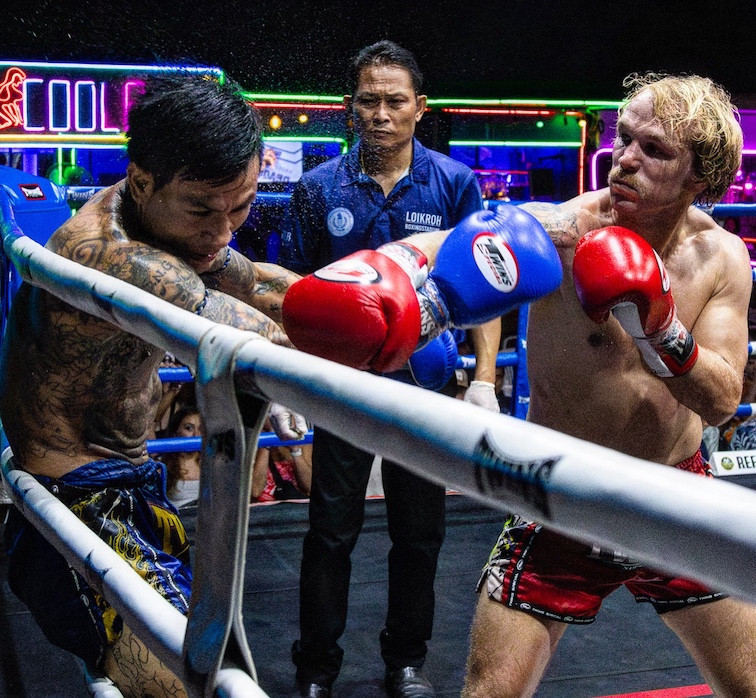
Sam Alexander, fighting as “Uncle Sam,” attacks his Thai opponent, Sonram, in the ring. Muay Thai is called “the art of eight limbs” because blows are delivered by two fists, elbows, knees and shins. A native of Burlington, Vermont, he became a disciple of “combat sports” after arriving in Thailand in 2017. Photo courtesy of The Fight Lens CM
Gracious in defeat
Sam Alexander’s match in the 70-kg weight class was the fifth on the nine-match card. After about two dozen professional fights, with occasional prize money for his successes, “Uncle Sam” had learned to give and receive: He could take a punch but he could strike back with force.
As he and his opponent, Sonram, traded barbs in the Thai language, there were smiles all around. There was clinching, striking and grappling. With 30 seconds to go in the fifth and final round, bright lights fell across the ring, and Sam raised his arms to prompt applause from the audience. But it was all a good-natured show. Sonram, in Blue, won a narrow decision and Sam, giving the Thai man a bear hug, heeded his own advice: “Be gracious to your opponent.”
Dutch visitors Henk and Liesbeth DeVries, on their first visit to Thailand, were fascinated by the spectacle. They had come upon it with no advance plan, following the crowds after an evening meal at the nearby Kalare Night Bazaar. “It was quite a surprise,” said Henk, “and well worth the money we paid.” His wife concurred. “Those young women can really fight!” she exclaimed.
A glance at the fliers advertising Muay Thai matches around Chiang Mai is an immediate indication of worldwide interest. The handouts picture men and women from the United States and Canada; from England, Italy, Sweden, Russia and the Ukraine; from Australia and New Zealand; from Brazil and Venezuela; from India, China and Taiwan. They come to train and fight not only in Chiang Mai and Bangkok, but also in the tourist beach towns of Pattaya and Phuket, as well as Koh Samui, Krabi and Hua Hin.
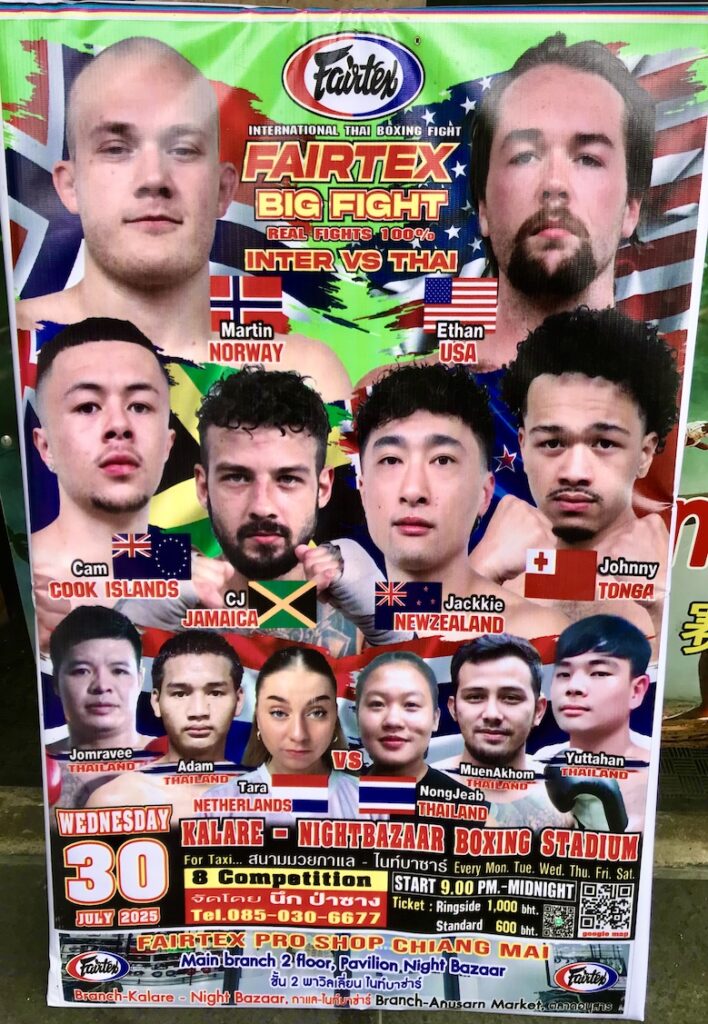
Colorful posters advertise Muay Thai fights at venues around Chiang Mai. This card, at the Fairtex ring in the Kalare Night Bazaar, features competitors from eight different countries. Photo by John Gottberg Anderson
A fighting chance
Albertsen, 55, is no stranger to international life. Born in Denmark, raised in Nigeria, he spent seven years in Vietnam before settling in Thailand in 2012. In 2024, he and his Thai partner, TookTook Jantima, converted a former car dealership in suburban Hang Dong into a dedicated training facility they call Forever Muay Thai.
“Our focus is on accessible, structured training for both locals and visitors,” said TookTook, who is owner and manager. “We run four 90-minute sessions daily, morning and late afternoon. About half of our members are Thai, with most of the remainder long-term expatriates and a smaller number of visiting tourists. Our students range in age from 4½ to 73.”
Located 15 kilometers outside the old city, the gym offers unlimited monthly training for 5,000 baht (US$160) or 350 baht (US$11) per session.

Forever Muay Thai’s Per Albertsen, left, and TookTook Jantima flank Kru Chanom after a championship fight. As a trainer at the Hang Dong gym, Chanom instructs many foreign athletes. Photo courtesy of Forever Muay Thai
The couple are vigilant about hygiene and client safety, following strict cleaning protocols to minimize the risk of skin infections. And coaches carefully assess when students are ready for sparring or competition. “It’s very dangerous to fight after only a few weeks,” Per said. “You have to be mentally ready and have physical stamina. Many beginners use all their energy in the first round. Proper preparation is essential — and depending on your experience and conditioning, it can take months.”
Although they train regularly for fitness and conditioning, neither Per nor TookTook competes in the ring. But Per credited his daughter Hannah with encouraging his early interest in the sport. As a teen-ager, Hannah came to Thailand from Denmark in 2013 and dedicated eight months to training before she ever entered her first fight. In all, she competed five times. “Following her journey across different gyms gave the family firsthand insight into training standards, safety and gym culture,” Per recalled.
The steady growth of Forever Muay Thai — two years with an emphasis on disciplined training and a community atmosphere — is reflective of the continuing appeal of Muay Thai itself. One might say the gym, like the sport, has a fighting chance at success.
John Gottberg Anderson is an East-West News Service contributor living in Chiang Mai. Please see his earlier stories on saving Phnom Penh’s colonial history and his spiritual journey through Viet Nam.