

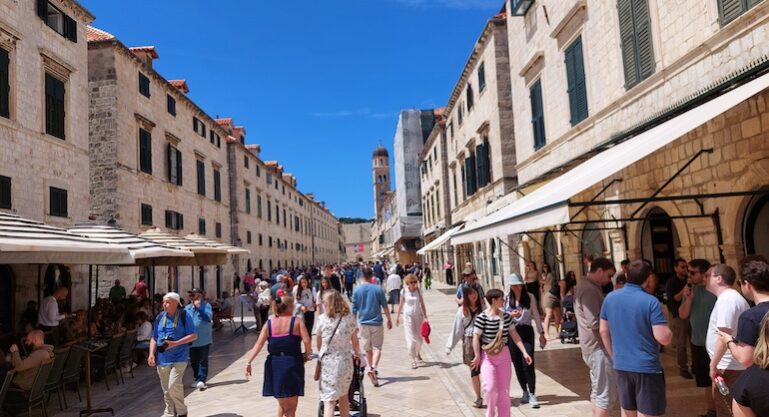
The more I traveled through Europe over the past couple of years, the more it hit me that many of its most famous tourist destinations were quietly feeling crushed by all that attention. Initially, it was the dwindling amount of energy, but then it turned into this constant deal with packed streets, super long lines, and blocks where it felt like daily life had been slowed down. This Global Business Insights article pulls from what I saw myself while moving through cities now stuck in the overtourism conversation
Dubrovnik: An Ancient Town That is Losing Its Authenticity
Dubrovnik made the biggest impression on me. Wandering the old medieval lanes with the local guide Lidija Miljas, I caught a side of the city a lot of visitors just don’t see. She pointed out the home where she grew up and said how, back then, there weren’t even many restaurants inside the Old Town. Kids ran around freely in the narrow paths, and neighbors kept an eye out from their windows. She even pointed me toward centuries-old Latin graffiti on a church wall, warning children not to play ball there.
Now it feels different. Many of those houses are holiday rentals, and cafés and restaurant terraces pretty much take over every open inch. The crowds, well, they were impossible to ignore. Even the “quieter” alleys often felt jammed, more congested than the famous Stradun main street at times. Locals told me cruise tourism has changed Dubrovnik in a big way, and that only a small number of residents who used to live behind the historic walls still do today.
Still, I also noticed real attempts to push things back toward normal. Timed tickets, visitor counters, better cruise scheduling, and marketing attractions outside the Old Town are slowly easing the pressure. I found my own little escape on Lokrum Island nearby , where you get forest trails, calm gardens, and a centuries-old monastery that sets a completely other pace.
Amsterdam and Italy: Managing Visitors Without Losing Their Identity
Amsterdam felt like another puzzle. Near Dam Square and the Red Light District, the streets were still loaded with people all day, while even booking the Anne Frank House meant planning weeks ahead. Walking through the tight rooms where Anne Frank wrote her diary was one of the most personal, heavy moments of my trip, despite visitors always streaming in.
Local guides said the city has responded by shrinking tour group sizes, limiting short-term rentals, cutting down cruise traffic, and raising tourist taxes. The idea is pretty clear—try to restore a balance between tourism and the rhythm of everyday life.
Italy has similar stress points. St. Mark’s Square, the Rialto Bridge, and the Grand Canal continue to be crowded during daytime hours. The cost of entry is paid by the majority of tourists; big tour groups have limited access and huge cruise ships are prohibited from entering the historic lagoon.
Florence didn’t really feel any different. Even with timed tickets, getting to the Duomo and Michelangelo’s David still meant standing in long queues. The city has tightened rules on new Airbnb-style rentals too, while adding steps to reduce congestion and noise across its historic center
Istanbul’s Historic Heart Under Pressure
I also experienced the same pressures in Istanbul, although the location varied a bit. It was quite loud in the Grand Bazaar, where shoppers filled every nook and cranny in the maze, and Hagia Sophia, the Blue Mosque, and the Basilica Cistern all had very long queues. In order to manage the crowds, the government has done a lot of work on developing pedestrian zones , creating better transportation connections, and encouraging tourism in less known archaeological places.
Finding Peaceful Places Off the Beaten Path
Even so, I noticed time and again that Europe values those who take their time. One such instance took place in Dubrovnik when early one morning I could hardly see any people on the streets. Even Venice got unexpectedly calm once night fell and cruise passengers returned to their ships. Amsterdam’s canals still feel almost magical before the city begins its workday. Those quiet moments made me think again that perhaps these destinations haven’t completely “lost their charm;” they just need better zoning and, honestly a bit of patience
A Lesson Every Destination Can Learn
Over-tourism goes beyond numbers alone. It involves ensuring that the very people and places that make these destinations special remain safe. In Europe, cities are finding ways of preserving their heritage, in the face of a year-round tourism deluge. And those efforts carry lessons for tourists, but also for anyone following a Cultural and business news service online that tracks how global destinations are handling the pressures of modern travel.
For a deeper exploration of this journey, read the full article: