

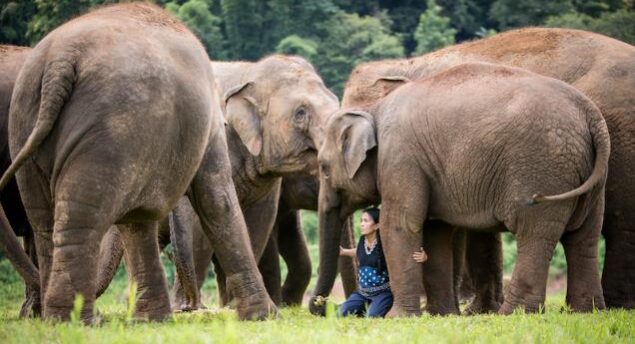
A bull elephant is not an animal you take lightly—I had known that long before I found myself standing in front of one in northern Thailand. But knowing and experiencing are two very different things. In many Asia Pacific travel recommendations, encounters like this are often described as unforgettable, but nothing quite prepares you for the reality. When brother elephants Kham Meun and Dodo stretched out their trunks toward me, asking—almost politely—for bananas, instinct told me to step back. Instead, I stayed.
They were young pachyderms, vigorous and impatient. One was bearing the stamp of a past mishap, a broken tusk from his time in a trekking camp. The tusks of the other were fewer but not any less threatening. But in that instant, there was no hostility, and the only thing was interest. I was also in a controlled space, an elephant sanctuary, managed by the Karen tribal nation, in the hills surrounding the northern Thai city of Chiang Mai.
Karen People’s Living History.
The Karen (kah-RENN) community has been coexisting with elephants long before the development of the tourism industry transformed the hills of the Golden Triangle that straddle the border separating the Kingdom of Thailand from the military dictatorship of Myanmar (formerly known as Burma.) For centuries elephants have been used to haul trees, assist in the construction of villages, and even in battle. But history has marked that on a bitter note. Currently, in the world, fewer than 50,000 Asian elephants remain wild, and many of the animals are still held in captivity.
The most significant thing that I noticed when I was visiting was not the numbers only, but rather the silent change in the treatment of these animals. Now labor and entertainment were no longer the order of the day in this small refuge near Doi Inthanon National Park. The two young bulls and a middle-aged female elephant that I saw had come to reside here.
Healing with Accompaniment.
Their story stayed with me. The older female had lost her calf; the brothers had lost their mother. It was not about breeding or business to bring them together, but companionship. It was strangely reminiscent to see them feeding one after another, with timidity at first and, afterwards, with complete ease. It would appear that grief was not exclusive to humans.
The Woman Behind a Movement
Some days before, I had gone to Elephant Nature Park, a larger sanctuary, which had been started by Saengduean (Lek) Chailert. When the Karen camp was intimate, this place was much bigger.
Lek, a nickname that means “small,” does not match the appearance of someone who manages a group of elephants. She is delicate, yet can handle animals that weigh multiple times her body weight. The way she worked with them showed her ability to manage the situation, while she showed her ability to trust people.
She told stories about sad events, which were difficult for listeners to understand. The elephants endured torture through their loss of sight, physical assaults, and their forced separation from their mothers during their early development. The tourism industry undergoes a gradual transformation as its traditional business methods face modern challenges. She has previously rescued more than 200 elephants by creating the Save Elephant Foundation, a refuge and rehabilitation center that gave them a chance to recuperate both physically and emotionally.
Bringing a different mindset to Tourism and Responsibility.
What amazed me the most was what visitors now are prohibited from doing. Carnival rides, acrobatic shows, and acted-out exchanges are all absent. Even tourists feeding the elephants is limited. At first, it felt restrictive. But, walking along the park, when the elephants were meandering about, intermingling with one another, and not at all attending to us, I began to perceive the park’s goal. This wasn’t about us.
Then, when in a muddy field, I stood when a small group of elephants approached. They were striding slowly, deliberately toward us, not because they needed anything, but because they recognized Lek. These elephants could distinguish one human from another. They had recognized Lek and were coming to say hello. When they arrived, the lead elephant stretched out his trunk in greeting.
A Quiet Understanding
The experience was more practical at the Karen Elephant Home. We followed lunch by observing the elephants feeding from a spread of fruits and vegetables, a moment that felt simple yet grounding—something you rarely sense in typical travel news articles. Soon enough, the two young bulls noticed us again. Their trunks lifted, searching the air with quiet expectation. This time, I did not hesitate to offer the bananas.
The impression that I got when interacting with these people was not the exhilaration or the show. It was a little less dramatic, a realization that these animals do not have to act in order to be treated with respect. They just require space, care and, maybe, the most important thing, the opportunity to live in their native environment.
For a deeper exploration of this journey, read the full article: