

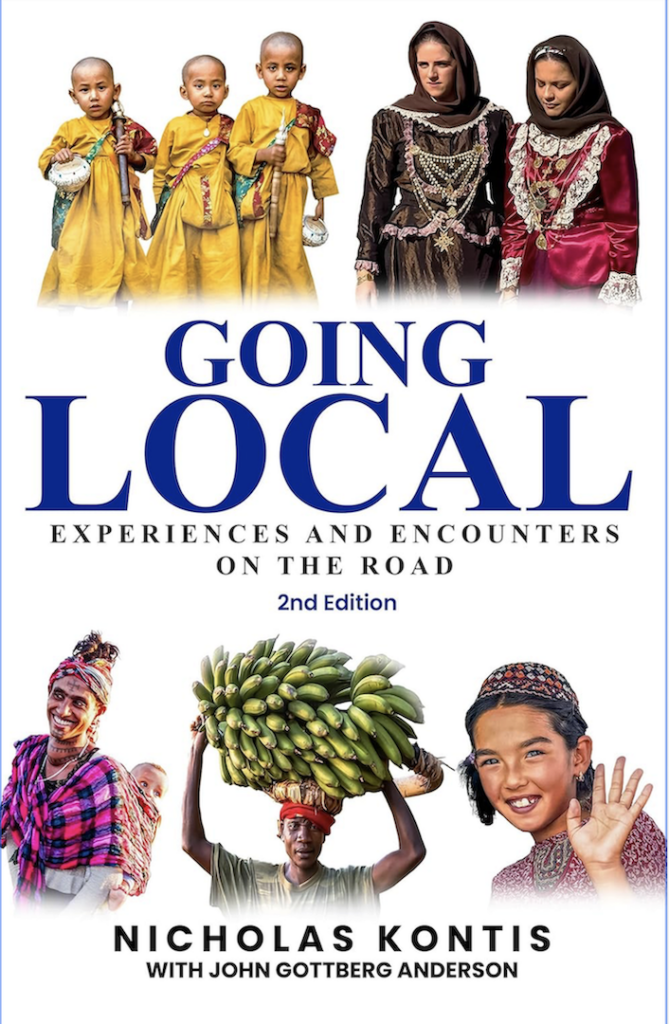
Going Local: Experiences and Encounters on the Road
Reviewed by Steffy McCourt
In the age of social media, authentic cultural travel experiences have become simultaneously coveted and carefully staged. The world is a backdrop, and travel increasingly feels performative. One photograph. One reel. One impossible moment at a time.
In the palm of my hand, I swipe up. The reel opens on untouched Vermont powder. Breath. Speed. Pines ripping past as music swells, turning risk into something that looks easy.
In December 2025, the Associated Press reported that Stowe Mountain Rescue in Vermont had seen their rescue missions more than double, as inexperienced skiers ventured off trail, chasing what social media made look simple. “People are increasingly skiing out of bounds, finding themselves lost in the woods and in need of rescue,” the report noted.
If spectacle-senza-context is the current model for travel inspiration, it raises the question: where should travelers look for guidance that is authentic, informed, and grounded in reality?
Going Local: Experiences and Encounters on the Road has a somewhat misleading title. A better title might suggest what this book actually is: a practical guide, part handbook and part index, written by two people who know, not just where to go, but how meaningful travel is built. A more fitting title might be, What the Travel Industry Knows (And Most Travelers Don’t).
Nevertheless, this is the kind of book that belongs on a bookshelf, not buried in an e-reader library. In short, this isn’t a travel memoir; it’s a manual. For example, readers can find no less than 14 different websites and apps that offer travelers alternatives to hotels. Want to pitch a tent in someone’s backyard? There’s a site for that (campspace.com). Fancy a stay in a British Pub? Check out stayinapub.co.uk. It just might be the most useful travel manual I’ve ever come across. (And because of its usefulness, I ended up purchasing my own copy.)
The authors, Nicholas Kontis and John Gottberg Anderson, bring a lifetime of lived travel experiences to this book. Kontis was just three years old when his family moved from Greece’s Santorini Island to San Francisco, but regular return trips ensured that he grew up with a clear understanding of where he came from. As he notes in the book, “ I traveled experientially before it became in vogue.” That foundation later informed his launch of the first US travel agency that specialized in around-the-world journeys.

Nick Kontis dresses to celebrate when he visits Rio de Janeiro’s Samba City neighborhood.
Anderson’s path was similarly formative, beginning when he took a job in his mother’s cousin’s furniture factory in the heart of Sweden. “From that point on, I was hooked,” he recalls. Soon after, he bought a round-the-world ticket and was on the road for almost three years, an experience that shaped his later career as a travel writer and editor.
Kontis and Anderson write like practitioners, not performers. Whereas influencer culture has turned travel into an identity– adventurer, explorer, nomad– this book treats travel as something you practice. That is why this reads like a manual. And manuals aren’t glamorous, but they are, of course, practical.
That practicality shines through in the way that the book is organized. The chapters function as reference points– sections that the reader can return to depending on the kind of trip they are currently planning. Early chapters focus on peer-to-peer travel and shared economy. Here, readers will find an extensive catalogue of apps, platforms, and small businesses that make it easy to stay local. Think farm stays, glamping sites, and home exchanges. A notable absence is any mention of a chain hotel. The emphasis is consistently on proximity to local people and everyday life. The authors write, “Beyond a doubt, modern wanderers search for unique and enriching engagements that reveal a country’s diversity. Peer to peer travel amplifies the likelihood of such opportunities.”
Several chapters in Going Local covers food travel with the authors acknowledging that modern travelers are increasingly following their stomachs. “Food tourism began to boom in the last decade, beginning around 2010. According to the travel research group, Skift, the typical traveler spends about 25 percent of his budget on meals.” From there, readers gain access to a treasure-trove of practical resources– food tours, meal-sharing, and hands-on cooking experiences. These chapters pair concrete tools with trustworthy advice on how to approach food culture thoughtfully. While these sections could have been condensed, their cumulative value is undeniable. Once again, the book becomes a well-thumbed manual which a traveler can pull from her shelf when planning a trip to, say, Paris, and deciding that learning how to make a croissant might be even more satisfying than just eating one.

Unexpected visitors often drop by for dinner at Nairobi’s Giraffe Hotel.
Later chapters widen the lens on responsible travel, sustainability, and volunteering, grounding these ideas in cultural respect rather than trend-driven ethics. As the authors write, “ No traveler can immerse in local society, seeking to take home life-changing memories, without learning and respecting the culture of the local community.” From there they offer a carefully curated catalogue of cruise lines, travel companies, and organizations that put social and environmental responsibility first. Readers get a glimpse into these experiences through first-person accounts. Some sections will resonate more with certain readers than others. As a mom of three, I skimmed parts, like the chapter on living abroad, that assumed a level of flexibility that I don’t currently have. Still, even these chapters reinforce the book’s core premise– meaningful travel is built intentionally.
The final two chapters take an even wider lens offering reflections from key travel industry figures and the authors themselves. These chapters reinforce what the entire book has been saying: travel is not something to consume or collect, but something to practice, revise, and return to time and time again. As the authors reflect, “In every episode of our travels, we are reminded that through human interaction and by practicing sustainability, we can do our part to change the world. The billions of humans on this planet are far more alike than they are different.” This is a generous conclusion. One that resists urgency, but rather insists on attention, humility, and care.
Back in my palm, another swipe brings another reel– quick shots, swelling music, a world compressed into something that is consumable. But after reading Going Local: Experiences and Encounters on the Road, it’s easier to spot the difference between travel as performance and travel as a practice. Performance demands speed; practice requires time. Meaningful travel doesn’t fit neatly inside a reel. It is built slowly and deliberately. Going Local is not an escape from the world as it is, but a manual for moving through the world with intention.
Going Local: Experiences and Encounters on the Road, Second Edition
Written by Nicholas Kontis and John Gottberg Anderson
Published by Trip Rambler Media
Hardcover edition, $26.95, at Barnes & Noble | Paperback edition, $16.95, on Amazon
Steffy McCourt is a writer, editor, and English teacher whose work focuses on travel, place, and narrative. She is an associate editor for LA Family Travel and brings a literary lens to travel writing, which she did in her first story for EWNS, a Christmas profile of Santa Claus, Indiana.