

By Nancy Wigston
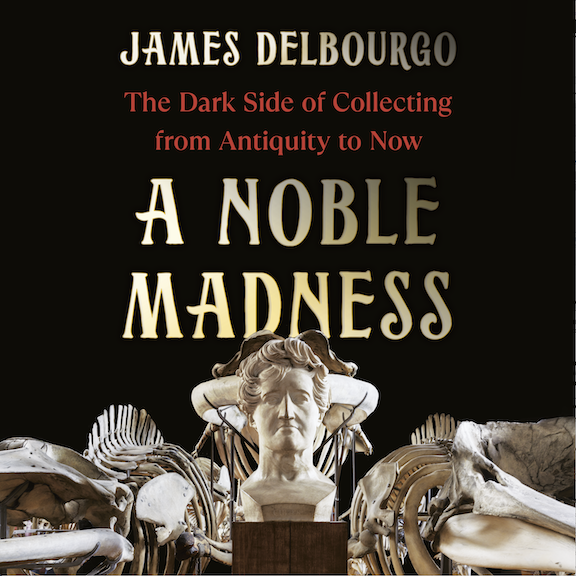
Why do we collect? Shopping has long ranked high among travelers’ favorite activities. For the affluent, collecting carpets in Turkey, art in Paris or Puerto Vallarta and gems in Thailand can evolve into decades-long passions. We like to think that our own collections reflect our best, most tasteful selves, so we buy what speaks to us (excluding ivory or other endangered items), treading in the path of what Rutgers University History Professor James Delbourgo in his newly published work, A Nobel Madness: The Dark Side of Collecting, From Antiquity to Now, identifies as the romantic tradition. Our collections ideally reflect our own good taste, our personalities.
Yet they may reveal the less than ideal too, and this is the central focus of the good professor’s research into collecting, an area of the human psyche that holds a seemingly endless fascination for him, as he delves into humanity’s ancient and often rapacious urge to acquire–even steal–revered or holy objects from foreign lands.
The romantic poet Lord Byron was infuriated when a guide showed him the Parthenon, stripped of its marble sculptures by the former British Ambassador, Lord Elgin. Bought from the Ottomans and shipped to England, the Elgin Marbles
remain on proud display in London’s British Museum. Many regard his act as equivalent to theft, payment notwithstanding. And Elgin’s later life—he divorced and then was afflicted by a skin disease that cost him his nose—seemed suitable retribution for defacing this ancient archaeological gem. Byron, in contrast, died from a fever caught while fighting for Greek independence from the Ottomans. Arguments between those who take too much and those who own just enough have raged throughout human history, long before poets and soldiers got in the act.
In 70 BCE, Cicero, the Roman orator and Senator, argued a court case against Verres, Governor of Sicily, attacking his unseemly behavior as a collector, extortionist, and probable rapist during his tenure. Romans revered Greek art –sculpture, pottery, architecture—for its naturalism and perfectionism. Cicero himself admired and collected Greek art, generously opening his home to the public, but he viewed Verres’ squirrelling away of stolen art as a stain on the Roman Empire.
Cicero is the image of a responsible citizen, precursor of later philanthropists, whereas Verres is still considered dangerously unhinged. Delbourgo’s book takes us on an eye-opening romp through time, visiting the worlds of Imperial Rome, pre-modern China, European Romanticism, and military-sanctioned looting (Napoleon, Goering) as well as its generous opposite (Lord Wellington returned war loot), with stops along the way to examine fashions in collecting, from the rather respectable (books, paintings), to the valuably scientific (Wallace, Darwin) and the frankly perverse (Hitchcock’s fictional Norman Bates).
When bloodless investors and obsessed hoarders take center stage, readers grow frankly nostalgic for that day in 1845 when Calvino’s statue of Psyche so transported French writer Gustave Flaubert that he stole a kiss from her marble armpit, touching beauty itself.
Inevitably, Delbourgo reminds us of our own collections and belongings amassed over decades of travel in foreign lands. Some personal examples follow–a colorfully embroidered, fringed shawl, purchased in Old Jerusalem, when I was a 20-something college student. I later wore that shawl at my wedding in rural Ontario. One theory holds that souvenirs from abroad are modern equivalents of the pieces of the True Cross that early Christian pilgrims eagerly acquired. True or not, they prove that we’ve been to fabled places and seen remarkable things.
In our twenties, when money is tight, we choose inexpensive things that connect us to “faraway places with strange sounding names”, as Willie Nelson sang. Another example: a copper pot for brewing Turkish coffee, made by artisans in Sarajevo’s “Coppersmith Alley,” became a tangible memory, even though it leaked.
Asian curio (thrift) shops and church rummage sales can be Aladdin’s caves, busting with items discarded by descendants of grannies whose tastes are no longer in fashion. They are also places to meet friendly locals, like the charming Penangite Miss Tsiang, who sold things at the 100-year-old St. George’s Church weekly rummage sale in the late 1970s, during my Malaysian years. Fifty cents bought four baby binders, beautifully hand-stitched together from worn batik sarongs. Other shops sold the lacy blouses called kebayas, once popular with stylish Chinese Malaysian ladies—enthusiastically snatched up by 30-something expats–along with tattered, tasseled Chinese embroideries featuring the eight emperor gods, meant to be hung above shop entrances during the Lunar New Year. These things still exist, but in newer, flashier versions that pale in comparison to those made in colonial days.
Religion-free China now produces religious souvenirs—Buddhas, prayer wheels—for tourist consumption, as David DeVoss writes in his April 2024 article, To Lhasa and Beyond on the Road to Shangri-La.
Similarly, visitors to the former Straits Settlements on the Straits of Malacca, home to early Peranakan communities from China, who might hope to add to their collections of “baba-Nyonya” chinaware, with its delicate shapes, cheery reds, pinks and greens, won’t find anything today but smooth imitations, imported from China for the tourist trade.
Best, however, when money and jobs are secure, to be careful when collecting. If a large expenditure is required, do your homework. Some curio/antique dealers are adept at selling out-and-out fakes—in Malaysia, these items were often advertised as coming from “Burma,” as if to add an extra layer of exoticism. And some art dealers have been duped themselves. In Toronto, a fake painting by indigenous artist Norval Morriseau was purchased from a prestigious dealer by a member of a famed Canadian rock band (The Bare Naked Ladies). The ensuing lawsuit made headlines.
That said, it’s best—unless huge sums are involved–not to dwell on mistakes made when salaries are secure and jet lag is severe. My own “Ming” vase came with an official-looking antiques association certificate and got me Christmas greetings from the shop for years, but was likely made just weeks before I bought it. Still, it makes a great story and looks good in my living room. Console yourself: fake antique porcelain from China has been a thriving business for centuries.
By 1960, the year that Hitchcock released Psycho, starring its seriously dangerous collector/taxidermist/killer, Norman Bates, public association between madness and collecting was firmly established, thanks in large part to psychiatrists Richard von Krafft-Ebing and Sigmund Freud. The latter was an avid collector, an “archeologist of the mind,” whose 3000 antiquities from Egypt, Rome and the Far East, displayed in his office, were used as prompts for his patients—whose case histories he also collected. Freud’s collecting began after his father’s death and gave him “comfort,” he wrote. The question becomes: how much comfort do we need and how much can our budgets afford?
In Asia, collecting’s deep roots stretch back to pre-modern China. Confucius advised against attachments to objects, but newly prosperous citizens in the Ming Dynasty (1368-1644) collected anyway, decorating their houses with art, books, and porcelain. More than three hundred years later, when Mao’s Red Guards showed up to destroy the trappings of bourgeois collectors, some talked them out of their destruction, arguing that their porcelain was made by the very workers the marauding gangs claimed to champion.
Weird and criminal behavior blossom under Delbourgo’s historian’s eye, yet, as knowledgeable as he is, he seems less than interested in the innocent, discerning travelers whose love and respect for a place and its art results in their own beloved collections.
In short, these dark collectors tend not to be a fun group. Most of us would rather travel in the company of funny t-shirt and fridge magnet afficionados than peer into the contents of Jeffrey Dahmer’s refrigerator. Delbourgo’s “long, twisted” study of collectors leaves us both impressed and overwhelmed by his research, yet unpersuaded that Norman Bates is a collector deserving anything other than a warning to avoid checking into the Bates Motel.
“Buy what speaks to you,” counseled a seasoned antiques dealer as I spent a few hours in his enticing shop on Hong Kong’s Hollywood Road. Since nothing seemed to speak very clearly that afternoon, I left with nothing—neither a porcelain horse nor a wooden monkey god. But I have carried his wise advice ever since.
A Noble Madness: The Dark Side of Collecting from Antiquity to Now
By James Delbourgo, Penguin Random House
320 pp. $32.00 US, ISBN: 978-0-393-54196-0
Nancy Wigston is a Montreal native who has traveled extensively and purchased items all over the world. She still has the three small Buddhas she found at a Saturday market in Cambridge, England. An expert at the British Museum confirmed that one was indeed from Burma. Also read her review of Brian Kelly’s How To Win At Travel .