

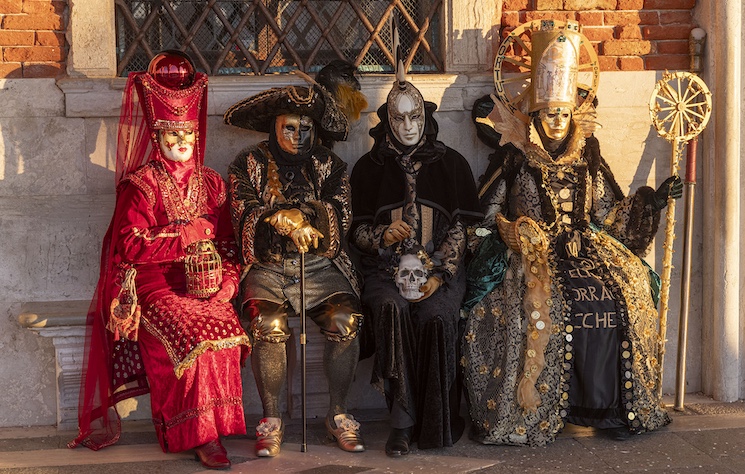
This foursome is resting beside the Doge’s Palace, soaking up the rising sun while being photographed by hundreds of image-hungry shooters. The variety of costumes is astonishing, and the show happens every morning, rain or shine. Photo by Kerrick James
By Kerrick James
Venice has been the subject of hundreds if not thousands of short stories and novels, like Thomas Mann’s Death in Venice (1912), Ernest Hemingway’s Across the River and Into the Trees (1950), and Pat Conroy’s Beach Music (1995). I’ve feasted on these and other tales set in this perennially at-risk city clinging to existence beside the Adriatic, and for me, the gravitational pull of Venice has never been stronger.
On my first Carnival, in 2026, I experienced more moments of visual magic and cultural magnificence than on any of my four prior visits to Venice. If you go for the Carnival, bring your camera and be prepared to walk everywhere, except to the major islands in the lagoon, Giudecca, Murano and Burano.
Street photography par excellence
For photographers, Venice is an alluring and accessible public movie set, a veritable stage open 24 hours a day. During Carnival, this access is enhanced by the dozens of tasteful and dedicated performance artists who don ornate costumes and makeup, allowing anyone and everyone to capture their personas visually — for free. I am profoundly grateful for the patience they exhibit while strolling the narrow lanes and plazas. When asked for a photo, they pause and share eye contact while exuding an aura of mystery commingled with beauty and a slight touch of melancholy. And then, they are gone. Most of the ‘actors’ speak very little, if at all, as their costumes and gestures are surely stagecraft enough.
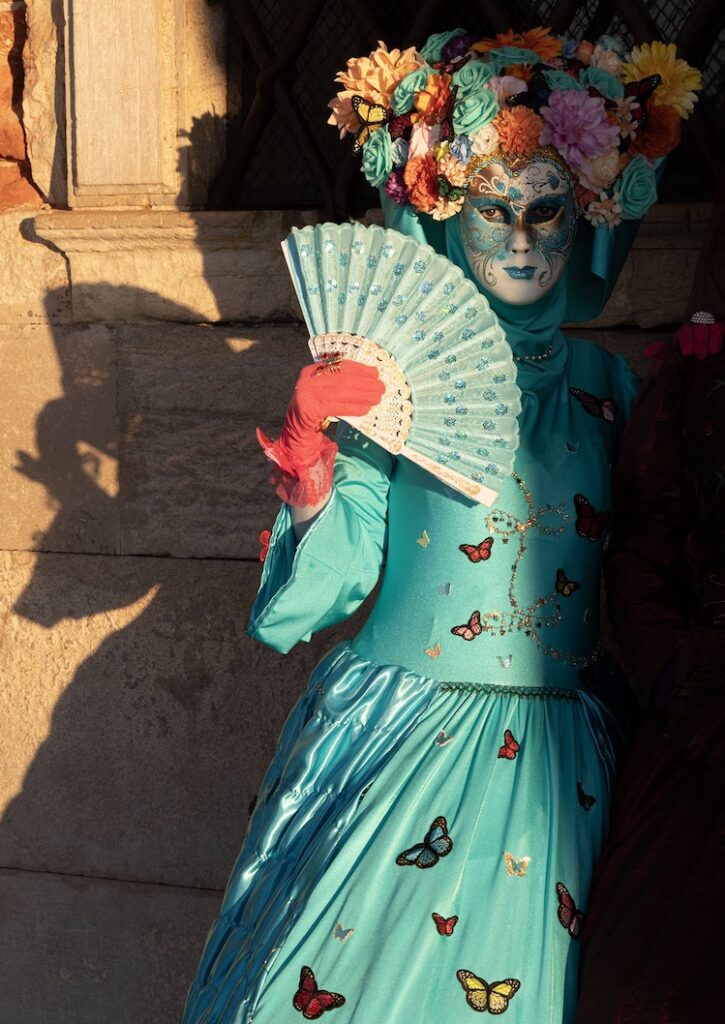
The warm, low sun partially illuminates a flower-adorned mystery woman, who knows how to throw a shadow. She is taking refuge from the crowds next to the Doge’s Palace, by St. Mark’s Square. Photo by Kerrick James
Be always ready to turn a corner and find a marvelous person or couple in full costume, and with a smile and a wink, you may engage them for a special pose or expression. It’s positively addictive to create images in this way, a connective experience, and a simple thank you to them will suffice.
To me, Venice Carnival embodies ‘street’ photography on a rare and elegant scale. It’s possible to roam the city’s urban canyons of Art and stone by day and night, embracing the classic architecture balanced on ancient sandbars in a lagoon that floods and recedes like we inhale and exhale.
I love Venice, even the crowds during Carnival as they dodge the saltwater welling up from drains in St. Mark’s Square, hire gondolas that skillfully ply the canals that serve as streets, and marvel at the mesmerizing 12th-century tessellated marble floor in St. Mark’s Basilica. Join the crowd of joyous visitors while they muse at the desperate legacy of the Bridge of Sighs, then head to Harry’s Bar at the Hotel Cipriani nearby to savor Bellini cocktails in the room where Hemingway had his own table in the late 1940’s.
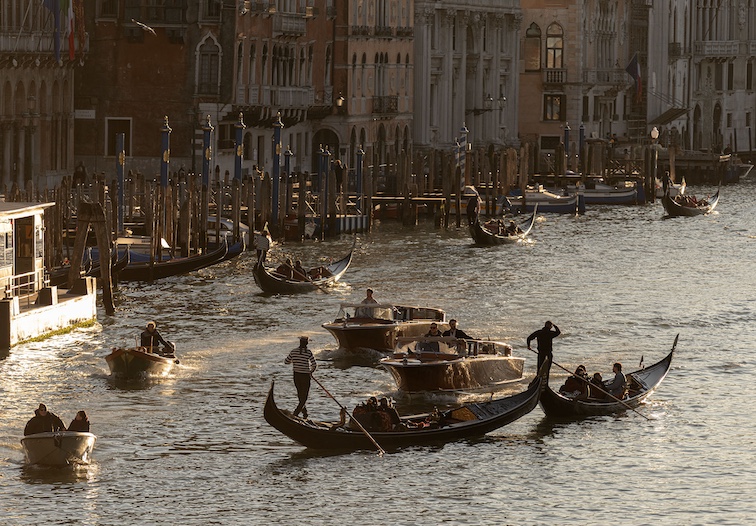
This view of gondolas, water taxis and private boats (their cars), plying the Grand Canal, was shot in late afternoon from the landmark Rialto Bridge. I never once saw even a near-miss collision, despite the traffic. Photo by Kerrick James
History of Carnival
The annual Carnival of Venice is recognized as the oldest carnival in the world, dating back to 1162. During the Middle Ages and Renaissance, when Venice was at its peak of wealth, influence and naval power, Carnival morphed from a celebration of an early military victory into an extended period of bacchanal festivities. It is said that the tradition of wearing masks evolved so that people of all social classes could mingle more freely, hide their personal identities, and indulge in pleasures of the flesh before the arrival of the strict censure of Lent. The literal meaning of Carnival is ‘remove meat,’ ahem.
In 1797, Emperor Francis II of Austria banned the Carnivale di Venezia entirely, feeling threatened by the anonymity of mask-wearing and also the hedonistic excesses that were becoming accepted practice. For 182 years, the tradition of mask creation and wearing was kept alive in private by artists, until in 1979, the Italian government brought the Venice Carnival back to life with great success.
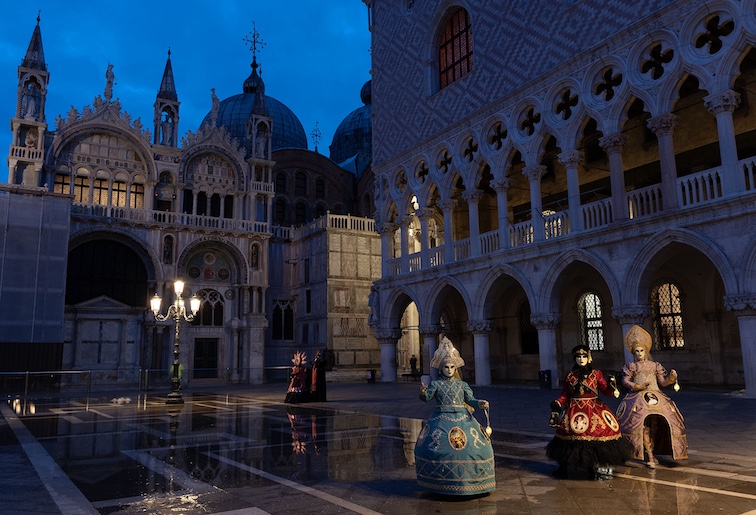
Arrive 30 minutes before dawn in St. Mark’s Square and you will see the costumed lads and ladies gathering. If the tide is high, they may well be reflected in the saltwater flooding this space, so bring a pair of water booties or a change of shoes. Photo by Kerrick James
Nearly 3 million people come to Venice every year to celebrate Carnival, yet if you walk about in the chill early blue hour of dawn, the streets are quiet and moody, and the ghosts of Carnivals past can be sensed, until the winter sun rises above the Venetian Lagoon, lighting up the Campanile Tower and the Doge’s Palace.
Regarding masks, everyone who visits Venice at some point desires their own mask, as did I. You can peruse a fabulous variety of them for sale in a plethora of shops, kiosks, and artists’ dens, ranging from ten to hundreds of Euros. Or, if you book ahead, you’ll have two hours with Kadija, the mask-maker at TragiComica in the San Polo district, who will help you design, paint and decorate your own very personal and unique mask in a workshop setting. This was one of the high points of my time at Carnival, and I took a piece of it home with me: a Sun-Moon-Stars motif mask, to don anytime I desire a taste of Venetian culture.
Exploring the labyrinth
Venice is a most intimate city in terms of scale, but it is also a walkabout treasure hunt, so –with a camera always at the ready — wear comfortable shoes and bring a shoulder bag for discoveries. You may wish to hire a local guide to explore lesser-seen sestieri (districts) like Santa Croce, Dorsoduro, Cannaregio, and Giudecca. San Marco, Castello, and San Polo are easy to explore on your own, but be aware that cell signals can vanish in the tight confines, since there are only small slices of sky to acquire a signal.
A guide will keep you from walking in circles and illuminate the architecture and character of each sestieri, saving you time and frustration. Our guide, Isabella Bariani, is a spirited Venetian native, speaking excellent, accented English with a gift for phrases like, “In Venice we walk on bridges” (a measure of distance). Venice has 210 pedestrian bridges crossing 150 canals and needs every single one.
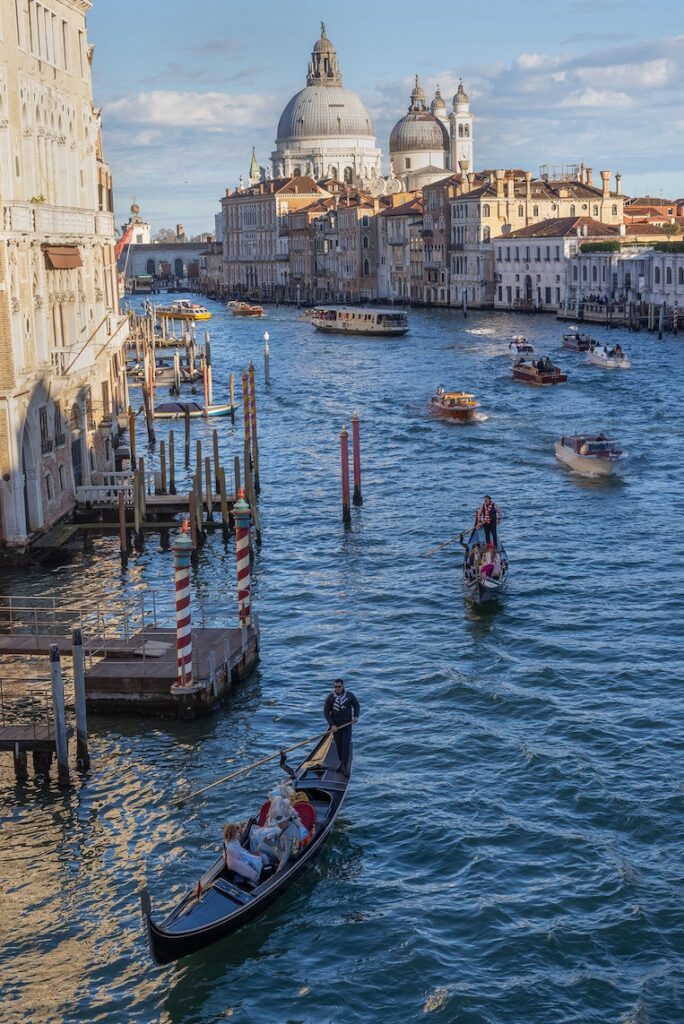
The other great bridge crossing the Grand Canal is the Accademia Bridge, the only one built entirely of wood. In the afternoon, watch the parade of gondolas, opulent water taxis and vaporettos (water buses), and of course their passengers. Photo by Kerrick James
“Everything is tilting in Venice,” extolls Isabella as we near the Campanile, a 325-foot landmark tower overlooking St. Mark’s Square. Why? The city was built on glacial silt and sand, and the pilings were sunk 25 feet into the soft delta. You may well experience light flooding when you visit, so a water-resistant pair of shoes is a smart item to pack.
The city’s architecture is an aesthetic blend of Italian Gothic, High Renaissance, and Baroque styles, with Islamic and Byzantine influence. The Doge’s Palace is a must-visit museum and a prime example of Italian Gothic design. Isabella narrates an incredibly detailed tour here through spacious chambers with ceilings painted by the Masters. She regales us with tales of Venice’s origins, excesses, power plays, and personalities. Over several days, we begin to appreciate the extraordinary power generated by their mercantile culture, and by no small measures of avarice, political will, and sheer ruthlessness.
Future Carnivals
In 2027, the dates to save for Carnival are January 30 to February 9, though some activities occur before opening day. Fat Tuesday comes quite early next year, on February 9, with the main festivities, grand masquerade balls and public parades (on the water), largely scheduled during this ten-day window.
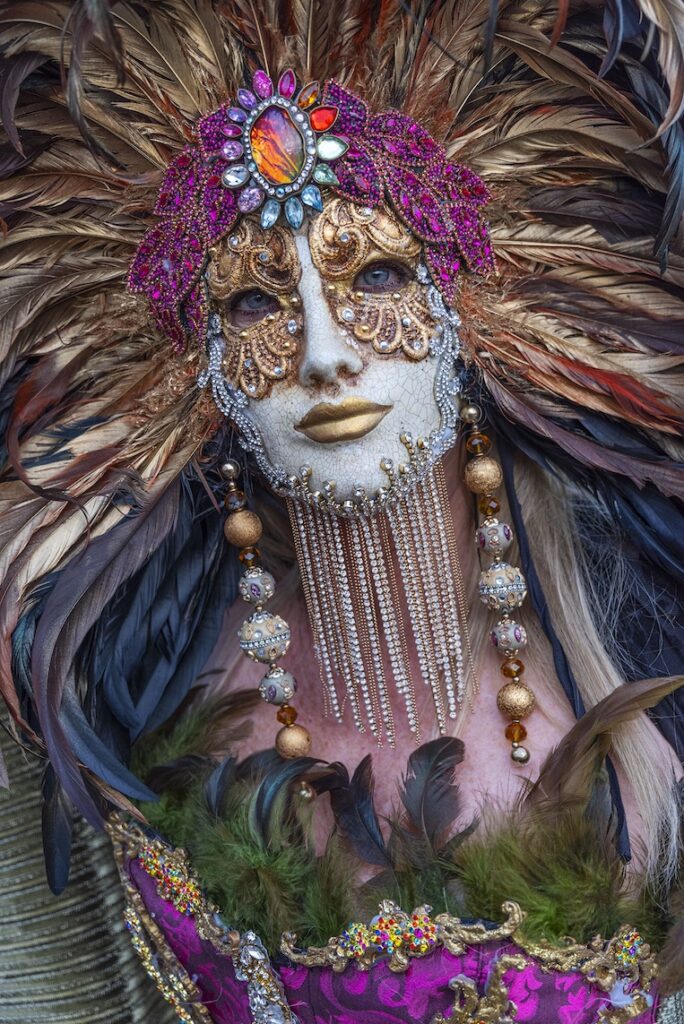
People from around the world journey to Venice to wear their creative costumes, and sometimes they’ll even tell you where their home is. This temptress is from Utah, and returns every year to enhance the greatest carnival on earth. Photo by Kerrick James
The Carnival is known for supremely grand and formal balls, several of which require (expensive!) tickets and appropriate costumes. Two of them are: The Grand Ball Carnival in Love: This highly anticipated 18th-century masquerade ball is scheduled for February 6, 2027, at the Palazzo Ca’ Zen ai Frari, and The Ball of Dreams, which leads off on January 30, 2027. Other balls may be more reasonably priced, but plan ahead. There are shops in Venice that rent elaborate costumes, if the ball muse strikes you.
Fortunately, there are numerous live public events that are free and well worth your time to appreciate and photograph, like puppetry and theatre. You can always show up at St. Mark’s Square in the blue hour before dawn, as the costumed characters gather, and drink in the splendor and variety of their visual personalities, and of those visitors sharing the square with you. I met people from around the globe at Carnival, some photographing with pro gear yet many folks using their cell cameras to fine result. Charge up your batteries and expect to capture many more images and videos than you ever thought possible. The energy is infectious, and thankfully, this is a safe event, with local Italian police keeping a watchful eye on the crowds. I’d return in a heartbeat, and love to take my family next time.
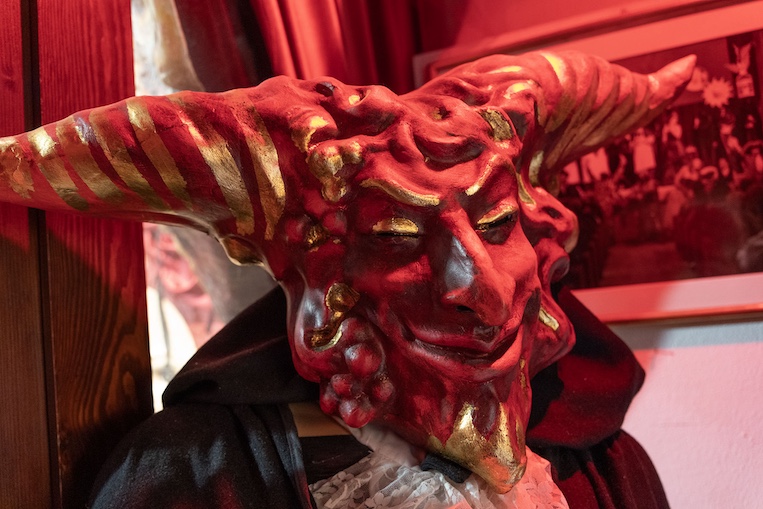
A smiling/leering Red Devil Satan guards the door at the fantastically rich mask workshop La Bottega dei Mascareri in the sestieri of San Polo. Go inside, take a picture, and choose a unique mask. Better yet, wear it home. Photo by Kerrick James
Arrivederci
Venice has endured for many centuries as a city-state of great influence and suffocating wealth. Even if one day it’s swallowed up by the Adriatic, Venice will be immortal in world history and consciousness, a lingering watercolor dream, an illusion of beauty and intrigue.
Is it destined to be a future Atlantis? Let us hope not. These images are from just one Carnival, mere slices of time I will never forget, and many more Carnivals await us, until the sea wins at last and Venice passes forever into Myth.
Kerrick James is an Arizona-based travel journalist who loves water, literature, pageantry, and history. He finds Venice an enticing amalgam of all those facets of life. Find him at the next Carnival, follow his work at www.kerrickjames.com, and check out his recent EWNS stories on the centennial of America’s mythic Route 66 and cruising through history on the Mississippi River.