

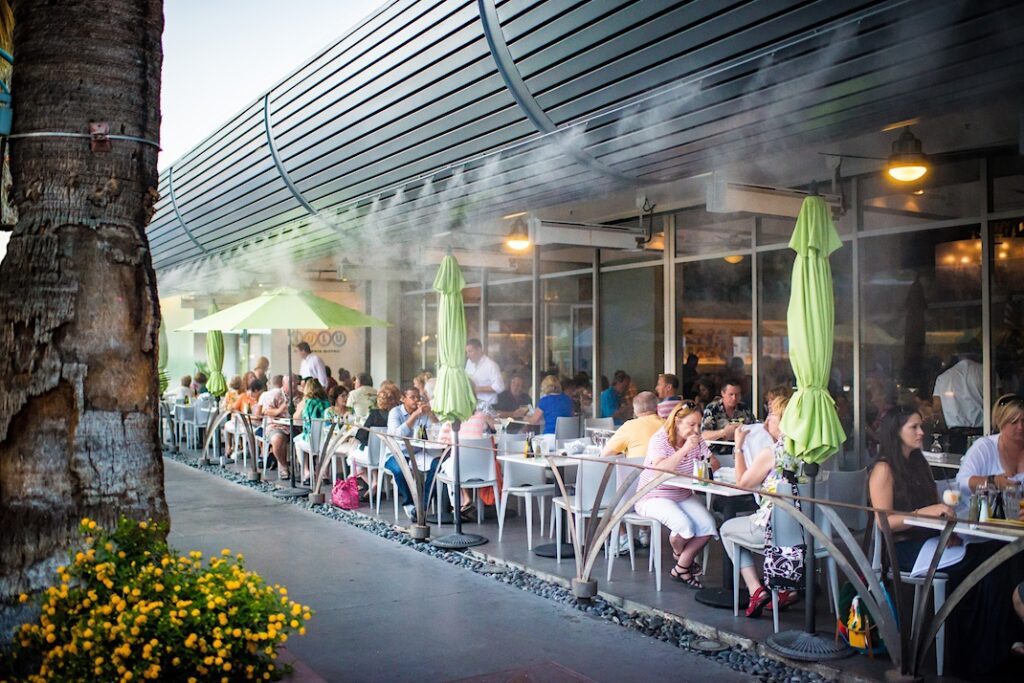
Misting systems at many restaurant patios, hotel outdoor dining areas, and public gathering spaces throughout the city help provide relief from hot weather. Photo courtesy of Visit Greater Palm Springs
Water made life possible in this desert landscape. Today, natural springs, groundwater,
resort pools and new aquatic attractions are helping fuel Palm Springs’ tourism economy
Temperatures typically reach sizzling triple digits in summer in Palm Springs, a desert town on the western edge of the Coachella Valley in Central Riverside County. And while rain is sparse in this ecological area known as the Sonoran Desert, Palm Springs has an abundance of natural and engineered water sources that transform this resort desert town into a welcoming oasis year-round.
Situated at the base of the San Jacinto Mountains about 107 miles east of Los Angeles, Palm Springs was historically a seasonal destination. Families like mine would pile in the car and make the two-hour drive from L.A. for a few days of relaxation and swimming in a hotel pool on spring breaks (before spring breaks became synonymous with partying).
For decades, many businesses scaled back or temporarily closed during the hottest summer months when visitation dipped and locals migrated to cooler climates. The city’s year-round population of about 45,500 residents swells to 75,000 to 80,000 when seasonal residents, snowbirds and visitors arrive during winter season, from November through April.
But that pattern is shifting, even during the hottest months of summer. “The desert has become a year-round tourist destination. There have always been stalwart locals, known affectionately as “desert rats” who endured the summer swelter. Now they are joined by tourists from all over the world,” says Tracy Conrad, president of the Palm Springs Historical Society.
Palm Springs tourism officials attribute the growth in summer visitation over the past decade to a more relaxed pace with fewer crowds, seasonal offers, and the best hotel rates.
“Water based attractions have certainly contributed to that evolution,” says Gary Forsyth, director of Palm Springs tourism. “Resort pools have long been one of Palm Springs signature experiences and the opening of the Palm Springs Surf Club in 2024 has added an exciting new attraction that appeals to both visitors and locals.”
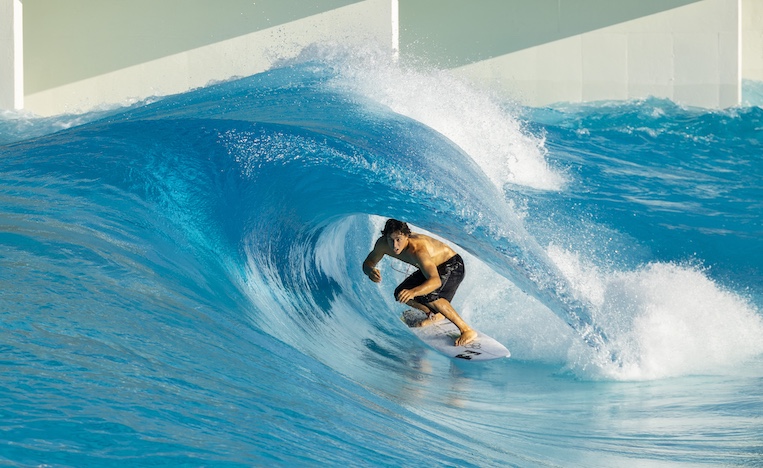
Beat the heat at The Palm Springs Surf Club, which features surf waves, water slides, a lazy river and poolside cabanas. Photo courtesy of Greater Palm Springs
Beyond swimming pools and water parks, many hotels and attractions feature splash areas, cooling fountains, and other water features that create a refreshing environment for guests. Misters are another example of how Palm Springs businesses help visitors stay comfortable during the warmer months.
“You’ll find misting systems at many restaurant patios, hotel outdoor dining areas, and public gathering spaces throughout the city. Combined with shaded patios, pools, cabanas, and cooling stations at some events, they allow people to continue enjoying outdoor experiences even during the summer,” says Forsyth.
Water sources and the birth of Palm Springs
While creative marketing and new attractions have helped reshape summer tourism, Palm Springs’ relationship with water has always been central to its identity. Long before water parks and luxury spas, the region’s natural springs made life—and eventually tourism—possible in this desert landscape.
For the Agua Caliente Band of Cahuilla Indians, whose ancestors have lived in the Coachella Valley for thousands of years, the natural hot springs, mountain-fed streams, and underground aquifers were a source of life, healing, and cultural significance.
The Tribe, one of nine federally recognized Cahuilla tribes in Southern California, played a central role in Palm Springs’ early development and continues to shape the desert region. The City of Palm Springs grew around the Tribe’s downtown hot mineral springs, which evolved from simple bath houses to a modern spa destination.
In the early 20th century, the mineral springs and swimming pools attracted Hollywood celebrities, artists, architects, and others seeking relaxation and wellness in the desert. Palm Springs evolved to a popular desert retreat with sparkling swimming pools, resort spas, lush golf courses, and attractive public parks with fountains and streams.
As tourism expanded so did the surrounding communities. Today, Palm Springs is among nine cities in the Coachella Valley, comprised of Desert Hot Springs, Cathedral City, Rancho Mirage, Palm Desert, Indian Wells, La Quinta, Indio, and Coachella. Together, they make up Greater Palm Springs.
Portions of Palm Springs, Cathedral City, and Rancho Mirage lie within the Agua Caliente Indian Reservation, which was established in 1876 and expanded in 1877.
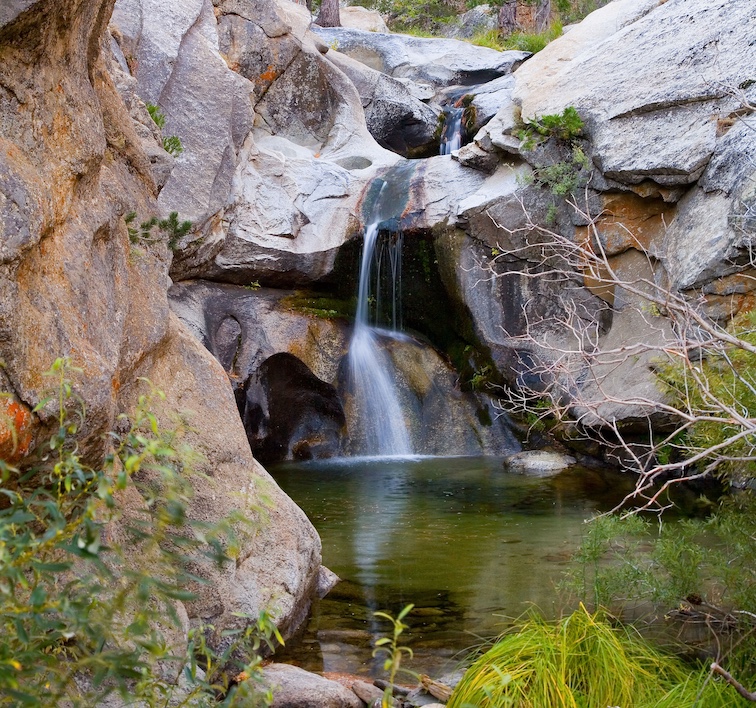
Visitors to Tahquitz Canyon can hike to a seasonal 60-foot high waterfall and explore rock art, native wildlife and plans along the way. Photo courtesy of Greater Palm Springs
More Hot Springs
Natural springs extend beyond Palm Springs. About 12 miles north, Desert Hot Springs has built its identity around geothermal mineral waters, with dozens of boutique resorts offering therapeutic soaking pools fed by naturally heated underground springs.
Unlike Palm Springs, where the hot springs are concentrated in downtown, Desert Hot Springs sits atop a unique geological setting where hot mineral water rises along fractures east of the San Andreas Fault (itself worth a visit on a guided tour).The sulfur-free water emerges from deep underground at temperatures reaching 180 degrees Fahrenheit, while a separate cold-water aquifer lies west of the fault.
Palm Springs’ Growth and Groundwater
Natural hot springs remain one of the region’s defining attractions, but they are only part of the area’s water story. With Palm Springs’ growth during the 20th century, the city increasingly relied on groundwater pumped from beneath the Coachella Valley. As demand increased, local water agencies developed long-term strategies to protect the aquifer.
For decades, the two local water agencies – the Coachella Valley Water District (CVWD) and the Desert Water Agency (DWA) – worked to offset declining aquifer levels by importing water from the Colorado River (via the Coachella Canal) and, later, the State Water Project, which is used for groundwater replenishment and for irrigation of agriculture and other large-scale landscaping.
“CVWD pumps water directly from the groundwater basin to serve its customers with drinking water,” says Lorraine Garcia, CVWD communication manager/public information officer.
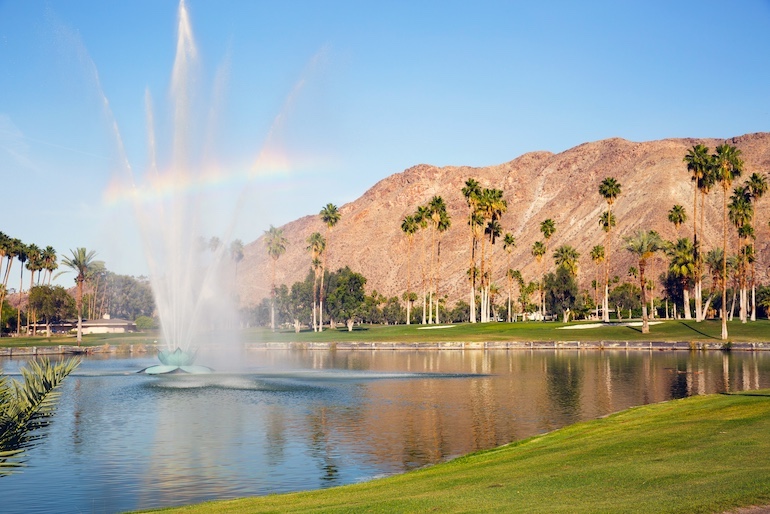
The 100-foot high Disney Fountain, located on the North Course between the 9th and 18th holes at the Indian Canyons Golf Course, was donated by Walt Disney in 1962. Photo courtesy of Visit Palm Springs
The Desert Water Agency (DWA) provides water to the City of Palm Springs and portions of Cathedral City, as well as some surrounding unincorporated areas. The agency’s primary source of drinking water is groundwater from the Indio Subbasin, an aquifer that is replenished naturally through rain runoff, snowmelt from the surrounding mountains, and imported water, says Victoria Llort, DWA director of public affairs & conservation.
The Indio Subbasin aquifer makes it possible for one of the driest locations in the Sonoran Desert to be one of the greenest. Bucolic parks and verdant golf courses welcome athletically-minded tourists, who can return to their hotels and relax in lounge chairs under cooling mist beside the swimming pool.
Those still seeking exercise can head to Prescott Preserve, a well-watered 100-acre urban park southeast of downtown Palm Springs, that offers hiking trails, bird watching, two golf courses, a large butterfly garden and several small lakes all interspersed with tranquil patches of native plants. Pause for a rest on a bench beneath massive shade trees, and one of the two park rangers patrolling the area will probably stop to offer a welcome.
Recently, the Agua Caliente Water Authority was created and an agreement between Coachella Valley and the Tribe in 2025 granted the Tribe 20,000 acre-feet of water annually and a shared role in regional water management. “Together, we will ensure the reliability and sustainability of our region’s water supply,” says DWA Board President Paul Ortega.
The Region’s Growing Tourism Economy
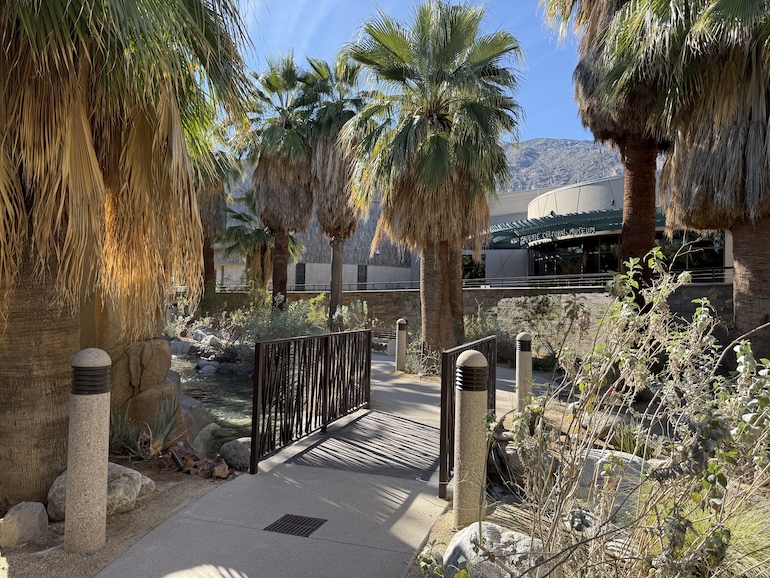
The Agua Caliente Cultural Plaza encompasses a museum, streamside Oasis Trail, a gathering plaza, and The Spa at Séc-he. Photo by Mimi Slawoff
Reliable water supplies not only support residents they also support the tourism industry that drives Greater Palm Springs’ economy.
The Tribe, steward to more than 34,032 acres, has more than 500 members, and is one of the largest employers in the Coachella Valley.
In the last five years, the Tribe has increased its workforce to more than 3,000 team members through the expansion of its enterprises, including the Agua Caliente Cultural Plaza in downtown Palm Springs, a third casino – the Agua Caliente Cathedral City – and Agua Caliente Fuel in Rancho Mirage, as part of the Tribe’s broader diversification strategy.
The tribe’s other enterprises include Indian Canyon and Tahquitz Canyon as well as the Indian Canyons Golf Resort. The Agua Caliente Cultural Plaza is a 5.3-acre complex that encompasses the Agua Caliente Cultural Museum and The Spa at Séc-he (which means the sound of boiling water). Located on the site of the Tribe’s sacred hot mineral water, the 73,000-square-foot Spa at Séc-he is the fifth bathhouse or spa at this historic site.
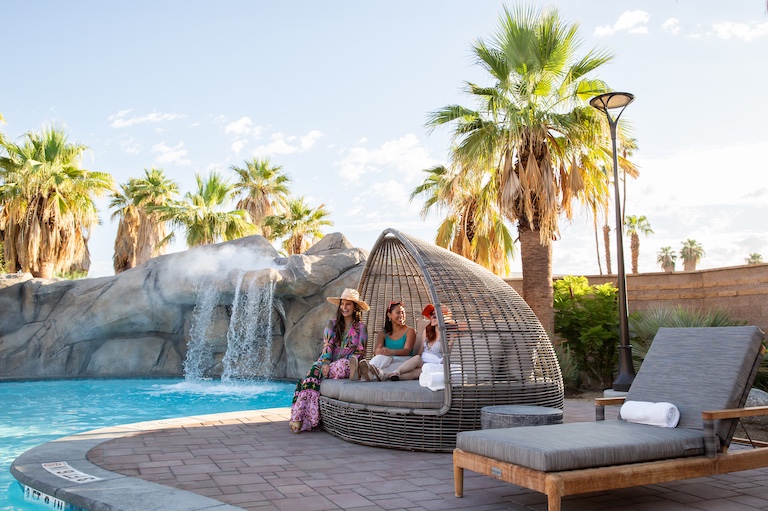
The Spa at Séc-he’ offers 22 mineral baths, massages, pools, steam rooms, and saunas. Photo courtesy of Visit Greater Palm Springs
Visitors can soak in the 105-degree water in the 22 private rooms for Taking of the Waters, an ancient tradition. The hot water, sourced directly from the underground springs, has a unique mineral composition.
Ready to Go?
Today’s visitors can experience firsthand how water continues to define life in the desert. “Developments like Palm Springs Surf Club and DSRT Surf (in Palm Desert) reflect growing interest in active recreation and unique outdoor experiences, offering another way for travelers to experience Greater Palm Springs,” says Joyce Kiehl, Visit Greater Palm Springs director of communications.
Whether relaxing by a resort swimming pool or soaking in ancient mineral springs, visitors will discover that water has always been—and remains—the lifeblood in this desert region.
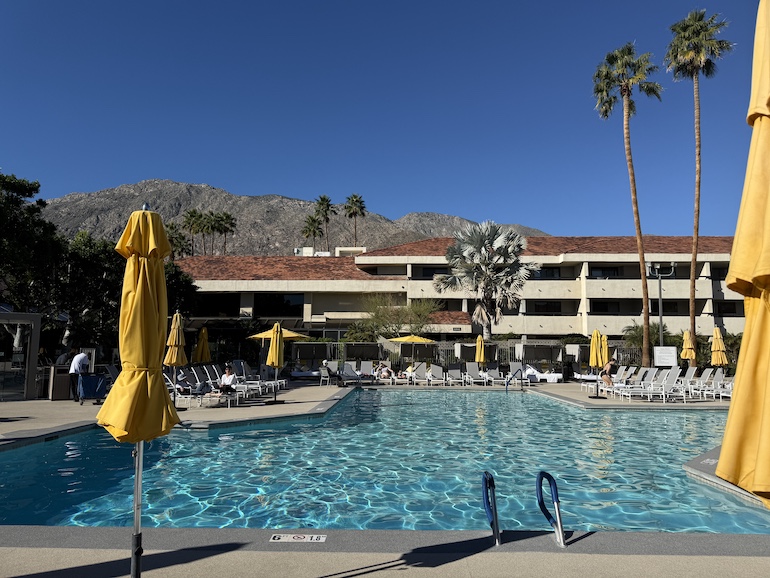
The Hilton Palm Springs is a full-service resort with a massive swimming pool located in downtown Palm Springs. It offers free shuttle service to and from the Palm Springs International Airport. Photo by Mimi Slawoff
Where to Stay and Play
To stay in the heart of Palm Springs, consider the Hilton Palm Springs, conveniently located across the street from the Agua Caliente Cultural Plaza. The hotel has a large swimming pool, restaurant, mountain views, and is walking distance to markets and shops.
Some resorts in Greater Palm Springs, like the Omni Rancho Las Palmas, Grand Hyatt Indian Wells, and the Westin Rancho Mirage, have on-site water parks. Day passes to the water parks are available for non-guests.
Mimi Slawoff is an award-winning travel journalist and the author of three books about Southern California. Her previous stories for EWNS featured Visit Switzerland’s Lauterbrunnen and Jungfraujoch Before Spring Turns Into Summer and Affordable Cruise Ship Condos for Digital Nomads Seeking Endless Vacations. Learn more about Mimi at Mimi Slawoff.com.