

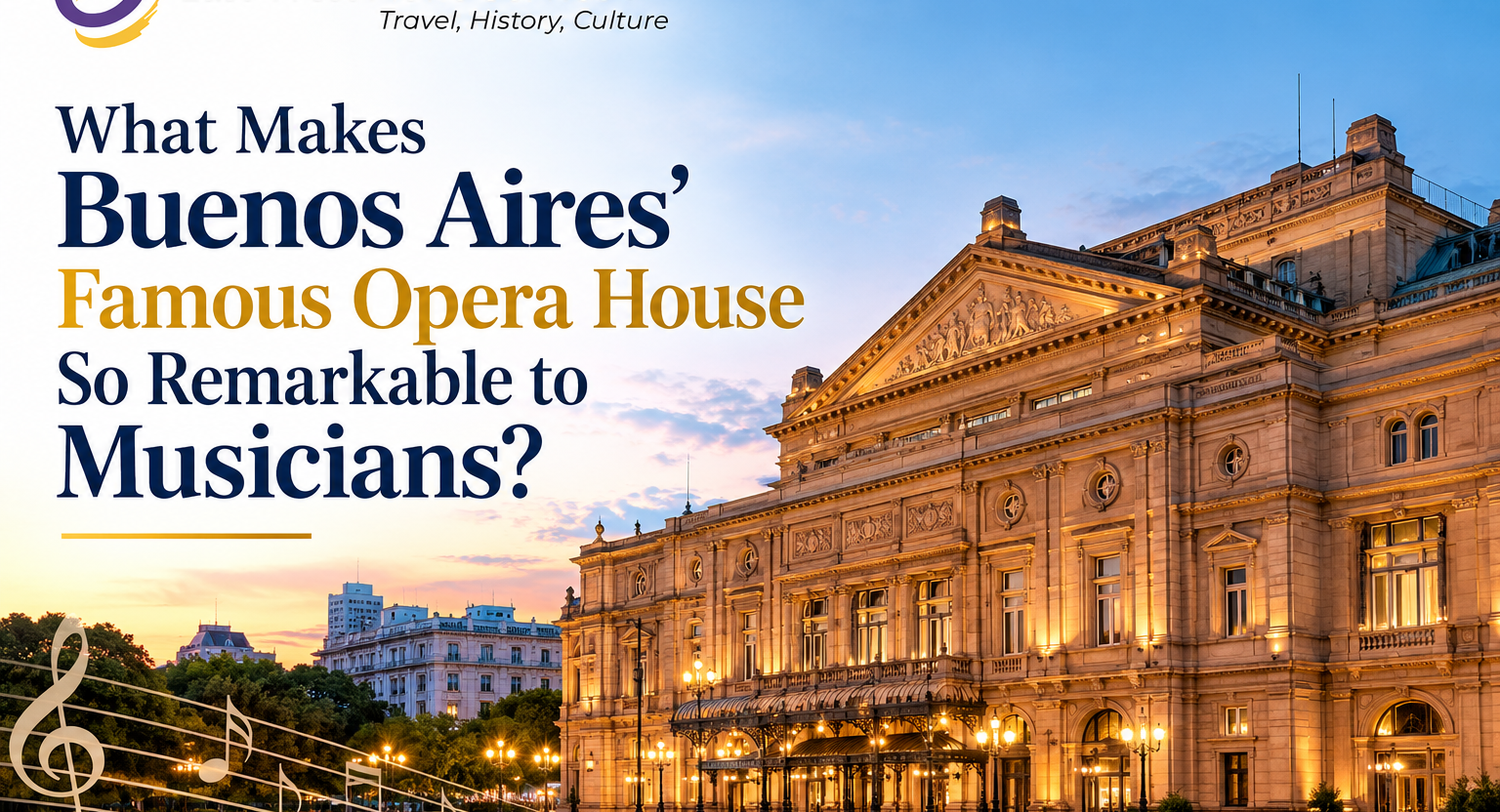
Summary: The Teatro Colon is one of the world’s most extraordinary musical venues because of its distinguished musical past, dramatically beautiful architecture, and stunning acoustics, all of which are found in the city of Buenos Aires. Built in 1908, it is a landmark that has long been the home of internationally renowned artists and entertainers and remains popular with music fans around the world. Find out about its architectural features and art heritage, which makes it a stunning tourist attraction.
What makes an opera house unforgettable to a musician? Beyond its grand appearance, the answer lies in how a voice carries, how instruments blend, and how an audience experiences every musical detail. In Buenos Aires, Teatro Colón has earned international recognition for precisely these qualities.
Opened on May 25, 1908, with a performance of Giuseppe Verdi’s Aida, the theater has become one of the world’s most celebrated opera venues. Its reputation rests on a combination of acoustic excellence, architectural craftsmanship, and a remarkable history of musical performances.
Acoustics That Bring Music to Life
The most famous part of the theater is its amazing acoustics. Entertainers and musicians require an environment that lets sound flow easily and avoids muffling the individual sounds of each instrument. It is the reason that Teatro Colón is highly praised for attaining this balance.
It boasts an auditorium in the shape of a horseshoe to ensure the optimum transmission of sound in the hall so that the audience can hear the performance very clearly, whatever their proximity to the stage. The interior spaces and materials also combine to give it an acoustic quality.
Soft surfaces tend to absorb sound while hard surfaces reflect sound. It is the combination of all these elements that produces rich tones, making an orchestral performance and vocal operatic music more appealing.
The setting is particularly effective for musicians, as its subtle variations in timbre, articulation, and volume can be appreciated naturally by the general public without overpowering the recording.
An Architectural Masterpiece
The Teatro Colón is spectacular in terms of its aesthetics. It reflects European architecture, notably that of Italy and France, strongly present in 19th-century grand theaters.
Francesco Tamburini, Víctor Meano, and Jules Dormal were among the architects involved in the creation of this building. The construction lasted for several years, giving way to a spectacular venue where decorative and functional aspects are combined.
Inside the auditorium, there are various tiers of seating, fancy decoration, and a huge chandelier with about 735 bulbs hanging in the center. The dome inside the building is painted and adds to the beauty of the setting.
A Stage Graced by Musical Legends
A concert venue’s reputation also grows through the artists who perform there. Numerous renowned musicians, conductors, singers and dancers have performed at Teatro Colón.
It has been graced with the presence of a host of great personalities who have included Maria Callas, Luciano Pavarotti, Igor Stravinsky and Herbert von Karayan. Their appearances contributed to the international prestige of the theatre, and linked Buenos Aires to the rest of the world of classical music.
It is a great honor for performers to perform here, because it inserts them into the building’s rich history. It connects contemporary divas to generations of past opera performers who together created an operatic history modern audiences revere.
The theatre is one of the most interesting places to visit in Argentina for classical music lovers and those with an interest in cultural history.
More Than a Performance Venue
Teatro Colón is also an important centre for artistic production and training. It has workshops for sets and costumes, Instituto Superior de Arte offers professional training for the aspiring singer and dancer.
These activities show a different perspective of the institution. Appearances of singers and audiences are only part of the story in a successful opera production. Each production is created collaboratively between designers and technicians, craftspeople and musicians.
Involving the restoration of the building, the project was finished before reopening the theatre in 2010; it also helped maintain the historic character of the building with contemporary technological advancements.
It’s a more-than-beautiful landmark for visitors who enjoy its greater purpose. It still performs today and is a part of Argentina’s performing arts community.
Experience Buenos Aires Through Its Musical Heritage
Apart from being the site of the high-voltage opera house of Buenos Aires, Teatro Colón provides a unique chance to discover more about this city, which is distinguished, among other things, with its famous traditions of tango dancing, but also with its cultural identity, in addition to that. It still reflects the importance of classical music in the Argentinean cultural life in the way it is still used for artistic activity, with a remarkably good acoustics as well as its architectural excellence.
Travelers can look for scheduled performances or guided tours to explore the building, depending on availability. As one of the top Argentina’s travel destinations, Teatro Colón is exceptional in that regard; visitors can not only enjoy the performance on stage but also the way it is being made. It is a historic opera house, which has to be visited by everyone going to Buenos Aires regardless of their love to classical music.
FAQs
1. Where is Teatro Colón located?
Teatro Colón is located in the middle of the city of Buenos Aires, Argentina, on street Cerrito 618.
2. When did Teatro Colón open?
It is a theater in use since May 25, 1908, when it hosted the opera Aida, by Giuseppe Verdi.
3. Why is Teatro Colón famous for its acoustics?
The horseshoe shape of the auditorium, its scale and interior finishes contribute to the dispersal and diffusion of sound within the performance area.
4. Which famous musicians have performed at Teatro Colón?
Noted performers and musical celebrities associated with the theatre are Maria Callas, Luciano Pavarotti and Igor Stravinsky.
5. What is the best time to visit Teatro Colón in Buenos Aires?
The best time to visit Teatro Colón depends on whether you want to attend a live performance or take a guided tour.