

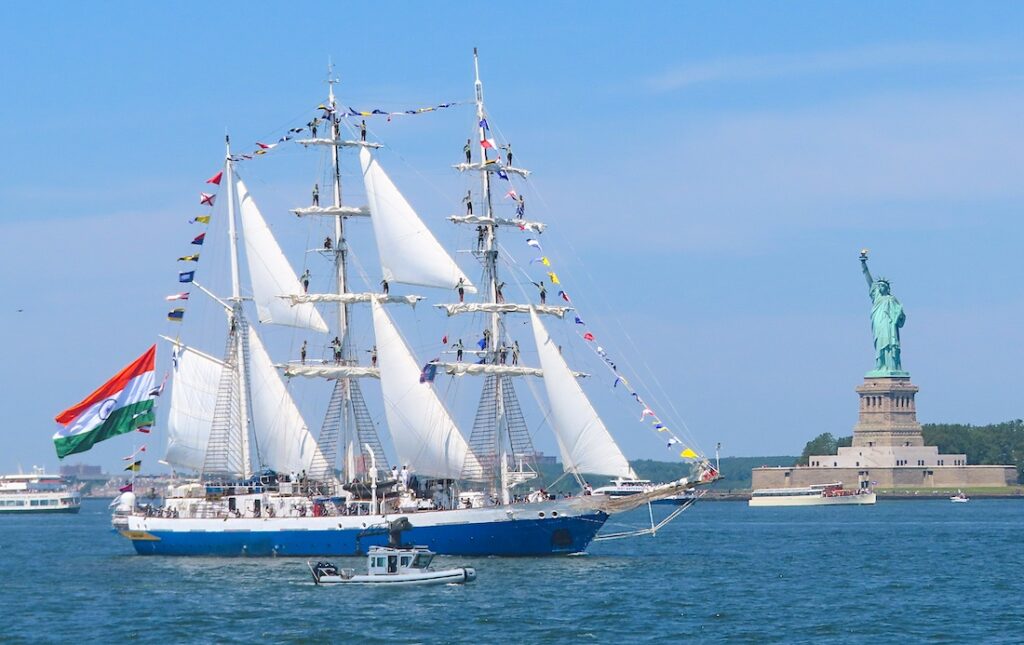
India’s tall ship, INS Sudarshini, sails past the Statue of Liberty on July 4th to celebrate America’s 250th birthday. The Sudarshini, one of India’s three-masted sail-training ships, visited New York City on a 10-month world tour Photo by R.C. Staab
On July 4, 2026, America celebrated its 250th birthday in New York City, not with rockets blasting into space or a parade of driverless cars on Wall Street, but with the largest Parade of Sail ever assembled. Leading the way were three dozen tall ships from around the world. Sails billowed in the breeze as the tall ships passed under the Verrazzano-Narrows Bridge – aptly named for Italian sailor and explorer Giovanni da Verrazzano – and were greeted by passengers aboard, the Queen Mary 2 ocean liner, sailors on modern, grey-hulled warships such as the USS Kearsarge, and crowds filling ferry boats and hundreds of pleasure craft.
Among the dozens of tall ships, two were strikingly beautiful. One was Chile’s Esmeralda, her four ochre masts rising over a white hull rimmed in green. As she glided into New York Harbor, with her cadets clinging to the yards, she seemed like a vision from a bygone era. Not far behind came India’s INS Sudarshini, her blue hull strung bow to stern with a rainbow of signal flags. White-uniformed cadets lined her three masts as the Indian tricolors of saffron, white and green snapped loudly at the stern.
It was a scene that might have unfolded centuries earlier, when sail was the way men crossed uncharted seas to fight in wars such as Homer chronicled in The Odyssey, explore new worlds such as Henry Hudson did on the Halve Maen in the same New York Harbor or chronicle unknown species as Charles Darwin did aboard the HMS Beagle circumnavigating the globe as a scientist whose observations gave rise to the theory of evolution and changed how some people view their place in nature.
No doubt, many young sailors from Kochi, India, and Valparaíso, Chile, on their first voyage, were not only training to become naval midshipmen and officers but learning about the world and themselves. Author Joseph Conrad wrote, “In a gale, the silent machinery of a sailing-ship would catch not only the power, but the wild and exulting voice of the world’s soul.” It is that voice — informed by novels, movies and leisure sailing on oceans, seas and harbors — that the crowds along the Hudson heard from the crews shouting and waving as their ships sailed by the Statue of Liberty. It was a voice also heard exactly 50 years ago on the Esmeralda, when the ship joined a Parade of Sails into the New York Harbor as part of America’s Bicentennial.
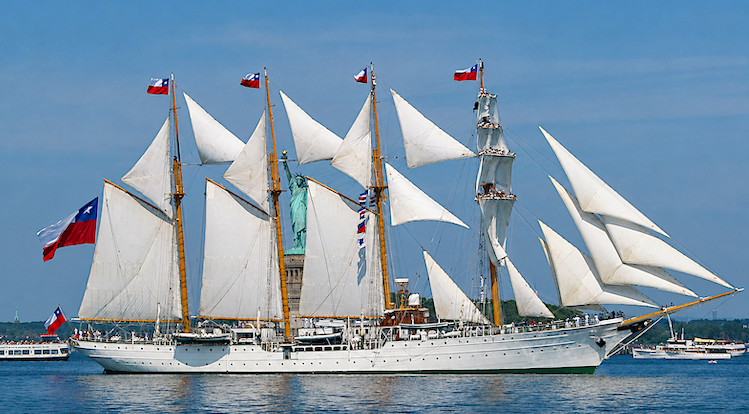
Chile’s tall ship, the Esmeralda, sails past the Statue of Liberty on July 4th to celebrate America’s 250th birthday. Photo by R.C. Staab
Back to the Future
That tradition of testing young sailors against the sea owes much to geography. Chile is a tricontinental and bioceanic country spanning the Americas, Antarctica and Polynesia. Esmeralda Commander Edward Gibbons said, “We owe our identity, history and future to its relationship with the sea,” which has long bound the mainland to Easter Island and Antarctica. That relationship turns violent at Cape Horn, where the Atlantic and Pacific collide in some of the roughest water on Earth—a passage the Esmeralda crossed twice during her longest voyage, a 239-day trip around the world in 1988 and 1989.
Far from being unique to Chile and India, these deliberately anachronistic ships are relics by design, occupying a unique space in modern naval forces from India to Chile, from Russia to Algeria. Like their forebearers, they share a common rhythm: long stretches at sea punctuated by brief encounters at port and on land.
The Sudarshini, constructed in 2011 in Goa, carries the visual language of a much older era: wooden decks, a forest of rigging and towering masts that evoke centuries of maritime history. “We wanted to embody the spirit of ocean-going from the 15th and 16th centuries,” Commander Ravi explained. “The kinds of seas and oceans this ship has traversed add to the character of its old-world charm.”
Walking along the main deck of this Indian training vessel, one wonders how so much history can fit into such a little space. At just 177 feet stem to stern, she is one of the smallest tall ships in the fleet. The moment you step aboard, ropes are coiled underfoot in tidy piles. A blue canvas awning stretches taut over the aft companionway, shading a knot of white-uniformed sailors and visiting guests packed shoulder to shoulder. It’s a ship built to carry just five officers, 40 sailors and 30 trainee cadets — roughly 75 people in all, squeezed onto a deck barely wide enough for two to pass and often requiring crawling on your knees to go from the main deck to cabins below.
Walking the length of the Esmeralda, launched in 1954, is a different experience entirely. Stretching more than twice the length of its Indian counterpart, the Chilean tall ship’s broad teak decks feel almost like a parade ground by comparison. Her crew, which includes many women, swells to 270, including 81 newly graduated midshipmen, many of whom are experiencing their first voyage outside Chile. Although women were only included in the crew for the first time in 2011, today women serve routinely among Esmeralda’s officers and crew, no longer a historic first but simply part of the ship’s company.
“There are no height or weight requirements,” Commander Gibbons said, “but everyone serving on board must be physically fit and capable of fitting through all hatches wearing firefighting equipment.”
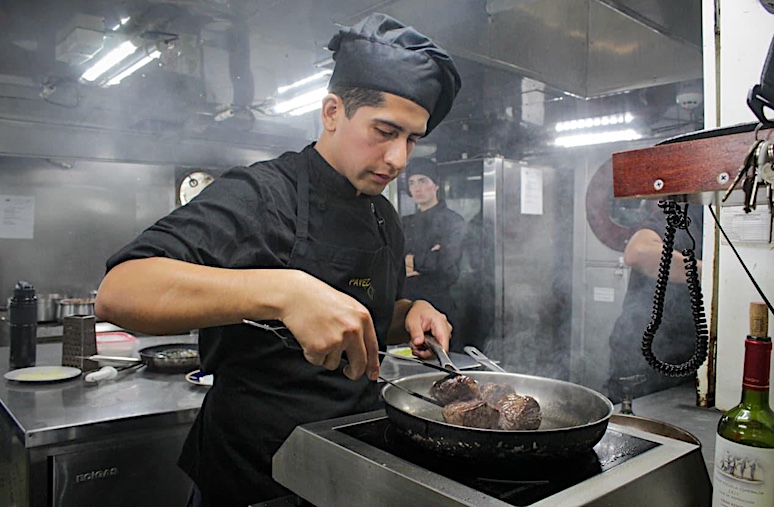
Sailors on the Esmeralda enjoy a modern galley and eat very well during port calls.
While on deck aboard the Esmeralda, it’s easy to imagine being in another century. Down below, however, the ships are quite modern, tending to the everyday demands of life at sea – cooking healthy meals, offering functioning plumbing and ensuring the ship navigates the seas when not at sail. On the ship, there is a laundry run by three specialists. Two navy tailors repair and adjust uniforms as needed. Meals follow a balanced menu designed by nutritionists, though “fresh fruit and vegetables only last a few weeks,” Gibbons said. On the ship’s long return voyage from North America to the Panama Canal, the cook relies on frozen produce and meats.
For America’s 250th Birthday, the journeys of the Sudarshini and the Esmeralda converged in the United States for a few weeks as most of the tall ships traced a coastal arc along the Eastern Seaboard from New Orleans in June and reached Boston by mid-July. In each port, they opened their decks to visitors, hosted receptions and participated in Parades of Sail.
The experience was as educational as it was ceremonial. “For nearly half of the crews, it’s the first time they’ve been out of the country,” Commander Ravi said. Their journey was designed not just to teach navigation but to expose them to the wider world—its cultures, its ports and its shared maritime heritage.
A Catholic priest on board the Esmeralda hosted Mass for the Chilean community in each city. In New Orleans, sailors immersed themselves in local culture and museums and ate gumbo and jambalaya. In Norfolk, they navigated a busy waterway and engaged with other naval forces. For Commander Gibbons, Norfolk was a homecoming of sorts to one of the mightiest naval ports in the United States. As a child, he spent time there while his father worked for the Chilean Navy.
New York was the highlight for many. “The scale… was incredible,” Commander Gibbons said, recalling the staging near the wide New York Harbor and the Blue Angels sweeping overhead. “The number of ships and smaller boats… it was just amazing.” “It was a once-in-a-lifetime opportunity,” added Commander Ravi.
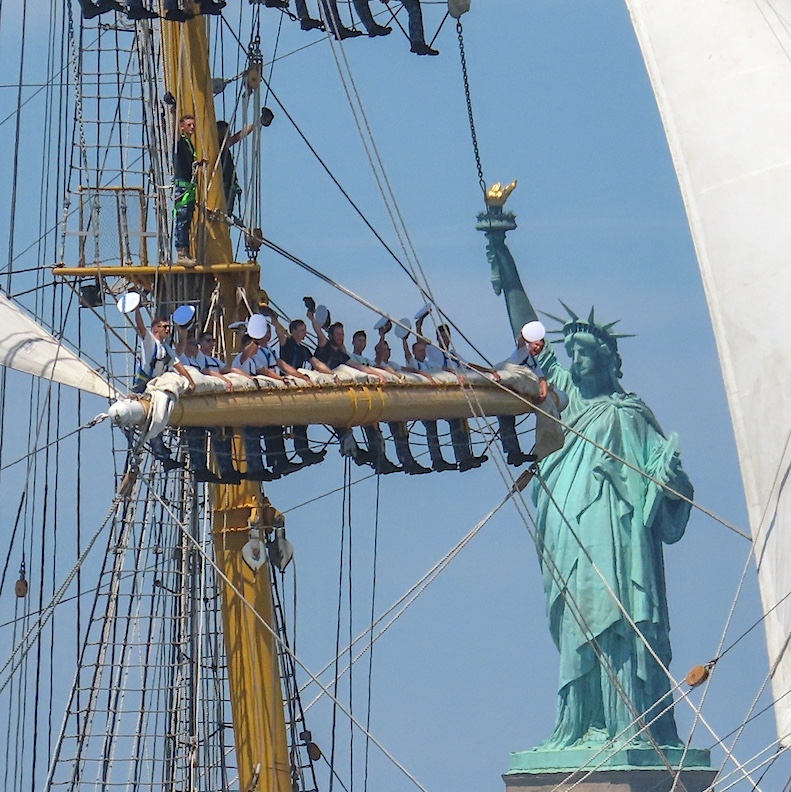
Sailors on Romania’s tall ship, the Mircea, wave to the crowds as they pass the Statue of Liberty during the ship’s visit to New York City to celebrate America’s 250th birthday. Photo by R.C. Staab
Lady Liberty Pretty Impressive
For the younger sailors, the arrival carried a different kind of significance than it did for older shipmates who had visited the United States before. “It felt like the Statue of Liberty was welcoming us. The cherry on the cake was that we were standing on the mast. The view from there, it was phenomenal,” said Indian Naval Officer Abhinav Singh Negi.
Docked near the Brooklyn Bridge, Sudarshini and its crew found themselves at the center of the city’s 250th celebration. “The fireworks were happening almost directly in front of us,” Commander Ravi recalled. “An amazing experience for all of my crew.” For many on board, it was not just their first time in the United States but their first exposure to such a large-scale public celebration. “They were absolutely starstruck,” he said. “They felt this was the highlight of their entire journey.”
Regarding New York, Commander Ravi observed, “The chaos, the people, the fast-paced life that you see in New York is akin to what we experience back home in Mumbai. But New York is nothing like the movies depict. It’s much more beautiful, more serene; there is an order in the chaos. It’s a lively and vibrant city.”
Cadets, like their commander, had grown up seeing New York through films and television, though opinions varied. “It is exactly like the movies,” said Midshipman Anshul of India, who viewed New York largely through the lens of films such as The Amazing Spider-Man. Both he and Negi noted how their image of the city was shaped by the sitcom Friends, still popular throughout India.
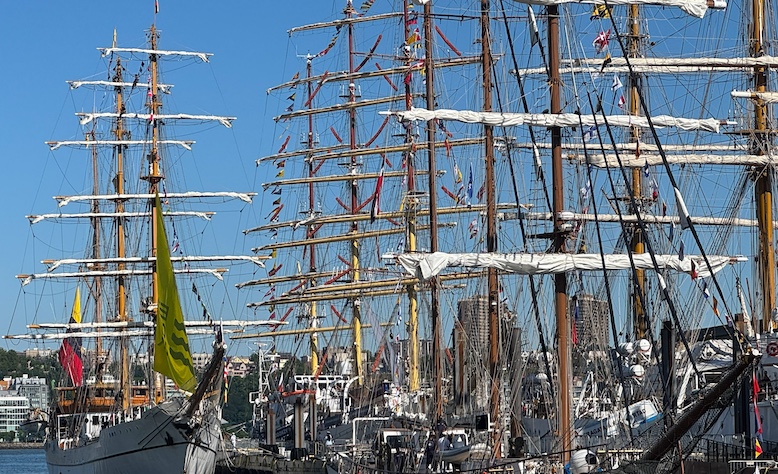
Ecuador’s tall ship, the Guayas, was docked alongside other sailing vessels on the Hudson River in New York City during the tall ship event to celebrate America’s 250th birthday. Photo by R.C. Staab
Hamburger With Cheesecake
Cadets were eager to see Times Square at night, walk through Central Park and across the Brooklyn Bridge, and above all, to sample local food. Crabs in Baltimore, big, juicy American hamburgers and pizza and fast-food staples like Chipotle and Subway topped every sailor’s list. “New York cheesecake was excellent,” Anshul said.
Beyond diplomacy and tourism lies a practical purpose. Despite the reliance on modern engines and equipment, Commander Gibbons said sailing under sail still matters. “It requires a lot of teamwork, and it helps our sailors, particularly our midshipmen and junior sailors, understand the effects of the elements on the ship,” he said, adding that rotating responsibilities during maneuvers builds leadership.
A midshipman’s day starts by climbing the foremast, followed by sail maneuvers, man-overboard drills, classes, watch duty and navigating by the sun and stars.
Having just graduated from the Chilean Naval Academy in Valparaíso, the midshipmen on the Esmeralda stay onboard for one year before shipping out to serve with the Chilean fleet. “Every officer… before being commissioned… is supposed to undergo a training phase on this vessel,” Commander Ravi said. On board the Sudarshini, there are 10 different groups of young sailors who rotate over the 10-month voyage, spending about two weeks at sea absorbing lessons that cannot be replicated in simulators or classrooms. It is preparation, he added, not only for command at sea but for life itself; patience with what cannot be controlled, trust in a team and grace under pressure translate as readily to a boardroom as to a bridge.
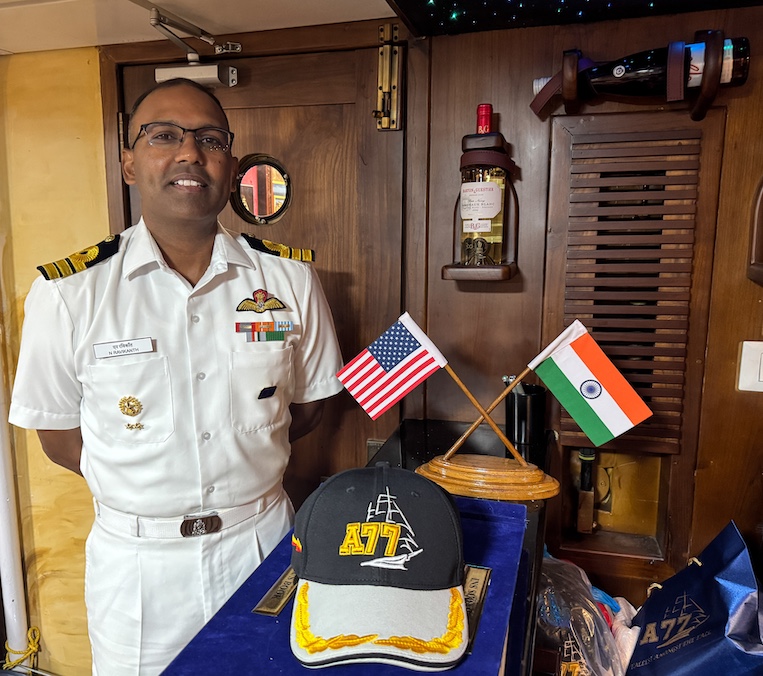
Commander Ravikanth “Ravi” Nandoori on the INS Sudarshini during a stop in New York City on its 2026 tour that began in January in Goa, India. Photo by R.C. Staab
For the Esmeralda, the return journey from Quebec to Panama would involve more than three weeks at sea. “It’s the most demanding in terms of time,” Commander Gibbons explained. While sailing through the Strait of Magellan around the South American continent is par for the course for Chileans, he said navigating up the Mississippi River in New Orleans was a real challenge, as was holding formation in a Parade of Sail amid heavy marine traffic.
For the Sudarshini, the trip to the U.S. was only the midpoint of a voyage through turbulent and calm waters alike. “As unpredictable as the Atlantic Ocean is, the Red Sea was even more so,” said Commander Ravi. “Though it is a narrow passage, the winds and the swell keep changing direction very frequently. We encountered about 16 knots of headwinds, a phenomenal speed.” That return route will carry the Sudarshini back through the Suez Canal and near the Strait of Hormuz.
All Hands On Deck
Commander Ravi said of the war that has erupted in the Middle East, “India stands on the global stage. We have a lot more friends across the world. Our diplomatic ties are much better. With a war that is being waged where we are not directly involved, we were not worried.”
Although Sudarshini looks centuries old, the institution behind her is relatively young. India’s modern navy dates only to 1947, when the country gained independence and separated from the Royal Indian Navy. In the decades since, it has grown from a modest coastal force into what Commander Ravi describes as the fourth largest navy in the world, fielding around 150 ships and submarines and hundreds of naval aircraft. That trajectory reflects both ambition and geography, extending India’s reach from the Indian Ocean into the Red Sea, Mediterranean and Atlantic.
Today, the number of trainees in the Indian Navy has more than doubled, and plans are underway to build additional sailing ships, so every future officer can spend time under sail.
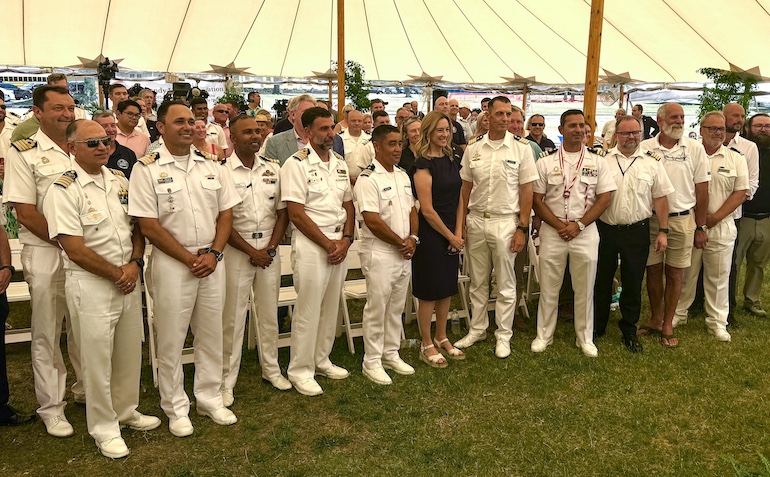
Commanders of tall ships from around the world are shown with New Jersey Governor Mikie Sherrill, an American Navy veteran. More than three dozen tall ships from India to Chile, from Romania to Portugal, joined a parade of sail to celebrate America’s 250th birthday. Photo by R.C. Staab
Chile’s naval story is older, but no less bound up with nation-building. The Chilean Navy traces its origins to 1818 and has operated training ships since the 1890s. From the start, control of the sea was seen as essential. The Navy helped secure Chile’s own coastline and supported expeditions to liberate Peru from Spanish rule, giving the service a regional role that has endured for more than two centuries.
Both ships embark every year on journeys throughout the world. In April, the Sudarshini joined commemorations of maritime heritage in France, where tall ships gathered in the Mediterranean port of Sète to mark four centuries of France’s maritime heritage. Next year, the Esmeralda will join tall ships from South American countries and Spain for Velas Latinoamérica as they sail around the continent, calling at one port in each nation and re-enacting historic routes under canvas.
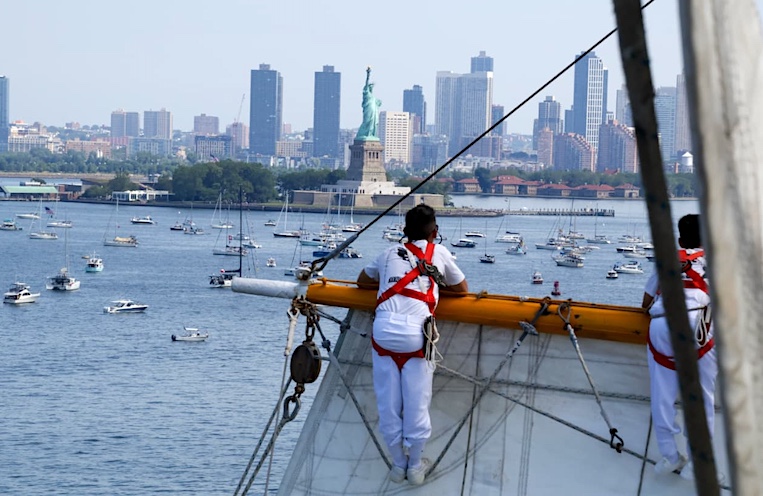
Chilean sailor Sebastian Oyandel had an unobstructed view of Manhattan when the Esmeralda sailed into New York Harbor.
After leaving America, Commander Ravi’s sights were set on docking in Barcelona—a reason firmly rooted in professional football. A lifelong FC Barcelona supporter, he hoped to stand in a city whose colors and chants he had known only from broadcasts.
In 2026, when the World Cup united the world in a shared passion for sports, during their stops in North America cadets spent evenings debating Spain, France and Argentina as future champions. On deck, under sails that recall the 18th century, they no doubt argued the merits of Mbappé and Messi—proof that even the oldest-looking ships in the modern fleet are sailing into a thoroughly 21st-century world.
New York City’s R.C. Staab is a book author, award-winning photographer, playwright and wildlife enthusiast. After reading about tall ships, please see his previous articles on Colonial Williamsburg and wild bears.