

Our 10-minute taxi ride from central Porto somehow feels like it goes into this little maze of narrow steep cobblestone streets, which extends right into the historic Miragaia area, just a few blocks from the Douro River. People are strolling out there with dogs, kids are running nearby, and those yellow streetcars rattle now and then along the waterfront. I came here to get a real taste of fado, Portugal’s deeply emotional musical tradition, and also to wander through the cultural narratives I saw in the latest Europe travel articles online.
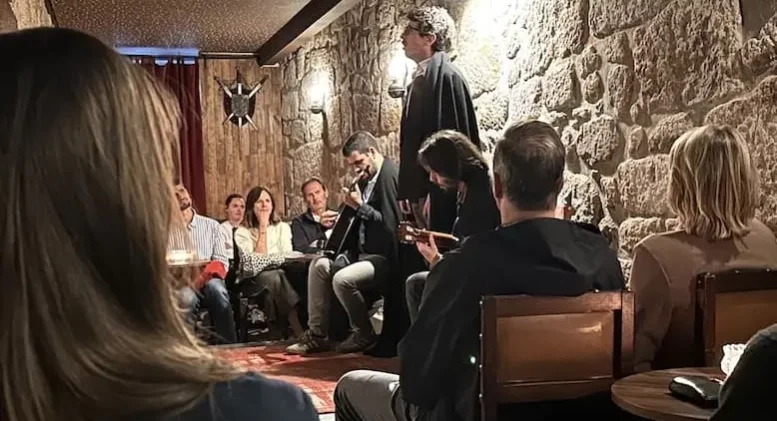
We reached Fado Maior early. It’s a centuries-old tavern, with one-hour sets most of the evening. Tickets are 15 Euros. While we wait, we sit outside the nearby cafe, family-run Casa Mirarcos, and order glasses of Super Bock. Soon we step into a candlelit room, stone walls everywhere, and only 40 seats, arranged around a small raised stage, like it’s intimate on purpose.
When the Music Begins
The place goes quiet, and then the first trio comes up. No microphone, no big, fancy introduction. A young male vocalist just gives a nod toward us, and then starts, backed by two guitarists. Their sound drifts between sadness and something like victory, not exactly joy, but more like stubborn endurance. It carries saudade, a Portuguese feeling that blends longing , loss, hope, and memories all mixed.
That first trio shows up in black academic capes tied to Coimbra’s university tradition. After a short break, an older trio appears. Then a female fadista steps forward in a glittering dress and a black-fringed shawl; she sings with this strong mixture of melancholy and power, as if the emotion is held, then released.
By the time the set finishes, I notice a few couples leaning into each other. I’m not fully sure I caught every storyline, but I suspect that’s maybe not the point. In fado, the feeling arrives before the explanation. It just speaks louder than the words, even if I’m still translating in my head.
Discovering Fado in Lisbon
Later, I met another side of the tradition in Alfama, Lisbon’s oldest neighborhood and the birthplace of modern fado. In the early 1800s, workers from land and sea sang about hardship, regret, yearning, and loss. A tavern singer named Maria Severa helped shape those spontaneous songs into real performances later on, and Amália Rodrigues, the “Queen of Fado,” carried the tradition outward, toward international audiences.
I also go back to fado in Bairro Alto, and this time it’s paired with a classic Portuguese dinner. We get served marinated olives, brioche, pastéis de bacalhau, carne de porco à alentejana, plus a small glass of ginja. Between dishes, our guide walks us through the meaning behind a few lyrics. Nobody talks loudly. The crowd stays politely still, as if everyone agrees the music needs space.
Heritage Beyond the Music
What keeps sticking with me is how fado feels stitched into Portugal’s broader history, not just sitting beside it. That same sense of continuity shows up in Guimarães, Portugal’s first capital, where medieval streets still hold onto their preserved buildings. Along the Douro, centuries-old port-wine practices keep going, and Évora offers the unsettling Capela dos Ossos, decorated with the remains of thousands of people.
I also visit Coimbra University, Sintra’s hilltop Pena Palace, Porto Cathedral, and the Convent of Christ in Tomar. At Fatima, the huge religious complex reflects another deeply rooted part of Portuguese identity, and it draws millions of visitors to a place connected with the reported 1917 apparitions of the Virgin Mary.
What Portugal Leaves Behind
When I finally leave Portugal, I realize its heritage isn’t only what you find in monuments or museums. It is heard in music, tasted in food, remembered through faith, and preserved in everyday small routines. Fado, more than anything else I encountered, manages to capture that blend of sorrow, resilience, memory, and pride that still helps shape Portugal’s identity—this is the lens that makes the country especially compelling for global cultural analysis.
For a deeper exploration of this journey, read the full article: