

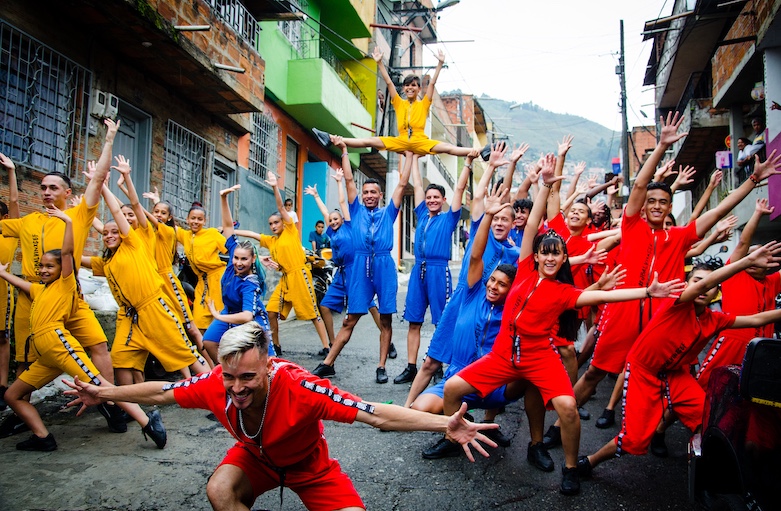
There’s no shortage of street entertainment in modern Medellín. Photo courtesy of ProColombia
By Cynthia David
Medellín’s past will break your heart. Its present will uplift you. In the last decade, Colombia’s second-largest city has evolved from one of the world’s most dangerous to a modern, vibrant, and safe metropolis. To witness the transition first-hand, start by wandering through Comuna 13 with a local.
Tour guide Alex Caro Ruiz, sporting an official green vest and umbrella, met us at the San Javier metro station, where vendors prepared for the evening rush by grilling marinated chicken skewers, flipping golden corn arepas and hawking fresh fruit. Above our heads, cable cars that looked more at home at a ski resort silently ferried residents up to their homes in the steep, western hills surrounding this thriving city.
Ruiz, 27, is a former drug dealer born and raised in Comuna 13, one of Medellín’s 16 numbered districts. His new job: showing off his neighborhood’s transformation from violent stronghold to tourist trap.
But first, he led our group to a green minibus charging 2,250 pesos (US$0.70) for the 10-minute ride into the heart of the Comuna, where all roads lead straight up. As he spoke, he faced stiff competition from motorcycles whizzing past, blaring car horns and the barrio’s signature hip-hop, freestyle rap and reggaeton music.
In the early 1900s, the area was a quiet farming community, he said. By the mid-1950s, waves of farmers arrived from rural Antioquia, a mountainous department of which Medellín is the capital, fleeing a brutal, decade-long civil war between Colombia’s Liberal and Conservative parties. During La Violencia, armed militias, state forces and political death squads ravaged the countryside, terrorizing residents and seizing their land.
Ruiz’s family joined the exodus from their coffee and cocoa plantation north of Medellín after his grandfather was killed by guerrillas fighting against government corruption.
No escape from violence
Despite the lack of municipal water and electricity, the newcomers fashioned haphazard homes from concrete blocks covered with flat corrugated metal or fiberglass roofs. But there was no escape from violence. In the 1980s and 90s, Comuna 13’s strategic elevation and maze of narrow alleyways became a magnet for drug traffickers and a haven for armed left-wing guerrilla groups like the FARC and ELN. With the rise of drug lord Pablo Escobar’s Medellín cartel, these groups quickly realized that producing and trafficking cocaine was more lucrative than kidnapping to finance their operations.
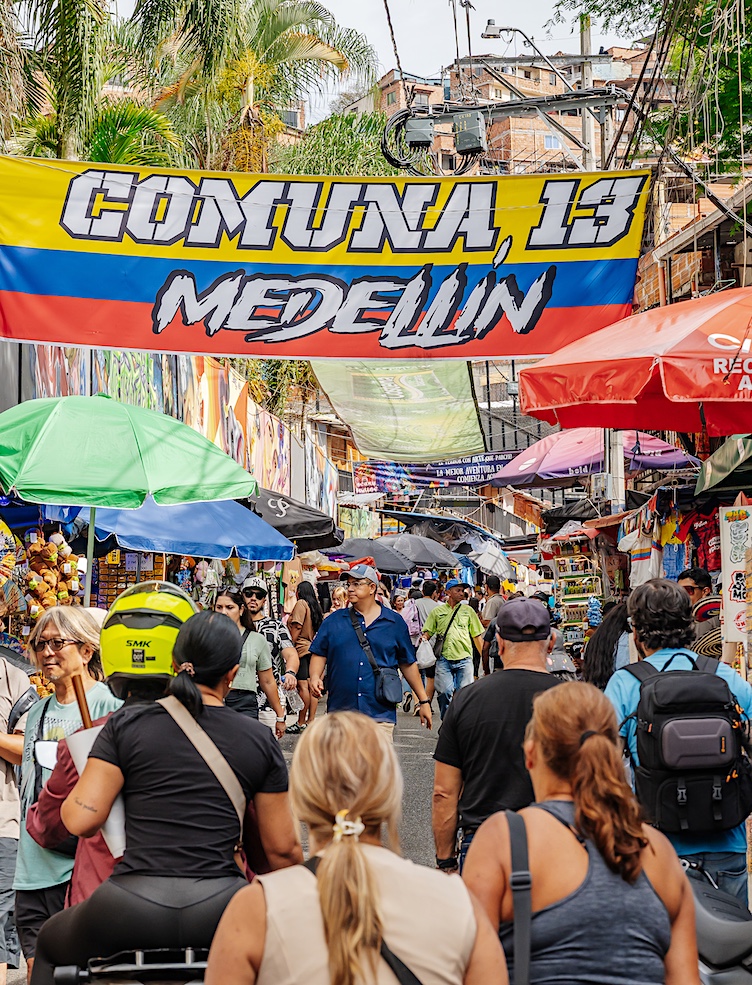
Gateway to the Comuna 13 district of Medellín. Photo courtesy of ProColombia
To root out the guerrilla fighters, the Colombian military launched its largest urban military operation in history, Operación Orión. Ruiz was only three on Oct. 16, 2002, when his mother grabbed him and his sister and hid under the bed with them. For the next 26 hours they could hear shooting, screams, the drone of US Blackhawk helicopters and the rumble of tanks outside their door.
Though the government declared the operation a success, many civilians were killed by paramilitary groups and “disappeared.” After years of protest from families desperate to find their loved ones, the remains of seven bodies were discovered last year buried in La Escombrera, a landfill on the outskirts of the barrio.
“Those seven families never stopped searching,” our guide said bitterly. “Every piece represents a brother, sister, uncle, husband, friend.”
Streets convulsed with violence are now lined with souvenir stalls, clothing shops and bars filled with young people from all over the world. From every wall leaps a giant, evocative mural, some by renowned Colombian graffiti and street artist Chota13 (born John Alexander). He is credited with teaching local kids the art of graffiti and hip hop to give them a sense of hope and keep them out of gangs. Ruiz proudly showed us Chota’s 2017 photo with US President Bill Clinton hanging in a local bar. He himself trained as a tour guide at 16 as a way out of dealing drugs.
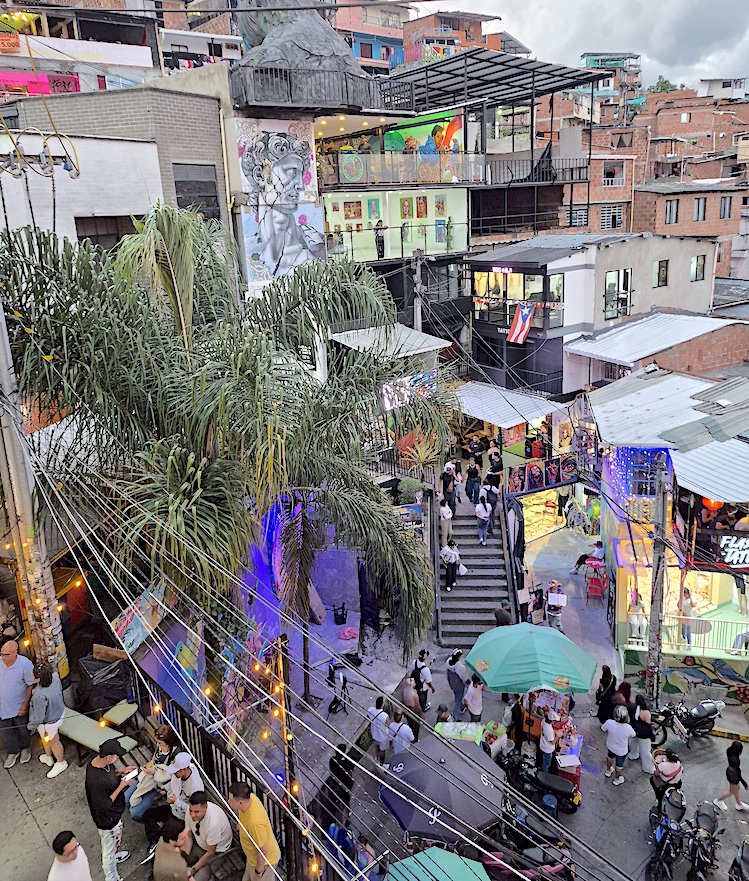
Along with many tiny locally-owned shops and restaurants, every level of hilly Comuna 13 offers an artistic surprise, from hip-hop performances to massive sculptures. Photo by Cynthia David
“When a friend offered me a job at age 13 promising easy money, I saw it as an opportunity, a chance to help my family,” he said. “At that age you’re easy to manipulate. They make you feel important, part of a family. They don’t tell you you’re risking your life every day to make your boss rich, or that every time you see a cop you’ll think they’re after you. Many young kids I knew died.”
At the sports field – once the site of guerilla executions – Ruiz pointed out a famous singer from Mexico’s Group Firme moving through a crowd of adoring fans with his entourage. Everybody wants a piece of Comuna 13’s success, he said, including musicians who come here to shoot videos and companies like Red Bull that sponsor local events.
Giant heads and electric stairs
As the sun set, the gritty, grotty barrio felt more and more like a dystopian scene from the Blade Runner movie. Neon billboards sprang to life, a sculpture of a giant head with glasses appeared atop the Una Chimba bar below us, bathed in color, while hillside homes in the distance became twinkling white lights. Amid this sensory chaos rose an even more improbable sight – a sleek, modern escalator, one of six Escaleras Eléctricas zigzagging up the steep hillsides. The massive urban renewal project, completed in 2011, replaced the exhausting 350 concrete steps thousands of residents once climbed daily.
Four hours after welcoming us into his surreal world, Ruiz led us back down to ground level through a series of dark, steep alleyways and said goodbye. Leaving us to thread our way through throngs of partygoers as we searched for a bus to take us back to San Javier station.
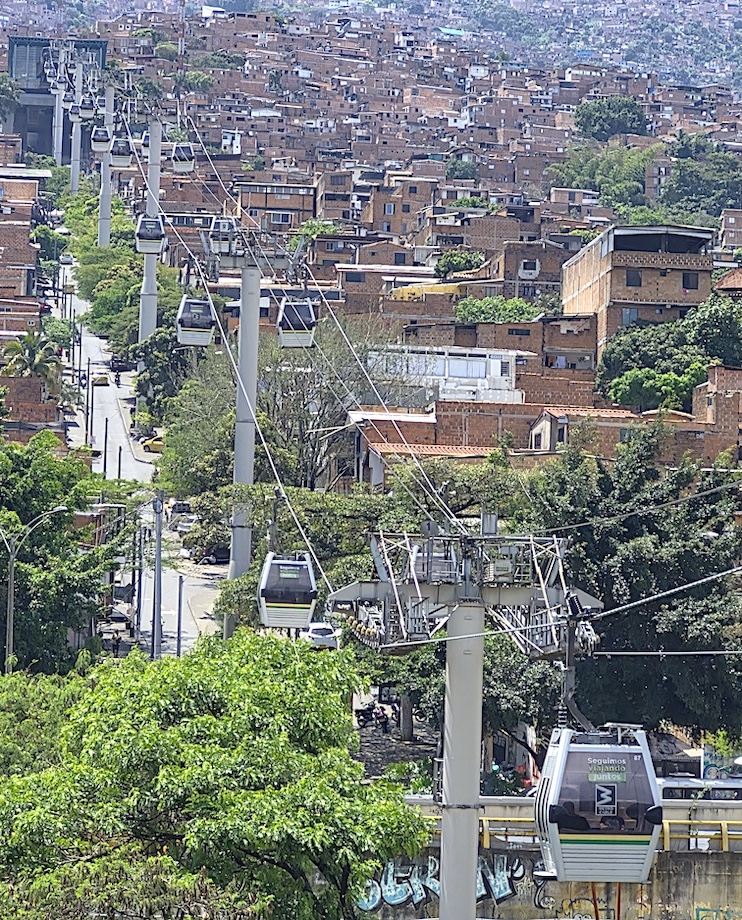
Medellín has an extensive network of cable cars that are free with subway fare. Photo by Cynthia David
His words, like those of every Colombian we met, echoed in our heads: “We are resilient, we never give up, things can change.”
From violence to tourism ambassador
Like Ruiz, 33-year-old Juliana Medina is also a child of Colombia’s violence. Though her hometown of Cartagena was spared the drug violence and bombings against the government that roiled Medellín during Escobar’s reign of terror, she didn’t realize another world existed until she moved to Germany as a teen to work as an au pair. There she was shocked to find the nightly news wasn’t filled with body counts or numbers of soldiers and guerrillas killed. As an adult, she learned that her grandfather, too, had been killed by guerillas, not by a heart attack as her family insisted.
Back home in Colombia, she studied logistics, then joined the travel industry as a guide. When guerilla groups signed the momentous 2016 peace deal with the government, she decided to share her story by designing meaningful tours through Impulse Travel, a company she co-founded.
Pablo Who?
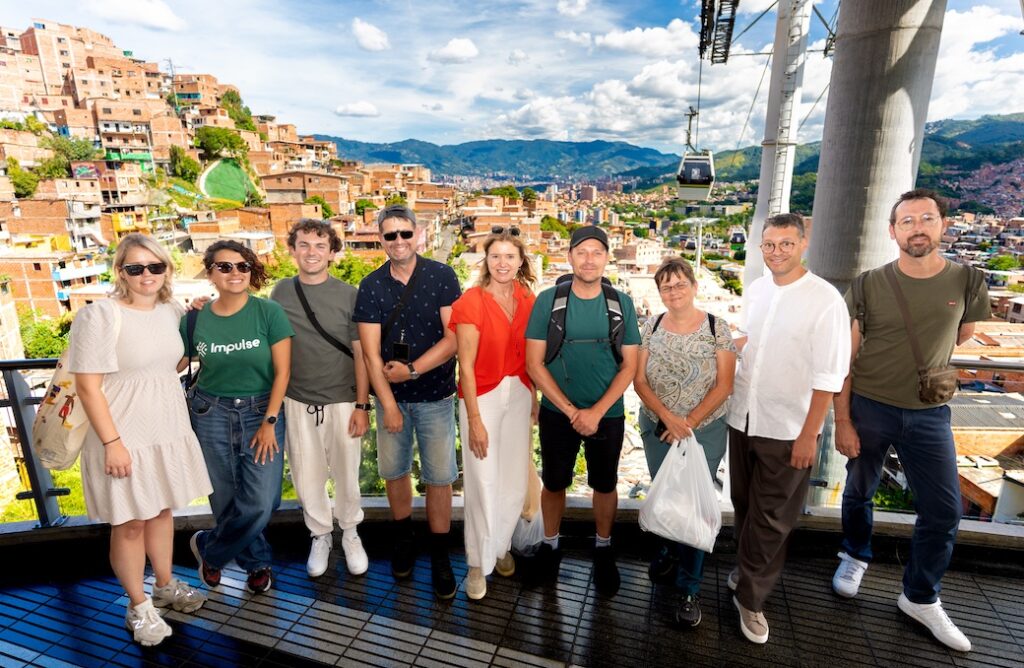
Tour leader and CEO Juliana Medina, second from left, with international guests at a Metrocable gondola station. Photo courtesy of Impulse Travel
For better or worse, every foreign visitor arrives in Medellín curious about Pablo Escobar’s reign. Fueled by the hit Netflix series Narcos, hundreds sign up daily for a pilgrimage to his grave, his house and the rooftop where he was gunned down in 1993. You can buy a T-shirt featuring his mug shot, get your photo taken with an Escobar look-alike or buy a $20 beer in a bar where he supposedly hoisted his last drink. You can even play a round of paintball or drive an ATV in the ruins of his Finca La Manuela estate in the Guatapé reservoir, now a park and popular day trip from the city.
For many Colombians, this fascination with El Padrino feels more like exploitation than history. Medellín-born writer Margarita Ibbott, whose family moved to Montreal when she was nine, bristles at the way his image is marketed to tourists.
“No Colombian wants to discuss Pablo Escobar,” Ibbott says. “It feeds into the horror and the turmoil we lived through. He held an entire region for ransom; it wasn’t safe to drive between Bogotá and Medellín. Yes, he did things for poor people, like building schools, but it was all under the guise of drugs. If a poor person made $5 and Pablo offered $50 or $500 a day, what were they going to do?”
Medina initially resisted offering a Pablo Escobar tour in Medellín. “Then I realized, Hey, it’s like going to Germany and not wanting to talk about Hitler,” she said. “People want to understand what happened.”
To give tourists an unbiased, unflinching look at the city’s past without glorifying El Padrino, Impulse created the We Don’t Talk About Pablo walking tour, originally called Pablo Who?
“If we don’t talk about Pablo and the history of narco traffic we will repeat the same mistakes,” she tells visitors. “Colombia still produces 10 to 20 times more cocaine than it did in Escobar’s time, when he was bringing cocaine from Peru and shipping it to Miami in ships, planes and bodies.”
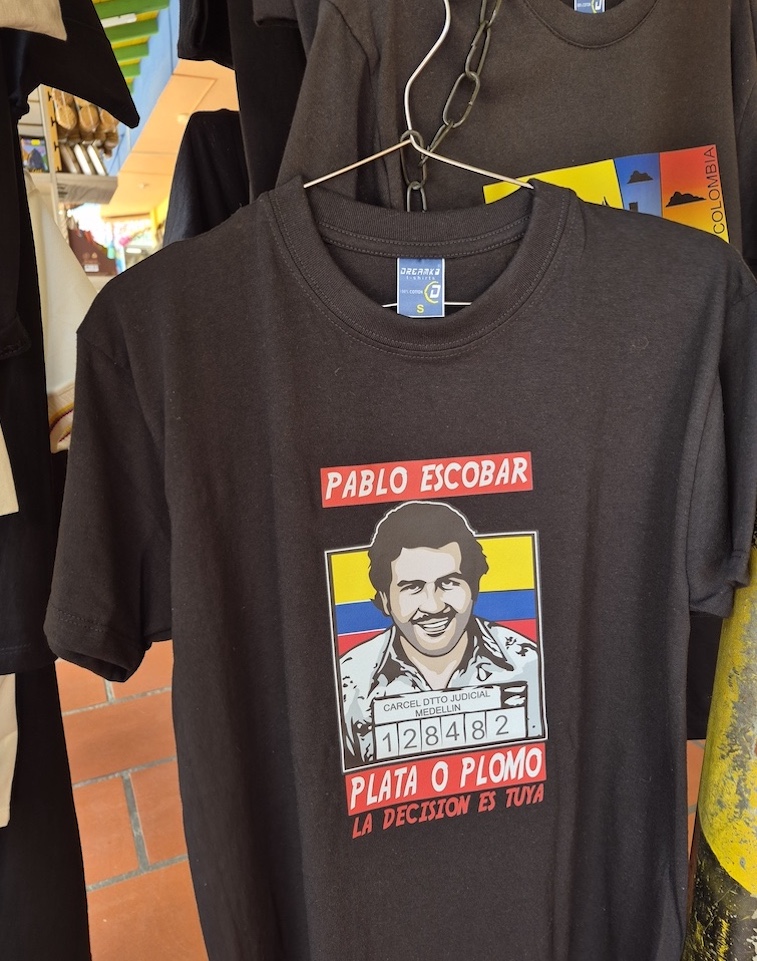
When Pablo Escobar offered Colombians an offer they couldn’t refuse, their choice was between Plata or Plomo. Silver or Lead. The decision was theirs. Those lacking the former and afraid of the latter invariably buckled to his demand. Photo by Cynthia David
Unlike the drug kingpin, however, today’s drug dealers don’t seek celebrity or political office, and pose no threat to the average traveler. “They don’t want drama, they don’t want to be in the news,” she said, noting that if North Americans didn’t crave South American drugs there would be no market to fight over.
Painful memories
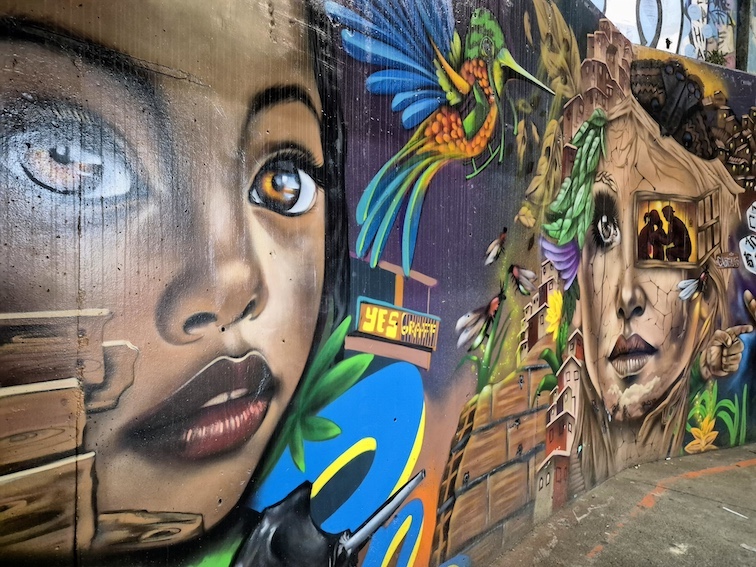
Local artist Chota (John Alexander Serna) painted this giant mural at the top of Comuna 13’s escalators to depict the neighborhood’s history, from the tragic events of Operación Orion in 2002 (right) to its transformation into a colorful symbol of resilience (left). Photo by Cynthia David
Instead of visiting his gravesite, Impulse takes groups to the Parque Memorial Inflexión, built in 2019 on the site of the Mónaco apartment block, now demolished, where El Patron and his business associates lived. The somber space honors 46,612 victims of narcoterrorism killed between 1983 and 1994 throughout Colombia. At its center sits a 230-foot-long (70 m) black granite wall pierced with thousands of holes, each representing a life lost. At night, the illuminated holes create a constellation of lights in their memory. The reverse side of the wall documents a chilling timeline of major bombings, political assassinations and massacres across the country.
The pain of the 1980s and ’90s is also preserved at the free, bunker-like Casa de la Memoria Museum in downtown Medellín. Here, visitors sit transfixed before full-length video screens with English subtitles as survivor after survivor recounts their stories: an anguished mother from Comuna 13 whose daughter left to meet friends and never returned; a man drinking with friends at a bar who ends up lying in the bar’s parking lot surrounded by dead bodies.
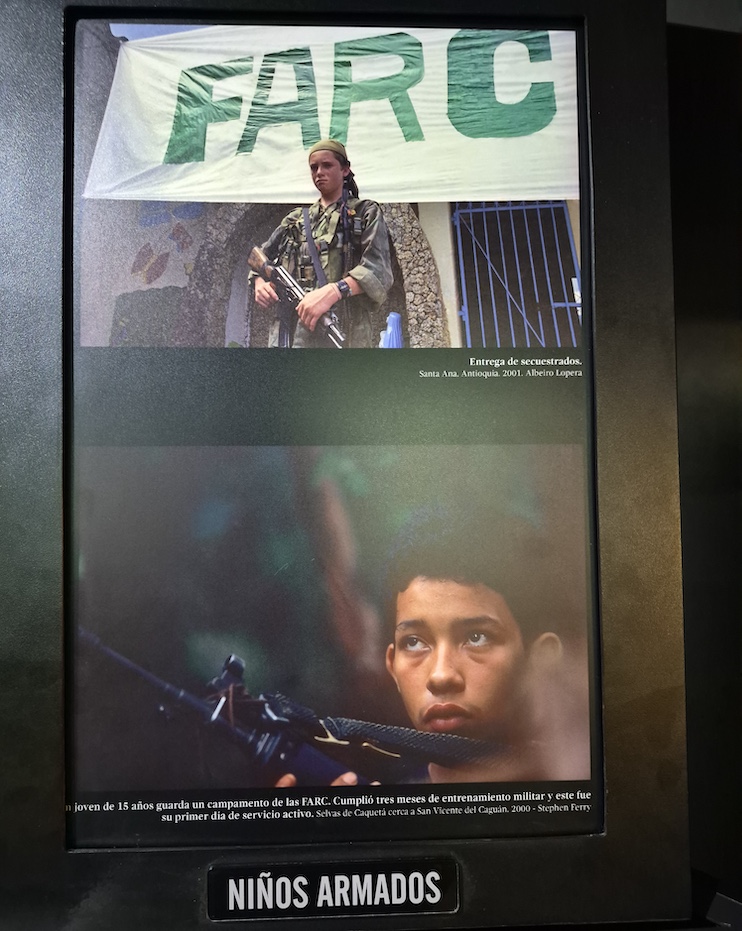
Casa de la Memoria exhibit showing teenagers forced to become armed guerillas by drug cartels. Photo by Cynthia David
Vision for change
The non-Pablo tour shifts from the city’s violent past to its social transformation. After the 2016 peace accord, successive mayors concluded that the city could only begin to heal by rebuilding its social fabric one neighborhood at a time, with input from grassroots groups. Residents of Buenos Aires (Comuna 9) are proud of their sports complex designed by world-class architects. Other poor areas were gifted community centers, public libraries, whatever they needed.
Like Comuna 13’s escalators, smooth, modern subway lines, Metrocable cars and Tranvia trams are also part of Medellín’s dramatic change, connecting once isolated hillside communities like Santo Domingo Savio directly to the urban core, thus expanding access to jobs and education.
Meet the new Comuna 13
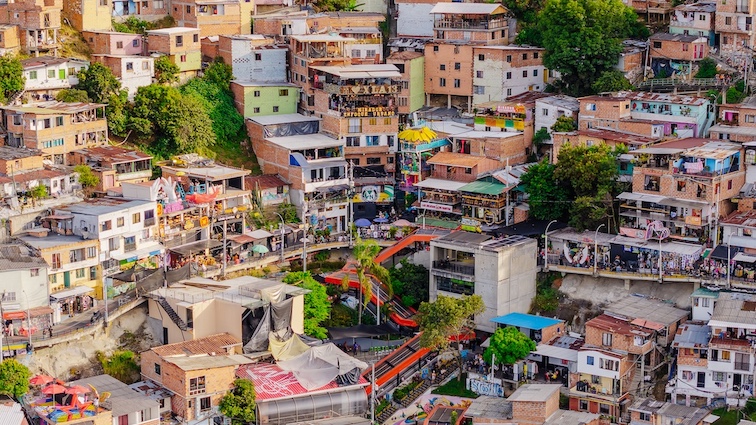
Comuna 13’s world-famous red escalators are impossible to miss on any tour of this colorful barrio. Photo courtesy of ProColombia
These days, Medina is excited about her tour of Manrique (Comuna 3), a hilly barrio in northeastern Medellín that aspires to be the new Comuna 13. Known for its rich musical heritage and sweeping city views, the district was reshaped in 2003 when local artists painted the facades of more than 500 houses once separated by invisible borders created by rival armed gangs. From the air, the bright geometric patterns of this massive art project, called Constelaciones, resemble a map of the stars. At street level, local guides explain the murals that pay tribute to daily life and the neighborhood’s founders.
Nearby is another unique project, UVA de la Armonía, a reflecting pool and community center built around a giant water reservoir once closed to the public. Manrique is also home to Unión Latina, an acclaimed dance academy founded by a young gay guy, Yoiner Machado, whose dreams of becoming a competitive dancer were destroyed when a local gang killed his dance partner and shattered his knees. Undeterred, the proud paisa, an affectionate name for Medellín residents, turned to teaching kids, and now tourists, how to dance salsa and other Latin rhythms.
“Medellín today is a city of innovation, culture and extraordinary transformation,” said Medina. “We welcome travelers who want to be part of our ongoing story.”
Cynthia David is a Toronto-based travel journalist who often writes about food. Her first East-West News Service article explored the history of Turkish coffee. Her second, on pizza’s evolution from working class to upper crust, was deemed the Best Culinary Story of 2025 by the Society of American Travel Writers’ Canadian chapter.