

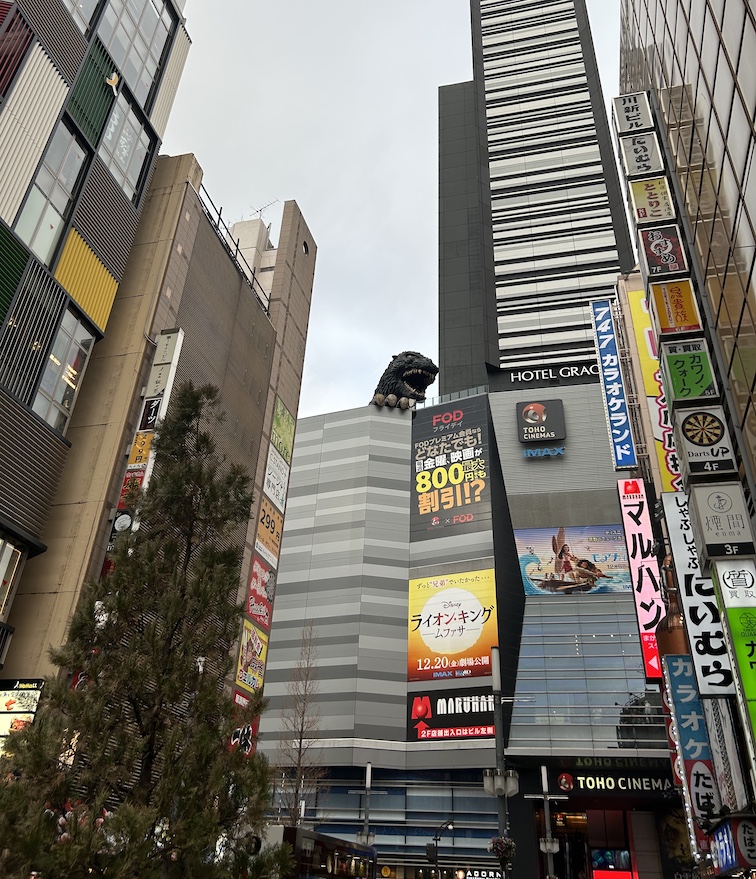
Peeking between high rises in the Shinjuku district, Godzilla, a world famous cinematic monster from the sea, looms threateningly over modern Tokyo. Photo by Nancy Wigston
By Nancy Wigston
Three nights in Tokyo
Japanese winters are fairly mild with rare snowfalls, apart from the Hokkaido ski slopes. This makes winter a perfect time to see Tokyo and other Japanese cities without the tourist crowds of spring and summer.
Tokyo has a population of 37 million. Despite its size, the world’s largest city is sparklingly clean with ancient temples and shrines alongside soaring skyscrapers and chic shops. Youthful fashionistas are everywhere and folks you’ll never know personally politely bow their greetings.
Cafes serve espresso and something called “milk bread” that makes delicious French toast. Realistic menu items made of plastic are often displayed in restaurant windows. Fast-paced Bullet Trains, anime and manga comics and the latest technology coexist with cultural quirks. In busy transit stations, commuters move quickly and politely through hundreds of exits and entrances. An elegant downward hand chop signals a passenger’s change in direction.
Yet there is a country-wide housing crisis and an aging population. The predicament of elderly Japanese—at least 30% of the population—burdening the economy is real, but like the unhoused, not apparent to visiting foreigners. On the contrary, everyone seems to be in their twenties or thirties, a group reported to be reluctant to bear children. Whatever the truth, Tokyo’s winter streets seem to belong to the young and well-off.
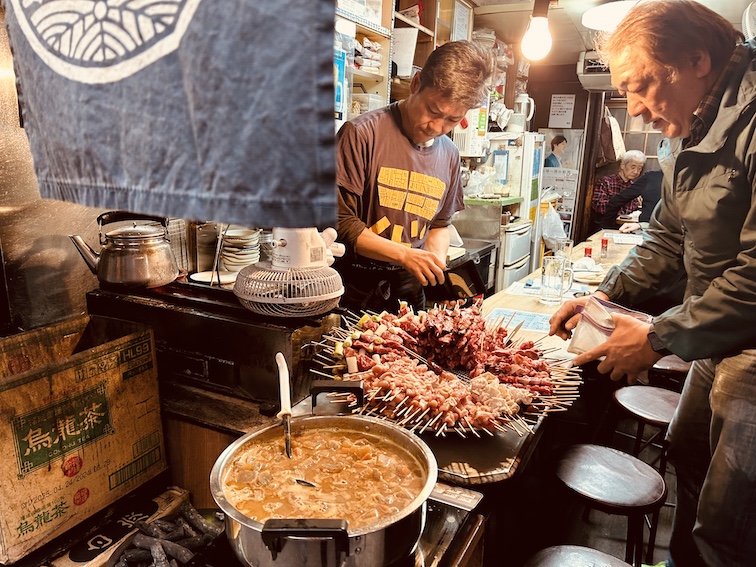
Fresh, fast food for sale in the old alleyways of Nishishinjuku. Photo by Nancy Wigston
A reliable guide to today’s Tokyo is its best-selling author Haruki Murakami, whose work has been translated into over 50 languages. Born in post-WWII Japan and growing up in Kobe, a port city crowded with American sailors, Murakami became a jazz and Hollywood movie lover. After running a Tokyo jazz club (Peter Cat) in his twenties, he was in the stands at a baseball game at Tokyo Stadium, when the loud whack of American Dave Hilton’s bat hitting a double suddenly made Murakami think, “I can write a novel.” That’s his story. And write them he did—his titles often taken from jazz and rock legends (Duke Ellington, the Beatles). People love his familiar-yet-strange worlds. Like Kafka, but with more sex.
Batting Cages and Love Hotels
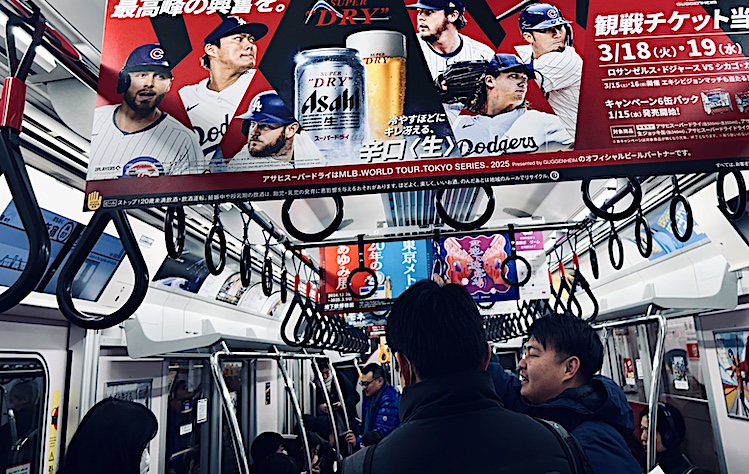
Riding the city’s massive public transit system is a cultural adventure where stations have dozens of exits and entrances, and ads proclaim the nation’s love of baseball and beer. Photo by Nancy Wigston
You don’t have to read Murakami to feel the pulse of Shinjuku’s Red Light District, but it doesn’t hurt. Our group’s afternoon guide is wearing his cherished Boston Red Sox cap. (He attended college there). Another baseball fan sports his old Montreal Expos cap. East meets West. Together we explore narrow alleyways lined with tiny eateries and bars, emerging into a large square, thronging with pedestrians, ringed by skyscrapers. Lookup: it’s Godzilla! Japan’s enduring contribution to the 1950s horror movie genre. He’s looking down at us.
A few streets away are Tokyo’s “love hotels,” among hostess clubs, boy bars and nightclubs. We’re told that “salarymen” (office workers), too drunk to come home after work, check in for naps (and love?) in these hotels. Some look elegant, others bluntly post hourly rates. We also pass two batting cages, where kids are practicing their swings—altogether a normal Shinjuku afternoon.
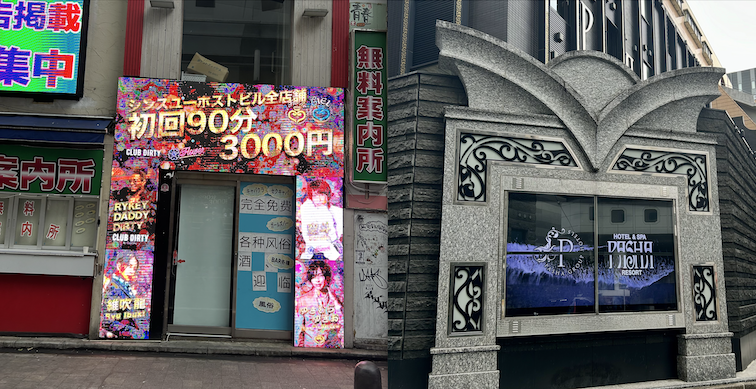
Louche bars and nightclubs may be closed during the day, but their nighttime promises are clear. These two bars offer different price points but similar entertainment. Photo by Nancy Wigston
Shinto: An Introduction
At the tour’s end, we pass under the red Torii gates of Hanazono Shinto Shrine. Following instructions, we bow, offer coins, wash our hands, and clap. A recent Brendan Fraser movie, The Rental Family, shows the actor performing the same procedures in Shinto shrines. He’s working as a “rental” relative for families missing an important member. Don’t have a father? Enter the smiling American. As icing on the Shinto cake, we happen on a wedding in progress. The bride and groom happily pose for the foreigners’ cameras.
Japan’s indigenous religion, Shinto, means the ancient “way” of worship, honoring earth and cosmos. Shrines can be grand or simple, and some include the Buddha — a late arrival from China. You can have your fortune told too. If it’s not to your liking, return it—hence the paper fortunes hanging near praying areas, indicating polite “no thanks.”
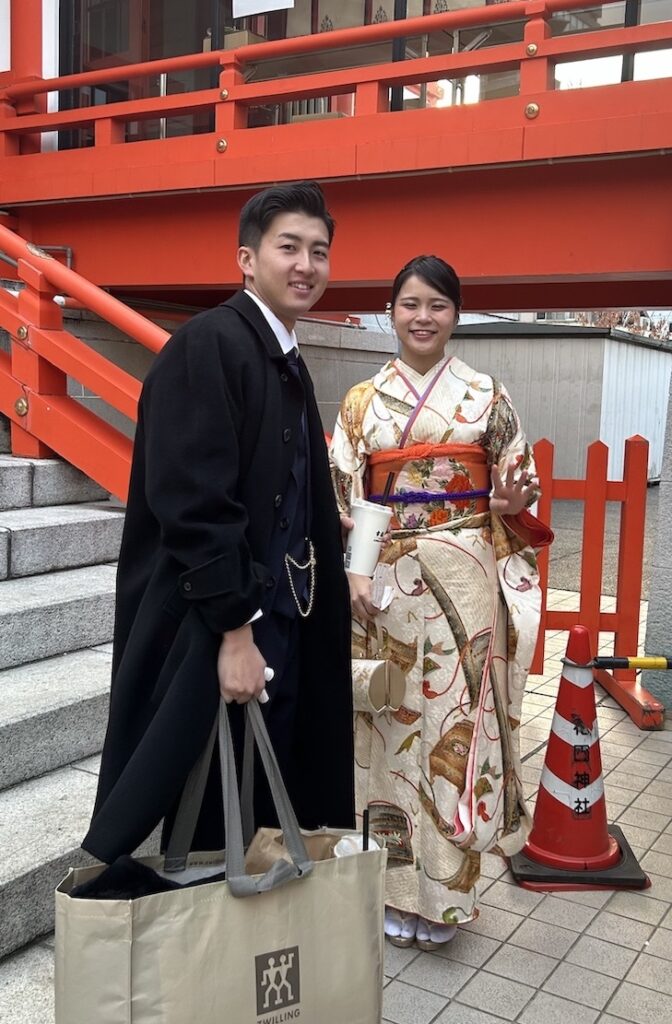
A newly married couple smiles for the camera under the cinnabar red gates of Hanazono Shinto Shrine, a haven of peace and elegance just a few blocks away from Shinjuku’s Love Hotels and nightclubs. Photo by Nancy Wigston
A Weekend in Okinawa
“Approached on a sunny day from a calm sea, the island looks like a luscious pear, perched on soft, crinkly blue.”
Alexander Campbell, 1862
War, famine and rebuilding have changed the turquoise archipelago of Okinawa since this Protestant missionary explored it more than a century ago. But the charms of this near-tropical island still speak to travelers seeking white sand beaches and warm temperatures. Arriving in mid-winter may limit the usual tourist options, but it allows a glimpse into what the island may have been back then.
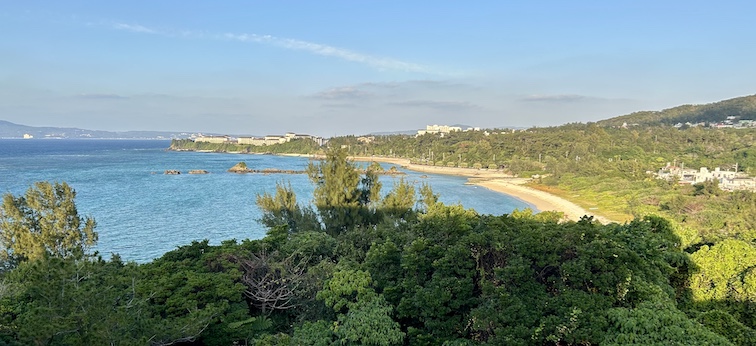
The sandy beaches of semi-tropical Okinawa have seen war and famine, but today they attract surfers and sun seekers to their shores. Photo by Nancy Wigston
From Puffer Fish to Spam
Chucking shoes for slippers, guests enter another world at Umi no Okinawa Inn, a luxurious hostelry where the two daily meals are breakfast and a nine-course dinner. One night, puffer fish (fugu) is served, a fish so lethal that only a professionally trained and licensed chef can prepare it.
About an hour from the capital, Naha, the inn is a private oasis — far from the resort hotel one might expect to find. Hotel pajamas are worn everywhere. Elevators take guests down to the onsen’s spa to bask in the quiet contrast to Tokyo.
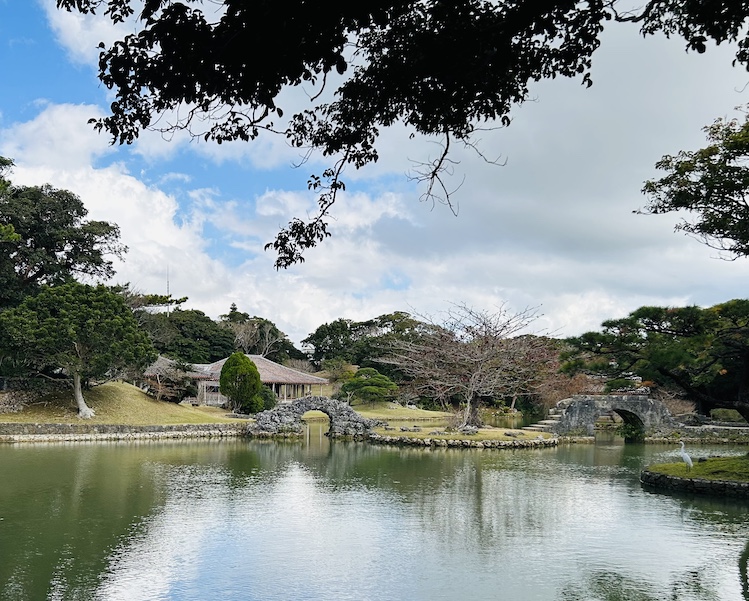
Shikinaen Royal Gardens embodies the relaxed luxury enjoyed in the 18th century by royalty in the Ryukyu Kingdom. They are a charming latticework of ponds, pagodas and curious cranes. Photo by Nancy Wigston
If Okinawa feels different, that’s because it is. Home to the Ryukyu Kingdom for 400 years until Japan annexed it in 1879. Okinawans consider themselves a separate ethnicity. (DNA proves it). Women priestesses were powerful, and their female spiritual strength was revered. When you say you’re Okinawan, you’re saying you’re not Japanese. Intermarriage has changed much, but differences in customs and even language endure.
Mythological lion-dogs, called shisa, still guard gates and entrances. They mean luck and resilience, qualities embodied by Shurijo Castle. Proud symbol of the Ryukyu Kingdom, the red castle was destroyed by fire in 2019. Currently rising from the ashes, it will soon resemble the red-tiled fortress of old—thanks in part to volunteer labor.
Meanwhile, at the World Heritage Site where Royalty once relaxed in the 18th century, Shikinaen Royal Garden is almost devoid of tourists. A small castle and pagoda, arranged in circular style, face a stream-fed pond. Bridges connect the islands in a scene from a long-ago romance.
In 1945, American troops invaded Okinawa’s beaches. History buffs can visit the former Japanese Naval Headquarters, following an underground tunnel. A terse comment about this “brutal” war accompanies poignant photos of American G.I.s feeding starving Okinawans who had hidden in the island’s many caves.
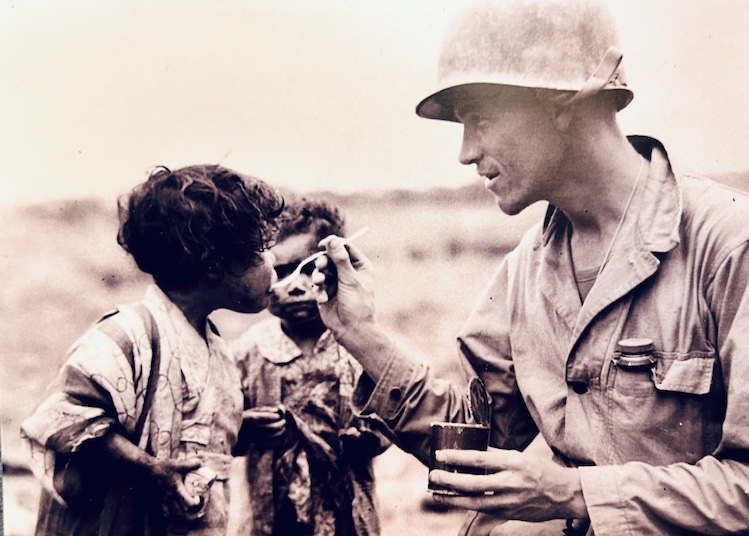
An American G.I.feeds starving children after one of the fiercest battles of the War in the Pacific. Many Okinawan families hid in caves as the battles raged.
Okinawa today remains an important U.S. military base with 26,000 active-duty soldiers, their presence tolerated if not universally loved. The G.I.s’ Spam and Hershey bars remain popular, but Okinawa’s current claim to fame—aside from its spectacular Bali-like scenery–is longevity.
Blue Zone
We all want to live longer—if not forever. Studies have identified a number of “Blue Zones” where living a century is not unknown. Okinawa is one. Factors contributing to longevity seem to be eating root vegetables, soy, miso, and mugwort until 80% full. Gardening seems to prolong life as does socializing and embracing community activities.
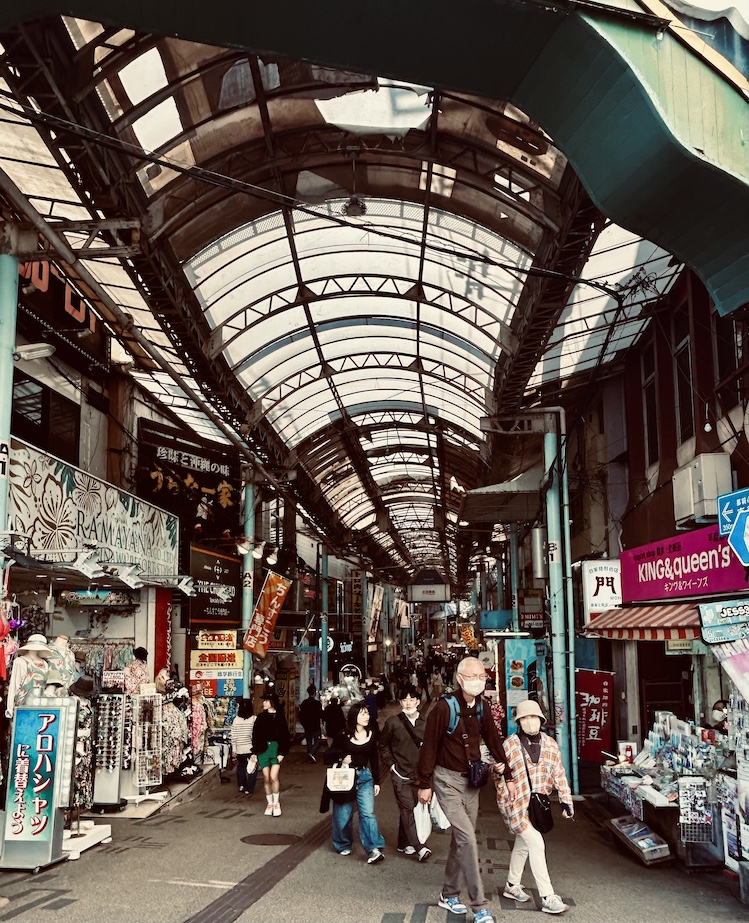
Naha’s busy covered market remains a popular destination for shopping and eating—its roots trace back to WWII’s wartime black market. Photo by Nancy Wigston
Off-season, Okinawa has few guides, so our group was lucky to find one willing to show us around. With Hiro, we enjoyed a pleasant drive along gently curving roads, the East China Sea on one side and green, rolling hills on the other. After stops at Shurijo Castle and the Royal Gardens, we explored Naha and its covered Makishi Public Market. Formerly a black market, today’s Makishi is the place to find to fresh meat, fish, produce and liquor, alongside cafes and shops with nostalgic favorites like SPAM.
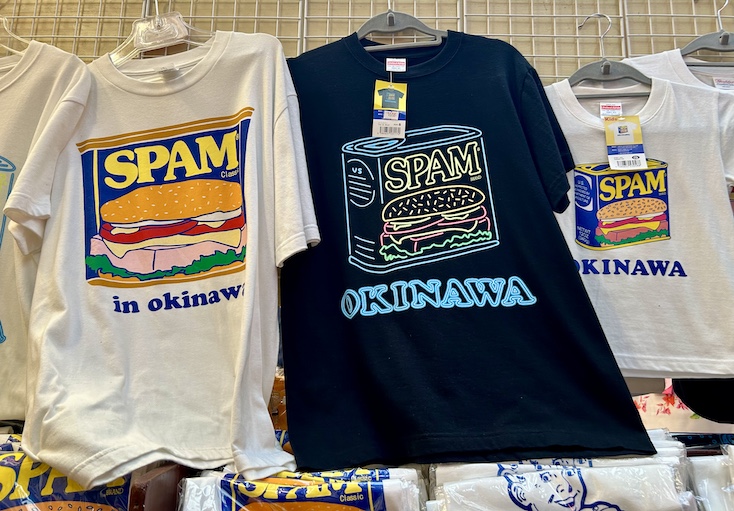
SPAM proved another enduring American souvenir, along with baseball. These t-shirts make a great retro-chic souvenir for the folks back home. Photo by Nancy Wigston
Naha pottery is valued for its bright colors and natural feel. At a small art shop, the group inspected shelves of plates and bowls, coming away with treasures that spoke of the turquoise blue of the East China Sea. Lunch nearby was a simple affair. As diners sat on tatami mats, steaming bowls of fresh noodles topped with veggies and soy sauce were served. It was no multicourse extravaganza, but a taste of authentic Okinawa.
Fukuoka
One of travel’s joys—perhaps the most important– is the chance discovery. Flying north, the mid-sized city of Fukuoka looked nothing like Campbell’s luscious Okinawan pear or Tokyo’s skyscraper forest. Serendipity leads travelers to Lamp Light Books Hotel, in what seemed to be Fukuoka’s hipster district (Daimyo), with bars, cafes and cool graffiti. The Lamp Light offers just the right blend of homey walls lined with books and modern robots cleaning the hallways. Students sat at a long wooden table, drinking coffee while tapping on their laptops.
Library or hotel? Seemingly an afterthought, check-in was located at the opposite end of the room. Each guest can borrow a book for their stay.
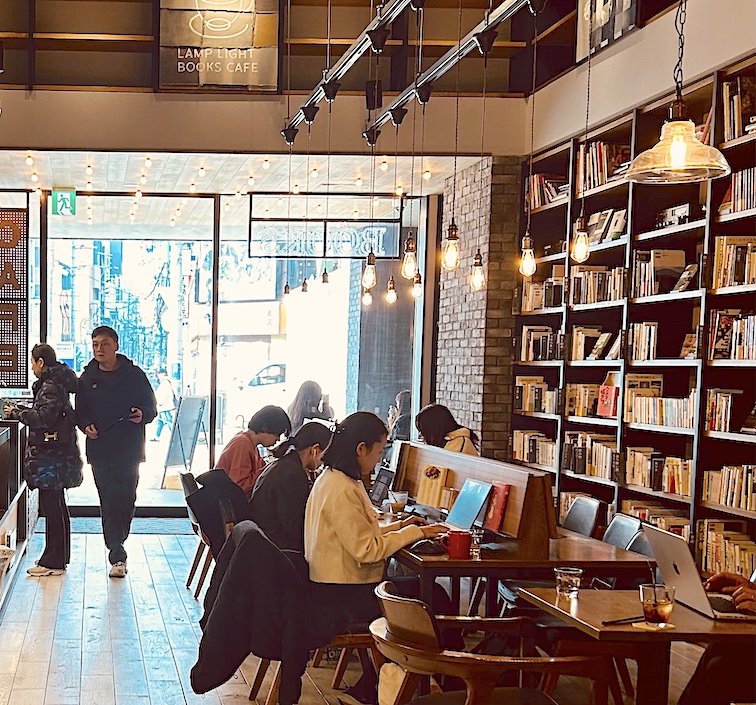
Check into Fukuoka’s Lamp Light Books Hotel and you’ll receive a book to read during your stay. The atmosphere is cafe-like, with laptops clicking away and bookshelves reaching to the ceiling. Robots clean the hallways. Photo by Nancy Wigston
Shinto Magic
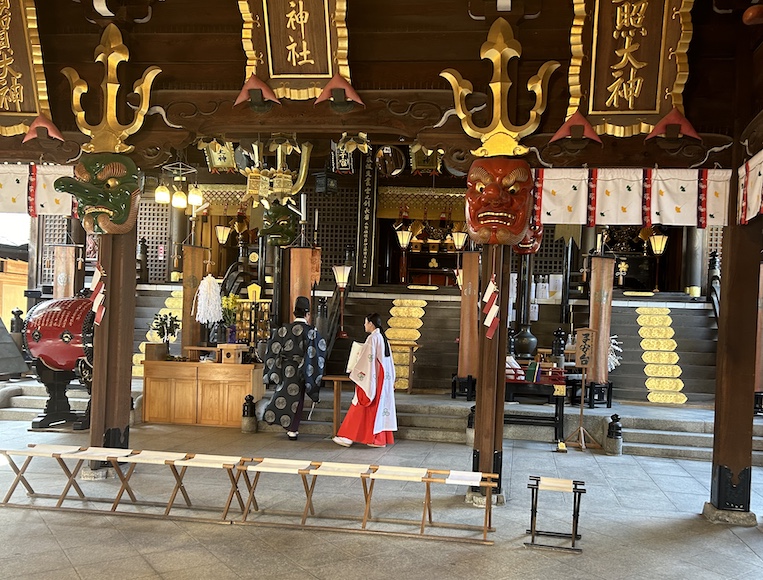
Tokyo’s Shinto shrine leaves visitors unprepared for Fukuoka’s Kushida-Jinja Shrine. Picture entering through a giant woman’s face, like a smiling fairground lady. She marked the festival when Otafuku masks signal the coming of spring. Like spring, these masks are harbingers of good fortune, prosperity in business and safety for the family.
Traditionally, you enter the mask throwing soybeans while shouting “Oni wa sotos! Fuku wa unchi!” (“Out with demons! In with fortune!”) People wander about the grounds and pray inside the old buildings. Exiting worshippers pass through another face mask, ready for the spring season.
In contrast is Fukuoka’s 1500-year-old Shofuku-ji Zen Temple, Japan’s oldest. The imposing temple and its grounds convey stillness and peace. Apart from a few tourists, awed by the great swooping roofs, this temple is pure Zen, calm and serene with none of the colorful exuberance of the Shinto shrine.
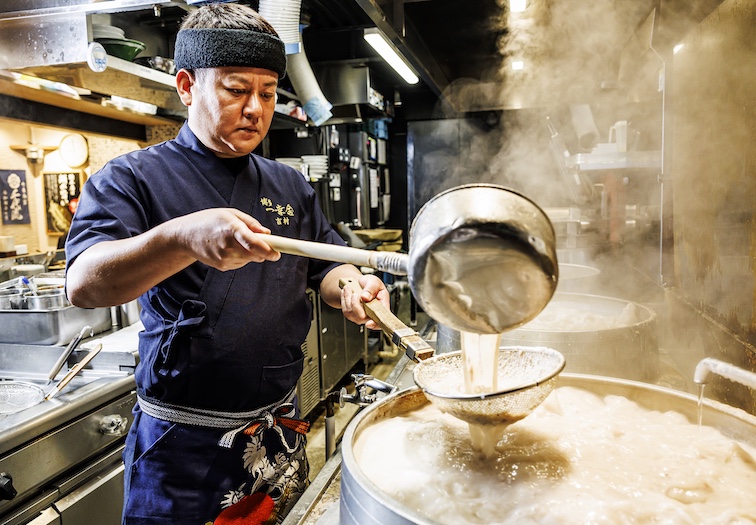
Fukuoka’s ramen cuisine soars beyond your average student fare, offering a myriad of sophisticated versions bearing little resemblance to any other noodle dish. Image courtesy of TolyoTourism
Fukuoka is well worth seeing. It is notable for its Contemporary Art Museum with modern works and a charming café. Winter days are all blue skies and high energy. Fukuoka’s famous ramen noodles make perfect evening meals. At the Ichiran restaurant, chefs specialize exclusively in natural “tonkotsu ramen.” Ordering a meal requires obtaining a ticket and specifying noodle firmness, broth richness, and spiciness before proceeding to a private booth designed to minimize distractions. Dinner comes within seconds of preparation, so diners enjoy aroma, heat and textures at their peak. The city also boasts 100 street food stalls in the nightlife districts of Nakatsu and Tenjin. The most memorable name goes to the popular Mentai Chudokku (Mentai Addiction), with its cod roe-focused menu.
One connection between East and West that doesn’t involve baseball is books. Checking out Lamp Light Books’ shelves reveals a copy of Anne of Green Gables, the 1908 bestseller about a red-haired orphan from Prince Edward Island, in the Canadian Maritimes. When her copy was left behind by a departing Canadian missionary, Montgomery’s book was translated into Japanese and took off like a rocket. To this day, planeloads of Japanese “Anne Fans” travel to Prince Edward Island each summer, visiting Montgomery’s enchanted landscapes.
Kyoto Fantasy
Kyoto was the capital of Japan for a thousand years (794-1868 AD). A city of roughly 3,000 temples and shrines and 17 World Heritage sites, it’s home to Japan’s geisha tradition, traditional inns, the tea ceremony, and a Samurai Museum. In particular, the Gion-Geisha neighborhood seems untouched by time.
Capital of Japan for a thousand years, Kyoto still has the ambiance of the very old. It’s not uncommon to see rows of wooden shops with specialty stores selling teas and miso soup powders, several of which have been owned by the same family for three hundred years. Photo by Nancy Wigston
Though there are plenty of modern hotels, many foreigners go full-tilt authentic, booking a traditional inn (ryokan), where guests sleep on futons and are served breakfast in their rooms. These inns are traditionally owned and staffed by women who are helpful with restaurant suggestions.
Be warned: sleeping on a futon may not suit those of a certain age. On the upside, the onsens are divinely hot and soothing, but take note: No tattoos are allowed in onsens, since only Yakuza gangsters sport them in Japan.
Dress like a Geisha
In Tokyo, Godzilla peeks over a high-rise. In Kyoto, geisha re-enactments are the trend. Both local and foreign visitors rent beautiful old kimonos (several shops rent them, starting at $30) for touring the Gion neighborhood, the heart of the geisha world. Since 2019, photographing real geishas has been prohibited following incidents involving disrespectful tourists.
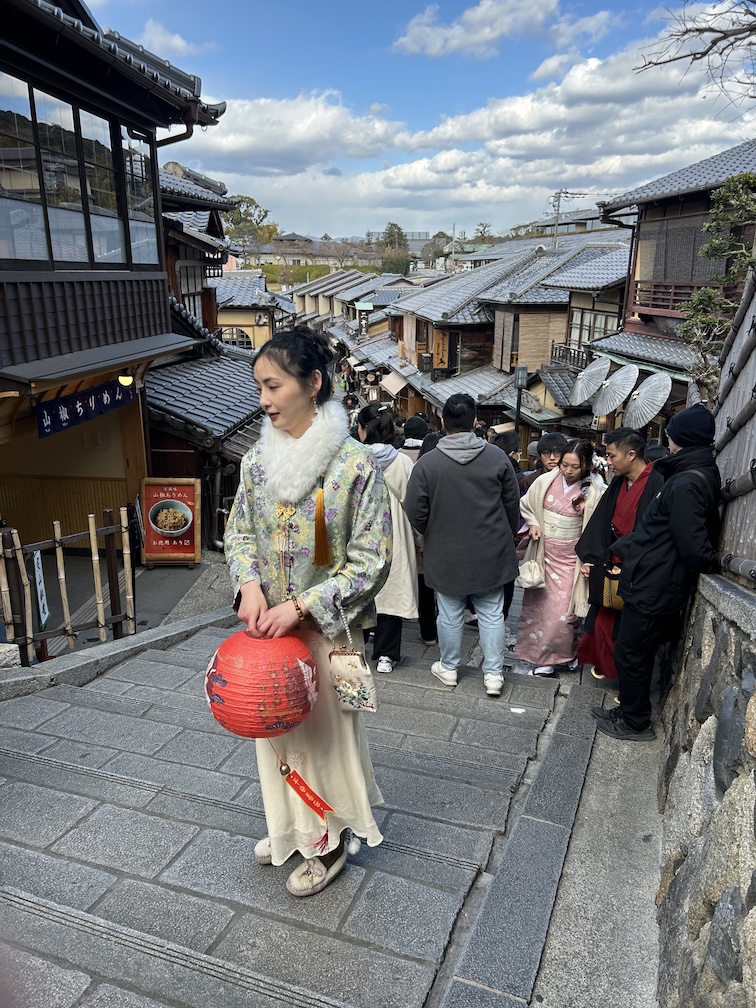
Japanese tourists enter the fantastic geisha world by renting beautiful silk kimonos paired with sensible shoes for climbing Hanamikoji Street, the narrow, hilly heart of the Gion neighborhood. Photo by Nancy Wigston
On a clear winter morning, you’ll find mostly Japanese visitors walking up hilly Hanamikoji Street, the central Gion geisha lane. In a strictly preserved style, no electric lines are overhead, but there are plenty of wooden houses, old shops, and teahouses. At the top of the hilly street is the sparkling red Yakasa-No To Pagoda, part of the Kiyomizu-dera Temple. These ancient wooden structures are named for a sacred water fountain that guarantees health and longevity.
Some businesses claim to be three hundred years old, but the best bargains I found came from a “pop-up” shop run by a young woman offering vintage silk kimonos in hues of orange, pink, and lavender for $100.
At the hill’s southern end, the thirteenth-century Zen Kennin-ji Temple attracts many more visitors, drawn to its intricate dragon murals (added in 2002) and its traditional Zen garden. Kyoto’s oldest temple closes at five, and you need tickets to enter.
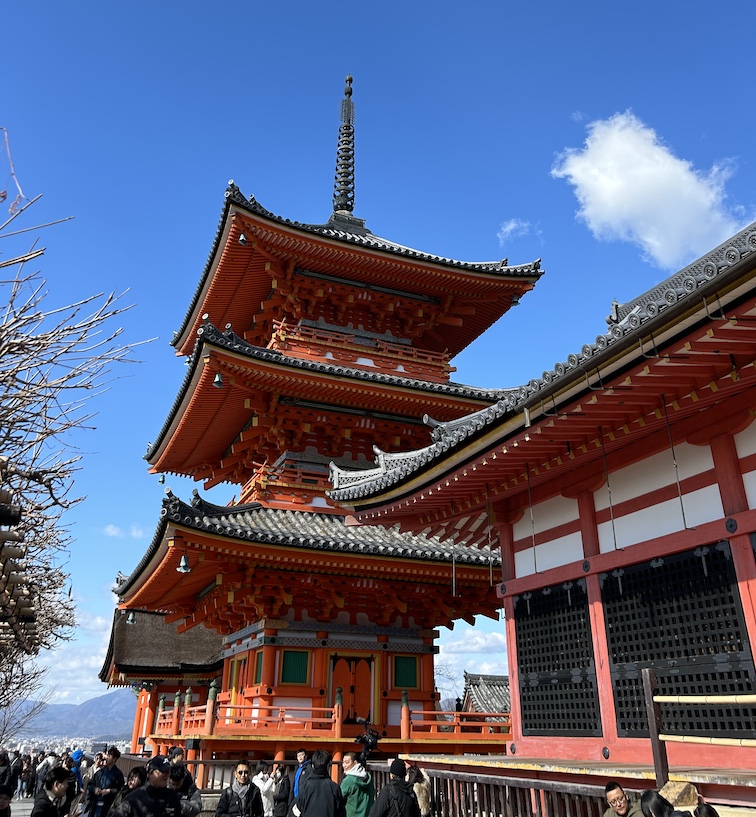
At the top of Hanamikoji Street stands the dazzling red Yakasa-NoTo Pagoda, part of the Kiyomizu-Dera Temple, renowned for its sacred water fountain, which is said to guarantee health and longevity. Photo by Nancy Wigston
Arashiyama Bamboo Forest is hugely popular—and free–for those longing for a “magical Zen-like atmosphere,” walking along sunlight-filtered paths lined by perpendicular bamboo. The wind blowing through these trees is officially ranked among Japan’s 100 special “soundscapes.” Emerging from the forest, walkers buy fresh juice from a stand and satay-like chicken on skewers.
Farewell Kyoto
Near busy Kyoto Station, in the Tokiwacho area, there is, surprisingly, a Starbucks with an attached café, and some Japanese chefs can be persuaded to sell take-out shrimp tempura to the tired tourist.
An astonishing sight shouldn’t be missed: the massive temple grounds at Tokiwacho, near-empty on a winter’s day, old, maybe haunted, and blessedly tourist-free. There’s a lovely sign in English there— “To think you know it all, that’s a sure sign you know nothing at all.”
Most first-time visitors to Kyoto know little about this heritage-drenched city, which some argue is still the rightful capital of Old Japan.
Toronto-based Nancy Wigston has lived in Asia and is a frequent visitor to Japan. During your visit to our website, please see her previous stories on the festivals of Penang and Istanbul’s world-famous television dramas