

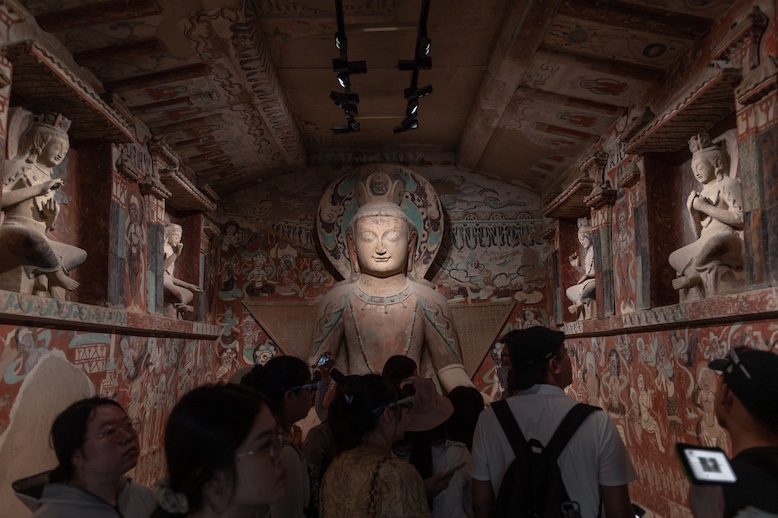
Located along a western stretch of China’s Silk Road, the Mogao Caves are filled with priceless art dating back to the early Tang Dynasty. The caves are softly illuminated to preserve the ancient wall paintings. Photo by Michael Snell
By Sharon McDonnell
UNESCO has called the Mogao Caves the “largest, most richly endowed and longest-used treasure house of Buddhist art” in the world. The caves are located outside Dunhuang, an oasis city in northwest China at the edge of the Gobi Desert in Gansu province. Filled with vivid murals and statues depicting Buddha and Buddhist paradise, as well as local daily life, the 492 caves date back to the 4th-14th centuries.
A UNESCO World Heritage Site, the “caves” are openings carved into sheer cliffs. The earliest cave, dated to 366 AD by a Buddhist pilgrim, was followed by hundreds more, used for worship and praying for a safe journey on the Silk Road. The fabled trade route started in Xi’an and wound almost 1,000 miles through Gansu and Central Asia before heading to Turkey and Italy. Rich merchants or top officials often sponsored the cave art. “Dunhuang was an important city since it was at the junction of the northern and southern trade routes on the Silk Road, which circumvented the Taklamakan Desert. To the north was Mongolia, to the south, the Qinghai-Tibetan plateau, to the east, the rest of China, to the west, Muslim Uyghurs in Xinjiang province,” explained my guide, Peter Huang. In one cave sponsored by women only, three Uyghur women clad in traditional costumes, headdresses, and lots of jade are featured in a mural of about 50 women, the majority of whom are Han Chinese.
Dunhuang: Commercialization of Religious Art
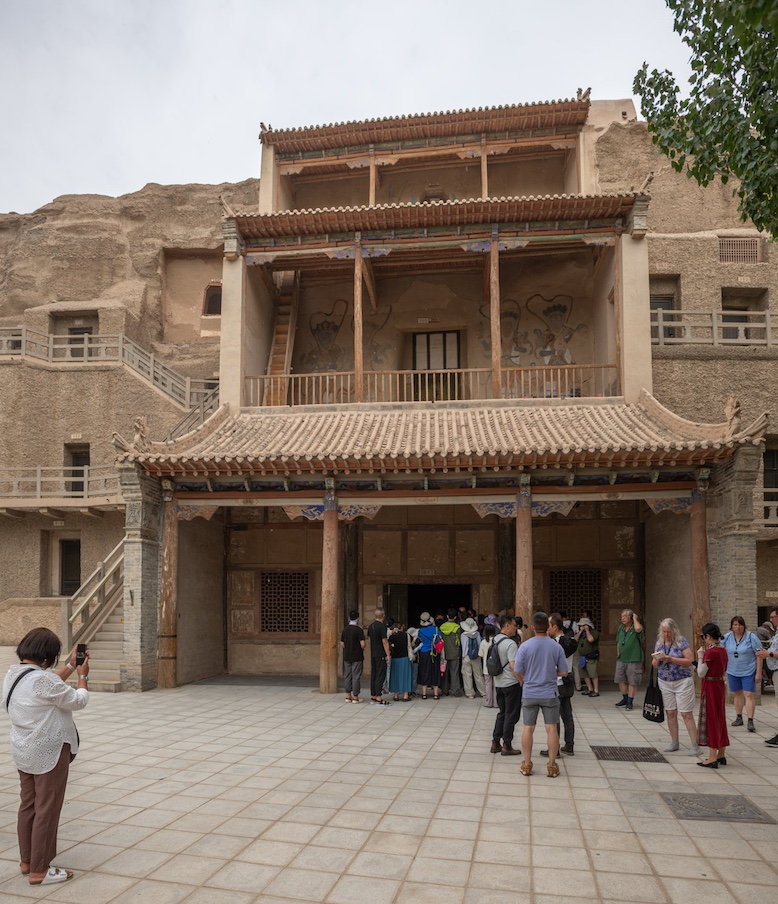
From the outside, the Mogao Caves in China’s Gansu Province resemble an ancient apartment complex. But inside, travelers will find spectacular caves covered with early Buddhist art, complemented by a multimedia light show featuring costumed actors. Photo by Michael Snell
But it wasn’t just silk. Merchants also traded ceramics, furs, paper, and gunpowder from China for wool, horses, glass, and spices on the route, which was also an avenue of cultural and religious exchange. “The Silk Road wasn’t simply a trade route but a mixing of ideas and religions. It was the way Buddhism entered China from India,” Huang added. Early caves show Indian faces and styles, while 7th-10th century murals often depict Tang Dynasty dress, architecture, music, and Flying Apsaras. You may never have heard of apsaras, graceful female spirits in long flowing skirts, trailing ribbons who scatter flowers in the sky for Buddha. After a visit to Dunhuang, you’ll never forget them. Apsaras are everywhere, from scarves, tote bags, stationery, art, jewelry, and metal traffic lane dividers. In the theater, costumed apsaras dangling from the ceiling can “fly” across the room during Ancient Sound of Dunhuang and land a few feet from your seat. In this dazzling multimedia extravaganza, everything is inspired by Mogao Caves art: musicians playing lute-like instruments, performers who dance and pose, light projections of Buddhas and camel caravans cast on walls to the gift shop. So is a deer, an early incarnation of Buddha, spiritual souvenirs, and yes, traffic lane dividers. In officially atheist Communist China, it’s a surreal sight.
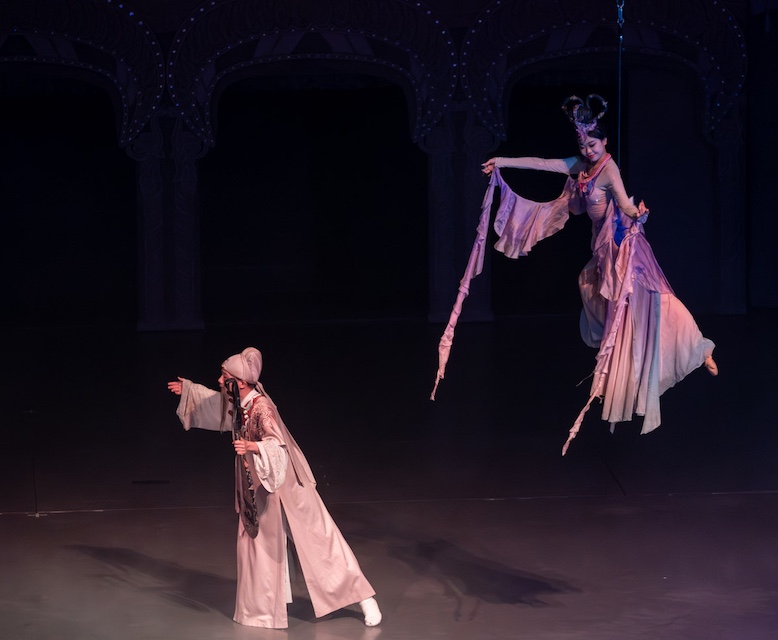
The “Ancient Sound of Dunhuang” is a dazzling multimedia extravaganza with apsaras and musicians playing hand-crafted lutes. Inspiration comes from the art-covered Mogao Caves. Photo by Michael Snell.
Excellent short films on Silk Road history and the cave art are shown at the Mogao Caves visitor center, which also displays replicas of some murals (no photography is allowed inside the dark caves). English-speaking guides use flashlights to show tourists eight caves, each with doors, wooden stairs, and walkways for easy access. Tourists are limited to 6,000 a day, and out of the hundreds who visited, I spotted only six non-Asians, besides my band of five Americans.
One is called the Library Cave because it once contained about 45,000 ancient religious scrolls on Zoroastrianism, Christianity, Islam, and Judaism, written in Chinese, Tibetan, Sanskrit, Uyghur, and other Central Asian languages. But most are now in London, Paris, and India, in the British Museum, British Library, Bibliothèque nationale de France, Musée Guimet, and the National Museum in New Delhi. That is because in 1907, English archeologist Aurel Stein purchased thousands for a pittance from a Taoist monk caretaker of the caves, which had been abandoned centuries before. Later, Paul Peilliot, a French Sinologist, bought about 8,000 pieces of art at a rock-bottom price. Harvard’s art museums even have some cave art, since Harvard professor and art historian Langdon Warner peeled off murals and brought home a sculpture.
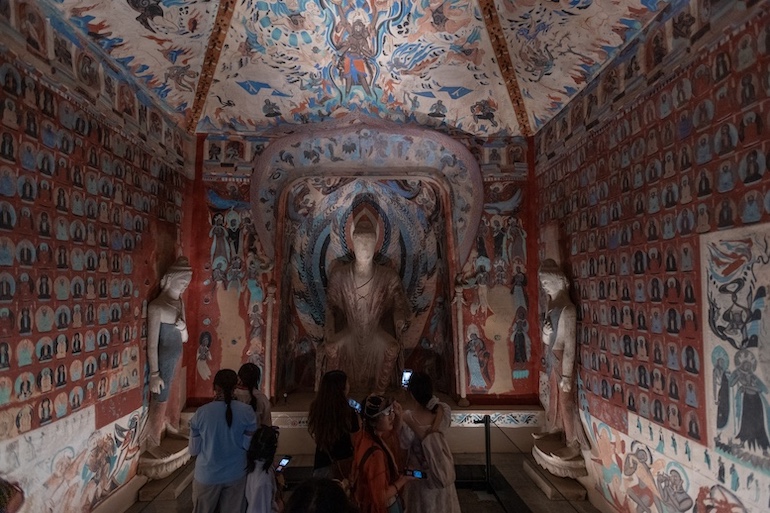
Photography is not allowed inside the Mogao Caves to protect the ancient Buddhist art. Photo by Michael Snell
Wind Power and 2,000-year-old Ruins
One might wonder what Dunhuang looks like today, since the Silk Road declined after the 14th century. It is surprisingly modern, prosperous and lined with leafy trees. Thanks to colorful lights and lanterns that illuminate the trees at night year-round, the city has a festive Christmas-like look, even in July. This city of 200,000 (a village by Chinese standards) has one of the highest incomes per capita in China, my Lonely Planet guidebook notes, due to wind and solar power production and tourism. I passed wind turbines and transmission towers by the hundreds on the train ride here. But it wasn’t always so. Forty years ago, Dunhuang was a poor, isolated, much smaller town. Indeed, the rural province was one of China’s poorest.
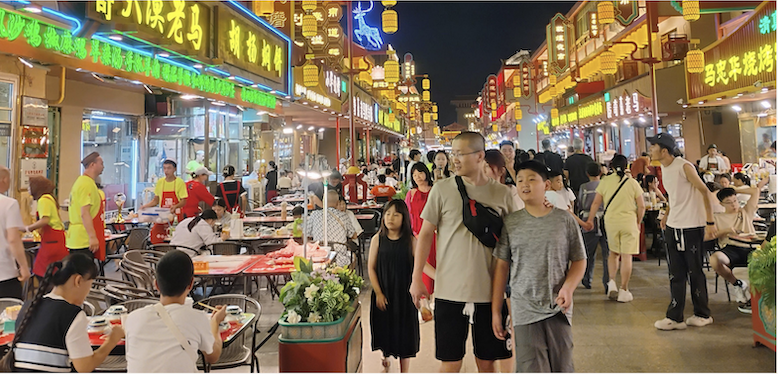
The lively Night Market in Dunhuang is exciting and affordable. Photo by Sharon McDonnell
Camels were the transportation on the Silk Road, so a camel ride is a great way to feel this ancient history in your bones. But camel treks to Singing Sand Dunes, whose highest tops 5,200 feet, are canceled if there’s a sandstorm. Nearby is the fast-disappearing Crescent Moon Lake, now pond-sized, four miles south of Dunhuang, whose original name, Shazhou, means “Continent of Sand.” A thrilling sandstorm occurred during my visit, so the predicted 110-degree Fahrenheit temperature plummeted to something breezier and more comfortable. I settled for seeing a statue of a two-humped camel inside the Silk Road Dunhuang Hotel and a photograph of a sunset camel trek in its hallway. Central Asian rugs and Chinese antiques adorn rooms in this small luxury hotel. Signs along paths lining its courtyards describe major Silk Road figures like Zhang Qian, the Han Dynasty Emperor Wu’s envoy, whose journeys to Central Asia first opened the Silk Road in the second century BC. Also mentioned are Kublai Khan, the Mongol Emperor who befriended Marco Polo, and German geologist/geographer Ferdinand von Richthofen, who coined the term “Silk Road” in 1877.
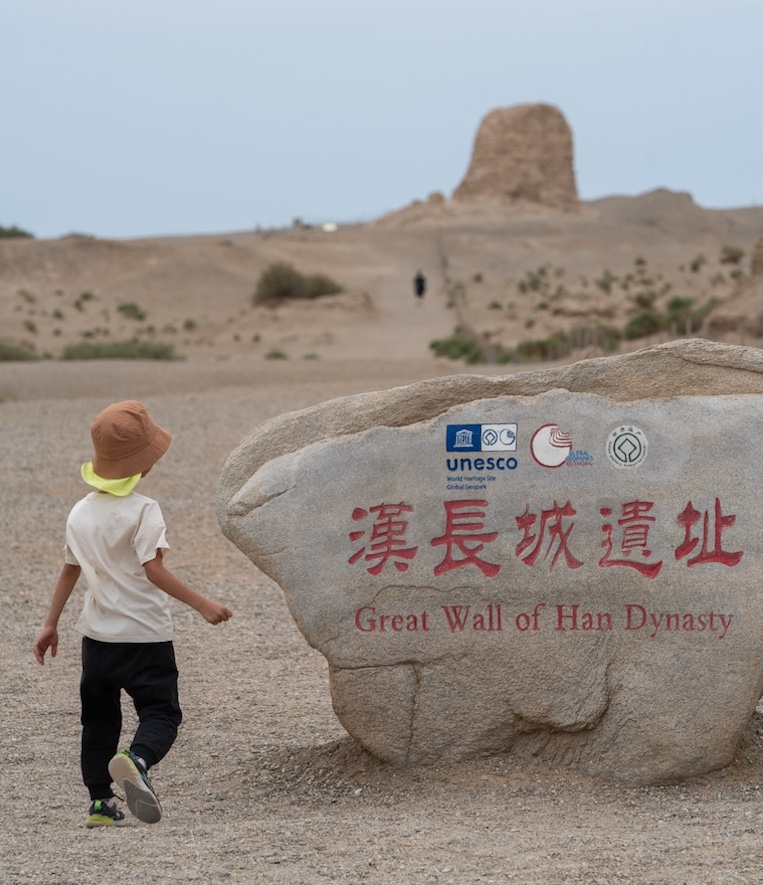
The Dunhuang UNESCO National Geopark in Gansu Province is China’s gateway to Central Asia. Photo by Michael Snell.
The ruins of the Great Wall, built over 2,000 years ago by the Han Dynasty to repel northern invaders and protect trade along the emerging Silk Road, stand 50 miles northwest of the city in a treeless stretch of desert now known as the Dunhuang UNESCO National Geopark. The remains of 10-foot walls built from silt, gravel, and feathergrass are visible. Crumbling beacon towers and frontier forts near Yumen Pass punctuate the only road on the northern Silk Road, which, along with Yangguan Pass further south, led to Xinjiang province and Central Asia, then called the “Western Regions.”
It looks different from the better-known, better-preserved stone walls built many centuries later by the Ming Dynasty (1368-1644), but it’s part of the wall that stretched 6,200 miles to the coast of North Korea. Further northwest, odd hoodoo-like rock formations sculpted by wind erosion, called yardangs, are also in the Geopark.
Zhangye: Rainbow-Colored Mountains
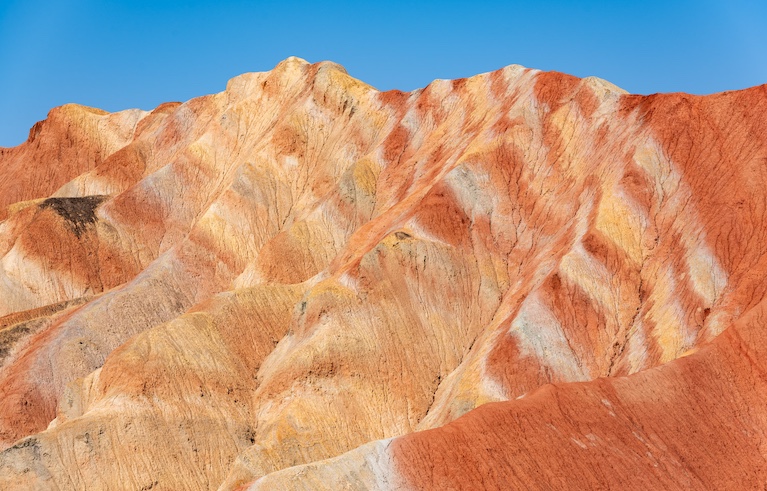
The “Rainbow Mountains” add color, perspective, and a wonderful selfie backdrop for travelers who stop at the Zhangye Danxia UNESCO Global Geopark. Photo by Sharon McDonnell
Marco Polo spent a year in Zhangye, another major Silk Road outpost, circa 1274, and described it in detail. A statue of the Venetian explorer stands in this city. Which is 3 ½ hours by “bullet train” east of Dunhuang. It is known for the “Rainbow Mountains,” colorful and striped sandstone formations. Signs explain how Zhangye Danxia UNESCO Global Geopark was shaped 137-196 million years ago when the Asian and Indian tectonic plates buckled, and sharp layers emerged from sediment once beneath a lake. This magnificent Grand Canyon-like park’s colors are due to minerals, from red for iron to blue-green for copper. A bus takes tours to highlights, where you admire the view from wooden platforms and stairs.
Lanzhou: The Flying Horse
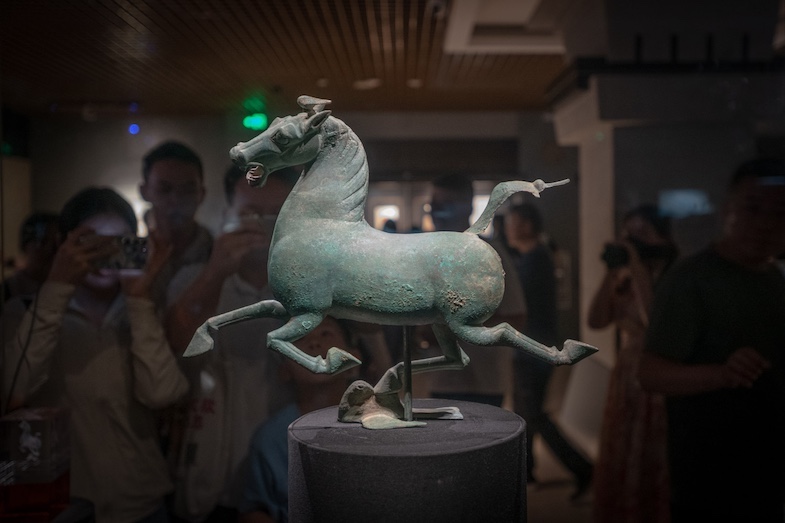
The “Flying Horse,” a 2nd-century bronze statue in the Gansu Provincial Museum in Lanzhou, is often simply referred to as the “Gansu Horse.” Photo by Sharon McDonnell
The city of Lanzhou, at the intersection of the Silk Road and the Yellow River, is two and a half hours east of Zhangye by train. Lanzhou is famous in China for two things: the “Flying Horse,” a 2nd-century bronze statue of a horse in triumphant full gallop with three hooves off the ground, and beef noodles. The symbol of China Tourism (and in its logo), the horse is in the Gansu Provincial Museum, which has a fascinating permanent Silk Road exhibit. It includes maps of old trade routes, ancient gold, bronze, and wooden artifacts, such as 2,000-year-old wooden tablets used for communication, and an interactive timeline where clicking an era reveals a museum object.
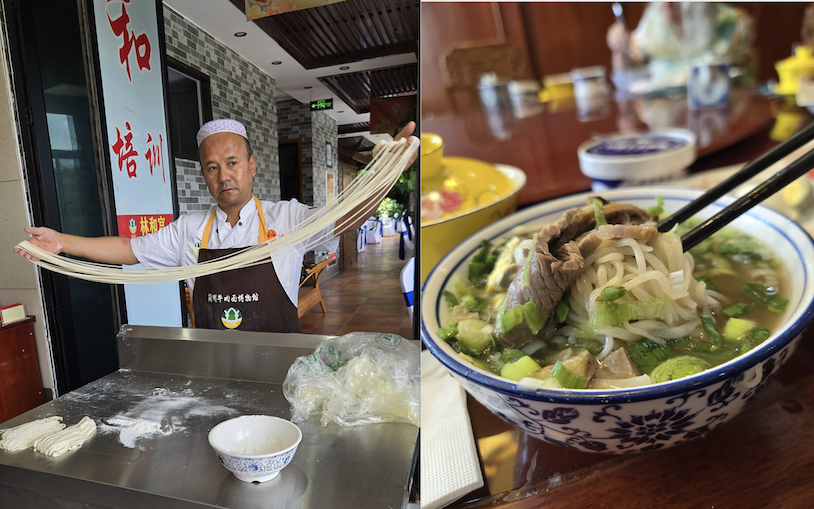
At the Lanzhou Hand Pulled Beef Noodle Museum and Restaurant, Western tourists can learn to make hand-pulled noodles and enjoy steaming-hot bowls of soup. Hand-pulled beef noodles are ubiquitous throughout the city. Both photographs by Michael J. Solender.
But in this modern city of three million people, beef noodles are as ubiquitous as apsaras in Dunhuang. A museum is even devoted to this Muslim dish, which is packed with chewy wheat noodles, beef chunks, cilantro, radish, chili oil and tasty broth. Three sculptures in front of the museum depict a noodle bowl, a man hand-pulling noodles and people eating. From Flying Apsaras in western Gansu to a Flying Horse in eastern Gansu, your journey on China’s Silk Road is complete.
Sharon McDonnell is a travel, culture and food writer in San Francisco who also writes for National Geographic, Food & Wine, Conde Nast Traveler and Travel + Leisure. Her previous East-West News Service stories were on Krakow and Estonia.