

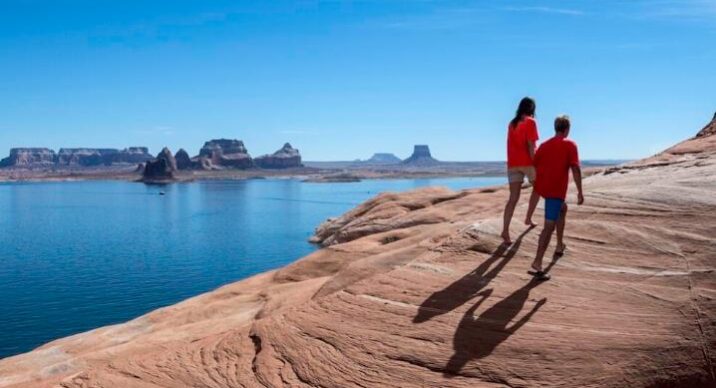
The gentle flow of water on Glen Canyon has an almost spiritual resonance to it. Located between Southern Utah and the Glen Canyon Dam in Arizona, the Colorado River, or “The American Nile,” covers some 9,000 feet from the Rockies into the Sea of Cortez.
When the weather is cool and snow has melted, water would run along the riverbed into Lake Powell. Today though, a different story flows from the once great Glen Canyon – one of drought and of human intervention.
Drought That Discovered a Secret Canyon
Lake Powell was once America’s second largest man-made lake. On my last visit, the lake was 150 feet below its full capacity. However, today, it holds much less water.
But the drop in water also has its silver lining. What was once a concrete wall in 1963 has revealed concealed side canyons, sandstone crevices, and rock formations now reemerging as the water level decreases.
East West News Service’s North America travel and cultural analysis dives into how nature and engineering have influenced the identity of the region.
Setting Out, Page, Arizona
My first stop was Page, Arizona, a miniature desert community that is also the gateway to Lake Powell. From Waheap Marina going northeast, the journey opened up into Antelope Canyon, then to Navajo. What was a deceptively short distance on a map took hours by water on a houseboat.
Padre Bay and Reek Creek Bay welcomed visitors along the way with expansive beaches that were also ideal for camping. Traveling on a small boat was easier to navigate, however it did require planning because of its limited fuel capacity and cellular reception along the waterway.
Navigating Changing Waters
The shrinking waterline presents many dangers. At one point I had struck a spire of sandstone which burst out of deep water. Then a shift in water level caught us by surprise, changing some 200 feet within seconds. Visitors who travel by boat should remain on guard, especially in the narrow canyons and in the arms and sides where water levels could change quickly due to climate variability.
Cathedral in the Desert: A Personal Moment
My favorite part of the journey was the Escalande River Arm. A massive sandstone amphitheater called the “Cathedral in the Desert” left the most profound impressions. I first encountered this place many years ago and distinctly remember how water splashed against its golden canyon walls.
Seasons on the Lake
Crowds are drawn to the water when days are long during the summer, but recedes once winter arrives. Exploring through the narrow canyons anytime of the year is an experience to remember. Whether you travel by kayak or a small boat, wading through the sandstone walls is akin to stepping into another world altogether.
Bottom Line
I have visited nearly 20 canyons in my lifetime. Each one offers a varying coastline where the sandbars move and new rock forms with the changing of water levels. Glen Canyon is unique all in its own and is a place of perpetual change. It transforms into something new with each visit.
For a deep dive, read the full article.