

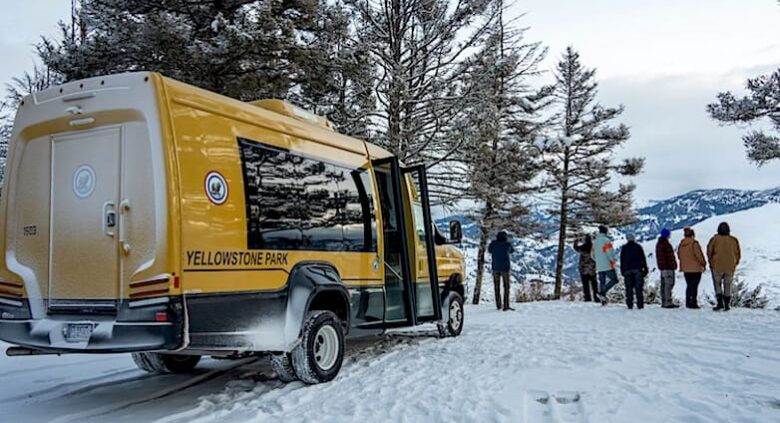
On a dark, frigid winter evening in Wyoming’s Yellowstone National Park, I sat in a snowcoach with enormous low-pressure tires, watching snow swirl through the headlights. Somewhere between Black Sand and Biscuit Basin, the road curved into darkness, and there, at the edge of the forest, stood a gray wolf. A fellow passenger gave a subtle nod, and the six of us fell silent. The wolf, a member of the Wapiti Lake pack, watched us as intently as we watched him. No cars behind us. No headlights ahead. No reason to move along. So, we didn’t.
Yet, beyond its wildlife and quiet roads, winter reveals a side of North America travel that few visitors see. Yellowstone averages more than 936,000 visits in July but only about 41,000 in February, its busiest winter month, when snow closes roads and 10,000 hydrothermal features send steam into freezing air.
Yellowstone by the Numbers: Summer vs. Winter
Over the past decade, July brought roughly 30,000 visitors a day. February averaged around 1,460 a day. The park’s workforce drops from approximately 750 employees in summer to 392 in winter.
The difference is easy to see at Old Faithful. I watched the geyser erupt with only five other people nearby. In summer, as many as 5,000 people may gather there. Rich Jehle, an interpretive ranger for more than 30 years, calls winter “a completely different national park.”
Where Winter Wildlife Gathers
Deep snow pushes bison and elk from higher country into lower valleys, where travel is easier. They follow river corridors, which also carry park roads, so animals are easier to spot.
The concentration of prey attracts wolves. Thermally influenced rivers, including the Firehole, can stay ice-free and draw trumpeter swans and other waterfowl. Bobcats sometimes follow, although seeing one stalk birds is rare. Snowcoach passengers may also see bald eagles and American dippers diving into icy streams. Bison sometimes surround vehicles, with frost clinging to their coats and calves kicking through the snow. Guide Gus Murray describes three ways animals face the season: bison “endure it,” migratory birds “avoid it,” and bears “hide from it.”
How Snowcoach Travel Changes the Visit?
Snowcoaches travel at about 20 miles an hour and stop for wildlife and photographs. The pace encourages visitors to slow down. John Wallingford, a Yellowstone guide since 2004, says many people try to see the park in one day. He suggests choosing a single focus, such as an animal, waterfall, or ridgeline, and staying awhile.
Without summer traffic, the park is remarkably quiet. Wind moves through the trees, boots crunch over snow, and a raven calls from the forest. Natural sounds carry farther.
After Dark: Steam, Stars, and Soundscapes
The winter-only “Steam, Stars, and Winter Soundscapes” tour takes visitors out after sunset. Steam rises from thermal pools beneath a starry sky. Guide Rachael Foote encourages guests to listen closely and notice the air.
At first, the night seems silent. Then a gurgle rises, followed by a deeper sound from out of view. I never found its source.
Why Winter Access Is Limited?
Winter quiet is partly by design. Since 2003, Yellowstone has limited snowmobile numbers and phased in guide requirements. Geography also shapes who can visit.
The only route open to ordinary vehicles runs from the North Entrance through the Northern Range and Lamar Valley to the Northeast Entrance. This lower area receives less snow. The higher interior gets heavier snowfall, so the park prepares its routes for snowcoaches and snowmobiles instead of regular traffic.
Only two lodges stay open. Mammoth Hot Springs Hotel and Cabins, near the North Entrance, is accessible by car. It has a historic guest wing dating to 1913 and a map room. Old Faithful Snow Lodge is reached by reserved snowcoach or snowmobile. Its stone fireplace and timber beams evoke an earlier era, although the lodge was built in 1999. Winter visits require planning and advance reservations.
A Different Way to See Yellowstone
Winter is not just summer covered in snow. Animals move in response to the season, geothermal features send steam into cold air, and visitors travel at a slower pace.
Ultimately, winter shows that Yellowstone’s appeal does not depend on crowds. Limited access, slower travel, and early planning protect the park’s wildlife and quiet. For visitors willing to prepare, a winter trip offers something rare in North America travel: the time and space to watch.
For a deeper exploration of this journey, read the full article: