

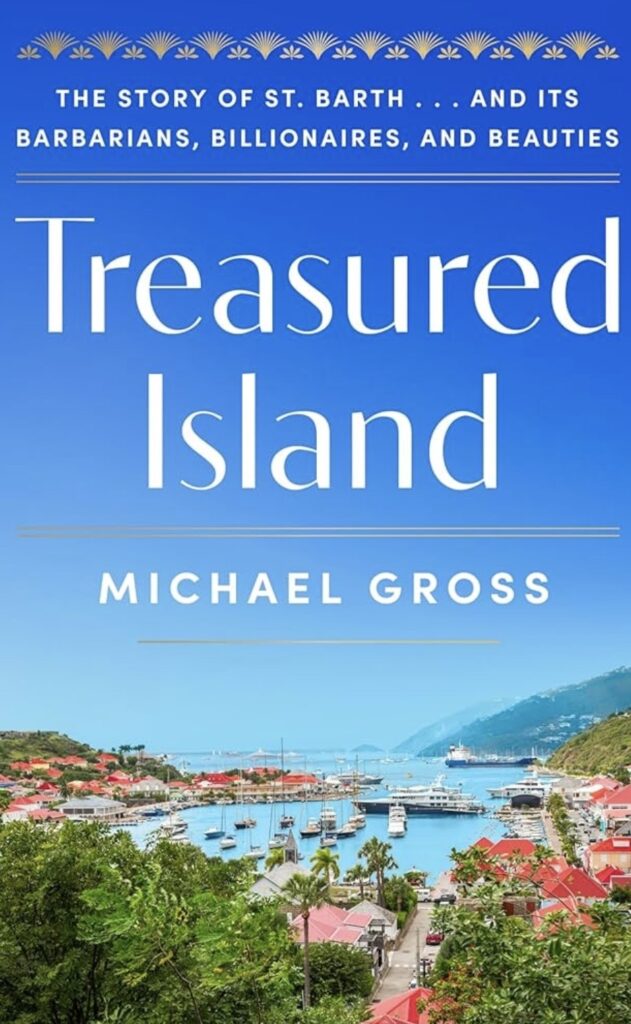
Treasured Island: The Story of St. Barth…and its Barbarians, Billionaires and Beauties
Reviewed By Nancy Wigston
In 1957, banker and oil tycoon David Rockefeller happened on the French-owned isle of St. Barthelemy (also known as St. Barth, St. Barths and St. Barts) while cruising the Caribbean in his family’s yacht. St. Barth is located just north of St. Kitts and southeast of St. Martin in the West Indies.
Enticed by its white sand beaches, turquoise waters, tiny population (fewer than 3000 souls – now almost 10,000) and twisting pathway-like roads, he purchased almost 140 acres in remote Colombier. He hoped his architect-designed hideaway would provide privacy, seclusion and environmental protection, away from the Caribbean’s many commercial resorts. In this sweeping social history of the island, author Michael Gross (a 35-year St. Barth veteran) delivers, in breathtaking detail, an intensely researched lowdown of the evolution of the French island that improbably became the most desirable—and pricey-destination in the Caribbean.
He begins with a charming close-up of rural St Barth (the preferred French version of the island name) in the early 20th century, before the Rockefellers, the Rothschilds or the vast cast of the rich, famous and stars of stage and screen discovered island pleasures. “We were poor, but we lived in paradise,” recounted a local named Marius to his biographer. Life largely depended on a diet of fish and bread—imported vegetables were rare—and Marius and his little brother were cared for by their grandmother, while their parents lived and worked on nearby islands. His most important role was running through town and scrambling up the hillside to reach the old Swedish Bell Tower, forged in Stockholm in 1799—there, at 6 am and 8 pm, he rang the old bell, alerting islanders to the hour. “It was my duty.” No matter if he was late, since time barely existed on St. Barth, a barren, volcanic rock with barely arable soil, sitting between the Atlantic Ocean and the Caribbean Sea.
The island’s most lucrative years were when its mixed population engaged in multiple activities (legal and illegal) and harvested cotton or indigo. Although a free port, the island’s only homegrown product was woven straw hats favored by families whose roots were in old France.
Christopher Columbus sailed around the island in 1493, naming it Bartolomey in honor of his brother. Arawak Indians knew it long before Columbus, until they were replaced by fierce Carib Indians. Over time, they too were supplanted by a confusing list of colonial rulers that included Spain, France, the Knights of Malta, Britain (briefly), and Sweden, which gave up its experiment in the imperial game in 1878 after only 94 years.
St Barth’s Swedish-sounding capital, Gustavia, endures, and tours of Swedish landmarks are offered today. The island was returned to French control and administered by French officials in Guadeloupe until a successful rebellion resulted in tiny St. Barth attaining “Collective” status.
As modern amenities arrived, French locals increasingly objected to large-scale economic development, including cruise ship tourism, so these changes to paradise came slowly. Soon, however, wealthy investors began to trickle in and build houses, villas, and eventually restaurants and hotels. St. Barth’s fabled history of brigands and piracy seemed to be fading fast amid boulangeries and bistros lining the newly paved streets. Yet before long, quaintness gave way to flamboyance, as innovative French adventurers began exporting local lobsters to Europe and building landing strips to serve their new airline.
Meanwhile, more sedate visitors built simple houses, enjoyed the sun, swam under the evening stars and passed time painting landscapes of cliffs and beaches. Although “weird expats” kept appearing, nobler types, like the American surgeon and his wife, a nurse, added to the island’s infrastructure by starting a hospital. St Barth was waking up.
What’s it like today for visitors? In the words of travel writer and editor Michele Peterson, a widely traveled, award-winning writer from Canada, “St. Barths is a very creative, elegant, artsy island with fashion shows, painting classes and champagne around every bend.”
Lots of French families with well-dressed children cared for by attentive nannies frequent hotels with unique kids’ programs. Swedish historical buildings like the Clock Tower, the Musee du Wall House and Fort Karl make pleasant diversions from a day at Shell Beach. The Swedes also made the island a free port.
As Peterson notes, St. Barth’s ultra-French atmosphere evokes parallels with St. Tropez in the south of France, including its current traffic issues. On my sole trip to St. Tropez, an old French tourist vacationing with his tiny dog, assured me that the formerly quiet fishing village now resembled “les dernier jours de Pompeii.” (the last days of Pompeii).
There may be similarities between the two destinations—not least in the bounty of deluxe French foods. Once smuggled to St. Barth from France, but now legally imported, nearly anything truly French, including pastries and local specialties like fresh seafood and fusion dishes like grouper in Creole sauce, is on the menu.
To see French wealth on display, just walk down to the harbor where yacht owners, including oligarchs and rock stars, share cocktails with skimpily clad young things in bikinis. Still too tame? Then head to the beach where French women often stroll about topless.
There’s no doubt that the St Barth of today, as pleasant as it is, has changed, perhaps reached its tipping point. It’s certainly no longer the sleepy leeward island where young Marius rang the Swedish bell twice a day. Folks who liked sailing into its harbor, like Mark Stevens of Ontario, can no longer afford the fees charged for a harbor slip. Mega-yachts owned by billionaires occupy all the prime spots. “The saying goes that if you want to be seen, go to St. Barth, if you don’t, go to Antibes,” chuckles Mark, who noticed two well known American comics in line on his last trip through customs, after his 15-minute flight from St. Martin.
Michael Gross candidly shares his own epiphany online, when he recalls the afternoon a few years ago when he went for his usual swim at Ti-Jean Beach, a favorite spot that always offered him total privacy. But that day it was far from private. The beach was swarming with tourists, desperately in search of their own taste of paradise.
Many of the colorful, feisty characters depicted in St Barth’s transformation by Gross have made their own real estate profits, retired, or departed island life. David Rockefeller sold his land for $136 million a few years back. A few stubbornly stay on, determined to save the environment, despite real estate predators or hurricanes, to protect their simpler way of life. True islanders today push back against being overrun–just as their ancestors did.