

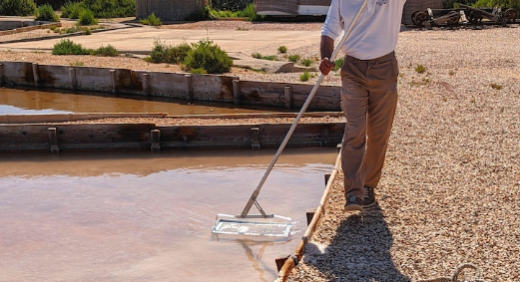
The brightest thing I saw in Mallorca wasn’t actually the Mediterranean Sea. It was a pile of freshly harvested salt, piled up like brighter snow. Standing under the summer sun at Salinas d’es Trenc I watched one worker, dressed entirely in white, gently rake delicate salt crystals from the surface of shallow pools, and somehow it looked calm, like he was doing something that’s both slow and precise. When he spread the sparkling flakes across a table, the light bounced back so hard it felt almost blinding. Those fragile crystals, called Flor de Sel, are among Mallorca’s most prized products, harvested in much the same way they have been for centuries—exactly the kind of authentic experience often highlighted in the latest Europe travel articles online.
Before visiting, I hadn’t given much thought to salt beyond what sat in my kitchen. Still, here, on Mallorca’s southeastern coast, I ended up learning how this ordinary ingredient once shaped economies and whole civilizations. The salt pans at Salinas d’es Trenc date back to the Carthaginian era, and today the place keeps being one of Europe’s few eco-certified salt producers. It uses only seawater, sunlight, and wind, and it produces thousands of tons of salt each year, which sounds simple, but it doesn’t look simple when you’re there.
Where salt and nature share space
What really struck me wasn’t just the production side of things; it was the landscape around it. The salt pans sit within the protected Salobrar de Campos wetland, where flamingos, stilts, (What is a stilt? Need a name here) and other bird species move across the horizon, like they own the view too. The wetlands, dunes, and native vegetation team up to create ideal conditions for Flor de Sel. Watching birds glide over an active industrial site felt like a small reminder that human activity and nature don’t always have to clash. Sometimes they can coexist, at least for a moment.
I learned that only the smallest ponds produce Flor de Sel. The delicate crystals float briefly, then sink, and they have to be collected by hand. They’re rich in minerals, and they have less sodium than ordinary table salt, so chefs around the world really value them. I tasted it on a simple plate of traditional Mallorcan Trampó—tomatoes, onions, and peppers—and it made me realize something that sounds obvious but wasn’t, it had this depth because it was familiar yet not boring at all.
A glimpse of Mallorca’s salty past
The visit also showed how tightly salt is stitched into Mallorca’s history. The wealth that came from the salt trade helped pay for some of Palma’s most important landmarks, like its heavy Gothic cathedral, La Seu. Later on, when I was walking through Palma, I couldn’t help noticing the city’s layers of history. They show up in architecture, narrow streets, and in majestic public spaces that genuinely feel central to the capital’s living history.
Palma itself is easygoing and welcoming. As I wandered through the old town, I kept running into elegant squares, historic buildings, and busy cafés tucked into centuries old lanes. And because Palma is compact, it’s kind of natural to explore on foot, which allowed me to notice those small details that you usually miss when you’re rushing between sights like you are late for something.
Experiencing Mallorca on two wheels
Mallorca has turned into a magnet for cyclists, and after a full day riding through the countryside, I finally understood why. With a local guide I cycled along quiet roads bordered by almond, lemon, and olive trees. The air had soft notes of lavender and pine, while the sea appeared out of nowhere between hills and behind stone walls. Unlike driving, cycling allowed me to embrace the surroundings. I caught the scent of wild herbs, the feel of dusty trails, and the calming silence surrounding small villages. We stopped at a lighthouse to watch the Mediterranean, then lingered by an old olive crusher before we headed back into the wider countryside again.
The Mallorca that stays in my head
By the end of the ride, I realized Mallorca had quietly rewired my impression of it. Beyond the beaches and the whole tourist reputation, I found an island shaped by centuries of farming, trading, and tradition. The salt pans gave me a clear view of that background, while the bike routes felt like a better way to experience everything at a slower and more gentle pace.
It’s those smaller moments—not the famous landmarks—that stayed with me long after leaving the island, and, honestly, they’re exactly the kind of discoveries that keep drawing me toward the latest Europe travel articles online.
For a deeper exploration of this journey, read the full article: