

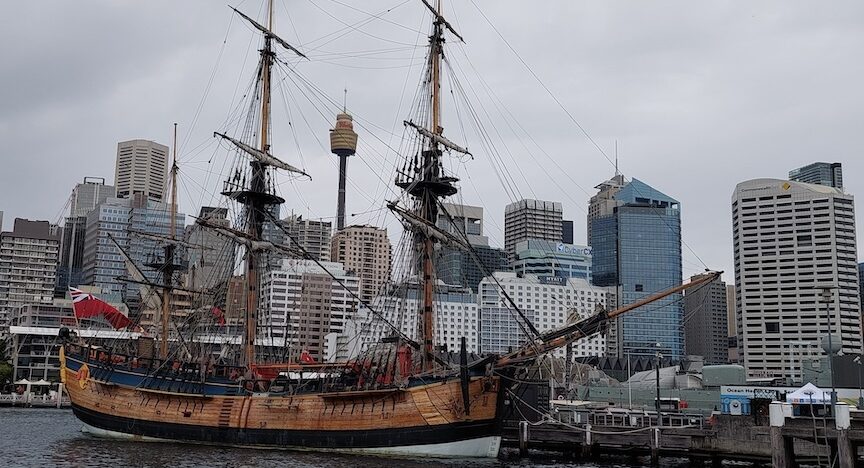
Walking aboard the replica of HMS Endeavour at Sydney’s Australian National Maritime Museum felt like I was slipping into another century. I had to duck beneath low wooden beams and squeeze through narrow passageways , which instantly gave me that sense of being hemmed in. Only after walking through the 18th Century research vessel did I realize, how constricted life must have been for the 94 sailors, officers and scientists who spent more than three years at sea.
The Great Cabin was really the eye opener. Even though it’s called that, it’s a surprisingly small space, with a central table and very tight sleeping nooks. It was there that Captain James Cook worked side by side with the botanists Sir Joseph Banks and Daniel Solander, jotting down plants, animals, and the outlines of coastlines they encountered. Standing in that spot, I could almost see maps laid out across the table while the scientists carefully documented their findings. It was one of those historical moments that made the stories I had read through East West News Service feel much more real and less like something I just skimmed.
Following Cook’s Australian Journey
Cook’s first voyage, from 1768 to 1771, had a long-lasting impact on Australia. In 1770, the Endeavour charted Australia’s eastern coastline, stopping at 14 locations over four months. At Inscription Point in Botany Bay, I stood near the commemorative monument overlooking the shoreline and wondered how different that landscape must have looked to Cook and his crew.
The expedition wasn’t only about finding new land. Cook had been tasked with observing from Tahiti the transit of Venus. It was a major astronomical event used to help scientists estimate the distance between Earth and the Sun. And at the same time , he was searching for the southern continent that people during that period were sure existed.
The Voyage That Nearly Ended
One of the more tense chapters occurred in June 1770 near what’s now Cooktown, when the Endeavour ran aground atop the Great Barrier Reef. The crew worked like crazy to keep the ship afloat , throwing nearly 48 tons of equipment overboard, including cannons and ballast.
Learning about the incident while seeing some recovered artifacts made the whole story come to life in my imagination. The vessel was eventually repaired along the Endeavour River ,where the crew remained for seven weeks. If the ship had sunk, Cook’s maps, along with the botanical collections from Banks and Solander, could have vanished with it.
Cook’s Story Beyond Sydney
In Melbourne, I visited Cook’s Cottage in Fitzroy Gardens. It was originally built in England by Cook’s father, then later dismantled, transported to Australia, and reconstructed here. The rooms are modest, with a fireplace, some older furnishings and a simple bedroom—so it offered a more personal lens on Cook’s life away from the sea.
Sydney also keeps his legacy alive through statues, museum items and historical records. At the Australian Museum, objects from Cook’s Pacific voyages give yet another view of how extensive his travels really were.
Remembering a Complicated Legacy
What stayed with me most was that Cook’s story can’t be fully understood only by studying the headlines of his explorations. After his voyages came European colonization. The mix of alien ethnicities brought disease, displacement, and a huge disruption to Indigenous communities. The Australian National Maritime Museum is increasingly acknowledging these perspectives, alongside Cook’s navigational and scientific achievements.
By the end of my trip, Cook felt less like a name that was stuck in a textbook, and more like a real person whose journey you can still follow through Australia’s landscapes, coastal waters and museums. It left me with a more layered sense of “adventure” and a deeper understanding of the consequences imbedded in historical travelers’ tales found in the East-West News Service’s fascinating travel news articles.