

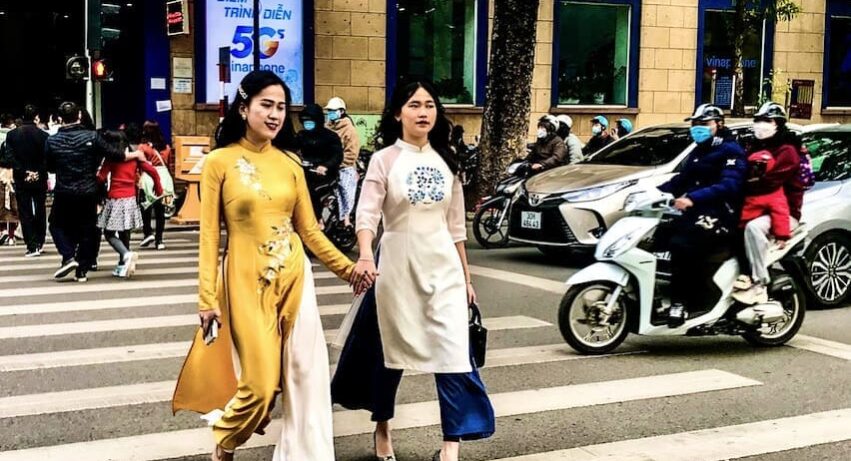
The Áo Dài has long showcased Vietnam’s colorful history and heritage, solidifying its status that it’s more than just a dress.
As someone who now calls Vietnam “home,” I’m fortunate to be surrounded by stunning visual sceneries each day. One particular sight that stands out is the view of Vietnamese women strutting in their charming áo dài dresses. Like the Japanese kimono or the Chinese cheongsam, the áo dài is truly representative of Vietnam’s unique fashion and feminine style.
It has the perfect balance of accentuating the female form while managing restraint with its traditional design of concealing bare legs and arms. Truly, it is at once marvelously modest yet incredibly provocative.
The garment’s name is pronounced differently depending on where you’re at. In Southern Vietnam it is pronounced “ow yai,” while in Northern Vietnam and in Hanoi, they pronounce it as “ow zhai.” There’s also a storied past as to why the áo dài has evolved differently from these two regions, which we’ll explore more in this Asia Pacific travel article that showcases one of Vietnam’s most splendid cultural treasures.
Unraveling The Áo Dài’s Roots
When the áo dài first made its foray, it was actually far from being fashionable. The apparel was first designed for functionality, with features like a simple appearance, baggy fits, and loose garments. This was in keeping with the style of the times from the ancient Champa empire who ruled in central and southern Vietnam in the 2nd to the 17th century CE.
Nguyễn Phúc Khoát, a famed warlord who conquered southern Champa, wanted to distinguish his kingdom’s cultural identity from that of his rival lords in northern Vietnam, where their dresses consisted of a four-panel tunic that made sure to cover the woman’s legs. To differentiate from this, Nguyễn Phúc Khoát dressed his courtiers in flowing gowns over loose trousers, then gave it the name, áo dài. And so, the iconic garment was born.
When French colonizers captured Vietnam in the mid-19th century, they greatly influenced the culture with its own culinary tastes, city planning, and a new awareness for style. Instrumental in this shifting era of Vietnamese fashion was Nguyễn Cát Tường, a daring designer who wanted to infuse contemporary French styles into the áo ngũ thân, a five-panel gown that was customary of the time.
Tường designed a sleeker, form-fitting áo dài that accentuated the female shape rather than hiding it under flowy garments. Adjustments were made to the sleeves, collar, and waistlines, giving the áo dài a more defined shape. For a time, this version of the áo dài was all the rage. Sadly, in 1945, when the Communist Party emancipated Vietnam from French colonization, Tường was among those who were never heard from again.
A Lasting Legacy
Thankfully, his redesign of the áo dài didn’t disappear. In fact, it only kept evolving from then. Prominent feminist figures like first lady Trần Lệ Xuân and vice president Nguyễn Thị Bình both popularized this apparel by wearing it during important historical events.
While it hasn’t been smooth sailing, especially during the stricter Communist regime, the áo dài has definitely gone a long way now, thanks to a growing free-market economy and Vietnam opening up to international tourism. Asia Pacific travel recommendations, in fact, always lists Vietnam as one of the top destinations in this side of the world.
And daily life in this marvelous country now features the beautiful sight of attractive and confident Vietnamese women who go about their day draped in various styles and designs of the iconic áo dài.