

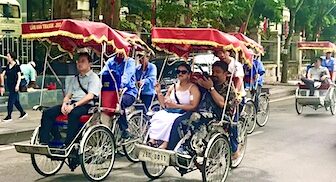
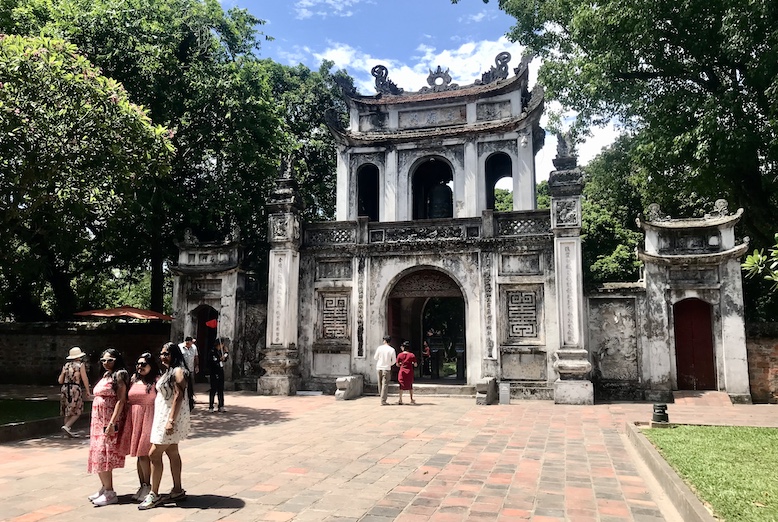
Once only royalty and aristocrats used the central portal of the ornate entrance to the 11th-century Temple of Literature. Students were welcomed on either side as they passed through on their way to the Imperial Academy, Vietnam’s first national university. Photo by John Gottberg Anderson
No other city in Southeast Asia has a neighborhood like Hanoi’s Old Quarter. Not Saigon, Not Bangkok. Not Singapore nor Jakarta. Only in Hanoi, Vietnam’s bustling northern capital, are the buildings packed so tightly that even rain is challenged to find a way through the gaps. Weathered wooden homes that defy centuries squeeze in next to ancient stone temples, where unseen spirits perhaps offer protection beneath their red-tile roofs.
As far back as the fifteenth century, this urban core was surrounded by a sturdy stone wall with few points of entry. The original east gate, an arched portal framed by gray stone and discolored brick, still leads to a matrix of streets that follow much the same pattern as they did long ago. Some of the ancient architecture persists, even as new buildings are gradually phasing out the old. Many historic homes now have shops or cafes on their ground floors, with laundry hanging from wrought-iron railings outside the landings of residences above.
Craftspeople once organized guilds to market their skills: Birds of a feather flocked together. The tin workers’ guild, for example, produced candlesticks and opium boxes. There was a guild for rattan baskets, for silk clothing, for conical nón lá hats, for copper crafts, for medicinal herbs. Bamboo raft builders and sailmakers set up on adjacent lanes near the Red River. Today the occupations are different, but you might find a jewelry street, a plumbing fixtures street, or a musical instrument street.
Along byways that lead in all directions, street food vendors set up shop from morning to late night. Seafood — notably, a bewildering range of snails (ốc) and shellfish — is especially popular, served grilled, steamed or simmered in rich noodle soups. As day becomes night, attention turns to the central blocks of Phõ Tà Hiên. Open-air restaurants fill both sides of this narrow lane with tables and chairs until the wee hours.
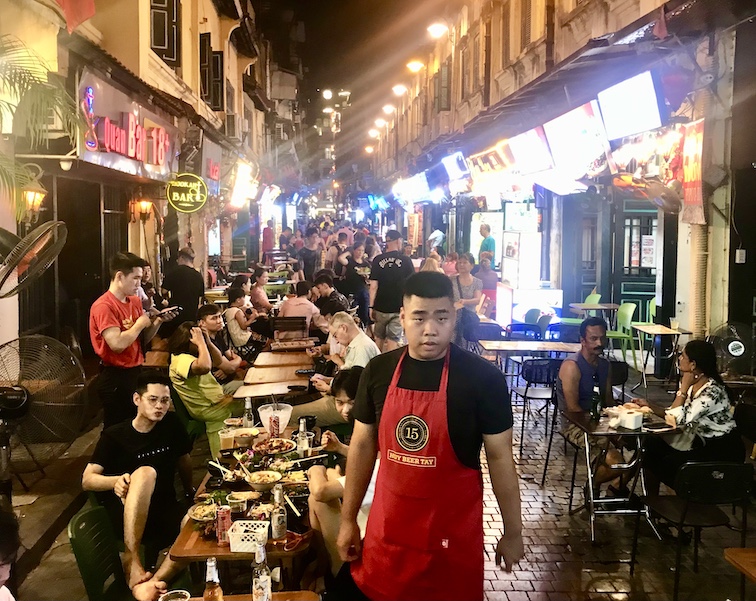
After dark, the busiest lane in Hanoi’s Old Quarter is Phõ Tà Hiên, where restaurant owners welcome international guests to enjoy local cuisine and beer well into the night. Seafood is especially popular, served grilled, steamed or simmered in rich noodle soups. Photo by John Gottberg Anderson
Prayers were once offered at the Hương Tượng temple, built to honor the patron saint of the original city of Thăng Long (“rising dragon”), combining elements of Taoism, Confucianism and Buddhism. At the heart of the nearby Bach Mã temple is a statue of a white horse, fabled to have carried founding Emperor Lý Thái Tổ to this very spot in 1010. Today his city walls have mostly been replaced by a seemingly endless stream of motorbikes zooming past, making clear this is the 21st century.
Beyond Confucianism
Hanoi in the 21st century is not the same city it was a millennium ago. The metropolis of 9.4 million, hub of bureaucracy and education in a nation of 100 million, is still facing challenges, half a century after it spurned westernization to embrace communism. The “Doi Moi” economic reforms of 1986 reintroduced private business ownership and free-market incentives, a giant step back from collectivization of agriculture and industry, while encouraging foreign investment.
“Some would say we’re now packing the worst aspects of communism and capitalism together,” said Harry Ngo, a Ho Chi Minh City-based consultant. “In fact, although we have a one-party Communist government, it’s not really communist anymore. It’s more like market socialist.”
Contemporary Vietnam is a magnet for Asia-bound travelers. Supported by a well-oiled tourism infrastructure, its spectacular scenic and historic attractions drew more than 20 million international visitors in 2025, surpassing pre-pandemic numbers. The growth is continuing in 2026 despite economic hardships caused by Mideast tensions. The government in Hanoi wants the boom to continue, even if that means pandering to capitalist investments.
“There are accusations of the party sucking up to the corporations,” said Ngo, acknowledging a decidedly un-communist economic division between wealthy Vietnamese and everyday small-business owners. “I think the government is hopeful of a trickle-down effect in the long term. But as the GDP and economy continue to rise, the (ruling) party has a lot of support. It’s reasonable to expect we can be a regional economic power by 2050.”
Hanoi carries a mandarin veneer reinforced by Confucian philosophy, reflective of its ancient history. In the formative years of modern Vietnam, between the 1950s and 1970s, the north was much more receptive to communist thought than the republican south. Indeed, Hanoi and steamy, subtropical Ho Chi Minh City, the former Saigon, are as different as two sisters can be. Located on the fringe of the Mekong Delta, Ho Chi Minh is Vietnam’s bustling and frequently frantic center for international business and industry.
But weighty decisions are made in stately, sedate Hanoi, with its picturesque lakes and four-seasons climate. Here, education has been paramount ever since the Imperial Academy, Vietnam’s first national university, was established more than 1,000 years ago.
Morals and education
Today the academy is incorporated into the Temple of Literature. It serves as a perpetual reminder of Confucian values — that moral integrity, learning and academic excellence should be prized above all else. A Confucian shrine was built here in 1070. Six years later, it incorporated the Imperial Academy. At first serving only the royal family and aristocrats, this institution later opened to brilliant students from across the country.
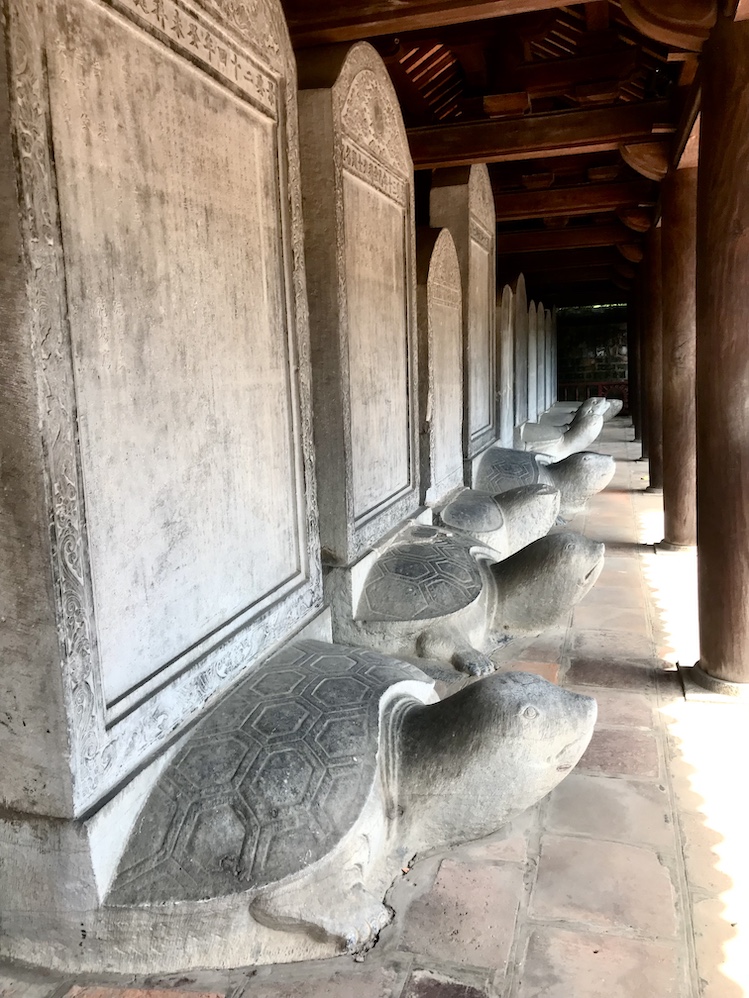
Eighty-two stone monuments, carried on the backs of turtles, honor royal scholars from the 15th to 18th centuries. Contemporary students still visit the main Confucius shrine of the Temple of Literature to pray for success in their exams. Photo by John Gottberg Anderson
Today the Temple comprises five interlocked compounds. Visitors enter through an ornate gate and pass through a serene garden whose paths wind around lotus-filled ponds. Rising above its far end is the two-story Khue Van Pavilion, built in 1805 (and pictured on the modern 100,000-dong banknote). Through another gateway stands an acclaimed assemblage of 82 stone monuments carried on the backs of turtles: doctoral steles honoring royal scholars from the 15th to 18th centuries.
In the elaborate main sanctuary, altars are dedicated to Confucius and his disciples. Traditional red columns and carved beams loom over students who come to pray for success in their exams. The fifth and final courtyard was once the venue for imperial examinations and royal ceremonies; it contains the reconstructed Thai Hoc House, focus of the Imperial Academy. Statues and altars honor kings and other champions of education.
But some Hanoi residents say the 21st-century government has forgotten the nation’s philosophical roots. “Education and medicine are the most important things, but they are only talk to this government,” said a local business owner who asked to remain anonymous for fear of reprisals. Make no mistake: Despite the occasionally liberal leanings of its economy, Vietnam remains a conservative, autocratic state whose leaders tolerate no expression of dissent.
While Hanoi treasures its past, from the Old Quarter to the mausoleum where Ho Chi Minh’s mummified cadaver lies in state, the metropolis is unapologetically looking to the future. And that may require some diversion from the lofty idealism of its founders, communist as well as imperial.
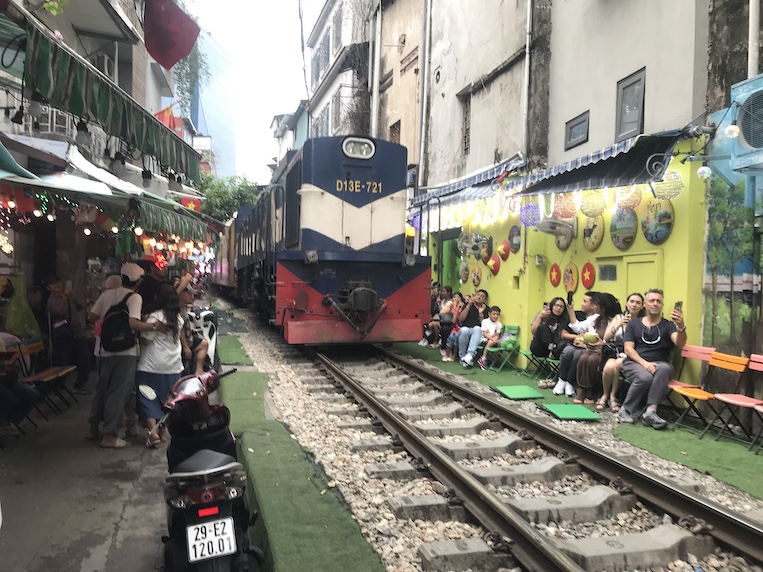
There are at least two different locations in Hanoi where, several times daily, commuter trains put the froth on cappuccino drinks at makeshift coffee shops. Although both venues are nicknamed “Train Street” for obvious reasons, no casualty figures are available. Photo by John Gottberg Anderson
The price of progress
Board a taxi from Nội Bài International Airport, and you see it immediately in the massive new highway construction extending 20-plus miles to the city center. You see it in the rapid rise of residential towers in suburban neighborhoods, and in the (some say frivolous) construction of a new lakeside opera house, its estimated price tag exceeding US$483 million. “You could build 10 high schools and three hospitals with that money,” said the unhappy businessman, shaking his head.
Designed by famed Italian architect Renzo Piano, the Hanoi (Pearl) Opera House will become an immediate landmark on West Lake in the Tay Ho district. Its unmistakable dome, said to mimic a giant oyster shell, will have an incandescent coating to suggest mother-of-pearl. Construction began this year, with completion expected in 2027. It will be home to Vietnam’s first private symphony orchestra as Hanoi seeks to position the city as a global cultural capital.
And not only culture: Sport, as well. Further from the center, the 135,000-seat Trong Dong football (soccer) stadium, already acclaimed as “the world’s largest,” is under construction. Work on the stadium, designed to resemble a traditional bronze drum, began in February, a few weeks before the U. S. and Israeli attack on Iran increased global energy and transportation costs.
Together with the surrounding Olympic Sports City development, future home to as many as three-quarters of a million people, this project carries a projected price tag of US$38 billion — all financed by Vingroup. There’s been no slowdown in construction. A privately owned conglomerate with headquarters in Hanoi, Vingroup is the nation’s largest real-estate developer and the manufacturer of VinFast electric cars, Vietnam’s only domestically built automobile.
Another cluster of satellite cities in the Red River Valley is not far behind. The science-and-technology center of Hoa Lac will be the largest of five planned urban centers, 50 to 60 miles from Hanoi. It is projected that by 2045, fewer than 20 years in the future, this will be a city of research centers, universities, artificial intelligence, application and technology transfer.
Part of the infrastructure will be provided by a US $67-billion high-speed national rail system that will begin construction next year, with completion projected for 2035. And perhaps to appease the local market, another train line will reduce the three-hour journey to tourist-favorite Ha Long Bay to just 30 minutes.
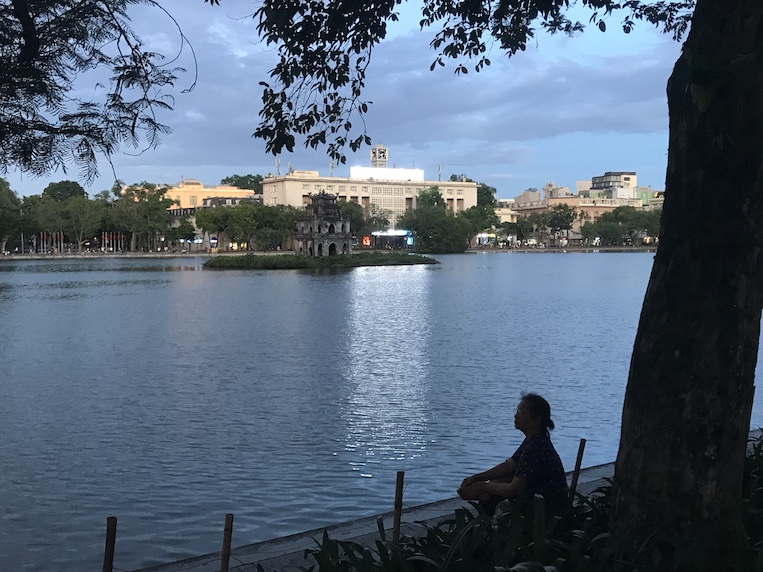
Hoàn Kiếm, the “Lake of the Restored Sword,” invites twilight meditation. According to folklore, ancient Emperor Lê Lợi bequeathed his magic sword to a golden turtle who had helped him to defeat the armies of China. Large turtles sometimes cluster on a small island where the 19th-century Turtle Tower stands. Photo by John Gottberg Anderson
But through all this high-profile growth, Vietnam’s domestic economy continues to struggle. Wealthy, state-favored industrial giants like Vingroup and Viettel rarely interact with the smaller businesses that represent 95 percent of the country’s companies. While Communist Party officials push for 10 percent annual growth, the government leans on big projects to make up for potential economic slowdowns caused by American tariffs and the Iran war, writes Damien Cave of The New York Times. Vietnam welcomes factories from foreign investors. Samsung, for instance, recently said it plans to invest about $1.5 billion in a semiconductor testing facility north of Hanoi.
Hanoi’s heart and soul
Much of this change, however, isn’t visible to the typical foreign tourist, who may spend only a few days in Hanoi’s central city area. Outside of the Old Quarter and a day trip to Ha Long Bay, a new arrival will marvel at the beautiful colonial-era buildings of the French Quarter, embrace visits to several outstanding history, art and cultural museums, and depart with rich memories of lakeside promenades and temples.
The heart and soul of Hanoi is Hoàn Kiếm, the “Lake of the Restored Sword.” Immediately south of the Old Quarter. The oblong lake is encircled by a delightful walkway that takes only about 20 minutes to circumambulate if you don’t stop along the way. But, of course, everyone stops. There are fresh fruit vendors and tour-bus stops at its north end, flower gardens and coffee shops around the lakeshore. There are statues and monuments.
Folklore says that a 15th-century emperor, Lê Lợi, was boating here when a golden turtle surfaced and requested his magic sword. The monarch was outraged until he recognized the terrapin as a divinity who had come to reclaim the sword that had been lent him to fight and defeat the armies of China’s Ming Dynasty. Large soft-shell turtles of an endangered species are still sometimes seen on a small island near the center of the lake, where the three-story 19th-century Turtle Tower stands.
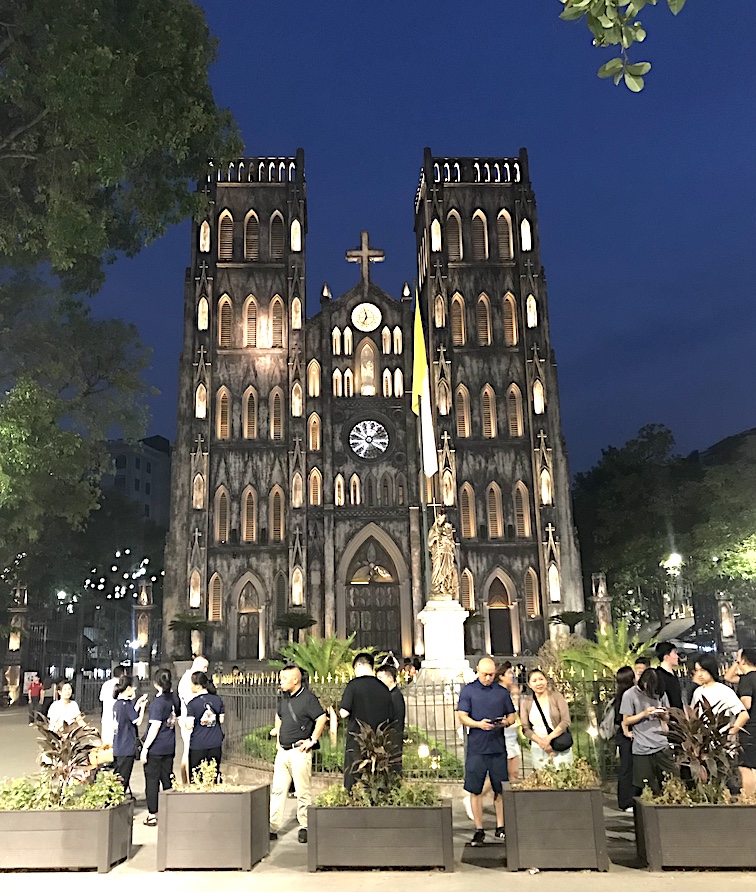
St. Joseph Cathedral, built by French colonists in 1886, towers above a small urban plaza just west of Hoàn Kiếm Lake. The twin bell towers of the Neo-Gothic building are illuminated by muted green and blue lights after dark. Photo by John Gottberg Anderson
Around the northeastern lakeshore, especially during holidays, scores of women of all ages are festively dressed in traditional áo dài, signature costumes of the Vietnamese people. A long, split tunic that sets the standard for formal dress in this nation, it is especially popular in times of merriment. And in Hanoi, there are few better places for celebration than Jade Island, with its 18th-century Đền Ngọc Sơn temple linked to the shore by a bright red wooden footbridge known as the Bridge of Morning Sunlight.
Elsewhere in the Hoàn Kiếm district is the St. Joseph Cathedral. Built by the French in 1886, the Neo-Gothic building towers above a small urban plaza, its twin bell towers illuminated by muted green and blue lights after dark. And Hanoi’s best Italian restaurant is situated in its shadow. Leonardo Fazioli, the owner of Mediterraneo,once offered sailing charters on the Adriatic Sea. He landed in Vietnam three decades ago, and today he offers all manner of cucina Italiana, from roast boar to pannacotta, to an appreciative clientele that (not surprisingly) tends to be European.
Many other excellent restaurants serve contemporary or gourmet Vietnamese food. At the Cầu Gỗ bistro, I enjoyed a midday meal of a beef-and-banana flower salad with spring rolls and a lake view. Bun Cha O Ba Ma, where former US President Barack Obama famously ate, is a cult classic. Coffee and pastry shops abound.
Within a short walk of the cathedral is the Hoa Lo Prison Museum, nicknamed “the Hanoi Hilton” during the American War. It includes a special acknowledgment of the late U.S. Senator John McCain, a former naval aviator prisoner who returned here decades later to promote improved American-Vietnamese relations.
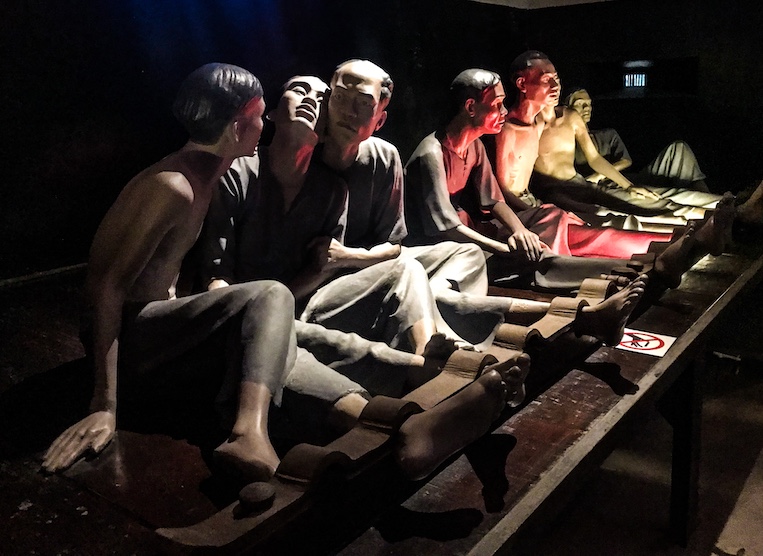
Graphic models of detainees at the Hoa Lo Prison Museum are reminders of the desperation they must have felt. Nicknamed “the Hanoi Hilton” during the Vietnam War, its inmates included the late U.S. Senator John McCain, a prisoner who returned here decades later to promote improved American-Vietnamese relations. Photo by John Gottberg Anderson
Patriotism and preservation
Hanoi’s Ba Đình neighborhood is dominated by the green expanse of the Ho Chi Minh Mausoleum Complex. Free of vehicular traffic, cloaked with botanical gardens, it can easily take a full day of exploration in its own right. Apart from the mausoleum with Ho’s mummified remains, structures include a fine museum, a historic pagoda, and a tiny village where Uncle Ho lived from 1954 until his death in 1969.
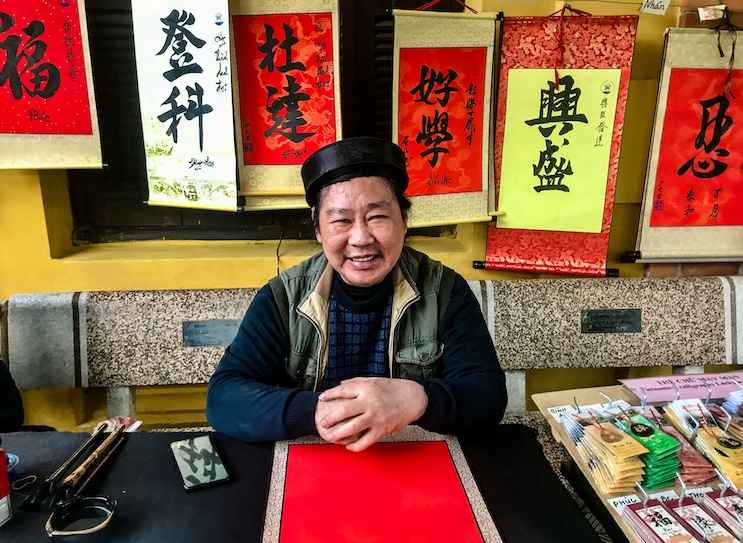
A calligrapher at the Ho Chi Minh Mausoleum Complex encourages visitors to purchase a hand-painted scroll bearing a Confucian mantra such as “prosperity,” “wisdom,” or “persistence.” An ancient belief system, Confucianism’s commitment to reverence for one’s elders meshes easily with communist ideals. Photo by John Gottberg Anderson
It’s the mausoleum that people come to see. Groups of patriotic Vietnamese venture from all over the country to honor Hồ Chí Minh (1890-1969), the political mind behind modern Vietnam, known to many merely as Bác Hồ (“Uncle Ho”). Although the man himself had requested a simple cremation and a scattering of his ashes, his body has been preserved in this grand marble tomb, his glass sarcophagus set deep within a maze of well-guarded stairways and corridors.
Pilgrims march a long, covered walkway from the gatehouse, serenaded en route by video performers singing patriotically of the greatness of the socialist republic of Vietnam. The path eventually leads to the grand mausoleum, where an honor guard dressed in royal white usher visitors inside with a stern “no talking, no photography” warning. A series of dimly lit stairways climb to the chamber where Bac Hô himself is laid to rest, under the watch of many more guardsmen.
I found Uncle Ho waxen, flaxen, as thoroughly embalmed a cadaver as I’ve ever laid eyes upon. The yellowish-gray hue of his skin looked unholy for a man who is revered as a god. I was fascinated. I’d like to say he looked pretty good for a guy who’s been dead for 57 years, but he really didn’t. I wanted to linger for long minutes staring at a scene befitting a Guillermo del Toro movie. The guards were having none of that. Keep moving, they said. Do not stop. I spent no more than 30 seconds with the man, or, rather, the corpse of the man. I think it will haunt me forever.
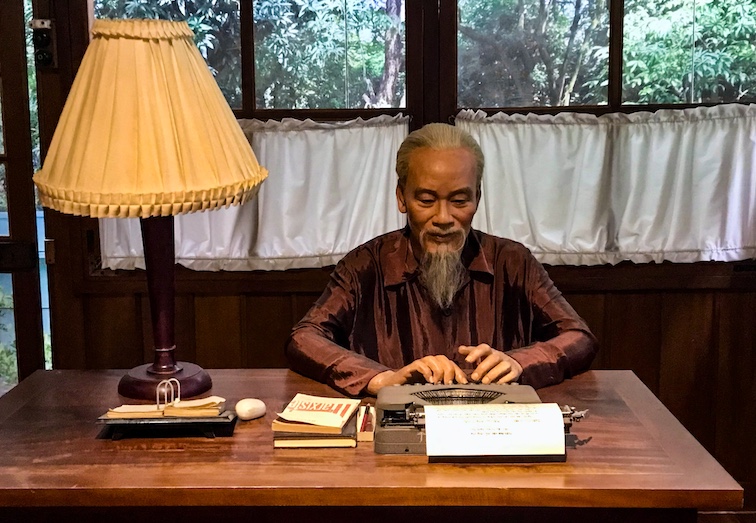
“Uncle Ho” lives on at his stilt house, in a private village surrounded by botanical gardens within the mausoleum complex in Hanoi’s Ba Đình district. A wax model depicts him working at an old manual typewriter in the simple home where he lived from 1954 until his death in 1969 at age 79. Photo by John Gottberg Anderson
No other city in Southeast Asia has a tourist attraction that is even vaguely like this one.
John Gottberg Anderson resides in Southeast Asia and has recently written about Northern Thailand’s elephant sanctuaries and the impact Chinese tourists are having on Laos’ old Royal Capitol of Luang Prabang.