

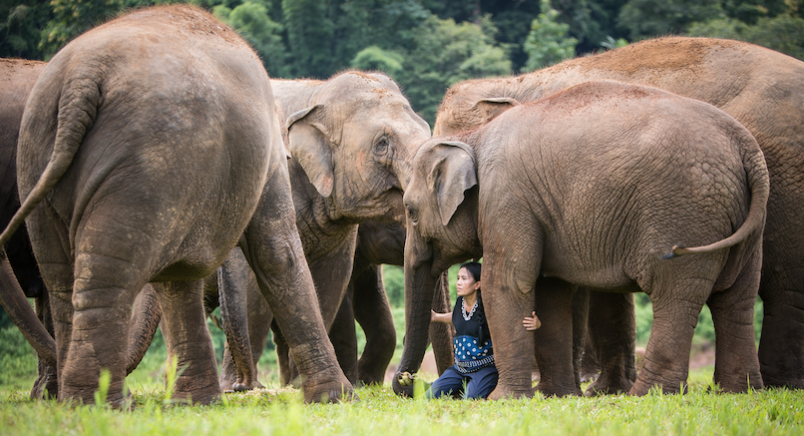
I showed up in northern Thailand hoping for misty mountains, old-school temples, and, loud colorful markets. But honestly what I didn’t see coming was that my most memorable interactions would happen a few feet from rescued elephants. Those calm moments, far from the usual, staged tourist setups, made me rethink wildlife conservation in a way I wasn’t ready for. And sure it might not sound “wow” on paper, but it felt deeply real, which is rare, so yeah it deserves a spot in every Global travel destination article.
Meeting the Gentle Giants
My first stop was Krieng Krai’s Karen Elephant Home in Mae Wang , tucked in a peaceful valley about a couple of hours from Chiang Mai. The minute I met Kham Meun and Dodo, two young Asian brother elephants, I automatically tried to keep some space. Kham Meun only had one tusk, from an accident years back at a trekking camp, while Dodo had two smaller tusks. Still, for all that size they didn’t seem interested in anything except the bananas I was holding. Within minutes my nerves eased, because their trunks reached toward me, slow and careful, like a reminder that these animals can be powerful and gentle at the same time.
The Karen People ’s Lifelong Bond with Elephants
The Karen community has lived alongside elephants for generations. Once, these animals moved teak logs through forests, and even showed up in battles, but today their life is thankfully different. With wild Asian elephant numbers dropping to fewer than 50,000 across 13 countries, conservation isn’t just “nice to have” anymore, it’s crucial.
Krieng Krai, together with his wife Phatbun, cares for three elephants: Kham Meun, Dodo, and an adoptive aunt named Mae KaPha. The two brothers lost their mother, and Mae KaPha lost her own calf years ago. Somehow, bringing them together just sort of turned into a new family, and watching them graze, eat, and quietly trail one another, it made me think that elephants really do have emotional bonds, not only instinct.
Inside Elephant Nature Park
A few weeks earlier , I’d been to Elephant Nature Park near Mae Taeng. I spent a day with the founder, Saengduean “Lek” Chailert. She’s small, but her determination feels huge. Like it fills the air. Lek has spent her life pulling rescue elephants out of logging camps, abusive tourist setups, and circuses that treat animals like props instead of living beings.
Growing up in northern Thailand , she saw the heavy loads elephants were made to carry. It shaped her views of the animal kingdom and convinced her to create the Elephant Nature Park, and later the Save Elephant Foundation. Today the sanctuary is home to around 120 rescued elephants, plus hundreds of dogs, thousands of cats, and a few other rescued animals too.
What caught me off guard was how it didn’t feel like typical elephant places. No rides, no performances, no forced “interaction”, no standing there ,while someone tells you where to look. People are basically just observing while the elephants roam freely, and at the same time learning about their rough past. It felt less like something you check off , more like a space made from respect.
Small Moments That Stay Forever
One rainy afternoon , I walked with Lek through muddy trails to meet a young elephant named FaaMai. When she moved closer , with her family in tow , each elephant greeted Lek by touching her with its trunk. It wasn’t dramatic at all, more like a soft, Hello moment, but it stayed in my head. Lek just smiled and said, “We give them a family.” At the time it sounded straightforward, yet after seeing the bond unfold, I finally got what she meant.
The sanctuary runs because of locally-based mahouts , veterinarians , volunteers , and nearby communities, all doing their part. During the pandemic, the Save Elephant Foundation even helped provide food for nearly 2,000 elephants across Thailand. That’s an enormous task, since each elephant can eat around 600 pounds of food every single day. Lek is also working toward an even larger dream: a forest sanctuary where elephants can roam with no disruptions, and visitors observe from raised walkways, without interrupting them, not once.
Leaving With a Different Perspective
My last afternoon at the Karen Elephant Home was surprisingly easy and quiet. I sat around rice terraces and forested hills, watching Mae KaPha, Kham Meun, and Dodo settle into a feast of pumpkins, bananas, cucumbers, corn, and watermelon. Later, from an observation platform, the two brothers noticed the bananas I was carrying and stretched their trunks out like they already knew what was coming. I gave them the bananas , and that was it.
When I left northern Thailand , I realized I wouldn’t remember it most for the scenery or the temples. It was those hushed moments with rescued elephants and the people who dedicated their lives to protecting them. Their story keeps repeating the same message, conservation isn’t about entertainment or getting the perfect photo, it’s about giving extraordinary animals dignity, they always deserved in the first place, and honestly it makes this journey fit right in with an Asia travel and cultural blog spirit.