

If you’re looking for a global travel destination article that goes beyond Colombia’s well-known cities, San Juan de Pasto offers an experience that feels, personal and out of the ordinary. I landed thinking I’d just have a quiet stop in southern Colombia. But I ended up leaving with scenes I can’t really shake, dramatic landscapes, centuries-old customs, and a city that kept surprising me over and over.
A shrine that feels like both a pilgrimage and a festival
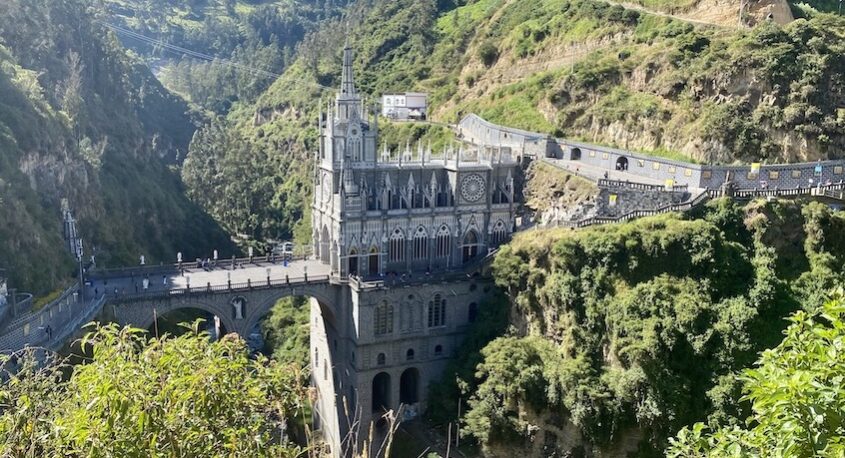
My trip kicked off at Las Lajas Sanctuary, which is one of Colombia’s major Catholic pilgrimage spots near the Ecuadorian border. As I made my way down the steep slope, I saw vendors selling rosaries, oversize lollipops in stripes, and handmade crafts. People were praying midway through, And yes, some folks were quite delighted to have their picture taken by a llama wearing a bright pink sequined hat. It honestly felt like faith, and the party side of life was in the same room.
The church itself is Gothic and rises right out of a canyon that’s spectacular. Locals say the Virgin Mary appeared there in 1754, so the place has this aura right away. Inside, stained glass windows show Marian apparitions from many places, and everything lights up with color. Outside, the plaques thank the Virgin for her intervention on their behalf. I took with me from there two figurines of guinea pigs that were dressed as a priest and a nun.
Discovering the unexpected side of Pasto
Once I got back to Pasto, it clicked why people call it both “the theological city” and “the surprise city.” The altitude is no joke; it sits around 9,000 feet, with the active Galeras Volcano right there nearby. Because of that, the weather stays cool, and the pace is noticeably relaxed, really laid back in a way.
Before arriving, I had heard so much about Colombia’s security problems, so I was a bit tense, There were people who advised me against wandering about on my own, but for the entire time I was there, nothing disturbing happened. When I was expecting to be under pressure, all I got was the reverse – police escorts, empty streets, and an ambience that contradicted my preconceptions.
Where carnival is more than a celebration
The Carnival Museum pretty much showed me Pasto’s biggest cultural event. It’s the UNESCO-listed Black and White Carnival. Inside the galleries, massive sculptures from past parades fill the space with mythical creatures, volcano-inspired figures, and bright animals. My favorite thing was a giant guinea pig wearing a feathered lion’s mane while it played a panpipe. Very weird, but in the best possible way.
I also learned how the festival works. The celebrations kick off with water fights, then Black Day comes in with black face paint to mark the liberation of enslaved people. After that, White Day follows, with clouds of white powder, which people describe as a symbol of equality, respect, and unity across the whole city.
A quick crossing into Ecuador
Just beyond the border, I visited Tulcán Cemetery, which is known for its amazing topiary gardens. The hedges are carved so carefully that they end up looking like angels and archways, geometric scenes, and even animals. Because of that, the cemetery feels almost cheerful, not gloomy, which is likely the opposite of what you’d expect in a place like this. Even the mausoleums seem to mirror the temperaments of the families buried there. In practice, it resembles an outdoor art exhibit more than a site of grieving.
Coffee , country , and the slowed-down pace of life
Another route that I enjoyed taking was to Laguna de la Cocha, the second largest inland lake in Colombia. After a peaceful ride on a boat, I discovered how the people make their coffee from the beans cultivated in the region using linen filters. Later, I went to a nearby family farm. The ducks were free-floating, the pigs dug about in the fields, and coffee made it to a farmhouse kitchen that was warm and sunny and airy. To be honest, it was the simplest moment on the entire journey and for some reason stuck with me the most.
A city that knows its history
The deeper I explored Pasto, the more I understood its darker history. In 1822, during the Black Christmas massacre ordered by Simón Bolívar, hundreds of residents died after pushing back against Colombia’s independence movement.
I stood inside one of the city’s older churches, watching people pray quietly. And I couldn’t stop imagining what happened in the same walls, two centuries earlier. That story still feels alive in Pasto, like it’s part of everyday memory.
A modern twist before leaving
Bellatriz was my final destination – a health tourism site specializing in cosmetic surgery and dentistry. It seemed odd to end this trip with an emphasis on churches, volcano viewing, and history. But that is exactly what makes it unique. Pasto is changing little by little, while still holding on to its traditions tightly.
When I look back, Pasto never tried to impress me with only famous landmarks or polished tourist spots. Instead, it revealed itself slowly through people, stories, and little everyday scenes. It’s the place that follows you after you go, and it honestly deserves a spot in thoughtful travel news articles features highlighting South America’s lesser-known corners.