

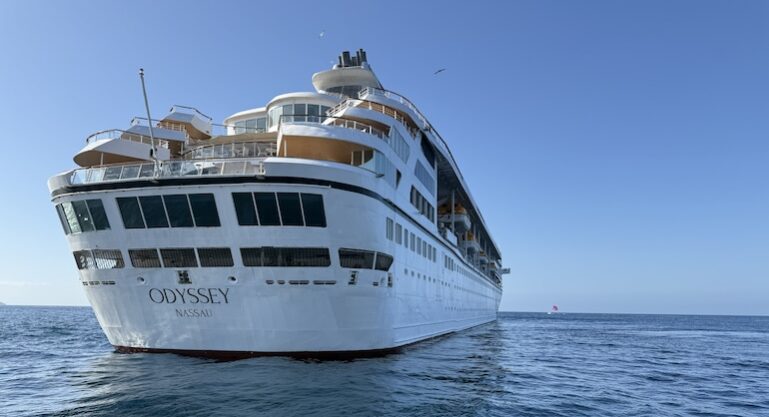
When I stepped onto the Villa Vie Odyssey, anchored off California’s Catalina Island, I expected that gleaming, polished luxury vibe, plus all those wealthy retirees, you know. But, yeah, what I saw was a lived-in ship, not some staged dream. There were software engineers, entrepreneurs, retirees, and even families with school-age children—people who basically swapped normal homes for life at sea. It didn’t feel like a cruise so much as moving into a neighborhood that just happens to roam from one country to the next. For readers following trends through a Cultural and business news service online, communities like this highlight how travel, remote work, and modern lifestyles are reshaping the way people choose to live around the world.
One of the first residents I ran into was Katrina Howard, from New Zealand. She and her husband, Mark, sold their motorhome to do this after deciding it was the most budget-friendly way to see the world. And it’s not like the ultra-luxury residential ships where the price of ownership can be in the millions. On Villa Vie, the residences run from $129,000 to $399,000, and the monthly fee covers meals, housekeeping, laundry, utilities, and internet, plus a whole set of onboard perks. If you aren’t yet ready to commit to ownership, you can still book individual cruise segments.
Working While Sailing
The Odyssey is built more for long-term living than for quick getaways. There’s a business center, a medical clinic, fitness facilities, a library, pools, and satellite internet that actually holds up. So, residents can keep working while the ship visits 425 destinations across 147 countries and seven continents.
Mark, who’s a software engineer, works remotely from a private office onboard. Katrina, meanwhile, now helps introduce prospective residents to the community. What really stood out to me was that this experience mirrors the bigger shift, remote work is normal now, and technology has improved too, so full time life at sea feels practical, not like some unreachable fantasy.
More Than Travel—It’s a Community
The itinerary was fine , but what surprised me more was the people, I mean when I talked with residents, I noticed this really diverse group, pulled together by one shared itch: to travel in a different way.
Cindy and Jack LeConey joined the Odyssey on cruise segments first, before they went ahead and bought their own villa. Cindy told me that living onboard changed the way she sees things, by making her feel more intertwined with the wider world. She also admitted that, just like any neighborhood, the ship has different moods, and yeah there can be an occasional disagreement. Still, she said the friendships and that sense of belonging outweigh the awkward parts.
Even the residences seem to match the owners, some people keep it simple and personalize their cabins with artwork and family photos. Others merge multiple staterooms into bigger apartments, which end up feeling almost unexpectedly like home.
A Slower Way to Experience the World
Unlike regular cruises where you only get a few hours in each port, the Odyssey often stays longer—sometimes for several days, sometimes even weeks. Residents get actual time to wander beyond the waterfront, go inland or step off the ship temporarily and then return later at another stop. The pace by itself nudges cultural experiences that feel authentic, not just rushed, checklist-style sightseeing.
Even dining follows that same mindset. Executive Chef Victor Ferri builds menus around fresh ingredients sourced locally whenever the ship reaches port. Residents are encouraged to toss in suggestions, and a lot of the meals seem tied to where the ship is right then, so each stop becomes part of the onboard experience, not just scenery in the background.
A Different Way of Thinking About Home
When I left the Odyssey, I wasn’t really thinking about cruise ships anymore. I was thinking about how fast the ideas of home and work are changing. With dependable technology, more flexible careers, and a desire for travel that actually feels meaningful, people are building lifestyles that would’ve sounded unrealistic just a few years back.
Whether this whole approach becomes mainstream is still a big question, but it definitely gives a useful peek at the future of remote living. And honestly, it’s evolving angle that fits right into a Global Business Insights article or a cultural and business news service online, where travel, technology, and shifting lifestyles keep colliding more and more.
For a deeper exploration of this journey, read the full article: