

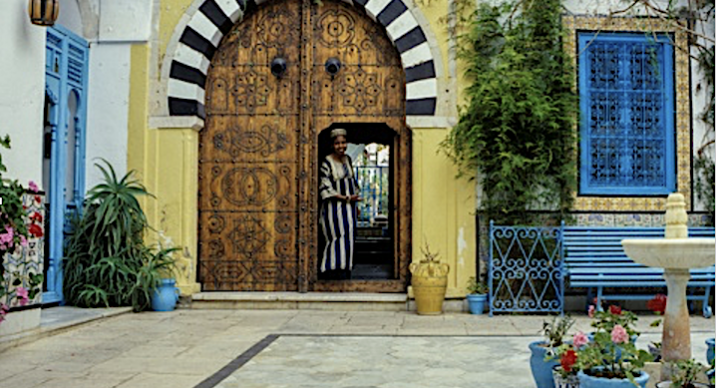
The first thing that caught my attention about Sidi Bou Said wasn’t so much the well known blue-and-white buildings. It was, honestly, the quiet. Not even a dramatic silence, just this steady hush that made everything feel paused. A short drive from the noise and bustle of Tunis, this hilltop little village seemed to have eased into its own flow, where sea breezes, narrow lanes, and centuries-old echoes sort of coexist. Looking out over the Mediterranean, toward the ruins of Carthage, I got why the place shows up so often in travel articles and “best destinations” articles. But when I visited the place in person, it seemed more real and connected than any of the stories I had read.
The city of Sidi Bou Said is named after Abu Said al-Baji, a renowned Islamic scholar. His tomb lies next to the minaret, overlooking the entire city. Way before the pilgrims started their journey up to this place, the Phoenicians used the very same site for their lighthouse. Standing there, I couldn’t help but picture all those layers stacking up beneath me—from the Roman destruction at Carthage to Crusader armies arriving and later the rebuilding of one of the Mediterranean’s biggest and most important cities.
Wandering the blue and white streets of Tunisia
I kept walking through those iconic lanes, past whitewashed houses sporting vivid blue doorways and ornate wrought iron windows, like I was just drifting. Everything looked surprisingly well-kept, and later I learned there are strict rules about the architecture so the village stays with its historic look. Still, it never feels overly curated or glossy, more like it has that slightly lived-in air. It feels used, in the sense that people actually inhabit the place, not just drop in for photos . A lot of residents commute back to Tunis during the day, then return each evening to the calmer hillside above the sea.
The climb is never fast, partly because the incline slows you down and partly because every few steps there’s always something you want to stop for. Local craftspeople had hand-painted ceramics, engraved metal trays, woven fabrics , and small souvenirs that felt more tethered to Tunisia’s Arab heritage compared to mass-produced tourist clutter. Then there were little food stops calling out with freshly fried Italian doughnuts called bamboloni, plus Turkish delight and nougat. I wound up lingering longer than planned, chatting with vendors and watching how people move through the narrow streets, almost without rushing, like the day itself asks them to slow down.
Halfway up, I sat on an old ceramic tiled bench that looked like it had made space for travelers for generations. It’s the small pause that rarely gets written into an itinerary, yet somehow it stuck to my memory anyway.
Cafés with Mediterranean views you can’t really fake.
Eventually, I reached Café des Nattes, tucked underneath the village minaret. It was a good, calm moment to slow down and have coffee before continuing the walk. Not far away sits Café des Délices, known for its wide views across the Bay of Tunis and out toward Carthage. The panorama really is impressive, though a couple of locals mentioned, very quietly, that the prices and the service don’t always stay in step with the scenery.
Before I left, I also stepped inside Dar Annabi, a preserved 19th-century mansion. It gave me a sense of the traditional upper-class Tunisian world. Nearby, Ennejma Ezzahra, once connected with French musicologist Baron Rodolphe d’Erlanger, now hosts Arabic and Mediterranean music through its museum and concert spaces.
A short journey into ancient Carthage
That afternoon slid naturally into nearby Carthage. Byrsa Hill gave sweeping overlooks over the old Punic Ports, and the Acropolium plus the Carthage National Museum added yet another layer to the region’s unusually deep past. Still, what stayed with me most was the Roman Arena, where Saints Perpetua and Felicity were martyred in AD 203. Even if very little of the original amphitheater is still there, standing inside the weathered ruins felt heavy in a way photos just can’t translate.
Why does Sidi Bou Said keep showing up in my mind?
When I finally returned to Tunis, it struck me that Sidi Bou Said didn’t remain memorable because of one single landmark. It was the blend—history, regular life, handcrafted traditions and those uninterrupted Mediterranean views—that made the village linger in my head long after I left. Some places hit you instantly. This one didn’t. It revealed itself little by little, along one quiet street after another, so that even now I feel it deserves to be mentioned in travel news articles, because it keeps earning attention, slowly, over and over.