

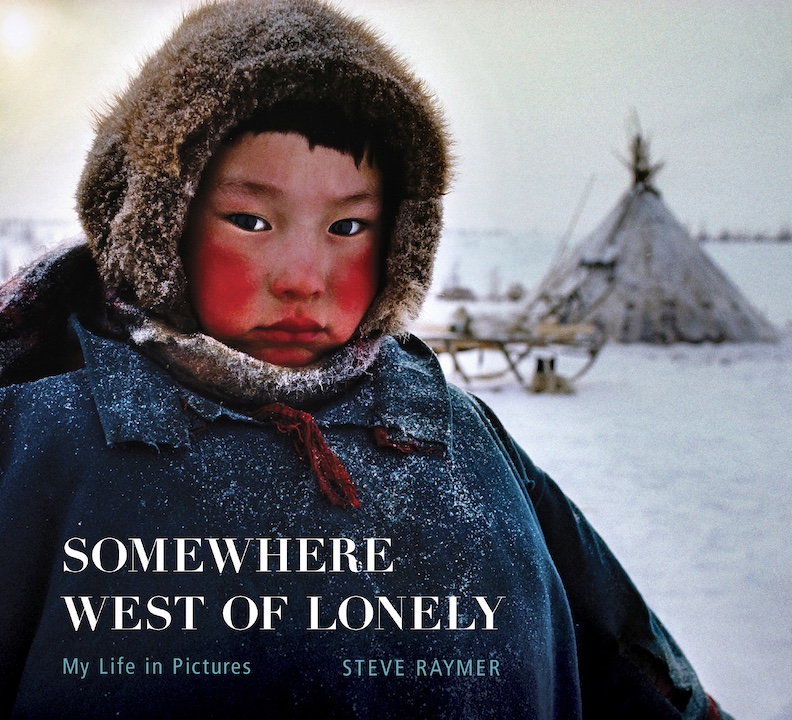
Somewhere West of Lonely: My Life in Pictures
Reviewed by Caroline Erskine
In the world of publishing, there are some books that fit into the world you inhabit — by work, or simply by life experience. You tend to see those books through a vision a little closer to what the author intended, aware of the small details that make a life in journalism so interesting and so consuming. Steve Raymer’s Somewhere West of Lonely: My Life in Pictures is one of those books.
Raymer’s career with the National Geographic ran from the early 1970s through the 1980s and 1990s into the new century — a period sometimes described as the golden years of photojournalism — especially for publications that were still acting as the eyes and ears of the world and not afraid to spend a few dollars to make it happen. The magazines had big budgets, pages to fill, and were fiercely competitive. That competition made its way down the food chain to the photographers themselves. Everyone wanted the cover, the double-page color spread, the exclusive. It was an exciting time, even though it was rare for anyone to make a lot of money.
The photographers who thrived in that era did it because they had to. They were driven to photograph, to tell stories with pictures, to follow the news, to relate the state of humanity.
There is a brief moment in the film Medium Cool, made at the time of the 1968 political conventions, when all hell is breaking loose and the cameraman says to no one in particular: “God! I love to shoot film!” It’s a line that probably makes no sense to anyone who hasn’t had tear gas sting their eyes or been stared down by a minder with that look that means wrap it up. But it captures something essential about the photographers who worked in Raymer’s era — and about Raymer himself.
In the opening pages of Somewhere West of Lonely, he describes his first Arctic assignment alongside National Geographic writer Bryan Hodgson, flying in a chartered helicopter over the Trans-Alaska Pipeline in temperatures well below zero, cameras fogging with frost, goose-down parkas making the cockpit feel claustrophobic. When Hodgson described the pipeline as looking like “a hair on a wedding cake down there,” Raymer doubled back over Prudhoe Bay at five hundred feet until he got the image. That level of dedication doesn’t come from a paycheck — it comes from passion.
Somewhere West of Lonely brings together 150 photographs from across more than four decades — famines in Bangladesh and Ethiopia, the Soviet occupation of Kabul, the Chernobyl disaster, the collapse of the USSR, extended stays in Asia, East Africa, India, and the American frontier. In each chapter, Raymer speaks about his subjects with a respect and understanding that is above all honest and forthright, making you feel that the photographs are part of a greater whole: a portrait of the world over the last forty years.
What sets this book apart from other photographers’ monographs is that Raymer — who is spending his time as a professor of journalism at Indiana University after his Geographic career — has gone out of his way to speak with the voice of a journalistic observer, someone for whom the truth of the story is sacrosanct. He emphasizes, correctly, that this is a book of pictures and text, and the text never fails to draw you in. His descriptions in words of what we are seeing are, in their own way, as captivating as the photographs themselves. Unlike so many photo books, the writing earns its place on every page.
When he documented the 1974 Bangladesh famine in color — rather than the stark black-and-white that many editors felt was the only appropriate register for tragedy — he won the Magazine Photographer of the Year award but also sharp criticism. He was accused of beautifying horror. He writes about this conflict openly, citing the aphorism of his former colleague Sam Abell: “Photography is truth; Photoshop is perfection.”
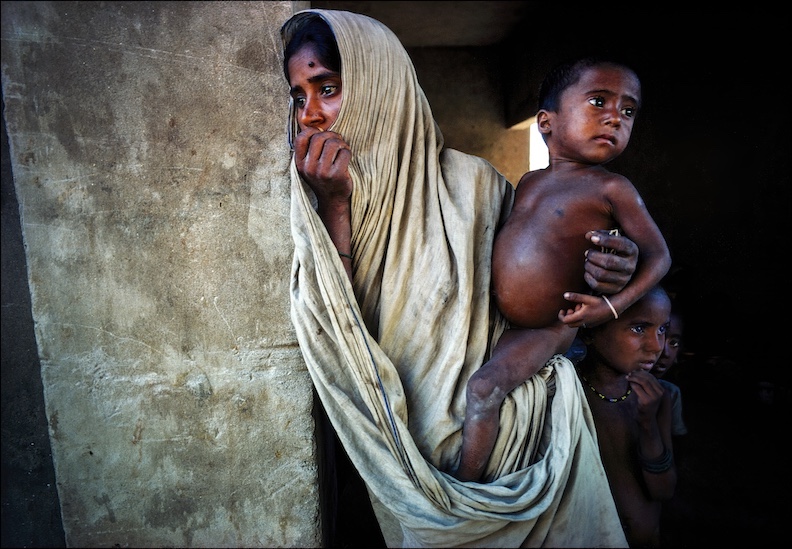
Ration card clutched in her left hand, a mother waits with her three children for powdered milk donated by the United States in Bangladesh during the 1974 famine. The child’s distended abdomen indicates severe malnutrition. Photo by Steve Raymer
He traces his debt to Henri Cartier-Bresson’s decisive moment, to Lewis Hine’s tradition of socially purposeful photography, to the hard-eyed mentorship of National Geographic photo director Bob Gilka, who hired him in 1972 despite Raymer never having published a color photograph. “We can make the pictures any goddamned color we want,” Gilka told him. “We’re hiring you for how you think and how you see the world.” Raymer has been passing those words on to students ever since.
One of National Geographic’s best-kept secrets was a small, self-carboning notepad on which photographers would write their captions in the field, often in great detail, so that, when edited, the captions would genuinely add to the sense of the picture. One can only imagine what those drawers full of Raymer’s notebooks look like after forty years.
The book’s title comes from a real place. In 1976, during that first Alaska pipeline assignment, Raymer and Hodgson flew west toward Lonely — a US Air Force radar station on the Beaufort Sea coast — when a fast-moving snowstorm shrouded their helicopter in a whiteout. The strip at Lonely was closed. Low on fuel, they set course for Deadhorse, 120 miles away, landing with the gauge hovering on the red empty line as the storm closed in behind them. Hodgson later coined the phrase “somewhere west of lonely” to describe the experience. A Geographic editor cut it. Raymer promised him he’d use it someday. Decades later, here it is — a title that works as geography, as metaphor, and as autobiography. “You don’t have to go to Lonely, Alaska, to feel lonely,” Raymer has said. “You’re away from your family and home for long periods of time.”
It would be hard to imagine that on that frozen February morning in 1976, hovering over the Arctic tundra with frost on his cameras and the fuel light glowing, Raymer knew that the name of a remote radar station would someday become the title of his memoir. But Steve Raymer, being the extraordinarily well-organized journalist and planner that he is, you never know. If you want a close-up view of what life — joyful challenges and frustrating pursuits — was like for a National Geographic photographer during the golden years of the craft, spending a little time Somewhere West of Lonely is not a bad start.
Somewhere West Of Lonely: My Life in Pictures
By Steve Raymer, Indiana University Press, pp 182
Caroline Erskine is a Syracuse University student studying magazine journalism. She specializes in culture, music and travel writing, and is currently interning with Peter Greenberg Worldwide.