

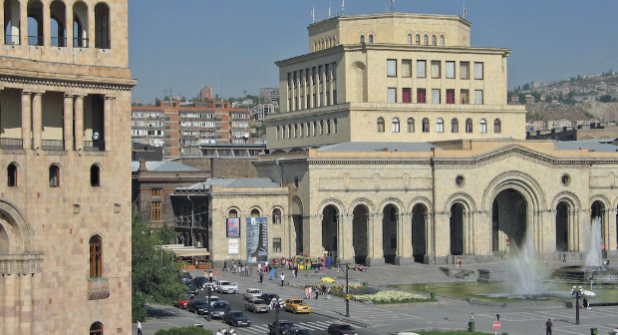
Standing in Republic Square, surrounded by elegant limestone buildings, fashionable cafés and the usual rush of city life, I had this strange idea, like maybe I was in almost any European capital. I wasn’t really sure. The architecture was grand, the mood was loud and active, and everything felt, well, sort of comfortably familiar. But within a few hours I realized I understood almost nothing about the place. Even the square’s distinctive pink and yellow stone facades somehow made me feel both comfortable and a little confused, like familiarity had a mystery hidden inside it. I had read a few travel news articles before arriving, but none of them quite prepared me for how layered and unexpected Yerevan would feel in person.
The Armenian alphabet was my first clue. Street signs, shop names, and public notices were written in characters I couldn’t decode. So, because I was curious, I went to the Matenadaran, Yerevan’s well-known manuscript repository. There, thousands of ancient texts opened up a whole civilization, and its story went back way further than I had imagined. The alphabet itself was created in by Mesrop Mashtots, the 5th Century Armenian theologian, and it still works like one of the clearest symbols of Armenian identity.
A city caught between different worlds
The more I wandered around , the more it felt like Armenia lives in a clashing between-space. At the Yerevan Museum of Folk Art I ran into carpets, ceramics, and embroidery that gave off these strong Persian notes. Elsewhere, you’d see Soviet-era apartment blocks and monuments, right there beside newer cafés and those freshly reworked public corners too.
Russian was spoken almost everywhere, and you couldn’t really ignore the little signals of the Soviet past. Yet somehow, the city still felt like it was pushing ahead, moving forward, in a calm, steady way. A lot of locals talked about relatives abroad, people who came back after independence, bringing money, ideas and a lot of fresh drive. With millions of Armenians living outside the country, the diaspora’s influence is visible in Yerevan at every turn.
Looking toward a mountain that isn’t “Armenia” anymore
One afternoon I climbed the Cascade, the city’s huge staircase, sculpture park and cultural complex. From the top, Yerevan spread out underneath me, framed by that unmistakable outline of Mount Ararat.
The most surprising bit, though, was when I learned that Armenia’s most cherished symbol is, in a sense, not really located inside Armenia. The mountain is across the border in Turkey, yet it still hangs right in the middle of Armenian history, identity and folklore. Almost everyone I talked to brought it up, in one manner or another, like it was obvious. And when I looked at it from Victory Park, it finally felt like I understood why.
The weight of history
No matter what you do, you can’t really visit Armenia without confronting its difficult past. At the Genocide Memorial and Museum, I spent hours reading accounts of the mass killings and deportations of Armenians during the Ottoman Empire in 1915.
It was sobering, and not in a distant way. Fresh flowers around the eternal flame made it clear this is not just history locked inside displays; it’s part of a collective, everyday memory. More than a century later, the loss still shapes how Armenians understand themselves and where they believe they belong in the wider world.
Following the roots of Armenian Christianity
Religion is another thread that shows up in almost every part of Armenian life. A bit of a drive from Yerevan and I ended up at Echmiadzin Cathedral, more or less the spiritual center, of the Armenian Apostolic Church. Armenia went with Christianity as a state religion in 301 AD, so it became the first Christian country in recorded history.
Once I was outside the capital, everything felt more real somehow, like it wasn’t only background, or scenery. At Garni I wandered through what’s left of a Greco-Roman temple that was meant for the sun god Mihr, and even if it wasn’t really hot, the stones gave this warmish feeling. A little further off, Geghard Monastery looked like it was rising out of the rock by itself, like it had always been there, not something erected recently.
But my most memorable stop was Khor Virap. Going down into that narrow underground chamber, where St. Gregory the Illuminator was said to have been kept for 13 years, felt unsettling, yet also oddly absorbing. It didn’t feel like I was just ticking off some tourist thing, more like I’d quietly slipped into a story that still has weight for the folks living nearby right now.
More questions than answers, though.
By the time I was done with the visit, Armenia didn’t feel unfamiliar anymore. What at first looked like a straightforward European capital turned out to be far more layered—a place shaped by old dominions, shifting borders, devotion, grief, and a stubborn sort of staying power.
And the longer I tried to understand it, the more complicated everything became. In many ways, that’s the biggest takeaway from this travel article. It wasn’t a single monument, mountain view, or historic site that stayed with me, but the realization that Armenia’s story is far richer and more complex than it first appears.
For a deeper exploration of this journey, read the full article: