

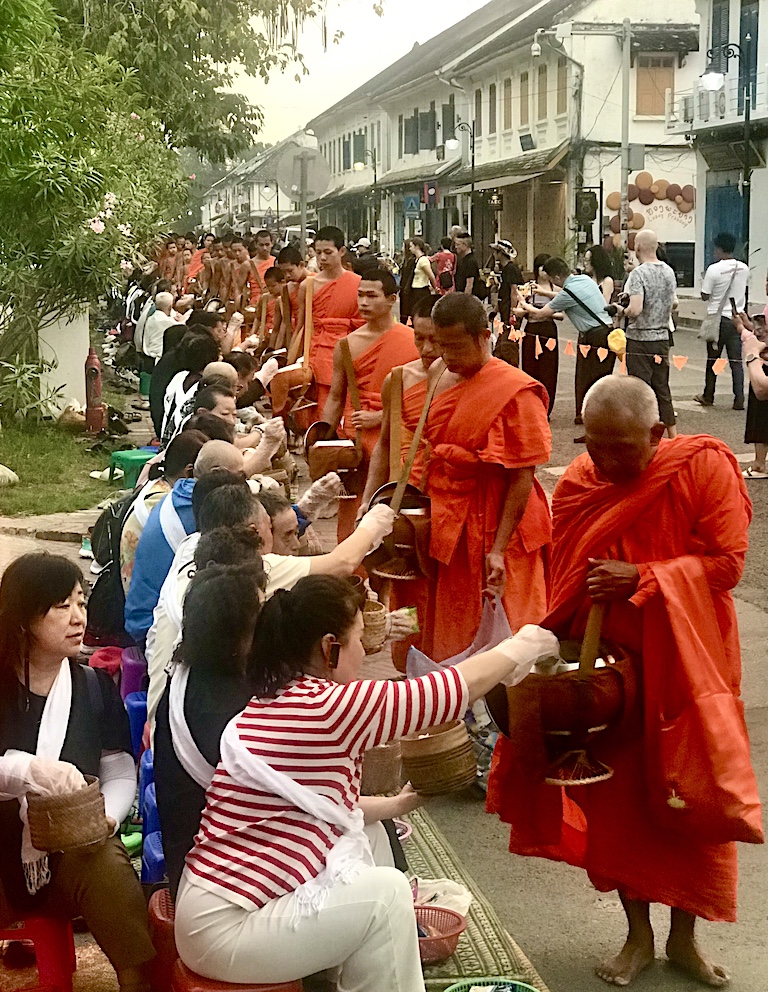
Led by their abbot, barefoot monks accept offerings of rice and other food as they circumambulate the UNESCO World Heritage City of Luang Prabang at dawn each day. Known as the sai bat ceremony, it is a centuries-old Theravada Buddhist tradition. Photo by John Gottberg Anderson
By John Gottberg Anderson
At first light each day, a couple of hundred monks depart Luang Prabang’s ancient Xieng Thong temple on a sunrise stroll. Carrying nothing but the saffron robes draped over their shoulders and alms bowls for receiving daily food and other offerings, this barefoot assemblage exits the wat grounds in single file. The monks proceed four long blocks, down broad Sakkaline Road, before turning a corner to complete a circuit of the UNESCO-designated world heritage city in northern Laos.
Known as the sai bat ceremony, this reverent almsgiving ritual has roots dating back centuries. According to Theravada Buddhist tradition, it benefits not only the sacred brotherhood, austere in its pledge to accept only what is offered to nourish their bodies and spirits, but also the donors themselves, who believe their support will earn them merit for their next and future lives.
Modern tourism has given this rite a tone decidedly different from its tranquility of not so many years ago. Back then, it was mostly frequented by respectful Lao locals. Now it is far more frenetic. Tourism promoters extol the parade as a “must-do” activity in languid Luang Prabang. From the moment the first monk steps into the boulevard, well-intended onlookers jostle for photo ops. They often block the views of more sedate alms-givers or otherwise hinder the procession.
The climax (or nadir, depending upon one’s viewpoint) occurs outside of a French-colonial building, an old bank perhaps, where the stream of monks turns onto Sisavang Vatthana Road. It’s a favored spot for Chinese tour operators to position their group members. With voices like megaphones, guides direct their charges to occupy child-sized plastic stools packed side-by-side along the route. Here they chatter incessantly despite requests for quiet. It’s fine, they’re told, to offer handfuls of sticky rice or other victuals (preferably not chocolates) to the Buddhist brethren. The guests don’t listen. Logjams often occur when amateur photographers — paparazzi, as it were — abandon their assigned seats and barrel through the front lines to capture a monk’s pose or expression as he turns the pivotal corner.
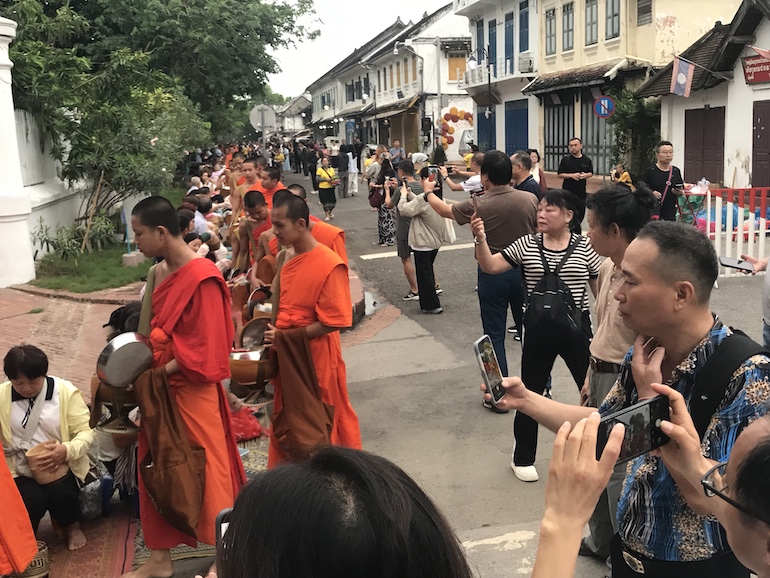
Carrying nothing but their saffron robes and alms bowls, monks complete a circuit of historic Luang Prabang each morning. Almsgivers believe their support will earn them merit in their next and future lives. Tour guides may recommend appropriate behavior, but they are frequently ignored by overzealous photographers. Photo by John Gottberg Anderson
Now There’s a Railroad
Locals inevitably point their fingers at the Chinese, who’ve become omnipresent since the China-Laos Railway opened to passengers in April 2023. (The train began running in late 2021 but initially handled only cargo.) Providing a direct 643-mile (1,035-kilometer) link between Kunming, China, and the Laotian capital of Vientiane via Luang Prabang, at speeds of up to 100mph, the railway is an integral part of China’s highly touted (and controversial) Belt and Road Initiative.
In 2023, fewer than 63,000 Chinese tourists visited Laos. The number leaped to 438,000 in 2024 and more than tripled to about 1.5 million in 2025. Yet Chinese tourists are not widely appreciated in Laos, nor in Luang Prabang in particular.
“The Lao government is very supportive of its Chinese investors,” said business owner Seng, a Luang Prabang native who asked that only their first name be used for this story. “But tourism statistics don’t tell the whole story. The Chinese are loud and rude, and they do very little for the economy here. They come for two or three nights with Chinese tour operators and Chinese guides, who take tourists only to shops where they are paid commissions. They stay in Chinese-owned hotels and eat in Chinese-owned restaurants. They even take sunset cruises on boats owned by the Chinese hotels and tour companies, not by our local people.”
A significant number of Chinese come to Laos on zero-dollar tourism packages paid in advance in renminbi (RMB), Seng said. The money never leaves China.
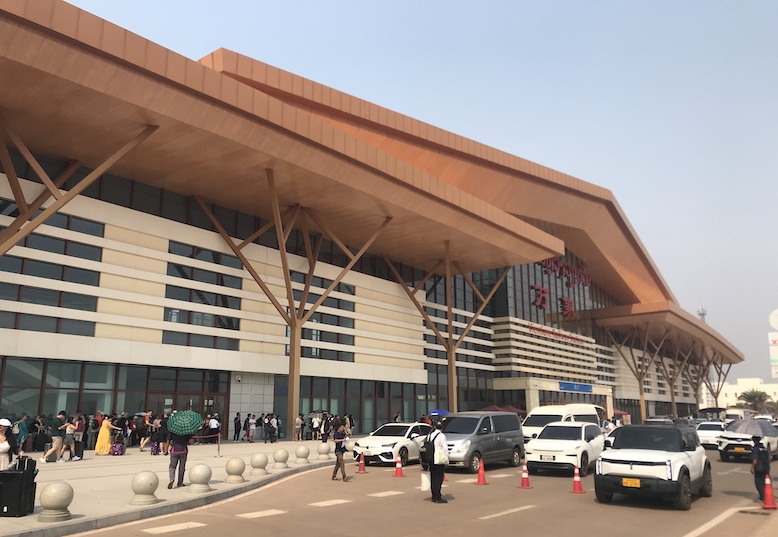
The China-Laos Railway station in Luang Prabang can handle up to 1,200 passengers at any given time. Opened in 2021, nine miles from the heart of the historic city, it is the largest station on the 643-mile line between Kunming, China, and Vientiane, Laos. Photo by John Gottberg Anderson
“Luang Prabang’s official tourism figures show record visitor numbers and substantial revenue, yet small guesthouses, family restaurants, bicycle rental operators, and independent craft sellers aren’t seeing corresponding economic benefit,” wrote Gavin Cox, the British expatriate publisher of Asia Unmasked, an online magazine focused on news and insider knowledge of Southeast Asia. “Large tour buses carrying 40 to 50 passengers create infrastructure strain but disperse minimal spending across local communities,” Cox said. “This creates a fundamental tension: Over-tourism pressure increases whilst local economic benefit remains unequally distributed.” Even charges incurred in Laos may be paid via WeChat Pay or Alipay, so the money flows directly back to China.
Unforgettable Architecture Being Forgotten?
Unlike its Indochinese neighbors, landlocked Laos doesn’t have any remarkable sights. It lacks Thailand’s shimmering beaches and its glorious palaces and temples. It is missing Vietnam’s stunning seascapes and the fervor of its revolutionary heritage. It doesn’t boast the spectacular ruins of Cambodia’s great Angkor empire. From a tourism standpoint, Luang Prabang is about as close as it gets.
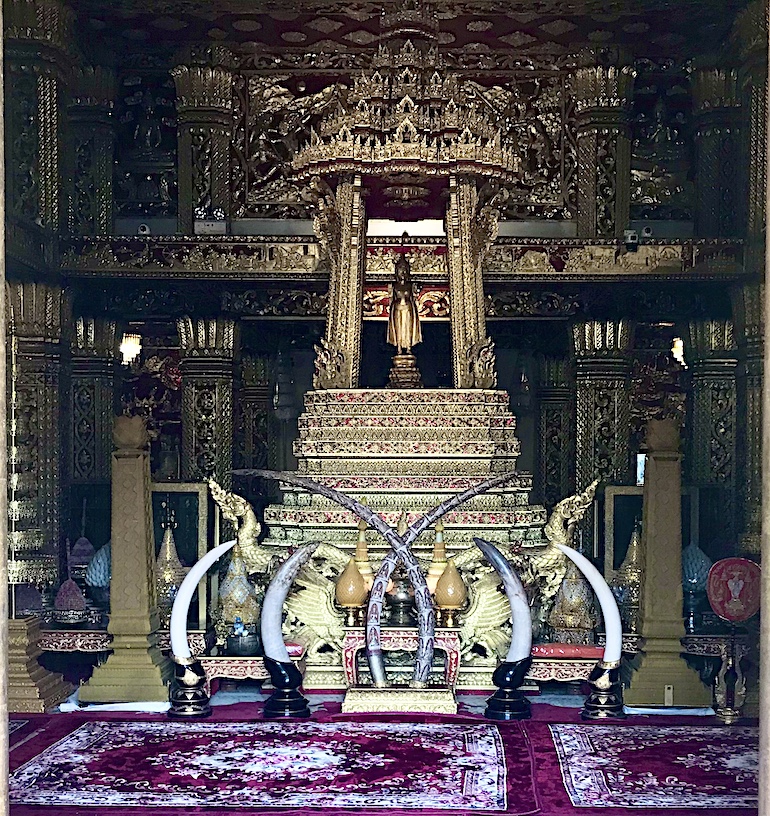
Laos’ former imperial residence, now the Royal Palace Museum, is a window into the country’s pre-Communist past. The most beautiful chamber is the ornate Haw Phra Bang Pavilion, home to a child-sized 13th-century Buddha statue (Phra Bang) that is the city’s namesake.
A UNESCO World Heritage Site covering a little over 3 square miles, Luang Prabang is acclaimed for its fusion of traditional Lao architecture and European colonial styles. Centuries of settlement preceded the arrival of the French on this stretch of the Mekong River in the 1880s. Today, a sleepy gentility overlies the finger-like peninsula that separates the tributary Nan Khan from the Mekong River. Its languid charm, reminiscent of America’s Deep South, pervades the town of immaculately preserved homes, businesses, schools and Buddhist temples.
A typical itinerary for visitors, after alms at daybreak, is to return to their hotels for breakfast, then come back to the heritage district for the mid-morning opening of the Royal Palace Museum. Guides lead visitors through the parlors and bedrooms of this former imperial residence, then show them to the ornate Haw Phra Bang Pavilion, home to a child-sized 13th-century Buddha statue (Phra Bang) that is the city’s namesake. The beautifully planted and groomed Royal Palace grounds also feature a theater that presents colorful costumed performances in the evenings.
It gets hot by midday, when many visitors take time to rest or join a short tour to the Kuang Si waterfall, where a natural pool beckons bold swimmers. By 5 p.m., tourists may be back at the riverside for a two-hour cruise on the Mekong. The next morning, those of modest fitness may climb the 380 steps of Phousi Hill for a city sunrise view before joining the monks at Wat Xieng Thong to see the cut-glass mosaic work in its sacred buildings.
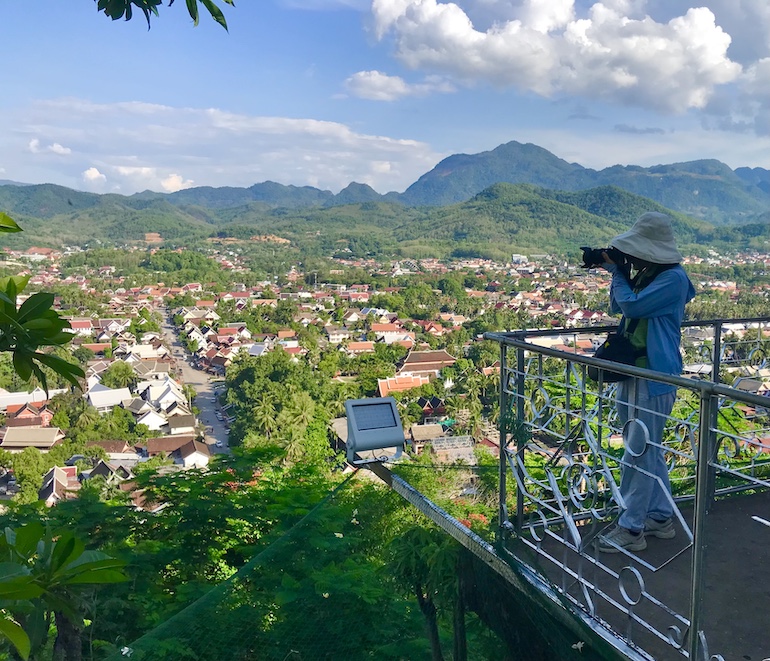
Phousi Hill is only 380 steps high, but once at the top, photographers will find excellent views of Luang Prabang and the Nam Khan River. Photo by John Gottberg Anderson
More to See and Do
Independent Asian tourists and farang (Westerners) are far less regimented. Besides hiking and other soft adventures near Kuang Si, they may engage in day trips to an elephant conservation camp or a bear rescue center. They may ride a bicycle out of the city, as I did, and swap it for a kayak to paddle a gentle stretch of the Nam Khan.
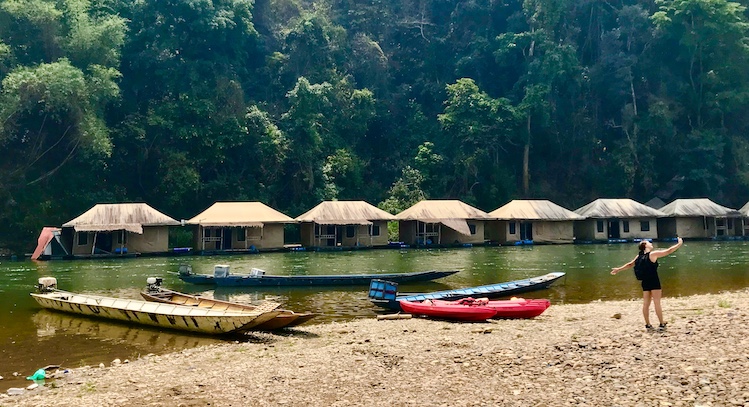
An Australian visitor dances on the shore of a wilderness eco-resort before paddling a kayak down the Nam Khan, a Mekong tributary. Soft adventure is a popular activity in rural Laos for young travelers, who too often may overlook the risks of off-road wanderings. Photo by John Gottberg Anderson
They may visit the Laos Buffalo Dairy farm to sample homemade yogurt and ice cream, or venture to the riverside Ock Pop Tok Living Crafts Center, which combines a weaving center, a garden, a restaurant, and a small guesthouse. Here, local Lao people demonstrate how they nurture silkworms and weave their silk into beautiful traditional fabrics. At the Heuan Chan Heritage House, a restored 19th-century Laotian home draped with bougainvillea in the heart of Luang Prabang’s UNESCO district, craftspeople also exhibit bamboo weaving, mulberry papermaking, and preparation of floral temple offerings — and invite visitors to learn.
The town has marvelous marketplaces, including the colorful Morning Market, where many hungry travelers stock up on fruit and bread, and the Night Market, with its dozens of food stalls hawking Lao, Thai, Indian and (of course) Chinese food at budget prices. Narrow lanes — big enough for motorbikes but not automobiles — nestle between fragrant boughs of frangipani, hibiscus and crepe jasmine, offering seclusion to French-language schools (écoles) and cultural centers like the Institut Français de Luang Prabang. These lanes are dubbed ruelles, or little roads. The substantial French presence extends far beyond the well-stocked wine shops.
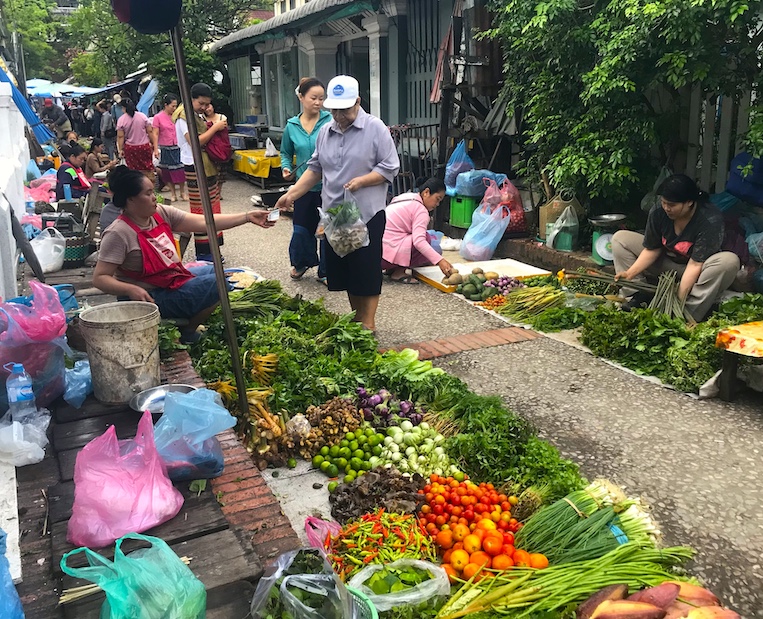
Luang Prabanh’s colorful morning market flourishes along the edges of narrow lanes that wind through the heart of the city’s old French colonial. This is the place to find just-baked baguettes and sugar-dusted beignets. Photo by John Gpttberg Anderson
Tribal Weavers
The Traditional Arts and Ethnology Center (TAEC), with a museum on the lower west slope of Phousi Hill and a shop on Sakkaline Road, is another intriguing stop. The 7.9 million people of Laos comprise between 49 and 160 separate ethnic groups, with at least 73 distinct languages, depending on who does the counting. Perhaps unsurprisingly, barely 50% of Laos’s population is ethnically Lao. The next largest groups are Khmou (11%) and Hmong (9%), both mainly in the mountainous north.
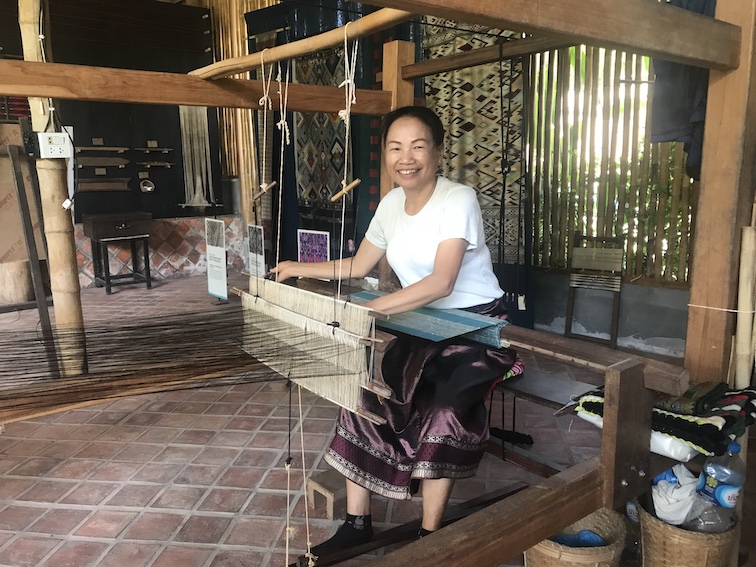
The craft of silk weaving continues to thrive in Luang Prabang, especially at places such as the Ock Pop Tok Living Crafts Center, the Heuan Chan Heritage House, and the Traditional Arts and Ethnology Center. Each has a shop selling merchandise among other attractions. But all have low-key vibes that encourage learning and asking questions. Photo by John Gottberg Anderson
Each hill tribe has a trademark style — including the Oma, whose 2,800 members live in seven villages in Laos’ northernmost Phongsali province, and the Katu, whose 83,000 people live some 500 miles south near the borders of Cambodia and Vietnam. The Oma are renowned for their distinctive red-and-black embroidery and appliqué, painstakingly stitched onto hand-dyed and woven clothing. This exceedingly slow and precise work is seen in wardrobe components from ornamental jackets to head scarves. The Katu are known for incorporating beads and banana tree fibers into the nature motifs of their weaving.
In spring 2019, the Italian design group Max Mara released a catalog featuring fashions with colors and compositions identical to the Oma. TAEC promptly charged Max Mara with plagiarism and became an advocate on the world stage. The company, said TAEC, had digitally duplicated the designs and printed them on factory-produced women’s clothing without any acknowledgment of the Oma or compensation. A display at TAEC’s museum is part of an ongoing media campaign that seeks credit for the Oma and, with it, some level of shared profit.
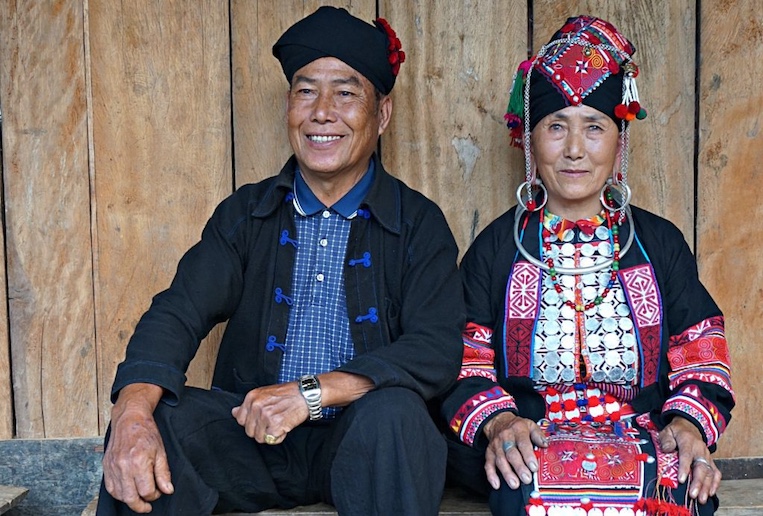
San Oula and Anle Laochu, members of the Oma hill tribe in remote Phongsali province, visit the Traditional Arts and Ethnology Center in traditional costumes. The museum is representing the Oma in a media campaign to ensure they get proper credit and compensation for the theft of their embroidered designs by an Italian fashion group. Photo courtesy of TAEC.
Chinese Restaurants and Hotels
In Luang Prabang’s historic city center are dozens of ornate temples and carefully maintained colonial structures. Especially along Sakkaline Road, but also throughout the heritage district, French-era buildings have been converted to boutique hotels or guesthouses, as well as coffee shops, bars and restaurants. They represent an international choice that reflects the influx of Western influences — French, Italian, Australian beef, even Swiss and Hungarian — along with Vietnamese, Korean, Japanese, Thai and Indo-Malaysian. Look further, you’ll even find dedicated Hmong and Khmu kitchens alongside a Lao noodle shop.
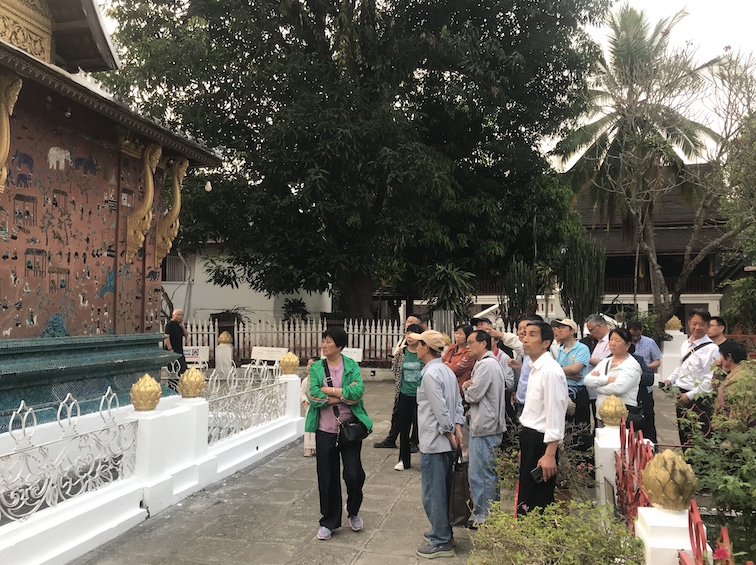
Chinese visitors listen to their tour guide describe the striking cut-glass mosaic work at Wat Xieng Thong. Dating from the mid-16th century, the temple is considered a highlight of a visit to Luang Prabang. Photo by John Gottberg Anderson
But the arrival of thousands of Chinese is having an impact. Last year, for instance, the upper floor of Luang Prabang’s long-standing Tourist Information Center, a heritage building on a corner facing the Night Market’s food stalls, was transformed into a Chinese hot-pot restaurant. When a historic open balcony was removed to create a larger dining room, critics were quick to point out a violation of city and UNESCO historic restoration guidelines. “The transformation of a key tourist facility into a restaurant not only diminishes the city’s ability to preserve its cultural essence but also shifts the focus away from its historical significance,” the Laotian Times wrote in February 2025.
Among the projected new hotel properties is the Intercity Hotel Luang Prabang, scheduled to open next year in the city’s historic center. It is a member of the massive, Chinese-owned H World Group, which claims to operate more than 12,000 hotels in 21 countries. H World also has announced plans to add three hotels in Vientiane.
The Obama Coconut
“There are a lot of Chinese coming over to invest and take land, that’s for sure,” said longtime resident Simon Cote, a French-Canadian filmmaker and partner at L’Etranger bistro. But Cote expressed little concern about any negative impact on his own business. Although L’Etranger serves nothing remotely Shanghainese, he still feels he has something to offer visitors from the giant nation to the north. “We are starting to have more Chinese come and eat here at our restaurant,” he declared with a smile.
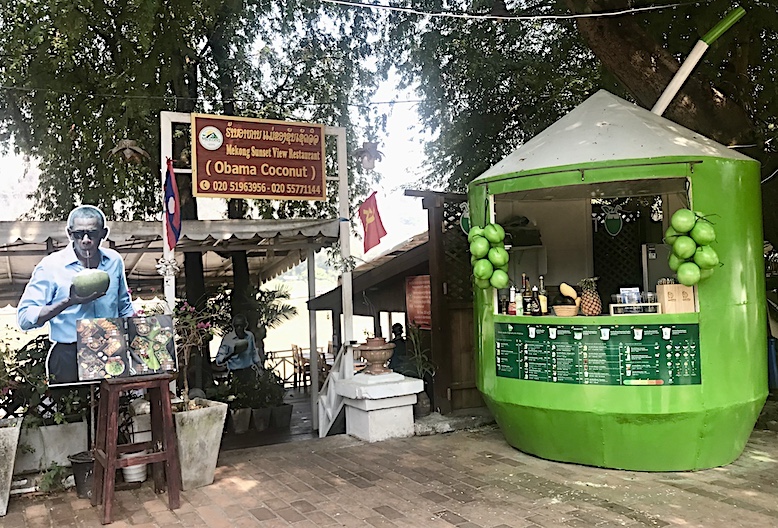
When former U.S. President Barack Obama visited Luang Prabang during a tour of Southeast Asia in 2016, he famously sipped coconut water from a straw at the Mekong Sunset View Restaurant. The moment was commemorated in a photograph, and the little restaurant is now dubbed the Obama Coconut. Photo by John Gottberg Anderson.
As yet, there are no Chinese eateries in the strip of open-air cafes that rise on a low bluff above the Mekong River. There is, however, plenty of Beerlao, the country’s unofficial but ubiquitous national brew, along with simple Lao and Thai cuisine. And ripe green coconuts abound. When former U.S. President Barack Obama visited Luang Prabang during a tour of Southeast Asia in 2016, he famously sipped coconut water from a straw at the Mekong Sunset View Restaurant. The moment was commemorated in a photograph, and the little restaurant is now dubbed the Obama Coconut.
Laotian flags wave above motorized launches that operate on the river below. Their busiest times are always the twilight hours, when the sun sinks toward the forested hills downriver of Luang Prabang. I explored this stretch of the Mekong aboard the elegant but understated Coconut Cruise. As we skimmed across the water, several crowded party boats passed, their loud music blaring above the sound of their engines and carrying all the way to the blufftop restaurants. “It seems every Chinese tour company has its own boat,” commented my host, Keo. “The city has formal regulations that don’t allow music to be played more than an hour after sunset. But the Chinese think those laws don’t apply to them.”
Before long, Mekong traffic may also be challenged by controversial new Lao-Thai hydropower dams that threaten to displace riverside villages and create reservoirs where there is now a free-running river. An initial trio are expected to open in 2027, 2029 and 2032. Already, according to Eurasian Review, the Lao government envisions itself as the “Battery of Southeast Asia” with its plans to export electricity to other Southeast Asian countries.
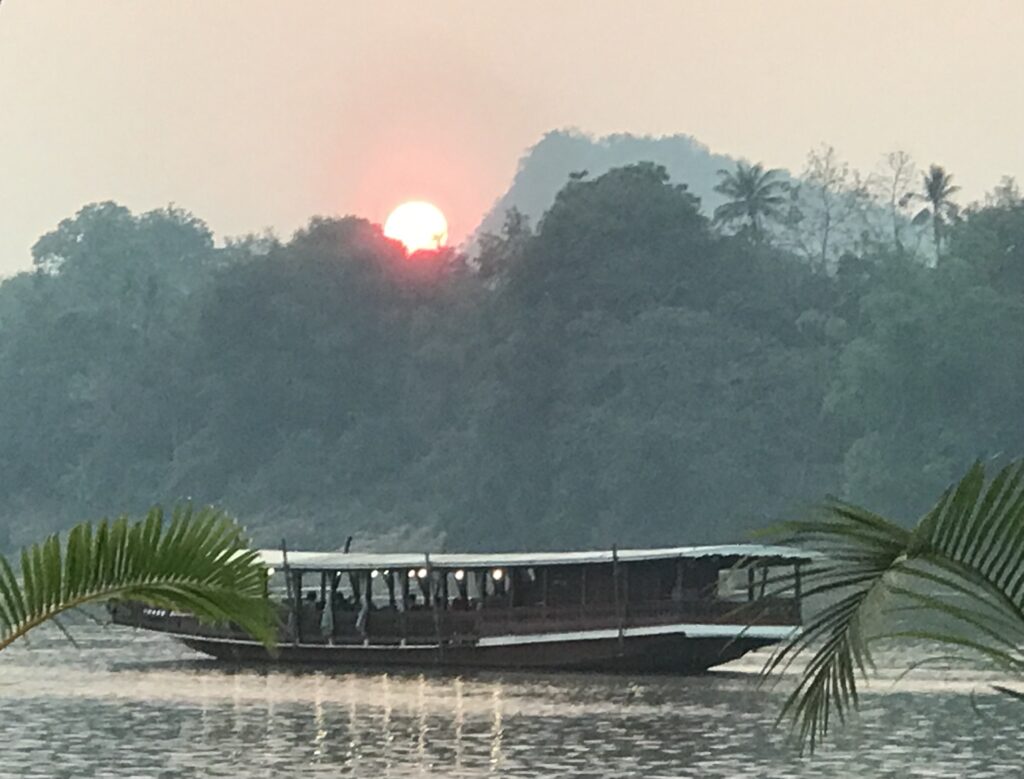
As the skies are much clearer in October than in April, it’s a more attractive time for party boats on the Mekong. City regulations restrict the hours during which loud music can be played, preserving the serenity of sundown cruises. Photo by John Gottberg Anderson
Beyond Luang Prabang
Many travelers, especially younger backpackers, identify landlocked Laos as a destination for soft adventure. Seventy percent of the country is covered by mountains and thick green forests. There are no ocean beaches. But intrepid youth enjoy multi-day treks into remote hill-country villages, adventure parks with zip-lining and whitewater rafting, and towns like Vang Vieng, 83 miles south, that promote themselves as hubs for such sports as rock climbing, caving and parasailing. Near the remote town of Houay Xai, 116 miles northwest, the Gibbon Experience offers visitors the opportunity to stay in treehouses in Nam Kan National Park and zip-line through a lush rainforest canopy. If they’re lucky, they might spot a sleuth of endangered Lao black gibbons
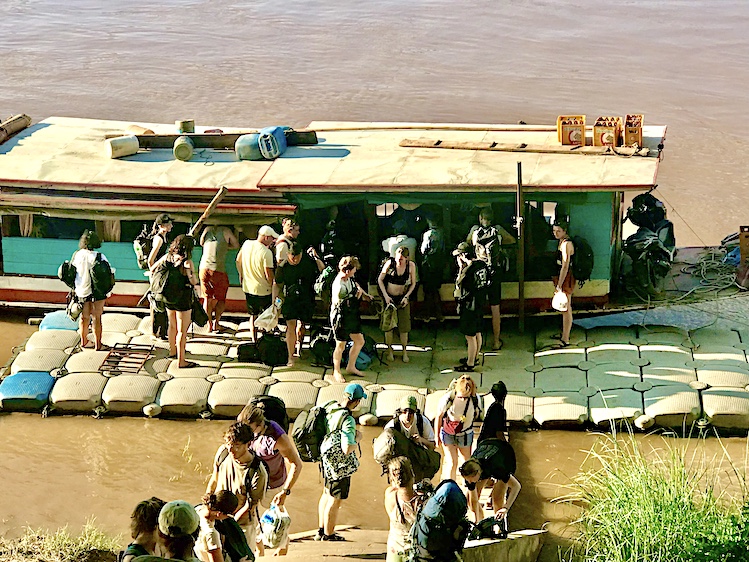
Western backpackers disembark the Mekong “slow boat” at Luang Prabang after a two-day voyage from tiny Houay Xai in the far north of Laos. Local residents seeking downriver transport may also choose this excursion, offered by several companies, as a commuting option. Photo by John Gottberg Anderson
Most of those who travel to tiny Houay Xai from northern Thailand are there to catch the 150-passenger “slow boat” down the Mekong River to Luang Prabang. Several river companies offer this two-day voyage as a travel option, popular among foreign backpackers and often also used as a commute option for local residents seeking downriver transport.
Indeed, Laos is defined by the Mekong. The great waterway rises in the Himalayas of China, nibbles at Myanmar, and extends along most of the 1,146-mile border between Laos and Thailand. Finally plunging into Cambodia, it continues as a ribboned delta through southernmost Vietnam. In northern Laos, the Mekong hurtles through verdant canyons flanked by farms, rustic villages, and vacant beaches. On the upper hillsides, it’s hard not to imagine the bygone fields of opium poppies that were a major source of revenue in the Vietnam War era of the ‘60s and ‘70s. This was, after all, part of the fabled Golden Triangle. Today the drugs are being replaced by modern gambling casinos in Bokeo, a 21st-century boomtown on a bend in the Mekong where Laos faces both Thailand and Myanmar.
Living in the Discomfort Zone
Adventure, by definition, includes an element of risk. It’s not absent here. In December 2025, a Laotian woman and her two children drowned when a “slow boat” struck rocks and sank in the Mekong as it approached its destination. In October last year, an American father and his teenage son died in a Luang Prabang hospital after being stung more than 100 times by giant hornets while zip-lining at a jungle park. Even urban centers may not be safe. As recently as November 2024, six international travelers died of methanol poisoning after drinking spiked beverages at a party hostel in Vang Vieng.
And then there’s the danger to off-trail adventurers of unexploded ordnance (UXO), a legacy of the Vietnam War (here called the Second Indochina War). According to the New Zealand-based Mines Advisory Group (MAG), more than 2 million tons of bombs and 270 million cluster munitions were dropped on Laos between 1964 and 1973.
Yet some Laotians fear a greater threat may ultimately be the Chinese intrusion. “The Laos-China Railway’s completion in 2021 transformed visitor dynamics in ways preservation frameworks weren’t designed to manage,” observed Gavin Cox of Asia Unmasked.
China isn’t going away. In fact, no country’s citizens (and China has 1.4 billion of them) travel more than the Chinese, not even Americans. Decades of economic growth have created a huge and burgeoning middle class with high disposable incomes. While they are leaving their mark all over the world, they are often drawn to other Asia-Pacific nations, including Thailand, Cambodia, Indonesia (especially Bali), and South Korea.
Unlike most Americans, middle-aged and older Chinese prefer to travel in tightly controlled tour groups that minimize language barriers and emphasize personal safety. The consequent “pack behavior” doesn’t encourage them to interact as easily with another nation’s “locals.” Cultural sensitivity and understanding are easily lost in the interchange.
Other countries have generations of experience dealing with foreign visitors. Laos is only just learning appropriate behavior and responses. It’s a challenge to which the Indochinese nation, as a latecomer to the party, must rapidly adjust or suffer the consequences.
John Gottberg Anderson resides in Southeast Asia and has recently written about Northern Thailand’s elephant sanctuaries and the effort underway to save Phnom Penh’s colonial history.